If your 9-year-old says their backpack hurts their shoulders, take the complaint seriously—but do not panic. The first step is a simple weight-and-fit check. The American Academy of Pediatrics (AAP) advises that a backpack should not weigh more than about 15% of a child’s body weight. That percentage is a practical upper guideline, not a diagnostic cutoff: a lighter bag can still hurt if it fits poorly, and pain can have causes unrelated to the backpack.
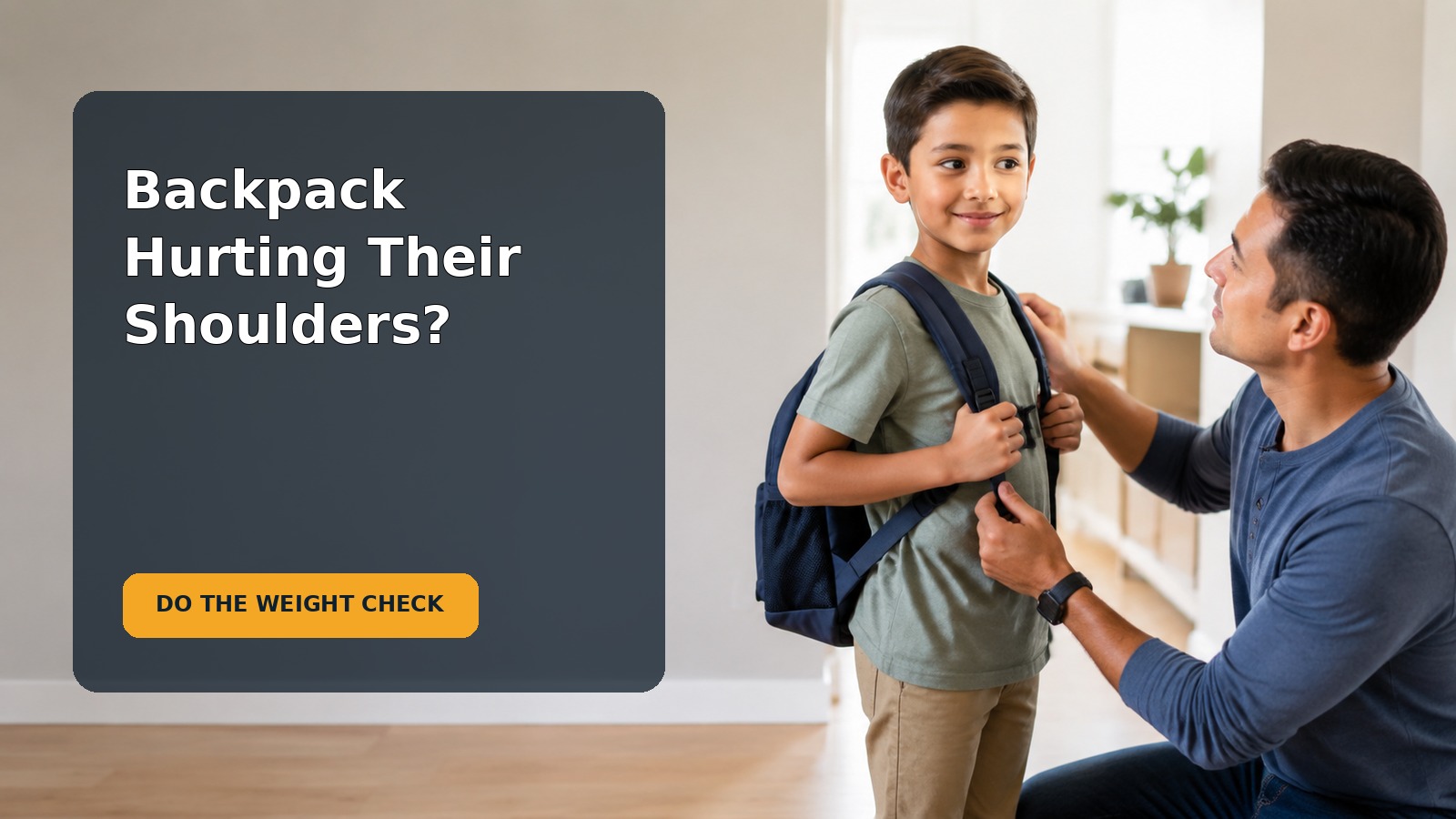
This guide explains how to check backpack weight, improve fit, reduce the daily load, and decide when shoulder pain needs medical attention. It provides general education rather than an individual diagnosis.
How heavy is too heavy for a 9-year-old’s backpack?
Use 15% of body weight as a simple ceiling. To estimate it, multiply your child’s weight by 0.15. For example:
- A child who weighs 60 pounds: 60 × 0.15 = 9 pounds.
- A child who weighs 70 pounds: 70 × 0.15 = 10.5 pounds.
- A child who weighs 80 pounds: 80 × 0.15 = 12 pounds.
Some school guidance uses a 10%–20% range, but the AAP’s backpack-specific safety page recommends no more than 15%. Because your child already has shoulder pain, treat comfort and posture as important evidence too. Do not add books until the bag reaches a calculated limit. The goal is the lightest practical load that your child can carry without pain or altered posture.
Signs the load or fit needs attention
A backpack is likely too heavy or poorly adjusted if your child leans forward, arches backward, lifts one shoulder, struggles to put it on, or says the straps dig in. Red marks on the shoulders, tingling, numbness, weakness, or pain that lasts after the bag comes off also deserve attention. Ask where it hurts and whether the pain happens only while carrying the bag, later in the day, during sports, or at night.
What is common at ages 9–10?
School-age children may carry textbooks, a laptop, lunch, water, sports gear, and items that have accumulated unnoticed. A heavy bag can cause temporary shoulder, neck, or back discomfort. According to the AAP, backpacks have not been shown to cause scoliosis or long-term problems, but poor use can contribute to strain and pain. Pain should not be dismissed as an unavoidable part of school.
Do a calm five-minute weight check
Step 1: weigh your child and the packed bag
Use a household scale on a typical school morning. Weigh your child without the backpack, then weigh the fully packed bag. If the scale is not sensitive enough, weigh your child holding the bag and subtract their body weight. Record both numbers so you can repeat the check after making changes.
Say, “Your shoulders are giving us useful information. Let’s check the bag together and make it easier to carry.” This keeps the problem practical and avoids blaming your child for packing “wrong.”
Step 2: empty everything onto a table
Create three groups: needed today, belongs at home, and can stay at school. Remove old papers, duplicate supplies, toys, extra books, and an unnecessarily large water bottle. Ask the teacher whether digital materials, classroom copies, lockers, or a second set of books can reduce the load. Repeat this cleanout weekly; small items add up.
Step 3: repack close to the body
Place the heaviest flat items—such as books or a laptop—in the compartment closest to your child’s back. Balance smaller items between the left and right sides. Use compartments to keep the load from shifting. Make sure pencils or hard corners cannot poke through the back panel.
Fit the backpack to your child—not the other way around
Use both broad shoulder straps
Both straps should be broad, padded, equal in length, and snug enough to hold the backpack close to the body. Carrying the bag over one shoulder concentrates the load and can strain muscles. Padding can improve comfort, but extra padding does not make an overloaded bag safe.
Check the height and position
The backpack should rest in the middle of the back. The AAP advises that it should extend from about waist level to 1–2 inches below the shoulders, with the bottom in the curve of the lower back. It should not hang far below the waist or sway as your child walks. The bag itself should be proportional to your child’s height; a bigger pack often invites more weight.
Use the chest or waist strap if available
A chest or waist strap can keep the pack close and distribute weight more evenly. Fasten it comfortably rather than tightly. After adjusting, ask your child to walk, climb a few stairs, sit, and take the bag off. The straps should not pinch, rub the neck, limit breathing, or make normal movement awkward.
A practical one-week shoulder-pain reset
Day 1: reduce, repack, and retest
Complete the weight-and-fit check, then have your child wear the lighter bag for a short walk. Ask for a simple rating before and after: no pain, mild discomfort, or pain that changes movement. Do not make your child carry the bag repeatedly to “prove” that it hurts.
During the school week: limit carrying time
Use lockers or classroom storage when available. Carry only the materials needed for the next class or for homework. If a long walk or bus route is part of the problem, ask the school about reasonable load-reduction options. A rolling backpack may help in some settings, but confirm school rules and consider stairs, crowded corridors, and trip hazards first.
At home: monitor rather than repeatedly test
Note when pain starts, its location, how long it lasts after removing the bag, and whether there is numbness, tingling, weakness, swelling, or limited movement. Check whether pain also appears during sleep, sports, computer use, or other activities. A brief written pattern is more useful to a clinician than a vague memory.
Do not prescribe stretching, braces, pain medicine, or strength exercises solely from an online article. If your child needs symptom treatment or has an injury, ask their healthcare professional what is appropriate.
Common backpack mistakes and better alternatives
Mistake: focusing only on the percentage
Better: combine weight with fit, posture, carrying time, and symptoms. Fifteen percent is an upper guideline, not permission to ignore pain below that number.
Mistake: buying the largest backpack available
Better: choose a bag proportional to your child, with two broad adjustable straps, a padded back, useful compartments, and a chest or waist strap.
Mistake: tightening one strap more than the other
Better: adjust both straps evenly and use both every time. Recheck them after a growth spurt or when your child changes coats.
Mistake: telling a child to stop complaining
Better: treat the report as information. Try: “I believe that your shoulder hurts. We’ll lighten and fit the bag, then decide whether we need advice.” Trust makes it more likely that a child will report numbness, weakness, or an injury early.
When should shoulder pain be checked by a professional?
Schedule medical advice
Contact your child’s pediatrician or another qualified healthcare professional if pain persists despite a lighter, properly fitted backpack; recurs frequently; limits school, play, sleep, or sports; occurs when the backpack is not being worn; or follows a fall or collision. Also seek advice for visible swelling, reduced shoulder movement, unusual posture, or pain in the neck or back.
Seek prompt assessment for warning signs
Get prompt medical care for new weakness, persistent numbness or tingling, severe or rapidly worsening pain, an obvious deformity, inability to use the arm normally, significant swelling, or pain after a substantial injury. Call emergency services for a serious injury or other emergency symptoms. A backpack adjustment is not a substitute for assessing neurological signs or trauma.
One-page parent checklist
- Weighed the child and fully packed backpack.
- Used 15% of body weight as an upper guideline, not a target.
- Removed everything not needed that day.
- Packed heavy flat items closest to the back.
- Adjusted two broad straps to equal lengths.
- Positioned the bag close to the middle and lower-back curve.
- Fastened the chest or waist strap comfortably.
- Checked for leaning, strap marks, rubbing, or altered walking.
- Asked about pain, tingling, numbness, weakness, and movement.
- Made a school plan for lockers, digital materials, or spare books.
- Set a weekly backpack cleanout.
- Planned medical advice if symptoms persist or occur without the bag.
Frequently asked questions
Can a heavy backpack cause scoliosis?
The AAP states that backpacks have not been shown to cause scoliosis. They can contribute to back, neck, or shoulder strain and pain when overloaded or worn poorly, so weight and fit still matter.
Should a 9-year-old use a rolling backpack?
It may reduce carrying in some situations, but ask the school first. Stairs, bus steps, narrow hallways, and trip hazards can make a rolling bag impractical. Reducing unnecessary contents and improving fit remain important.
What if the bag is under 15% but still hurts?
Lighten it further, check the fit and carrying time, and listen to the symptom. If pain persists, recurs, changes movement, or appears without the backpack, contact your child’s healthcare professional.
How often should we weigh the backpack?
Check it now, after making changes, and whenever the timetable or equipment changes. A weekly cleanout is a useful routine. Recheck your child’s fit after growth spurts or seasonal clothing changes.
Sources
- American Academy of Pediatrics: Backpack Safety
- American Academy of Pediatrics: Back-to-School Tips
- American Academy of Orthopaedic Surgeons: Backpack Safety—Preventing Injury
This article provides general education and does not diagnose or treat shoulder, neck, or back pain. Seek individualized advice from your child’s healthcare professional.