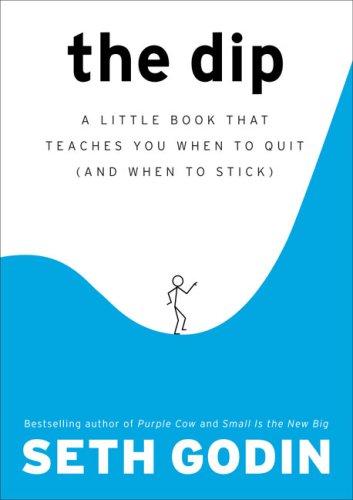
Most people treat perseverance as a moral rule: keep going no matter how hard the work becomes. Seth Godin offers a more useful question. Is this difficulty a temporary passage on the way to something valuable, or are you stuck in a dead end? That distinction can protect your time, money, and attention.
The Dip: A Little Book That Teaches You When to Quit (and When to Stick) is a short business book about strategic persistence. Godin argues that winners are not people who never quit. They quit the wrong projects quickly so they can reserve their best effort for the right challenge.
The central idea: not every hard thing is worth finishing
Every meaningful project has an early stage when excitement fades and progress feels slow. Godin calls this low point the Dip. It is the gap between starting and reaching mastery. The work gets harder, but the difficulty may be temporary. If you keep learning and improving, the effort can eventually produce a valuable result.
Other projects are a cul-de-sac: a road with no useful exit. More effort will not create a better outcome because the opportunity itself is broken, the market is absent, or the goal no longer matters. The skill is not simply persistence. It is diagnosis.
Godin also describes a cliff, where continuing becomes increasingly dangerous. Debt, burnout, an unhealthy partnership, or a business model that consumes cash can all look like challenges to overcome when they are actually warnings to stop.
What the book gets right
- Quitting is a resource decision. Every yes uses hours, cash, energy, and opportunity. Leaving a weak path can free those resources for a better one.
- The hardest moment can be informative. A Dip tests whether your goal is worth the price and whether your method needs to change.
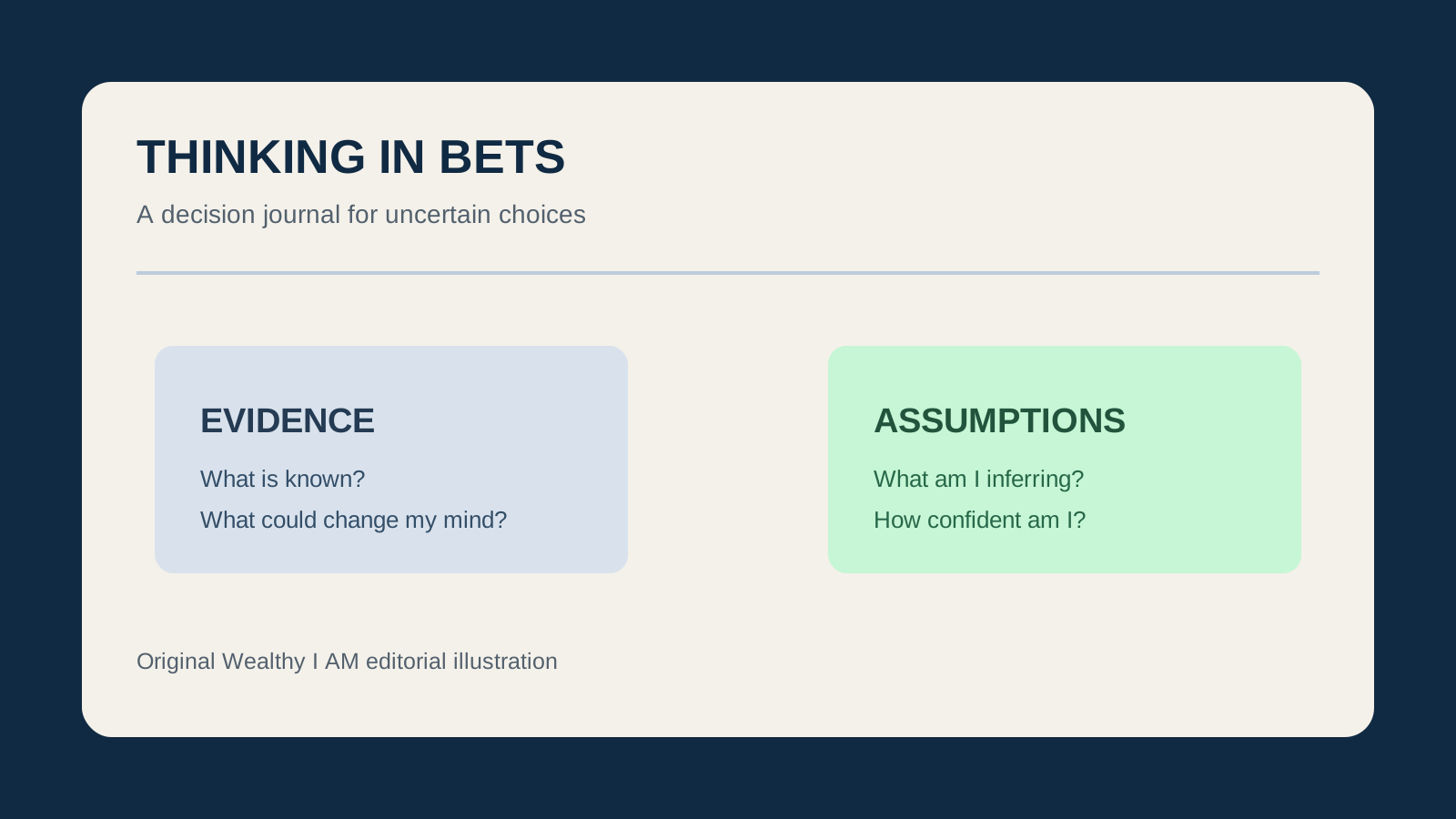
- Strategic quitting is different from impulsive quitting. The point is not to abandon anything uncomfortable. It is to decide in advance what evidence would justify continuing or exiting.
- Excellence requires focus. Trying to be average at ten things may be less valuable than becoming excellent at one carefully chosen problem.
Five practical lessons for wealth and work
1. Choose the hill before you climb it
Before investing serious effort, define the outcome you want and why it matters. “Build a business” is too broad. “Reach 20 paying customers for a bookkeeping service within six months” gives you something to test. A clear target makes later decisions less emotional.
2. Expect the Dip and budget for it
Plan for the point when the novelty disappears. Set aside a realistic runway, schedule learning time, and decide which weekly actions will show progress. In personal finance, this might mean automating savings even when motivation is low. In entrepreneurship, it might mean reserving cash for customer testing rather than spending everything on appearances.
3. Use a quitting rule before you need one
Write down conditions for continuing, changing course, or stopping. For example: continue if qualified customers return, revise the offer if conversations are positive but purchases are absent, and stop if repeated tests show no meaningful demand. Pre-committed rules reduce the temptation to defend a failing idea simply because you have already spent money on it.
4. Quit the tactic, not always the mission
A failed channel does not necessarily mean a failed goal. If social-media advertising is expensive, you might test partnerships, search content, referrals, or direct outreach. Good persistence often looks like changing the method while preserving the valuable outcome.
5. Stop restarting at the beginning
Godin warns that frequent quitting can become a habit. If you leave every project at the first sign of friction, you never reach the stage where accumulated skill creates an advantage. Pick a worthwhile area, expect difficulty, and stay long enough to learn whether you are in a Dip.
A useful decision question: If I knew how much effort remains, and if the reward were still attractive, would I choose this path today? If not, the honest answer may be to exit. If yes, identify the next experiment that could move you forward.
A step-by-step “Dip audit”
- Name the goal: Write the specific result you want, the deadline, and the reason it matters.
- Describe the obstacle: Is the problem lack of skill, lack of demand, poor cash flow, a weak partner, or simple fatigue?
- Look for evidence: Review customer responses, savings progress, revenue, learning milestones, or other observable signals—not just your mood.
- Test one improvement: Choose a small change that could produce new information within two weeks.
- Set a review date: Decide when you will evaluate the evidence and what result would lead you to persist, pivot, or quit.
- Protect the downside: Never risk rent money, emergency savings, or essential obligations to prove that you can endure a bad plan.
Where readers should be careful
The Dip is deliberately punchy, not a complete business plan or investment guide. “Quit fast” can be misunderstood as permission to avoid patience, practice, or uncomfortable learning. Wealth-building usually requires long time horizons, consistent saving, skill development, and sensible risk control. Use Godin’s framework to allocate effort—not to chase novelty.
The book also cannot tell you whether a particular project is right for you. That requires facts: your finances, responsibilities, skills, market evidence, and values. A decision that is wise for a funded startup may be reckless for a household with no emergency reserve.
Bottom line
Seth Godin’s lasting lesson is that persistence becomes powerful only after it is aimed at a worthwhile destination. The goal is not to prove that you can suffer longest. The goal is to recognize which challenges reward patience, which strategies need changing, and which commitments are quietly consuming the future.
Use a clear goal, expect the difficult middle, track evidence, and make exit rules before emotion takes over. That combination lets you persist intelligently—and redirect your money and energy toward work with a better chance of creating lasting value.
Sources & credit
- Penguin Random House — publisher information and author details
- Amazon.com — matched product page, ISBN 9781591841661
- Open Library — edition and bibliographic record
- Cover image credit — Open Library cover for the matched ISBN edition
This article is an original educational interpretation and is not affiliated with Seth Godin or the publishers.