Friendship problems can feel enormous to a school-age child—and surprisingly urgent to a parent. When your child comes home saying, “Nobody played with me,” it is natural to want to call the school, contact another family or arrange a new friendship immediately. Yet children also need safe opportunities to practise joining in, reading social cues, repairing disagreements and deciding which relationships feel respectful.
Parents searching for how to help child make healthy friendships do not need to leave children alone with painful situations. The goal is to listen carefully, teach concrete skills and step in when a pattern affects safety, learning or wellbeing. Good support sits between two extremes: solving every problem for the child and dismissing friendship pain as “just drama.”
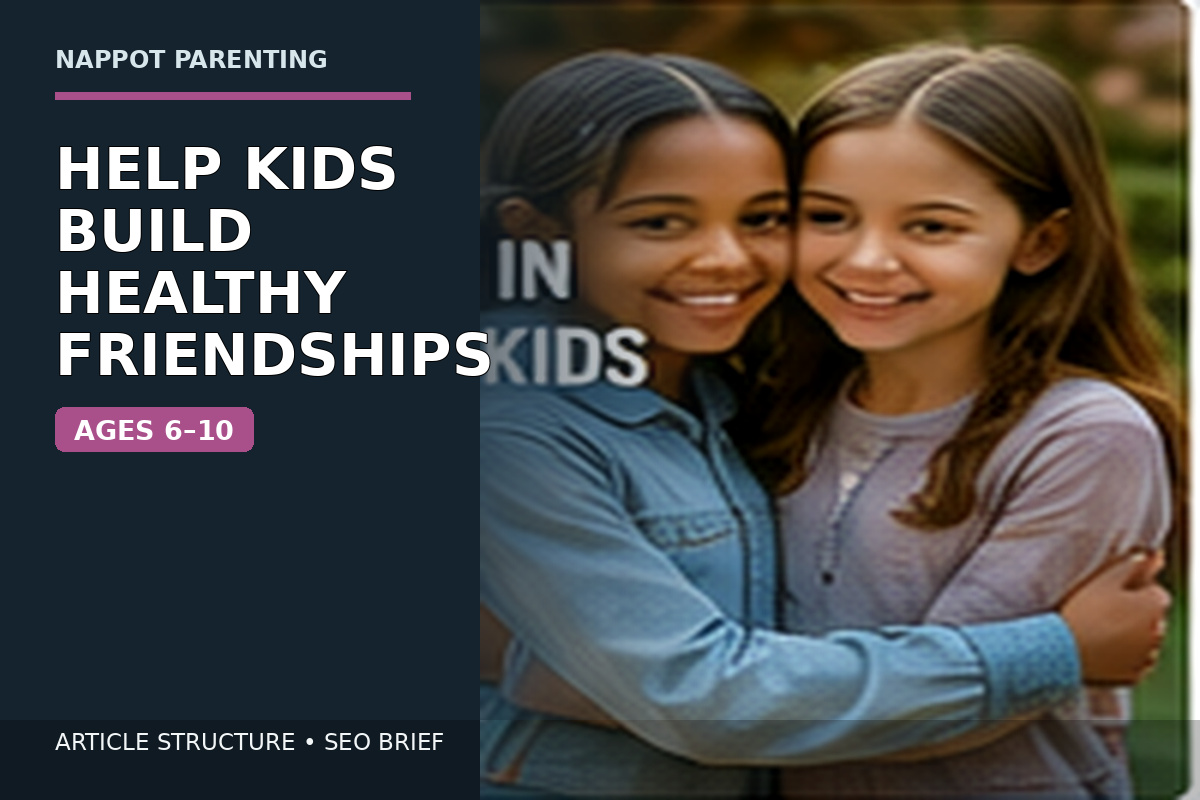
What healthy friendship looks like at ages 6–10
A healthy friendship does not mean two children always agree. At this age, children are learning to cooperate, handle disappointment and understand perspectives beyond their own. Look for a broad pattern of mutual enjoyment, respect, flexibility and repair after conflict. Both children should be able to suggest activities, say no, spend time with other people and make mistakes without fearing humiliation or retaliation.
Friendships may change as classes, interests and confidence change. A close friend in September may become a casual friend by spring. That can hurt, but it is not automatically evidence that someone behaved badly. Children benefit from hearing that friendship can grow, pause or change without either child being a failure.
How many friends does a child need?
There is no required number. Some children enjoy a large group; others feel secure with one or two reliable companions. Focus less on popularity and more on whether your child has opportunities for connection, feels accepted somewhere and can participate without regularly being controlled or demeaned. A child who prefers a small circle is not necessarily lonely.
Listen before you fix
Start with calm curiosity. Put down distractions, reflect the feeling and ask what happened in the child’s own words. You might say, “It sounds as though you felt left out when the game started,” rather than deciding immediately that another child is a bully. Details often emerge slowly, and the first version may describe only the most upsetting moment.
Then ask one useful question: “Do you want me to listen, help you plan, or step in?” A child may only need comfort at first. If they want a plan, agree on one small next step. If they want adult action, explain what you can do and what information you still need.
Try to separate a one-time disagreement from a repeated pattern. Ask when it happened, what happened before and after, whether anyone repaired it and whether the same thing happens with the same children. Avoid an interrogation. The purpose is to understand frequency, impact and safety—not to force a perfect courtroom account from an upset eight-year-old.
Teach concrete friendship skills
General instructions such as “be nice” or “make friends” are hard to use on a busy playground. Practise short actions and scripts when your child is calm. Keep role-play brief and slightly playful so it feels like preparation rather than correction.
- Joining play: Watch for a moment, learn what the group is doing and ask, “Can I be the next player?” or offer a useful role.
- Inviting someone: Use a specific invitation: “Do you want to draw with me at break?”
- Taking turns: Agree on an order or use a clear endpoint instead of grabbing or arguing indefinitely.
- Reading cues: Notice whether the other child is answering, making space and showing interest. If not, pause and try another person or activity.
- Setting a boundary: Say, “I don’t like that. Please stop,” then move toward a trusted adult if it continues.
- Repairing conflict: Name the action and a next step: “I interrupted your game. I’m sorry. Can we start again?”
Do not demand an instant apology while emotions are high. A useful repair includes understanding what happened and changing the next action, not merely saying a word. Nappot’s guide to repairing conflict without forced apologies uses the same principle in family relationships.
Help without embarrassing the child
Practise privately rather than coaching loudly in front of peers. Offer two possible scripts and let your child choose the one that sounds natural. Afterward, ask what worked instead of demanding a full report. Quiet support protects dignity and makes it more likely that your child will ask for help again.
When a child feels excluded
Exclusion hurts, even when no formal rule was broken. Begin by validating the pain: “Being left out felt awful.” Then gather facts without attacking other children. A group may have been full, a game may already have started, or there may be an ongoing pattern of deliberately shutting one child out. Those situations need different responses.
Create a “small next step” plan for the next school day. Your child might greet one approachable classmate, bring an activity that can include another person, ask the teacher where group play is happening or try a supervised club linked to an existing interest. One manageable action is more useful than “Just make new friends.”
Broaden opportunities without treating a new activity as a replacement-child delivery service. Clubs, sports, art groups, library activities and community events give children repeated contact around a shared interest. Familiarity can make conversation easier, but allow relationships to develop at their own pace.
Contact the teacher or school when exclusion is repeated, affects attendance or learning, involves humiliation or threats, or leaves your child without a safe place during the day. Describe observable facts and ask what staff have noticed. A collaborative message—“Could we compare what we are seeing and make a support plan?”—usually produces more useful information than accusing another child or demanding a particular friendship.
Playdates and sensible parent boundaries
A playdate can deepen a friendship because two children have more time and fewer group pressures. Before a first visit, exchange contact details and ask practical safety questions. The level of detail can match the children’s age and the setting, but uncertainty is a reason to ask, not a reason to feel rude.
- Who will supervise, and will adults be home throughout the visit?
- What activities are planned, and will the children go anywhere else?
- What are the household rules for devices, gaming and internet access?
- Are there pets, pools, trampolines or other features you should discuss?
- Are firearms or other weapons present, and if so, are they unloaded and securely locked with ammunition stored separately?
- Does the host need to know about allergies, medication or another essential safety need?
- What are the drop-off, pickup and emergency-contact arrangements?
Keep monitoring low-profile and age-appropriate. You can remain available, check in naturally and set a clear end time without directing every minute. Shorter first visits may be easier for children who become overwhelmed. If either child is repeatedly controlling, cruel or distressed, end the activity calmly and discuss it later rather than staging a public confrontation.
When adults should step in
Ordinary conflict is usually about a specific disagreement between children with relatively equal power, and both may participate in the problem. Bullying involves repeated aggressive behavior or a meaningful power imbalance and may include threats, physical harm, social humiliation, coercion or coordinated exclusion. A child should not be expected to solve bullying alone.
Seek school support promptly for repeated targeting, threats, physical aggression, discriminatory harassment, sexual behavior, extortion, online abuse that spills into school or any situation in which your child feels unsafe. Preserve relevant messages or dates and follow the school’s safeguarding process. Do not confront another child directly.
Extra support may also be useful when you notice persistent isolation, sudden withdrawal, school refusal, significant anxiety, sleep or appetite changes, frequent physical complaints around school, or communication differences that make social situations consistently confusing. A teacher can describe what happens in the group setting. A pediatrician or qualified mental-health professional can help assess broader developmental or emotional needs without blaming the child.
Frequently asked questions
Should I contact another parent after a friendship conflict?
Not for every disagreement. Listen, gather facts and consider whether the children can repair the situation with light coaching. Contact another parent when there is a practical safety issue, a repeated pattern outside school or a need to coordinate boundaries. Stay factual and avoid asking the other parent to force a friendship. For school-based concerns, begin with the school.
What if my child only wants one best friend?
Respect the close bond while keeping the social door open. Encourage activities with different classmates and avoid describing one friend as the child’s only possible source of belonging. Children can value a best friend and still learn to cooperate with others.
What if my child is excluding others?
Stay curious and direct. Ask what happened, state the impact and teach a better boundary. A child does not have to be close friends with everyone, but they must not humiliate, threaten or organize cruelty toward another child. Practise respectful phrases such as, “We’re playing this game now, but you can join the next round.” Work with the school if the pattern continues.
When is friendship drama actually bullying?
Look for repetition, aggression, power imbalance and difficulty escaping the behavior. One argument between evenly matched friends is not automatically bullying. Repeated intimidation, targeted humiliation or coercive exclusion needs adult intervention, documentation and a safety plan.
A simple coaching plan for this week
- Have one calm conversation and ask whether your child wants listening, planning or adult action.
- Identify whether the concern is a single conflict or a repeated pattern.
- Practise one joining, boundary or repair script for two minutes.
- Choose one small social opportunity connected to an interest.
- Check in after the next school day without demanding a perfect outcome.
- Contact the school or an appropriate professional if the pattern affects safety, attendance or wellbeing.
When deciding how to help child make healthy friendships, aim to be a secure base rather than a social manager. Listen without panic, teach skills that can be used tomorrow and intervene clearly when safety or repeated harm requires adults. Children do not need parents to manufacture a conflict-free social life. They need steady support while they learn what respect, repair and belonging feel like.
Sources and guidance note
- American Academy of Pediatrics: What Parents Can Do to Support Friendships
- American Academy of Pediatrics: Problems With Peers
- American Academy of Pediatrics: Getting to Know Your Child’s Friends
This article provides general educational information, not individualized medical or mental-health advice. Seek prompt help from the school, an appropriate health professional or emergency services when a child faces threats, violence, exploitation, self-harm concerns or another immediate safety risk.