Children do not need two identical households to feel secure. They can usually learn that one home serves dinner earlier, one allows different weekend activities, or each adult organizes chores in a different way. What matters more is knowing that the adults will protect them, share essential information and keep them out of adult conflict.
Useful co parenting rules across two homes focus on the few areas where inconsistency could affect safety, health, school or a child’s relationship with either parent. They leave room for ordinary household differences. This approach can reduce control battles between adults while giving children enough predictability to settle into both homes.
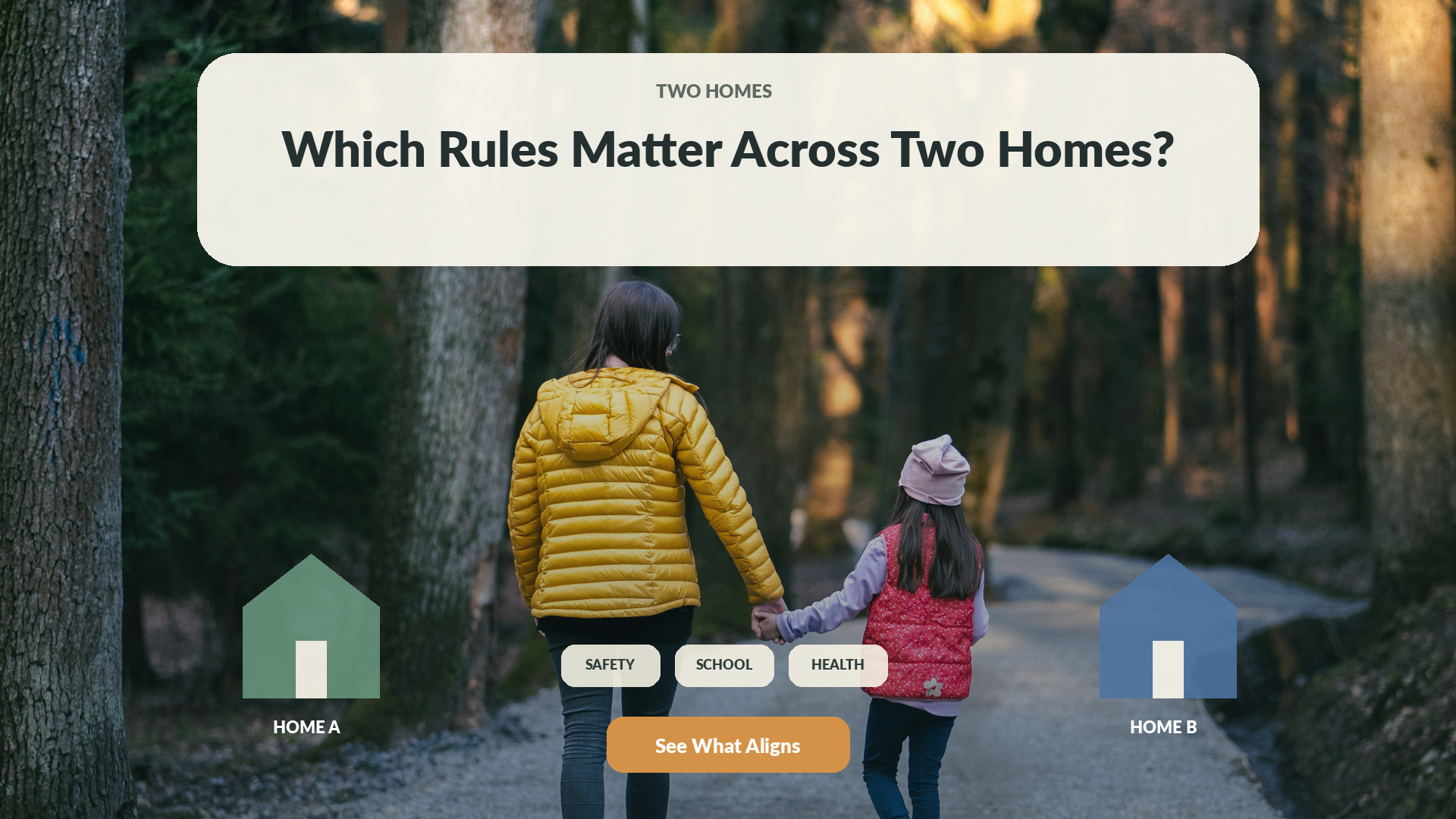
Consistency does not mean creating identical homes
Trying to copy every bedtime detail, meal, chore and consequence can create more conflict than stability. Each home has its own work schedule, space, resources and relationships. A child may also need different support as they move from preschool to school age or tween years.
A better question is: Which differences are harmless, and which gaps could leave our child confused, unsafe or responsible for adult communication? Emotional safety should be the priority. A child should be able to enjoy both homes without being questioned, asked to take sides or made to feel disloyal.
When adults can cooperate safely, agree on a short list of essentials and allow flexibility elsewhere. If communication is hostile, frightening or unsafe, a more structured arrangement may be necessary.
Five areas that benefit most from alignment
1. Health and medication
Both homes should have current information about allergies, diagnoses, prescriptions, doses, appointment plans and emergency contacts. Medication should travel safely or be duplicated only when a prescriber or pharmacist says that is appropriate. Record when time-sensitive medicine was given so a child does not receive a missed or duplicate dose.
Keep information factual. A shared health note can list the date, symptom, care provided and follow-up needed without becoming a place for criticism.
2. Safety rules
Align on age-appropriate car restraints, water supervision, firearms or other weapons, online access, substance exposure and who may supervise the child. These are not style preferences. If adults disagree about a significant safety risk, seek qualified professional or legal guidance rather than using the child to negotiate it.
3. School attendance and learning needs
Both adults should know the school calendar, attendance expectations, homework responsibilities and how teachers will share information. Make sure the school has the correct authorized contacts and any required copies of parenting or court documents.
For a child who needs learning, attention or disability support, share the plan and the practical strategies that help. The goal is continuity of access—not monitoring the other home.
4. Major behavior expectations
Children benefit from a few clear expectations that cross households: people are treated with respect, physical aggression is stopped, property is handled safely and adults are told about serious problems. Consequences do not have to be identical, but they should not put a child in the middle or ask one parent to enforce the other parent’s anger.
5. Adult communication
Choose one dependable channel for schedules, health, school and travel details. Keep messages brief, factual and child-focused. Include what happened, what the child needs and any deadline. Avoid insults, old relationship arguments or demands for an immediate reply when the matter is not urgent.
Where different household rules are usually manageable
Within safe and lawful limits, families can often allow differences in:
- exact bedtime routines and room setup;
- meal style and ordinary food preferences;
- chores and allowance arrangements;
- clothing choices;
- leisure activities and family traditions;
- screen routines that do not create a safety, sleep or school problem; and
- the adult’s general communication and discipline style, provided it remains safe and respectful.
A different rule is not automatically a bad rule. Avoid asking children to report on minor household details. If a child says, “At Dad’s house we do it this way,” or “Mum lets me stay up later,” a neutral answer can be: “Homes can have different routines. Here, this is what we are doing tonight.”
If a difference consistently affects sleep, health, school attendance or emotional wellbeing, discuss the effect rather than attacking the other adult’s character. Describe the pattern, propose one practical change and set a review date.
Make handoffs calmer and more predictable
Transitions can be emotionally demanding even when a child loves both homes. Tiredness, missing one adult and adjusting to another household can all appear as irritability, silence, tears or clinginess.
- Use a visible calendar: show where the child will sleep and mark school, activities and special changes.
- Prepare essentials early: pack medication, school materials and comfort items before the handoff rush.
- Duplicate basics when possible: toothbrushes, chargers, pajamas and everyday toiletries reduce the burden of carrying a life in a bag.
- Keep goodbyes warm and neutral: avoid last-minute disputes or visible distress that makes the child feel responsible for the adult.
- Allow decompression: offer a snack, quiet play, movement or private time before asking many questions.
Do not use the child as a messenger. “Tell your other parent…” places adult logistics on the child and invites mistakes. Send the information through the agreed adult channel.
Use a child-focused communication template
When communication is difficult but safe, structure can help. A message might read:
“Sam’s school trip form is due Thursday. I signed my section and placed it in the blue folder. Please complete the medical contact line and return it to school by Wednesday evening. The teacher’s message is attached.”
This gives the needed information without blame. For recurring logistics, a shared calendar or written record can reduce repeated messages. Limit access to responsible adults and protect sensitive health, school and location information.
The Government of Canada’s parenting-plan guidance recommends addressing practical subjects such as information sharing, communication and decisions. A plan can be detailed where clarity is useful while still allowing age-appropriate changes. Requirements differ by location, so use local legal advice when an agreement or court order is involved.
Protect children from loyalty conflicts
Children should not have to prove love for one parent by rejecting the other. Avoid asking them to keep ordinary secrets, choose the “better” home, carry financial messages or provide evidence about the other adult.
Give children permission to care about everyone important to them. You might say: “You can miss your other home and still be glad to be here,” or “You do not have to solve adult problems.” If adults disagree in front of the child, make a clear repair. Nappot’s guide to repairing after parents disagree offers an age-appropriate way to restore reassurance without oversharing.
Listen to the child’s experience without conducting an interrogation. Ask open questions such as “What helps transition day feel easier?” and “Is there anything you need in both homes?” Take disclosures about fear, harm or unsafe behavior seriously and seek appropriate safeguarding help.
When parallel parenting may be more appropriate
Collaborative co-parenting advice is not suitable in every family. When there is ongoing harassment, coercive control, stalking, threats, violence or repeated boundary violations, direct cooperation may increase risk. Safety plans and court orders take priority over general communication tips.
Parallel parenting generally uses limited, structured communication and clearer separation between households. It is not a do-it-yourself legal solution. A qualified family-law professional, domestic-abuse advocate or family service can help determine whether it is appropriate and how to protect the child and the affected adult.
If anyone is in immediate danger, contact local emergency services. Do not use a shared calendar, location feature or joint account if it could expose a protected address, movement or private communications.
A 20-minute two-home consistency plan
- List the child’s essential health, safety, school and contact information.
- Choose one adult channel for routine updates and define what counts as urgent.
- Write three to five major expectations that genuinely need alignment.
- Name the household differences that each adult will manage independently.
- Create a handoff checklist and duplicate inexpensive essentials where possible.
- Ask the child one age-appropriate question about what makes transitions easier.
- Review the plan after a month or after a major school, health or schedule change.
Keep the list short enough to use. The aim of co parenting rules across two homes is not to win control over both households. It is to make essential care dependable while allowing children to belong comfortably in each home.
Frequently asked questions
Do rules need to be the same in both homes?
No. Align on safety, health, school and a few major expectations. Different meals, chores, traditions and ordinary routines are usually manageable when the child is safe and adults do not criticize each other through the child.
How should we handle different bedtimes?
Start with the effect. If the child is rested and functioning well, different routines may be harmless. If sleep loss is affecting school, health or transitions, share observations and agree on a realistic minimum sleep opportunity rather than demanding identical rituals.
What should a child carry between homes?
Carry items that cannot safely or affordably be duplicated, such as school materials, prescribed medication and special comfort objects. Duplicate basic clothing, toiletries and chargers when possible. Adults—not the child—should check essential items.
What is parallel parenting?
It is a highly structured approach that limits direct interaction between adults and gives each household clearer independence. It may be considered in high-conflict situations, but safety, legal orders and individual circumstances require qualified guidance.
Sources and further guidance
- Department of Justice Canada: Parenting-plan topics and practical arrangements
- GOV.UK: Looking after children during divorce or separation
- American Academy of Child and Adolescent Psychiatry: Children and divorce
This article provides general educational information, not legal, mental-health or safeguarding advice. Parenting laws, court orders and family circumstances differ. Seek qualified local help for legal questions, serious conflict, coercive control, violence or child-safety concerns.