Potty training readiness is not determined by a single birthday. It appears as a pattern: your toddler notices what their body is doing, can take part in a simple routine, and is willing to practice without becoming overwhelmed. Some children show these abilities close together; others develop them gradually over many months.
The goal is not to prove that your child is “advanced” or to satisfy outside pressure. It is to choose a time when learning can be calm, understandable, and physically comfortable. This guide explains ten useful signs, when to pause, and how to prepare without turning the bathroom into a battleground.
Why readiness matters more than age
Toilet learning asks a toddler to connect several developing abilities. They must notice an internal sensation, understand what it means, pause what they are doing, communicate or act, reach the bathroom, manage clothing, and sit long enough to finish. That is a demanding sequence for a young child.
The American Academy of Pediatrics explains that children develop the physical, cognitive, and emotional abilities needed for toilet training at different rates. A toddler may understand the routine but still struggle to notice the urge early enough. Another may stay dry for longer periods but strongly resist sitting. Partial readiness is normal.
Look for a cluster of signs over a few weeks rather than treating one successful potty visit as proof that formal training must begin immediately.
10 potty training readiness signs
1. Your toddler notices a wet or dirty diaper
Your child may pause, point, hide, tell you, bring a diaper, or ask to be changed. The exact signal matters less than the growing awareness that something has happened in their body.
2. Dry periods are becoming longer
A dry diaper after a nap or a stretch of roughly two hours can suggest that the bladder is maturing and your child is beginning to hold urine for longer. This sign is helpful, but it is not a test a child must pass every day.
3. Bowel movements have a somewhat predictable pattern
Some children tend to have a bowel movement after breakfast, after dinner, or at another recognizable time. A pattern makes it easier to offer an unhurried potty opportunity before the need becomes urgent.
4. Your child shows interest in the bathroom
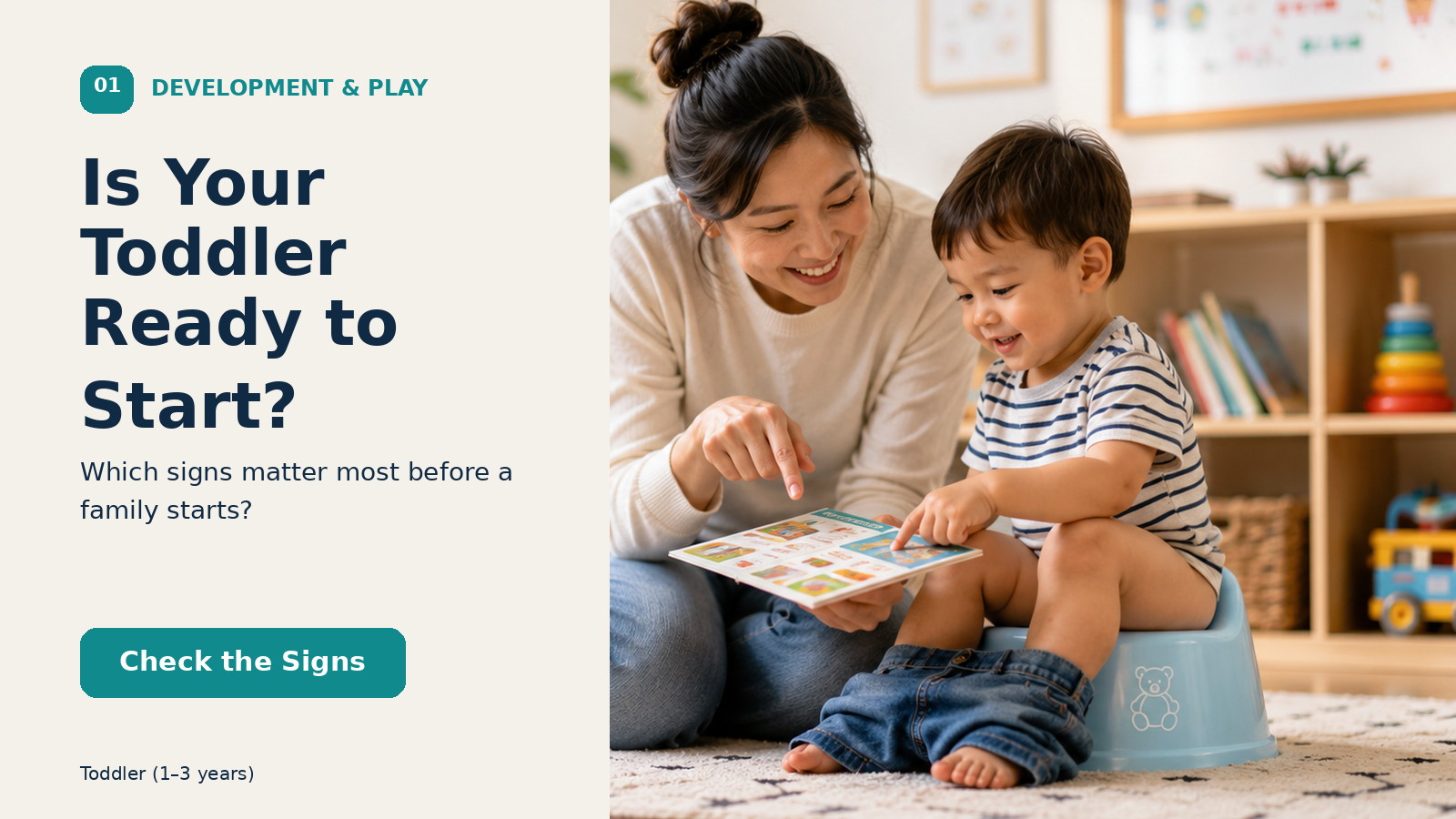
They may want to watch a caregiver wash hands, flush the toilet, read a potty book, or sit briefly while clothed. Curiosity is useful because it lets the routine become familiar before performance is expected.
5. Your toddler can sit safely for a short time
Your child should be physically stable on a floor potty or on a toilet insert with secure foot support. Dangling feet can feel unsafe and make it harder to relax. Never leave a young child unattended on a toilet.
6. They can follow one or two simple directions
Instructions such as “walk to the bathroom,” “pull your trousers down,” and “wash your hands” are part of the routine. Your toddler does not need to complete every step alone; they need enough understanding to participate with help.
7. They can communicate a basic need
Words are not required. A sign, gesture, picture, sound, or consistent action can all communicate “potty,” “wet,” or “help.” Use the method your child already understands rather than withholding support until speech catches up.
8. Your child helps with clothing
They may push trousers down, pull them up with help, or cooperate while you assist. Easy elastic-waist clothing reduces frustration. Complicated buttons, belts, overalls, and tight layers can make a successful response harder.
9. A soiled diaper is becoming uncomfortable
Wanting a prompt change can motivate learning. Respond matter-of-factly: “You noticed your diaper is wet. Let’s get you comfortable.” Avoid calling bodily functions dirty, disgusting, or babyish.
10. Your toddler is willing to try without strong distress
A child can be cautious and still be ready. What matters is whether they can approach the potty with support. Repeated panic, intense resistance, or a battle at every invitation is a reason to slow down rather than apply more pressure.
Signs to pause instead of push
Starting later is often easier than continuing through escalating fear or conflict. Consider pausing formal training when:
- your child cries, panics, or strongly resists every attempt to sit;
- bowel movements are painful, very hard, or being deliberately withheld;
- the family is handling a move, new childcare arrangement, new sibling, illness, or another major transition;
- bathroom invitations repeatedly become power struggles; or
- your toddler cannot yet sit securely or communicate enough to participate.
A pause is not failure. Return to diapers without shaming, keep bathroom language neutral, and try again after a few weeks. If fear, pain, or withholding continues, speak with your child’s health professional. Constipation can make toilet learning painful and can worsen when a child avoids bowel movements.
How to prepare without officially starting
Make the setup safe and easy
Choose either a stable floor potty or a secure toilet insert with a step stool. Your child’s feet should have firm support. Put supplies where adults can reach them easily, but keep cleaning products, medicines, and other hazards locked away.
Use simple, consistent words
Choose family words for urine, bowel movements, and the potty, then use them calmly. Narrate body cues without demanding action: “You stopped moving. Maybe your body is getting ready to poop.” This helps your child connect sensations with language.
Let your child observe the routine
Read a short book, show how underwear and trousers move, and practice handwashing. Keep explanations brief. Toddlers learn through repetition more than through one long lesson.
Practice independence in small pieces
Work on pushing elastic-waist trousers down, pulling them up, and washing and drying hands. These are useful daily skills even if formal training is still weeks away. Nappot’s guide to building independence in toddlers offers the same helpful approach: give enough support for success, then reduce help gradually.
A gentle first-week plan
Once several readiness signs are steady and your household has a relatively calm week, begin with predictable practice rather than constant reminders.
- Choose a few natural opportunities. Offer the potty after waking, before a bath, or when you notice your child’s usual bowel-movement cues.
- Use an invitation, not a threat. Say, “It’s potty time. Would you like the small potty or the toilet insert?” Keep the boundary clear while offering one manageable choice.
- Keep sitting brief. A short attempt is enough. Do not require your child to remain until something happens.
- Respond neutrally to accidents. Say, “Your trousers are wet. Pee goes in the potty. Let’s clean up.” Help without scolding or lengthy lectures.
- Praise participation and awareness. Notice concrete actions: “You told me your body needed to go,” or “You helped push your trousers down.” Avoid prizes so large that the process becomes high-pressure.
- Review after several days. Ask whether your child is becoming more comfortable and aware. If distress or withholding is increasing, pause.
Consistency helps, but rigidity does not. A familiar rhythm can reduce decision fatigue; see these ideas for creating a daily toddler routine without expecting every day to look identical.
What success should look like at first
Early success is not perfect dryness. It may look like sitting willingly, telling you immediately after an accident, staying dry during one predictable part of the day, or accepting help with clothing. These are meaningful steps in the learning sequence.
Night dryness follows a separate developmental path and often comes later than daytime control. Do not remove nighttime protection simply because daytime practice has begun. Follow your child’s pattern and discuss concerns with their clinician.
When to ask for professional guidance
Contact your child’s pediatrician or another qualified health professional if toileting involves persistent pain, hard or infrequent stools, blood in the stool, repeated withholding, urinary pain, unusual thirst or urination, loss of previously established skills, or developmental questions. Seek prompt care for symptoms that concern you rather than assuming they are part of training.
Children with developmental, sensory, mobility, communication, or medical differences may need an adapted plan. The readiness principles still matter, but the sequence, equipment, communication supports, and timeline may be different.
A simple readiness checklist
- Notices wet or dirty diapers
- Has some longer dry periods
- Shows a predictable bowel pattern
- Is curious about the bathroom
- Sits safely with feet supported
- Follows simple directions
- Communicates basic needs
- Helps with clothing
- Wants prompt diaper changes
- Can try without strong distress
Observe the pattern for one week. If several signs are present and your child remains comfortable, begin with a few low-pressure practice times. If the process creates fear, pain, or a daily struggle, step back and seek guidance when needed.
Sources
- American Academy of Pediatrics: Toilet Training
- American Academy of Pediatrics: Emotional Growth Needed for Toilet Training
This article provides general parenting education and is not a substitute for individualized medical or developmental advice.