When a toddler hits, the moment can feel urgent, embarrassing, and personal. The most useful response is neither permissive nor shaming: stop the hit, protect everyone, and teach the missing skill after the child is calm. Understanding why toddlers hit makes that sequence easier to repeat.
Hitting at this age is a behavior, not a character verdict. Toddlers are still building language, impulse control, emotional regulation, and the ability to wait. A firm, steady adult response shows that feelings are allowed while hurting is not.
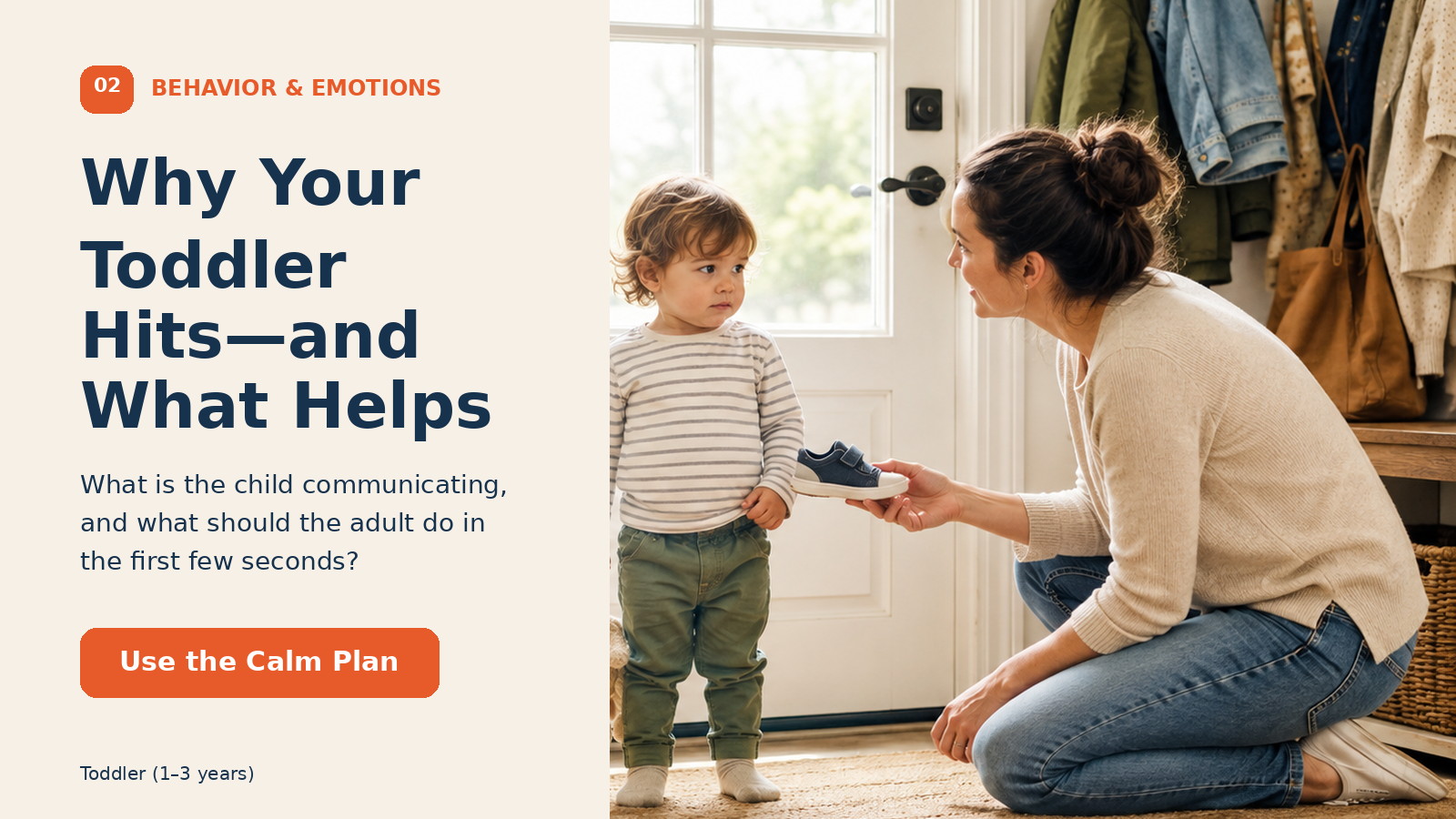
Why toddlers hit: what the behavior may be communicating
Toddlers may hit for several different reasons, and the same child may have a different reason from one day to the next. Looking at what happened immediately before the hit is usually more useful than demanding an explanation the child cannot yet give.
Frustration is bigger than available words
A toddler may know what they want but not have the words or patience to negotiate for it. “Mine,” “help,” “stop,” and “my turn” are complex skills when a toy has just been taken or an adult has ended a favorite activity. The hand can move before language catches up.
Impulse control is still developing
A young child may understand a rule during a calm moment and still be unable to use it when excited, tired, crowded, or angry. This does not mean the limit is pointless. It means the adult will need to enforce it consistently while giving the child many chances to practice an alternative.
The child needs space, help, or connection
Some hitting happens when another child is too close, when noise and activity become overwhelming, or when a toddler is competing for attention. Hitting can also appear during transitions, especially when the child is hungry, tired, rushed, or unsure what comes next.
The American Academy of Pediatrics explains that occasional aggressive behavior can occur as toddlers learn self-control, while adults should set clear limits and avoid responding with physical punishment. That combination—calm protection plus repeated teaching—is the foundation of the plan below.
The first 10 seconds: stop the hit without escalating
In the peak of the moment, use fewer words and more calm action. A long explanation is hard to process when a toddler’s body is activated.
- Block or interrupt safely. Move close, place your body between children if needed, and gently prevent another strike. Do not squeeze, shake, hit back, or restrain more than safety requires.
- State one short limit. Say, “I won’t let you hit,” or, “Hitting hurts. I’m keeping everyone safe.” Use a low, matter-of-fact voice.
- Attend to the person who was hurt. Check for injury and offer comfort. This communicates that safety matters without publicly labeling the toddler as “bad.”
- Reduce stimulation. Create a little space, move the disputed object if necessary, and pause extra talking until bodies are calmer.
If the toddler tries again, repeat the same limit and increase distance. Consistency matters more than finding perfect words. The goal is not to make the child instantly agree; it is to stop harm and show what the boundary looks like.
What to say instead of shaming
Shaming statements confuse identity with behavior: “You’re mean,” “You’re a bully,” or “What is wrong with you?” These phrases do not teach the child what to do next. Use language that names the limit and the need:
- “You wanted the truck. I won’t let you hit.”
- “You’re angry. Hands stay safe.”
- “You need space. Say, ‘Move, please,’ or come get me.”
- “I’m going to help your body move back.”
Avoid forcing an apology while the child is still overwhelmed. A rehearsed “sorry” is not the same as understanding or repair. Once calm returns, help the toddler check on the other person, return an object, bring a cold pack, rebuild a knocked-over structure, or offer a simple apology if they are ready. Repair should be brief, concrete, and connected to what happened.
Teach the replacement skill after everyone is calm
The lesson belongs after regulation, not in the peak of distress. Keep practice playful and short—often less than a minute.
Practice three useful words
Choose phrases that fit common triggers: “stop,” “help,” “my turn,” “space,” or “all done.” Model the words with a gesture, then let the child copy if willing. A child who cannot say the full phrase can use one word, a sign, or point to an adult.
Rehearse the difficult moment
Use two toys to act out a familiar situation. “Bear takes the car. Bunny wants to hit. Bunny says, ‘My turn,’ and gets help.” Rehearsal gives the toddler a response to retrieve next time. Our guide to teaching empathy and kindness to toddlers offers more ways to build these social skills in ordinary play.
Offer safe ways to use strong energy
Some children benefit from pushing against a wall, carrying a light basket, stomping feet on the floor, squeezing play dough, or taking a quick movement break. Present these as regulation options—not as punishment and not as permission to hit objects dangerously. The message is, “Your body needs movement; let’s choose movement that is safe.”
Track patterns that make hitting more likely
A simple trigger log can reveal preventable patterns. For one week, note the time, setting, what happened just before the hit, the child’s likely need, the adult response, and what helped. Do not use the record to blame the child or another caregiver.
| Pattern | What you may notice | What to try |
|---|---|---|
| Transitions | Hitting when play ends or it is time to leave | Give a brief warning, show the next step, and offer one limited choice |
| Hunger or fatigue | More aggression before meals, naps, or bedtime | Adjust timing, carry a suitable snack, and simplify demands |
| Crowded play | Hitting when children move close or reach for the same toy | Stay nearby, reduce crowding, and coach turn-taking early |
| Competition for attention | Hitting when an adult helps a sibling or starts a task | Offer predictable connection and a simple waiting job |
| Language demand | Hitting when the child cannot express a need | Teach one-word requests, gestures, or picture cues |
Predictable days do not eliminate every hard moment, but routines can lower unnecessary strain. See how to build a flexible toddler routine if transitions, meals, or sleep are recurring triggers.
A calm response script for home or childcare
Use the same four-part script wherever possible:
Stop: “I won’t let you hit.”
Name: “You wanted space.”
Offer: “Say ‘stop’ or come get me.”
Repair later: “Sam was hurt. Let’s bring the ice pack.”
Caregivers do not need identical personalities, but shared wording helps. Tell nursery, daycare, grandparents, or other caregivers what you are practicing. Ask them to block safely, keep the limit short, avoid labels, and report patterns. If one setting sees far more hitting than another, examine crowding, transitions, communication demands, and supervision before assuming the child is simply choosing to misbehave.
What usually makes hitting worse
- Hitting back or using physical punishment. This models the very behavior the child is being told not to use.
- Lecturing during distress. Too many words add stimulation without improving learning.
- Demanding an immediate explanation. Many toddlers cannot accurately explain the sequence while upset.
- Inconsistent limits. Laughing at hitting one day and punishing harshly the next makes the boundary harder to understand.
- Giving the hit a dramatic payoff. Safety requires attention, but yelling, prolonged public discussion, or automatically handing over the desired toy can strengthen the pattern.
- Expecting one conversation to fix it. Toddlers learn through repetition, practice, development, and adult support.
When more support may be useful
Occasional hitting does not by itself establish a diagnosis. Talk with the child’s pediatrician or another qualified child-development professional when hitting is frequent or escalating, causes significant injuries, appears across settings despite consistent support, or comes with concerns about language, social communication, sleep, hearing, development, or extreme distress. Seek prompt help if anyone cannot be kept safe.
Bring a brief trigger log and reports from other caregivers. Specific observations—what happened before, how often, how long it lasted, and what helped—are more useful than a label. A professional can consider the child’s development, health, environment, and communication needs rather than treating one behavior in isolation.
A one-week plan to reduce hitting
- Choose one limit phrase. Every caregiver uses the same short wording.
- Choose two replacement skills. For example, “stop” and “help.” Practice during calm play.
- Track triggers for seven days. Look for time, transition, crowding, hunger, fatigue, and attention patterns.
- Prevent one predictable trigger. Add a transition warning, earlier snack, more space, or closer adult support.
- Make repair concrete. Help the child check on the person and fix what can be fixed after calm returns.
- Notice safe behavior. Be specific: “You were angry and used ‘stop.’ That kept hands safe.”
- Review, do not grade. Ask whether frequency, intensity, recovery, or use of words changed. Progress may be uneven.
The answer to why toddlers hit is rarely a single cause. The practical response is clearer: protect, limit, regulate, teach, and look for patterns. A toddler can be held accountable for safe hands without being made to feel ashamed of having strong feelings.
Sources
This article provides general parenting education and is not a substitute for individualized medical, developmental, or mental-health advice.