The first school-bus ride can feel like a major step toward independence. But school bus stop safety for kindergartners should begin with adult supervision and a practiced routine—not with a test of whether a five- or six-year-old can manage traffic alone.
A child may remember every rule while practicing in a quiet driveway and still freeze when a large bus arrives, other children crowd the curb, or a favorite water bottle rolls toward the road. The goal of this five-step drill is to make the safest response familiar before the first real pickup.
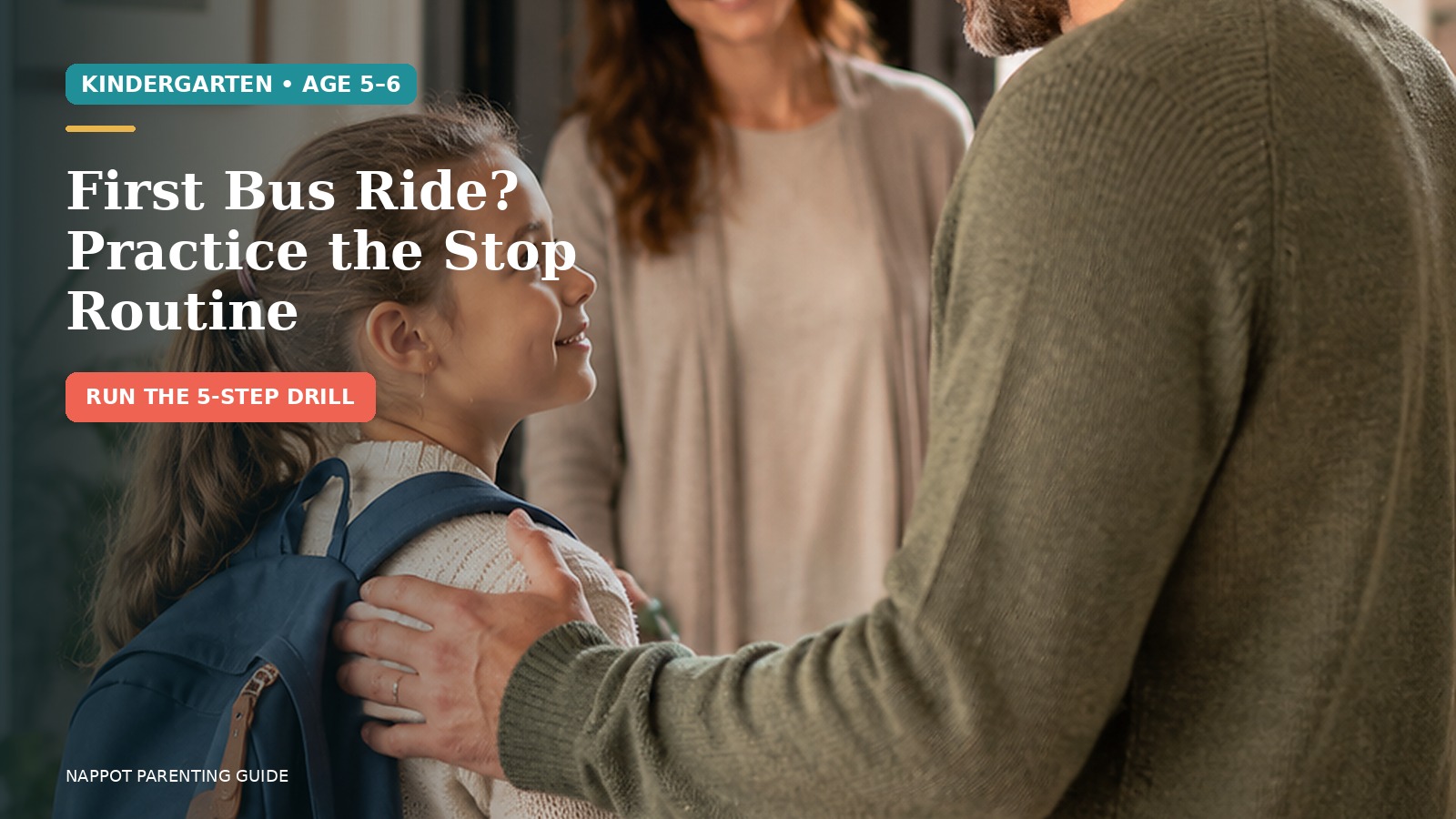
The short version: Visit the real stop, choose one safe waiting spot, practice approaching only after the bus stops and the driver signals, rehearse crossing and dropped-item rules, and make a dependable adult-supervision plan. Follow your school district’s transportation instructions when they differ from general guidance.
Why kindergartners need a practiced bus-stop routine
Young children are still learning to judge speed, distance, sound, and other people’s intentions. Excitement can also overpower a rule they know. A backpack may change their balance, a hood may narrow their view, and a busy pickup can make verbal instructions difficult to hear.
That does not mean a kindergartner cannot learn safe habits. It means adults should build those habits through repetition while continuing to provide the level of supervision required by the child, location, district, and local rules.
The National Highway Traffic Safety Administration advises children to arrive early, stand away from the curb, wait until the bus has stopped and the driver signals before boarding, and stay out of the bus driver’s blind areas. Use those principles as the foundation, then add the exact directions from your school or transportation provider.
Before the drill: check the school’s actual rules
Start with the transportation handbook, route notice, or school office. Confirm:
- the exact stop location and scheduled time;
- how early children should arrive;
- whether an adult must be present for kindergarten pickup or drop-off;
- whether the child must cross the road;
- the driver’s crossing signal;
- the procedure for a missed bus;
- who may receive the child after school; and
- what happens when weather, construction, or a substitute driver changes the routine.
Do not improvise a crossing plan that conflicts with school instructions. If the assigned stop seems unsafe because of visibility, traffic speed, a missing sidewalk, or another hazard, contact the transportation office before the first ride.
The 5-step first-ride safety drill
Step 1: choose and practice the exact waiting spot
Visit the real stop at about the same time of day as pickup. Choose a fixed place well back from the curb or roadway. A tree, fence post, driveway seam, or other stable landmark can help a young child remember where to stand. The safest position must match the school’s guidance and the physical layout of the stop.
Have your child put on the backpack and practice walking to the spot, stopping there, and facing the direction from which the bus will arrive. Repeat the routine in ordinary weather and, when practical, with the coat or rain gear they will actually wear.
Use a simple cue: “Feet at the waiting spot until the bus is stopped and the driver says it is time.” Avoid a long list of commands at the moment the bus arrives.
Practice check: Can your child reach the spot without stepping into the street, stay there despite excitement, and keep hands, feet, and belongings to themselves? If not, keep practicing with close adult guidance.
Step 2: rehearse a calm approach to the bus
Use a parked family vehicle or two chairs as a pretend bus. Let your child practice these actions in order:
- Stay at the waiting spot while the “bus” approaches.
- Wait until it is fully stopped.
- Look for the door to open and the driver’s signal.
- Walk—do not run—to the entrance.
- Use the handrail and board one person at a time.
Explain that being late is never a reason to chase a moving bus. If the child misses it, they should return to the responsible adult or another prearranged safe place. A kindergartner should not create a new route to school independently.
Practice with mild distractions after the basic sequence is solid. For example, have another family member talk nearby or place a backpack on the ground. The child’s job remains the same: wait, watch, then walk when signaled.
Step 3: practice crossing only if the route requires it
Crossing near a school bus needs special care because the bus is large and the driver cannot see every area around it. Follow the school’s route-specific directions and the driver’s signal. General safety guidance is not a substitute for that local procedure.
During practice, teach the child to stop at the designated place, make sure the driver can see them, wait for the signal, and check traffic as instructed. Even when bus warning lights are active, a passing driver may fail to stop. Children should not assume that the bus itself makes the road safe.
Use a short script such as: “Stop. See the driver. Wait for the signal. Look for traffic. Walk straight across.” Practice without a real bus first. Then, if the school offers orientation, rehearse with transportation staff who can demonstrate the district’s expected procedure.
If your child cannot reliably pause and wait for the signal, the plan needs more adult support. Do not treat one successful rehearsal as proof that supervision is no longer needed.
Step 4: teach the dropped-item rule
A rolling ball, paper, lunchbox, or backpack strap can pull a child into the danger area around the bus. The rule should be absolute and easy to remember:
“If something drops near the bus, leave it. Tell the driver or your adult.”
Practice by placing a harmless object several feet from the pretend bus. Ask, “What do you do?” Praise the safe response: stop, keep away, and tell an adult. Never ask a child to crawl under or reach beside a bus, even when the object seems easy to retrieve.
Also teach children not to walk close to the front, back, or sides of the bus unless following the driver’s directed boarding or crossing procedure. These areas can be difficult for the driver to see.
Step 5: build the adult-supervision and backup plan
Readiness is not determined by age alone. Consider the child’s impulse control, ability to follow a sequence under stress, traffic awareness, communication skills, and response when something unexpected happens. Then consider the stop itself: traffic volume, road crossings, sight lines, sidewalks, older students, weather, and distance from home.
For a kindergartner, the safest default is a reliable adult plan that also satisfies school policy. Write down:
- the primary adult for morning drop-off and afternoon pickup;
- a backup adult who knows the route and rules;
- what the child should do if that adult is not visible;
- where the child goes if the bus is missed;
- who contacts the school or transportation office; and
- how schedule changes are communicated.
Make sure the child can identify approved adults and knows not to leave with someone else. Keep the plan concrete. “Use good judgment” is too vague for a young child; “Stay with the driver until Grandma arrives” is easier to follow, if that matches district policy.
A simple rehearsal schedule for the week before school
Short, repeated practice is usually more useful than one long safety lecture.
- Day 1: Walk to the stop and choose the waiting landmark.
- Day 2: Practice waiting, approaching, and boarding with a backpack.
- Day 3: Rehearse the dropped-item rule and the missed-bus plan.
- Day 4: Practice crossing only if the assigned route requires it.
- Day 5: Run the entire sequence with one small distraction, then end with a calm success.
Keep corrections specific: “Go back to the waiting spot and pause” is more useful than “Be careful.” If your child becomes silly or overwhelmed, stop and try later rather than drilling until everyone is frustrated.
What to pack—and what to leave at home
Reduce avoidable distractions. Secure loose straps, choose a backpack the child can carry comfortably, and place small objects inside zipped compartments. Avoid toys or balls that could roll toward the road. Make sure clothing and footwear allow the child to walk steadily and see clearly.
A card inside the backpack may include the child’s name, school, and caregiver contact details, following the school’s privacy guidance. Do not display sensitive personal information where strangers can easily see it.
When your child is nervous about the first ride
Safety practice should build confidence, not communicate that catastrophe is expected. Name the specific concern and pair it with a specific plan:
- “You are worried you will not know when to board. We will watch for the door and the driver’s signal.”
- “You are worried I will not be here after school. Let’s review the approved pickup adults and what you do if you cannot see us.”
- “You are worried you will miss your stop. Tell the driver instead of getting off somewhere unfamiliar.”
If school-transition worries also include lockers, crowded hallways, or changing classes for an older sibling, Nappot’s first-week middle-school practice plan uses the same principle: turn one large fear into small skills that can be rehearsed.
Recheck the plan after the first few rides
Ask brief, practical questions: Where did you stand? What signal did the driver use? Was anything confusing? Did the pickup adult arrive where expected? One calm adjustment is better than an interrogation.
Revisit the routine when the route, season, caregiver, or stop changes. A child who manages a quiet neighborhood stop may need more help at a busier location. Likewise, a successful week does not override a district rule requiring adult supervision.
For other vehicle trips, remember that school-bus procedures and passenger-car restraint rules are different. Nappot’s school carpool booster and seat-belt fit check explains why the fit must be assessed in the actual car.
Frequently asked questions
How early should my child arrive at the bus stop?
Follow the transportation provider’s instruction. NHTSA commonly advises arriving about five minutes before the scheduled time, but your district’s route notice is the local authority. Arriving early helps prevent running after a bus.
How far from the curb should children wait?
Use the distance and location specified by the school or transportation provider and choose a clear landmark well away from moving traffic. NHTSA advises children to stand at least three giant steps back from the curb as the bus approaches. Adapt that instruction to the actual stop without placing the child in another hazard.
Should a kindergartner wait at the bus stop alone?
Do not assume so. Supervision depends on school policy, local rules, the route, and the individual child’s capabilities. Many schools require an authorized adult for young riders, especially at drop-off. For a five- or six-year-old, plan dependable adult supervision unless the school has confirmed another safe arrangement.
What should my child do after missing the bus?
The child should not chase the bus or walk to school on an improvised route. Practice returning to the responsible adult or another specifically approved safe place. The adult can then contact the school and arrange transportation.
What if my child drops something beside the bus?
Leave it where it is and tell the driver or supervising adult. The child should never bend near, reach under, or crawl around the bus to retrieve an item.
A final parent checklist
- Confirm the official stop, time, route, crossing procedure, and adult handoff rule.
- Visit the stop and select a safe waiting landmark.
- Practice waiting until the bus is stopped and the driver signals.
- Rehearse the dropped-item and missed-bus rules.
- Practice the required crossing sequence, if any, with adult supervision.
- Secure loose belongings and remove rolling distractions.
- Name the primary and backup supervising adults.
- Review the routine after the first rides and whenever conditions change.
Bus-stop independence should grow gradually from demonstrated skills, not from pressure to keep up with other children. A predictable routine, a clear adult backup, and repeated practice give a kindergartner the best chance to begin the school year safely and confidently.
Sources
- National Highway Traffic Safety Administration: School Bus Safety
- Your school district’s current transportation handbook, stop assignment, and driver instructions
This article provides general educational information. School transportation rules and supervision requirements vary. Follow your district’s instructions and contact its transportation office about route-specific safety concerns.