When your 2-year-old will not stay in the stroller, the answer is not a tighter improvised restraint or a bigger power struggle. The safest approach is a predictable outing routine: decide where walking is possible, state where the stroller is required, use the stroller’s approved harness every time, and offer small choices that do not change the safety boundary.
Stroller refusal is understandable at this age. Two-year-olds are mobile, curious and eager to make decisions, while their ability to stop, wait and judge danger is still developing. A toddler can genuinely want to walk and still be unable to stay beside you near traffic or in a crowded station. Your job is to make room for appropriate independence without handing over a decision that is not yet safe.
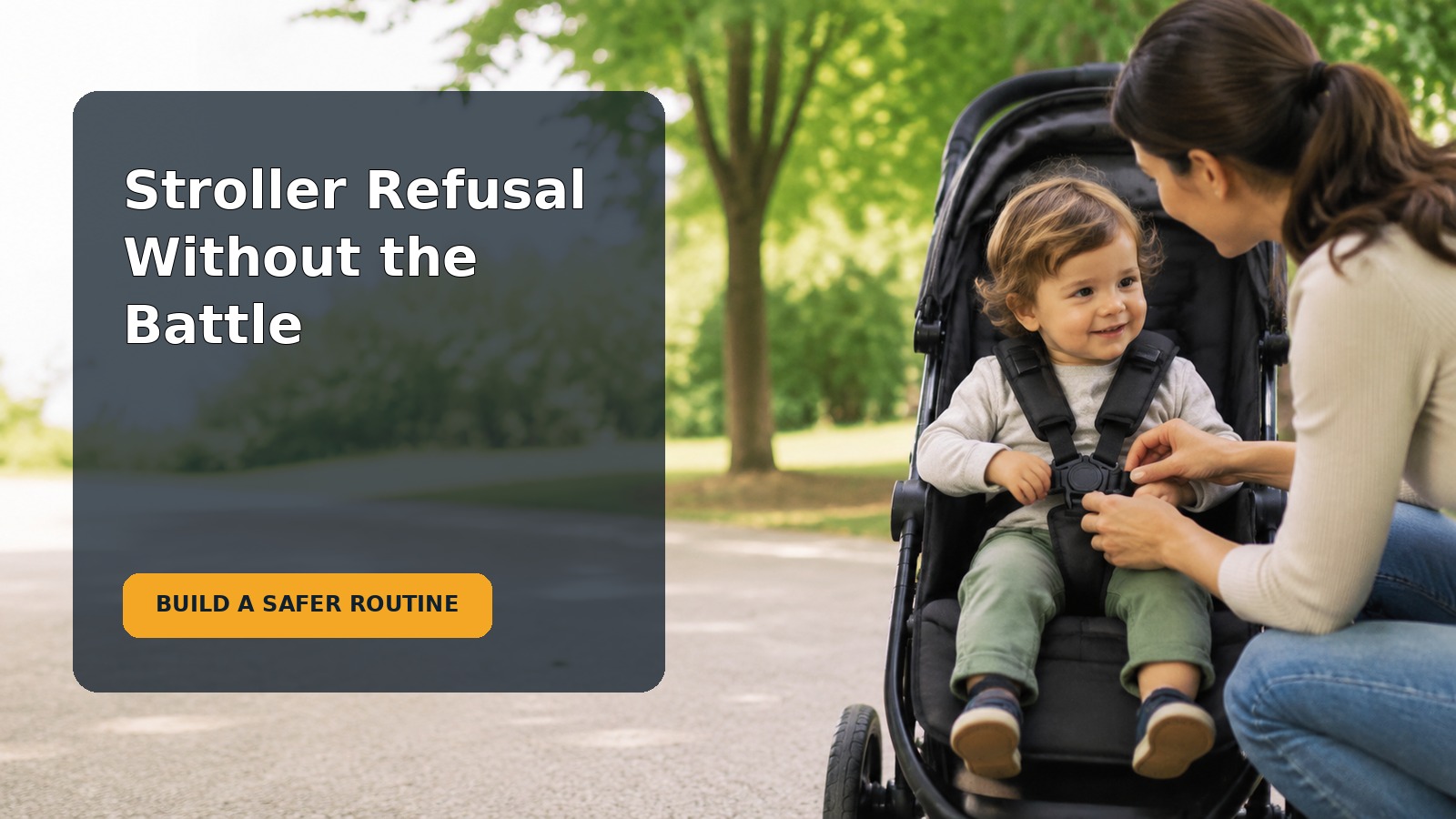
Why a 2-year-old may refuse the stroller
Independence is growing faster than judgment
The CDC’s guidance for ages 2–3 describes this as a period when toddlers assert independence, become more physically capable and can follow simple instructions. Those skills are important, but following a direction in a quiet room is different from stopping instantly beside a moving car.
“No stroller” may mean “I want to move,” “I want control,” “the straps feel uncomfortable,” “I am bored,” or “I have learned that protesting delays the buckle.” It is useful information, not proof that your child is manipulative or ready to walk everywhere.
Check comfort before treating it as behavior
Before the next outing, inspect the setup. Confirm that the stroller is approved for your child’s current height and weight. Follow its manual for seat position and harness adjustment. Check for twisted straps, crumbs, a hot or wet seat, clothing caught near the buckle, or a footrest that no longer fits comfortably. Look for damage, loose wheels and a brake that does not hold.
Do not add clips, cords, chest straps, pillows or other restraint modifications that the manufacturer does not approve. If the harness seems impossible to fit correctly, stop using the stroller until the manual, manufacturer or a qualified retailer helps you resolve it.
The non-negotiable stroller safety rules
Behavior strategies come after equipment safety. Health Canada’s stroller safety guidance advises caregivers to follow the manufacturer’s height and weight limits, use the safety harness and lap belt, supervise the child, and apply the brakes whenever stopped or helping a child in or out. It also warns against hanging bags from the handles because a stroller can tip.
- Use the complete manufacturer-approved harness. Buckle it for every ride, even a short one. It should restrain your child as the manual describes without twisting, pinching or leaving unsafe slack.
- Stay within arm’s reach. Never leave a toddler unattended in a stroller.
- Set the brake before loading or unloading. Keep the stroller stationary while you work the buckle.
- Keep hands and feet clear when folding or adjusting. Do not let your toddler climb into or out of a moving or unlocked stroller.
- Store bags where the manual permits. Do not hang heavy bags from the handle.
- Use elevators, not stairs or escalators. Plan the accessible route before you arrive.
If the stroller has been recalled, damaged in a collision, or no longer locks securely, follow the manufacturer’s or safety regulator’s instructions rather than trying to repair it with household materials.
A safe outing routine without a power struggle
Step 1: Decide the walking zones before leaving
Divide the outing into two kinds of places:
- Stroller-required zones: parking lots, roadsides, busy crossings, transit platforms, crowded shops, medical buildings, airports, or any place where you cannot safely supervise free walking.
- Walking-choice zones: a fenced playground, a quiet path, a clear indoor corridor, or another low-risk area where you can stop and reconnect quickly.
The boundary should depend on the setting, not on how loudly your toddler objects. If the route has no realistic walking zone, say so before leaving. If it does, tell your child when the walking chance will come: “Stroller in the parking lot. You may walk with me after we reach the park gate.”
Step 2: Use one short script
Long explanations usually add stimulation. Get close, speak calmly and repeat the same sequence:
“You want to walk. Walking is not safe here. Your body rides buckled in the stroller. You may hold the snack cup or choose the song.”
This validates the wish without presenting safety as negotiable. Offer two acceptable choices around the boundary: which small toy to bring, whether to climb in with help or be lifted, or which route to take. Do not offer “stroller or walking” if walking is not actually safe.
Step 3: Make buckling brief and predictable
Apply the brake. Put away your phone. Have the child-safe activity or snack ready before loading. Say the sequence in the same order: “Bottom back, arms safe, buckle, then we go.” Secure the harness according to the manual and begin moving once everything is safe.
If your toddler stiffens or arches, pause long enough to avoid pinching or forcing a limb into an unsafe position. Calmly restate the boundary. If you cannot secure the harness safely, do not start moving. Step to a safe location, regulate together, and either retry or change the outing plan.
Step 4: Build in planned movement
A stroller routine works better when the child knows riding is not endless. For a longer outing, include a safe movement stop when practical. Keep the promise: “At the playground gate, you can get out.” Then apply the brake, move to the safe area and unbuckle.
Use a simple transition warning before returning: “Two more slides, then stroller.” The same calm transition skills in Nappot’s guide to toddler transitions without a power struggle can make the change more predictable.
Step 5: Praise the specific skill
Notice cooperation without turning it into a performance: “You put your bottom back while I buckled you. That kept your body safe.” The CDC recommends giving attention and praise when toddlers follow instructions and show positive behavior. Specific feedback tells your child exactly what to repeat next time.
What to do when your toddler protests
If they cry or yell
Keep your voice low. A feeling does not require you to remove a necessary harness. You can say, “You are angry. I will stay with you. We ride buckled here.” Avoid threats, lectures and repeated bargaining. Once secure, move on if it is safe to do so.
If they try to climb out
Stop immediately in a safe place and apply the brake. Check that the harness is assembled and adjusted exactly as the manual requires. Do not keep pushing while your child is partly out, and do not improvise an extra tie or buckle. If an appropriately fitted approved harness does not contain your child, contact the manufacturer and use another safe transport plan until the issue is resolved.
If they refuse to get in at all
Use the smallest workable plan. For a nonessential trip, you may pause, reconnect and try again once. For an essential trip, calmly help your child into the stationary stroller and buckle them according to the manual. If you cannot do that without unsafe force, move to a secure area and change plans: another adult may help with supervision, the errand may need to wait, or you may need an age-appropriate carrier or other product used strictly within its instructions.
Do not chase a running toddler while leaving an unsecured stroller behind in traffic, and do not ask a sibling to be responsible for containment.
Common approaches that backfire
- Surprising the child at the curb. Preview the stroller-required zone before the transition.
- Turning safety into a debate. Offer choices only where both answers are acceptable.
- Removing the harness to stop crying. Comfort the feeling while keeping the safety boundary.
- Using shame. Replace “You are being a baby” with “Your body wants to move; this place is not safe for walking.”
- Walking until everyone is exhausted. Plan short, successful practice in low-risk places rather than testing a new skill during a rushed errand.
- Using food or a screen as the only tool. A simple activity can help, but it should support—not replace—a clear routine and properly fitted restraint.
A 7-day practice plan
- Day 1: Check the stroller manual, limits, brakes, wheels, seat and harness at home.
- Day 2: Practice “brake, sit, buckle, go” for two minutes without an errand.
- Day 3: Let your toddler choose one stroller activity and take a short familiar route.
- Day 4: Add one clearly named walking zone, then return to the stroller once.
- Day 5: Practice the same script with another regular caregiver.
- Day 6: Try a slightly longer outing with a planned movement break.
- Day 7: Review what triggered resistance—comfort, timing, hunger, fatigue, long rides or inconsistent limits—and change one factor.
Success is not zero protest. Success is a safe, repeatable routine in which adults remain calm, the approved harness is used correctly and the toddler gradually understands when walking is available.
When to ask for help
Contact the stroller manufacturer promptly if the brake slips, the frame or wheel is damaged, the buckle opens unexpectedly, the harness cannot be fitted as directed, or the product may be subject to a recall.
Raise the issue with your child’s pediatrician if refusal seems driven by pain, skin injury, unusual stiffness, weakness, major asymmetry, breathing difficulty, repeated vomiting, or a sudden change in movement or behavior. Also ask for guidance if your child frequently escapes multiple correctly used age-appropriate safety restraints or bolts into danger despite close supervision. These patterns do not establish a diagnosis, but they deserve an individualized safety plan.
Seek urgent medical care after a fall or stroller incident if your child has trouble breathing, loses consciousness, has a seizure, cannot use a limb normally, has severe bleeding, or seems seriously unwell. Follow local emergency guidance.
Quick parent checklist
- Stroller is within the manufacturer’s height and weight limits.
- Brakes, locks, wheels, seat and approved harness work correctly.
- Walking and stroller-required zones are decided in advance.
- Toddler hears one short script and receives two safe choices.
- Brake is on during loading and unloading.
- Harness is used exactly as the manual directs—no modifications.
- Movement breaks happen only in genuinely safe places.
- Caregivers use the same boundary and the same words.
Frequently asked questions
Is stroller refusal common at age 2?
It fits a stage when mobility and independence are increasing quickly. That does not mean every child behaves the same way or that an individual child is ready to walk safely in every setting.
Should I let my toddler walk if they promise to hold my hand?
Only where you can safely support that skill. Near traffic, crowds or other immediate hazards, use the stroller or another appropriate transport option rather than relying on a promise that a 2-year-old may not yet be able to keep.
Can I loosen the harness so my toddler feels less trapped?
Use only the fit described in the stroller manual. Unsafe slack can allow climbing, entrapment or a fall. Check comfort and clothing, but do not trade away correct restraint.
How long should I try this routine?
Practice on short, low-pressure outings for about a week and review the pattern. Keep the safety rules immediately; adjust timing, comfort, choices and movement breaks based on what you observe.
What if every outing still becomes a major struggle?
Check the equipment and fit first, shorten the route, practice outside rushed errands and compare what happens with different caregivers. If the behavior creates repeated danger or seems connected to discomfort, sensory distress or developmental concerns, discuss it with your pediatrician.
Sources
- Health Canada: Stroller and carriage safety
- Centers for Disease Control and Prevention: Positive Parenting Tips—Toddlers (2–3 years old)
This article provides general parenting and safety education, not individualized medical advice or a substitute for the stroller manufacturer’s instructions. Product designs and children’s needs vary. Consult the manufacturer and your child’s pediatrician when fit, comfort, development or safety remains uncertain.