The parental mental load is the ongoing work of noticing what a family needs, deciding what should happen next, remembering the details and checking that nothing has fallen through the cracks. It is different from simply completing a chore. Packing a lunch is a task; noticing that lunch supplies are low, checking tomorrow’s schedule, planning around an allergy, buying the food and remembering the lunchbox is the full mental-load loop.
This work can become exhausting because much of it is invisible. A family may divide visible chores and still leave one person carrying most of the anticipation, reminders and decisions. The goal is not to keep score or make every day perfectly equal. It is to create fair, dependable ownership so no adult has to function as the household’s permanent project manager.
What the parenting mental load actually includes
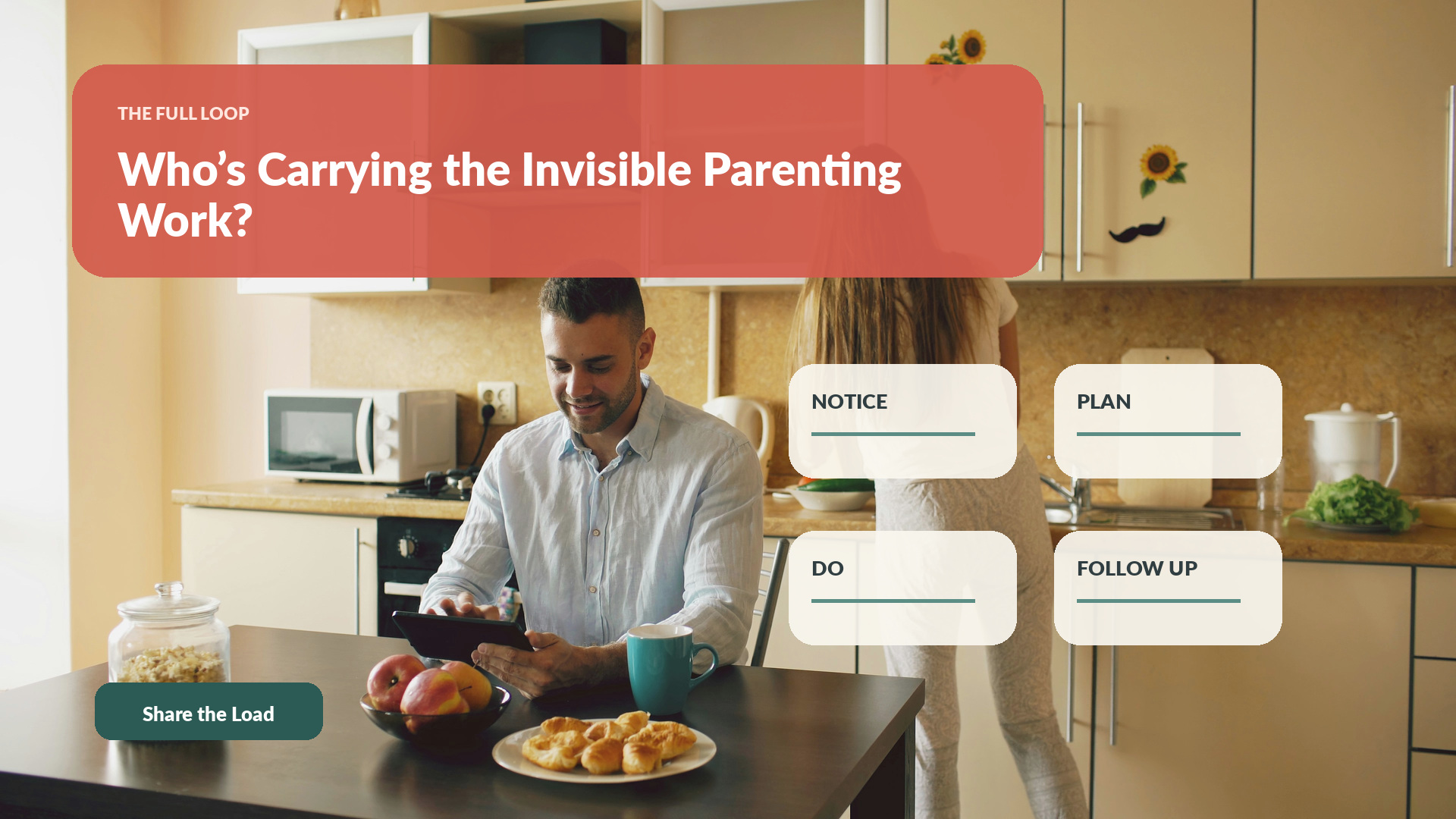
Family work often has four stages: notice, plan, do and follow up. The person who performs the final step is not necessarily the person carrying the whole load.
- School: reading messages, tracking special days, replacing supplies, signing forms and noticing when a child needs help.
- Health: scheduling visits, keeping records, refilling prescriptions and following care instructions.
- Food: planning meals, monitoring staples, considering preferences or allergies, shopping and using food before it spoils.
- Clothing: noticing changing sizes, checking the weather, replacing worn items and preparing what is needed for activities.
- Relationships: remembering birthdays, arranging family contact, watching for friendship concerns and repairing missed connections.
- Home administration: paying bills, managing documents, booking repairs and anticipating deadlines.
Mental load is not a medical diagnosis, and every family’s division of work will look different. Paid work hours, disability, health, caregiving demands, finances and each person’s capacity all matter. Fairness means acknowledging those realities rather than assuming that one arrangement fits everyone.
Audit one ordinary week without turning it into a blame list
Choose a typical week and capture family work as it happens. Use a shared note, paper list or spreadsheet. Write down the task, how often it occurs, who notices it, who makes decisions, who completes it and who checks the result.
Include small recurring items. Replacing toothpaste, responding to a teacher, arranging transportation and finding a birthday gift may each take only minutes, but together they create constant cognitive switching.
Use neutral questions
- What would happen if nobody remembered this?
- How urgent is it, and how often does it recur?
- Does it require research, emotional support or several decisions?
- Who currently reminds another person to begin?
- Which tasks create the most interruption or worry?
Avoid arguing about whose memory is more accurate while you are collecting the list. The first aim is visibility. Set a short review time later, when neither person is rushing or already overwhelmed.
Assign ownership instead of helper tasks
“Tell me what to do” may sound cooperative, but it leaves the planning burden with the person who has to notice, delegate and monitor. Real ownership transfers the full loop.
For example, the owner of school lunches might monitor supplies, choose workable foods, add items to the shopping list, prepare lunches and clean the containers. Another adult can still help during a difficult week, but help should not quietly return permanent management to the original owner.
Define the outcome and minimum standard
Agree on what “done” means without prescribing every step. A minimum standard might be: forms are submitted by the deadline, essential medication does not run out, or the kitchen is safe and usable before bed. Unless safety, health or a firm deadline is involved, let the owner choose the method.
This matters because transferring a task while criticizing every decision is not a true transfer. At the same time, ownership does not mean silence. Partners should share information and flag problems early.
Build a simple family operating system
The best system is the one your household will keep using. More apps and color codes can create another maintenance job. Start with a few dependable tools.
- One shared calendar: include appointments, school events, work conflicts, activities and preparation deadlines—not only event times.
- One recurring-task list: record weekly, monthly and seasonal work with a named owner.
- One document home: keep school, medical, insurance and activity information in a secure place both responsible adults can access.
- A short weekly check-in: spend 15 minutes reviewing the coming week, capacity changes and tasks that need reassignment.
- A basic meal rhythm: use a short rotation, a shared shopping list and a backup meal for demanding days.
- A brief home reset: choose a predictable time when everyone returns common spaces and essential items to a usable state.
During the weekly check-in, ask: What is unusual this week? Who has less capacity? What needs a decision? What can be postponed, simplified or dropped? The purpose is coordination, not performance review.
What to do when reminders keep returning
If one person still has to prompt the owner, look for the reason before assuming laziness or bad intent.
- The task is vague: define its boundaries and what completion looks like.
- The information is inaccessible: share logins, contacts, schedules and document locations securely.
- The system depends on memory: add a recurring reminder owned by the responsible person.
- Capacity is genuinely low: redistribute, reduce standards temporarily or remove nonessential work.
- A skill is missing: teach it once, write the steps down and allow practice.
- The owner repeatedly refuses: address the relationship pattern directly rather than creating more reminders.
If you need immediate breathing room before that conversation, Nappot’s 10-minute mental-load reset offers a short way to sort what is urgent, delegable or safe to defer.
Include children without making them responsible for adults
Children can contribute to family life in ways that match their age, skills and support needs. Young children might put toys in a basket or carry napkins. Older children can pack a school bag using a checklist, sort laundry, help prepare food or take responsibility for a recurring household task.
The American Academy of Pediatrics’ HealthyChildren guidance describes chores as a way for children to contribute and learn responsibility when expectations are appropriate and clearly taught. Start small, demonstrate the task and expect learning to take time.
Contribution is not parentification. Children should not manage adult conflict, finances, a parent’s emotional stability or caregiving beyond what is safe and developmentally appropriate. Adults retain responsibility for the household system.
Plan for predictable pressure points
Mental load rises during school starts, illness, travel, holidays, moves and changes in work. Do not wait for resentment to reveal that the system is overloaded.
Before a demanding period, identify what must continue, what can be simplified and who is the backup for essential responsibilities. Use convenience without guilt when it is available: repeat meals, pause optional activities, lower housekeeping standards or ask trusted support people for a specific form of help.
The American Psychological Association notes that prolonged stress can affect both mind and body. Persistent overwhelm, irritability, sleep problems or feeling unable to cope deserve attention—not a lecture about better organization. A primary-care clinician or qualified mental-health professional can help assess individual needs.
When the imbalance is more than an organization problem
A calendar cannot repair contempt, intimidation, coercive control, financial control or a persistent refusal to participate. If discussions repeatedly become threatening, one person restricts access to money or support, or you do not feel safe disagreeing, prioritize safety over a joint productivity system.
Seek confidential guidance from a qualified local service. In the United States, the National Domestic Violence Hotline explains patterns of power and control and offers confidential support. If there is immediate danger, contact local emergency services. People outside the United States can use an appropriate domestic-abuse or safeguarding service in their country.
When the relationship is safe but the same conflict keeps repeating, couples or family therapy may help partners discuss expectations and ownership. If a disagreement happens in front of children, use a calm, age-appropriate repair; this guide to repairing after parents disagree provides a practical script.
A 20-minute ownership reset
- Choose three recurring areas that create the most reminders.
- Name the current notice, plan, do and follow-up steps for each.
- Assign one adult owner per area, considering current capacity.
- Agree on the minimum outcome and any non-negotiable safety requirements.
- Move deadlines and recurring reminders into the owner’s system.
- Choose a review date two weeks away.
At review, ask what worked, what information was missing and whether the distribution still feels workable. Change the system without treating adjustment as failure.
Frequently asked questions
What is the difference between chores and mental load?
A chore is a visible action such as washing clothes. Mental load includes noticing that clothes are needed, checking supplies and sizes, scheduling the wash and making sure required items are ready on time.
How can a partner notice tasks without reminders?
Transfer a clearly defined area, its information and its recurring reminders. Let the owner manage the complete loop. If prompting continues, discuss whether the boundary, capacity, skill or willingness is the real problem.
Can a shared calendar really reduce parental mental load?
It can reduce duplicated remembering when everyone uses it consistently, but it cannot create fair ownership by itself. Each entry and preparation step still needs a named owner.
How much responsibility should children have?
Choose tasks that are safe and appropriate for the child’s age and abilities, teach them directly and increase independence gradually. Children can contribute, but they should not carry adult responsibilities or emotional burdens.
Sources and further guidance
- American Psychological Association: Parenting and stress
- HealthyChildren.org: Chores and responsibility
- National Domestic Violence Hotline: Power and control
This article provides general educational information, not medical, mental-health or legal advice. Family circumstances differ; seek qualified support for persistent burnout, relationship distress or safety concerns.