A 10-month-old who suddenly heads for the stairs can move faster than an adult expects. The encouraging part is that pulling up, cruising and exploring are normal parts of growing mobility. The important safety message is just as simple: a baby gate is a backup barrier, not supervision. Safe practice happens only when a capable adult is within arm’s reach and fully focused on the baby.
If your goal is 10 month old climbing stairs safely, start by separating two jobs. First, make the stairs inaccessible during everyday life with correctly chosen and installed barriers. Second, if you want to let your baby practice, create a short, planned session in which you control the space and stay immediately behind them. Do not leave stairs open so a baby can “learn from experience.”
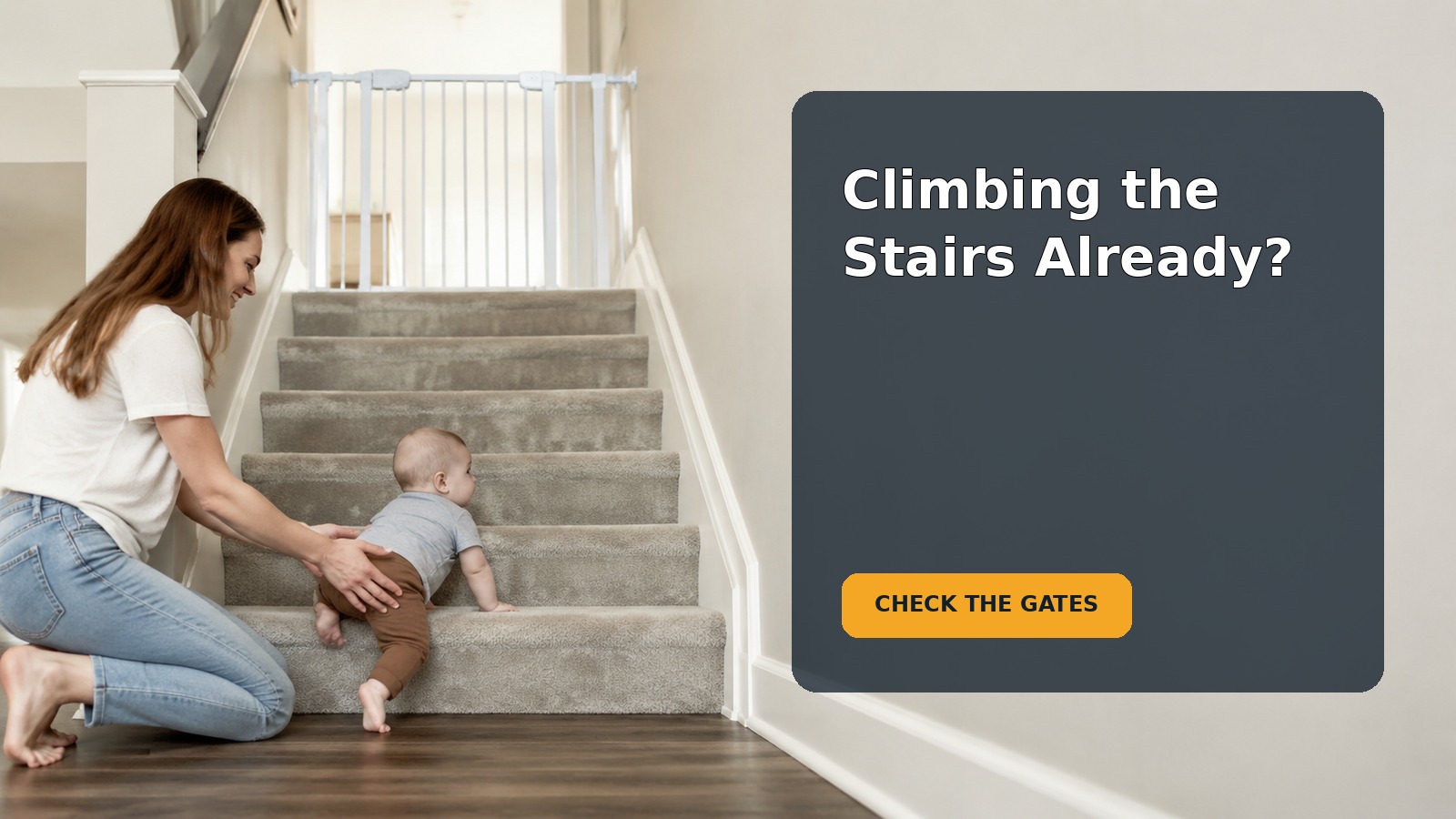
First, make the staircase safe when practice is not happening
Most of the day should not be stair-practice time. Your baby needs a reliable barrier between their play area and every flight of stairs. The U.S. Consumer Product Safety Commission regulates gates and enclosures intended for young children, including requirements related to height, openings, latches, strength and pressure-mounted hardware. A compliant product still has to be appropriate for the location and installed exactly as its manufacturer directs.
Use the right gate for each location
- At the top of stairs: use a gate specifically approved by its manufacturer for top-of-stair use. This is generally a hardware-mounted model secured to suitable structural surfaces. Do not improvise with a pressure-mounted doorway gate at the stair top.
- At the bottom of stairs: install a gate that the manufacturer permits in that location. Position it so the baby cannot reach through, climb nearby objects or access the first step around the barrier.
- At unusual railings or banisters: use a compatible installation kit or obtain qualified help. Never attach a gate with makeshift cords, zip ties or furniture.
Check the product label, model number, age or developmental limits, opening-width range and installation manual. If the manual is missing, get the exact instructions from the manufacturer rather than copying another model’s setup. Register the gate if a registration option is provided, and check the CPSC recall database for the model.
Run a two-minute gate check every day
Adults open gates repeatedly, hardware loosens and babies learn new ways to pull, shake and climb. At the start of each day, press the gate gently in both directions, confirm that the latch closes completely and look for loose fasteners, cracked parts or widening gaps. Remove or stop using a damaged gate until the manufacturer’s safe remedy is complete.
Keep stools, toy boxes, laundry baskets and climbable furniture away from both sides. Never step over the gate while holding the baby; use the latch and close it behind you. Make sure every caregiver knows which gates must remain closed.
Is stair climbing typical at 10 months?
Babies develop movement skills on different schedules. Around this period, many become eager to pull to stand, cruise along furniture or climb over low obstacles. Some 10-month-olds investigate stairs; others are not interested yet. Stair interest by itself does not prove advanced development, and a baby who is not climbing stairs does not automatically have a delay.
The CDC advises families to consider the whole developmental picture and to talk with a child’s doctor if the child has lost a skill, is not meeting expected milestones or the parent has another concern. Prematurity, muscle tone, vision, balance, medical conditions and previous injuries can all change what practice is suitable. Ask your pediatric clinician or physical therapist before stair practice if your baby has a known movement concern.
A controlled plan for 10 month old climbing stairs safely
Practice is optional. A baby can develop strength, balance and coordination through ordinary floor play, pulling up at stable furniture and cruising in a childproofed room. If stairs are available and you choose to practice, keep the session short and predictable.
Step 1: prepare before opening a barrier
- Choose a time when the baby is awake, calm and not hungry or exhausted.
- Remove toys, pets, shoes and other distractions from the staircase.
- Make sure the steps are dry, well lit and free of loose rugs or objects.
- Wear stable footwear or go barefoot if that gives you secure footing; avoid slippery socks.
- Have only one focused adult lead the session. Put the phone away.
- Confirm that the gate at the opposite end of the staircase remains secured.
If you cannot control both the environment and your attention, skip the practice. A closed gate and safe floor play are the better choice.
Step 2: let the baby climb up with you immediately behind
Going upward is usually the simplest direction to introduce because the baby can see the next surface and use hands and knees. Position yourself one step below and close enough to prevent a backward fall. Keep your hands ready near the baby’s trunk without pulling the arms or lifting the baby from step to step.
Use one calm phrase, such as: “Hands, knee, up. I’m right here.” Let the baby make the movement. Stop after a few steps or at the first sign of fatigue, frustration, slipping or loss of control. Carry the baby away from the stairs and immediately restore the barrier.
Step 3: teach coming down as a separate skill
A baby who can climb upward is not automatically able to descend safely. Do not place a baby at the top and invite them to figure it out. When your baby has enough control and you are ready to teach the idea, begin near the bottom with only one or two steps accessible. Turn the baby so their belly faces the stairs and guide a feet-first movement while remaining directly below.
Keep the words consistent: “Turn around. Feet first. I’m with you.” This is practice, not a test. If the baby resists turning, tries to sit facing forward or becomes upset, end the session. Carrying them down is not a failure.
What gates can—and cannot—do
| Safety layer | What it does | What it cannot replace |
|---|---|---|
| Correct gate | Restricts routine access to the staircase | Proper installation, maintenance or supervision |
| Adult supervision | Allows an immediate response during planned practice | A closed barrier during ordinary household activity |
| Short practice | Introduces controlled climbing and feet-first language | Developmental readiness or a professional assessment |
| Daily inspection | Finds loose hardware, latch problems and damage | Following the exact manufacturer instructions |
The CPSC’s gate standard covers products intended for children from 6 to 24 months, but age alone does not determine when a gate is no longer effective. Stop relying on a gate when your child reaches the manufacturer’s limit, can climb over it, can operate the latch or when the gate is damaged. Replace the safety plan before removing the barrier.
Common mistakes and safer alternatives
“They climbed it once, so they know how”
One successful climb does not mean the baby understands edges, can recover from a slip or can descend. Keep barriers in place and treat every practice as fully supervised.
Using a pressure gate at the top because it feels tight
A gate that feels firm in a doorway is not automatically suitable above a drop. Use only a model explicitly approved for that top-of-stair location and follow its mounting instructions.
Holding the baby’s hands from above
Pulling upward can place the adult off balance and does not protect well against a backward fall. Stay immediately below and behind the baby, ready to support the trunk.
Leaving the gate open after practice
Create a closing ritual: carry the baby to the safe side, close the gate, tug-test the latch and say, “Stairs are closed.” The ritual helps adults remember the final safety step.
Trying to stop curiosity with fear
A loud scare may upset the baby without creating reliable safety. Use a calm, firm boundary: “Stairs are for practice with a grown-up. The gate stays closed.” Redirect to a safe movement activity. Nappot’s floor-play games for babies offer alternatives that build skills without stair access.
A one-page staircase checklist
Before everyday use
- Top gate is approved for the location and mounted as directed.
- Bottom gate fits the opening and closes securely.
- Latches, hinges and fasteners work without damage.
- No furniture, toys or boxes create a climbing aid.
- All caregivers know the gate rules.
Before a practice session
- One alert adult is assigned only to the baby.
- Stairs are clear, dry and well lit.
- The session starts near the bottom and lasts only a few minutes.
- The adult stays directly below or behind the baby.
- The baby stops at the first sign of fatigue or frustration.
After practice
- Carry the baby back to the safe side.
- Close and tug-test the gate.
- Record any loose hardware or difficult latch immediately.
- Choose safe floor play instead of repeating when the baby is tired.
For a wider room-by-room review, use Nappot’s crawling-baby childproofing checklist.
When to ask for professional help
Contact your child’s clinician after any significant fall, especially if the baby hit their head or is not acting normally. Seek urgent medical help for loss of consciousness, repeated vomiting, seizure, unusual sleepiness or difficulty waking, worsening confusion, weakness, trouble breathing, persistent bleeding, a limb that looks deformed, or any symptom that feels severe. Follow local emergency guidance.
Schedule a routine developmental conversation if your baby has lost a movement skill, consistently uses only one side, seems unusually stiff or floppy, cannot bear weight as expected for them, or if you are worried about balance or coordination. The point is not to diagnose from stair behavior; it is to share the broader pattern with a qualified professional.
For gate-specific questions, contact the manufacturer with the model number and photographs of the installation area. A qualified installer may be useful for unusual banisters, glass, metal railings or walls that do not provide a straightforward mounting surface.
Frequently asked questions
Should I teach my 10-month-old to climb stairs?
You do not need to use stairs as a developmental exercise. Safe floor play and cruising can provide plenty of movement practice. If you choose to introduce stairs, do it only in a controlled session with an adult immediately behind the baby.
Do I need gates at both the top and bottom?
Restrict access from every side your baby can reach. Many homes need barriers at both ends, but the correct product and installation depend on the location. Use a gate approved for that exact placement and follow its instructions.
Can I use a pressure-mounted gate at the top of stairs?
Do not use a gate at the stair top unless the manufacturer explicitly approves it for top-of-stair installation. Hardware-mounted models are generally used there because the barrier must protect an opening above a fall.
When should we stop using a baby gate?
Follow the gate manufacturer’s age, height and developmental limits. Stop relying on it sooner if your child can climb over it, work the latch or dislodge it. Change the safety plan before removing the gate.
What if my baby cries when practice ends?
Acknowledge the frustration and keep the boundary: “You wanted more. Stairs are closed now.” Then redirect to a safe climbing cushion, stable push toy or floor game. Safety does not require the baby to agree.
Sources
- U.S. Consumer Product Safety Commission: Gates and Enclosures FAQ
- U.S. Consumer Product Safety Commission: Gates and Enclosures Business Guidance
- CDC: Developmental Milestones by 1 Year
This article provides general safety education, not individualized medical or installation advice. Product instructions, home layouts and a child’s developmental needs vary. When in doubt, ask the gate manufacturer, a qualified installer or your child’s healthcare professional.