When a 4 year old unbuckles car seat straps while the car is moving, treat it as an immediate transportation-safety problem—not a character flaw and not a debate to finish on the road. Your first job is to stay in control of the vehicle, pull over in a safe legal place as soon as you can, and secure the child correctly before continuing.
Then look beyond the moment. A preschooler may be curious, uncomfortable, testing a new skill, trying to reach something, or reacting to a harness that is fitted incorrectly. The safest plan combines correct restraint use, a short predictable rule, practice while parked, and help from a certified child passenger safety technician when fit or equipment is uncertain.
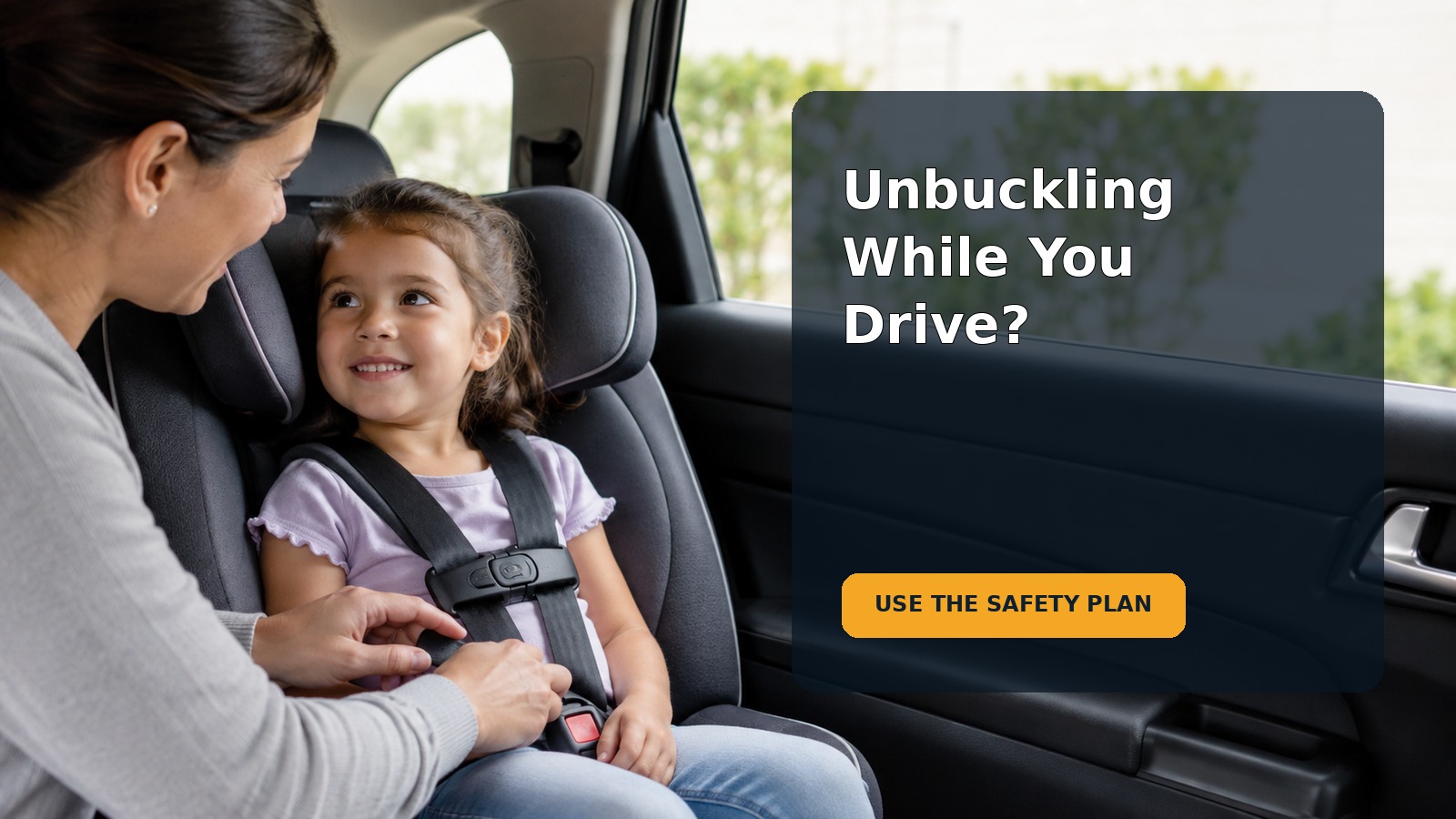
Start with a 60-second safety check
Before driving again, work through this short sequence:
- Stop safely. Do not turn around, reach into the back seat or try to re-buckle a child while the vehicle is moving.
- Check the whole restraint. Confirm that the child is using the correct seat mode for their height, weight and development, according to the seat instructions.
- Re-secure the child exactly as directed. Do not improvise with clips, covers, tape or other additions that the manufacturer has not approved.
- State the rule once: “The car moves only when everyone is buckled safely.”
- Continue only when the restraint is secure. If the child opens it again, repeat the same stop-and-secure response.
A four-year-old is not automatically ready for a booster. The American Academy of Pediatrics advises that children who have outgrown rear-facing limits use a forward-facing seat with a harness for as long as possible, up to the seat manufacturer’s highest permitted height or weight. A belt-positioning booster also requires the maturity to sit correctly for the entire trip. Check your particular seat manual rather than changing modes simply because unbuckling has become difficult.
What may be driving the unbuckling
You do not need to diagnose the behavior to respond safely. However, observing the pattern can reveal a practical fix. While the car is parked, ask a neutral question: “I noticed you opened your buckle. Was something hurting, hard to reach or bothering you?”
Check comfort and fit
Look for twisted straps, clothing bunched under the harness, an incorrect harness height, a misplaced chest clip, or pressure caused by an installation or fit error. Follow the manual for strap position and tightness. Avoid bulky coats under the harness because they can interfere with fit. If your child has a disability, low muscle tone, sensory needs or a medical condition, ask their clinician and a child passenger safety technician about an appropriate restraint rather than creating a homemade workaround.
Notice when it happens
Write down the circumstances for several rides:
- Does it happen immediately, near the end of a trip or only in traffic?
- Is the child reaching for a dropped toy, drink or sibling?
- Does it follow discomfort, boredom, conflict or a rushed departure?
- Is the child opening the chest clip, the crotch buckle or a vehicle seat belt?
- Can the child explain what they were trying to accomplish?
The exact part being opened matters. Bring that information, along with the seat model, child’s height and weight, and vehicle details, when you seek installation help.
A practical plan for every ride
Step 1: Prepare before the engine starts
Build the same sequence into every departure: bathroom if needed, comfortable non-bulky clothing, one approved quiet activity, and any essential item placed where it can be reached without leaning out of position. Secure loose objects so they do not become projectiles. Then complete the restraint check before starting the car.
Use one brief script:
“Your job is to keep your buckle closed and your body in position. My job is to drive safely. If the buckle opens, I will stop the car and we will fix it before we move.”
Avoid a long warning. Preschoolers are more likely to remember one concrete rule that is repeated consistently.
Step 2: Practice while parked
Choose a calm time, with the vehicle parked and the keys secured. Show your child what “ready to ride” looks like. Let them point to the parts an adult checks. Practice asking for help: “I am uncomfortable,” “I dropped something,” or “Please stop when it is safe.”
You can also rehearse the consequence without shame: the pretend car does not move until everyone is secure. The lesson is not that the child is “bad”; it is that a moving vehicle requires every passenger to remain properly restrained.
Step 3: Use the same response every time
If unbuckling happens in motion, keep your eyes on the road and tell the child calmly, “I hear you. I am finding a safe place to stop.” Pull over safely, secure the restraint, and keep the interaction brief. Do not bargain with the car moving.
When the child completes a ride correctly, describe the specific success: “You kept your buckle closed until we parked. That helped us travel safely.” Specific feedback teaches the expected behavior better than a large reward or a lecture.
Common mistakes and safer alternatives
| Instead of | Use this safer response |
|---|---|
| Reaching backward while driving | Keep control of the vehicle and pull over safely before touching the restraint. |
| Adding an internet “buckle-proof” product | Use only parts and accessories approved by the car-seat manufacturer for that exact model. |
| Moving to a booster to stop harness opening | Choose restraint mode by the child’s size, development, manual and applicable law—not by convenience. |
| Threatening, shaming or frightening the child | Set a firm neutral boundary and rehearse what to say when help is needed. |
| Assuming the seat is fitted correctly | Re-read both manuals and arrange a hands-on check with a certified technician. |
| Giving a dropped item back while moving | Explain that it waits until the next safe stop. |
When to get professional help
Arrange a car-seat check if you are unsure about installation, harness routing, the correct mode, allowed accessories, or whether the seat still fits your child. A certified child passenger safety technician can check the seat in your vehicle and teach you how to use it. Bring both the vehicle owner’s manual and restraint manual.
Contact the manufacturer if the buckle or harness appears damaged, sticks, releases unexpectedly, has missing parts, or may be affected by a recall. Stop using a seat according to the manufacturer’s directions if it cannot secure the child correctly. Do not repair or alter safety components yourself.
Talk with your child’s pediatrician or relevant therapist when repeated escape behavior may be connected to developmental, sensory, behavioral or medical needs. Some children require specialized assessment or an adaptive restraint. This should be selected with qualified professional guidance.
Urgent situations
If the restraint opens while the vehicle is moving, safely stop the vehicle before continuing. If a crash occurs, call emergency services as appropriate and follow current instructions from emergency personnel and the seat manufacturer about evaluation and replacement. If a child cannot be transported safely with the current setup, do not simply continue the trip; seek qualified help with a safe alternative.
One-page parent checklist
Before the ride
- Confirm the child is within the seat’s height and weight limits for the mode being used.
- Check installation and top-tether use where required by the seat and vehicle instructions.
- Position and tighten the harness exactly as the manual directs.
- Remove bulky outerwear from beneath the harness.
- Place one safe activity within reach and secure loose objects.
- Repeat: “The car moves only when everyone is buckled safely.”
During the ride
- Keep attention on driving.
- If the restraint opens, announce that you are finding a safe place to stop.
- Pull over safely, re-secure the child and continue only when ready.
- Do not hand back dropped items or argue while moving.
After the ride
- Praise the exact safe action.
- Record when and how unbuckling occurred.
- Check the manual and recall information if equipment is in question.
- Book a technician check if fit, installation or restraint choice is uncertain.
Frequently asked questions
Is unbuckling common at age four?
Preschoolers often experiment with newly learned physical skills and limits, but that does not make unbuckling in a moving vehicle safe. Respond as an urgent safety boundary while calmly investigating comfort, fit and the reason for the behavior.
Should I switch my four-year-old to a booster?
Not just to solve unbuckling. Many four-year-olds still need a forward-facing harness, depending on their size, development and the seat limits. Booster readiness also includes remaining properly positioned for the whole ride. Follow the restraint manual, current guidance and local law.
Can I cover the buckle so my child cannot reach it?
Do not add a device or alter the restraint unless the car-seat manufacturer explicitly approves it for your exact model and use. Added products can interfere with correct operation or emergency release. Ask the manufacturer or a certified technician for model-specific guidance.
How quickly should the behavior improve?
Some children respond after a few consistent practice rides; others need fit corrections or professional support. Focus first on zero driving while unrestrained. If the behavior repeats despite correct fit, calm practice and consistent stopping, schedule a technician check and discuss developmental or sensory concerns with an appropriate clinician.
The bottom line
When a four-year-old opens a car-seat restraint, the rule is simple: the vehicle moves only when everyone is secured correctly. Pair that firm boundary with a correct-fit check, calm parked practice and a predictable stop response. Do not modify the seat or rush into a booster. When in doubt, use the manuals and get hands-on help from a certified child passenger safety technician.
This article provides general safety education and is not individualized medical, legal or product advice. Restraint instructions, recalls and laws vary; follow the current car-seat and vehicle manuals, manufacturer guidance, and rules where you live.