If you are searching for “9 year old tick bite what to watch for”, begin with two calm actions: remove any attached tick promptly and write down what happened. Most tick bites do not lead to illness, but the tick type, where the bite happened, how long it may have been attached, and any symptoms can change the advice.
If the tick is still attached, use clean fine-tipped tweezers to grasp it close to the skin and pull upward with steady, even pressure. Do not twist, jerk, burn, smother, or coat it with petroleum jelly or nail polish. Clean the bite and your hands afterward. Then check your child’s scalp, hairline, behind the ears, armpits, waist, groin, behind the knees, and other skin folds for additional ticks.
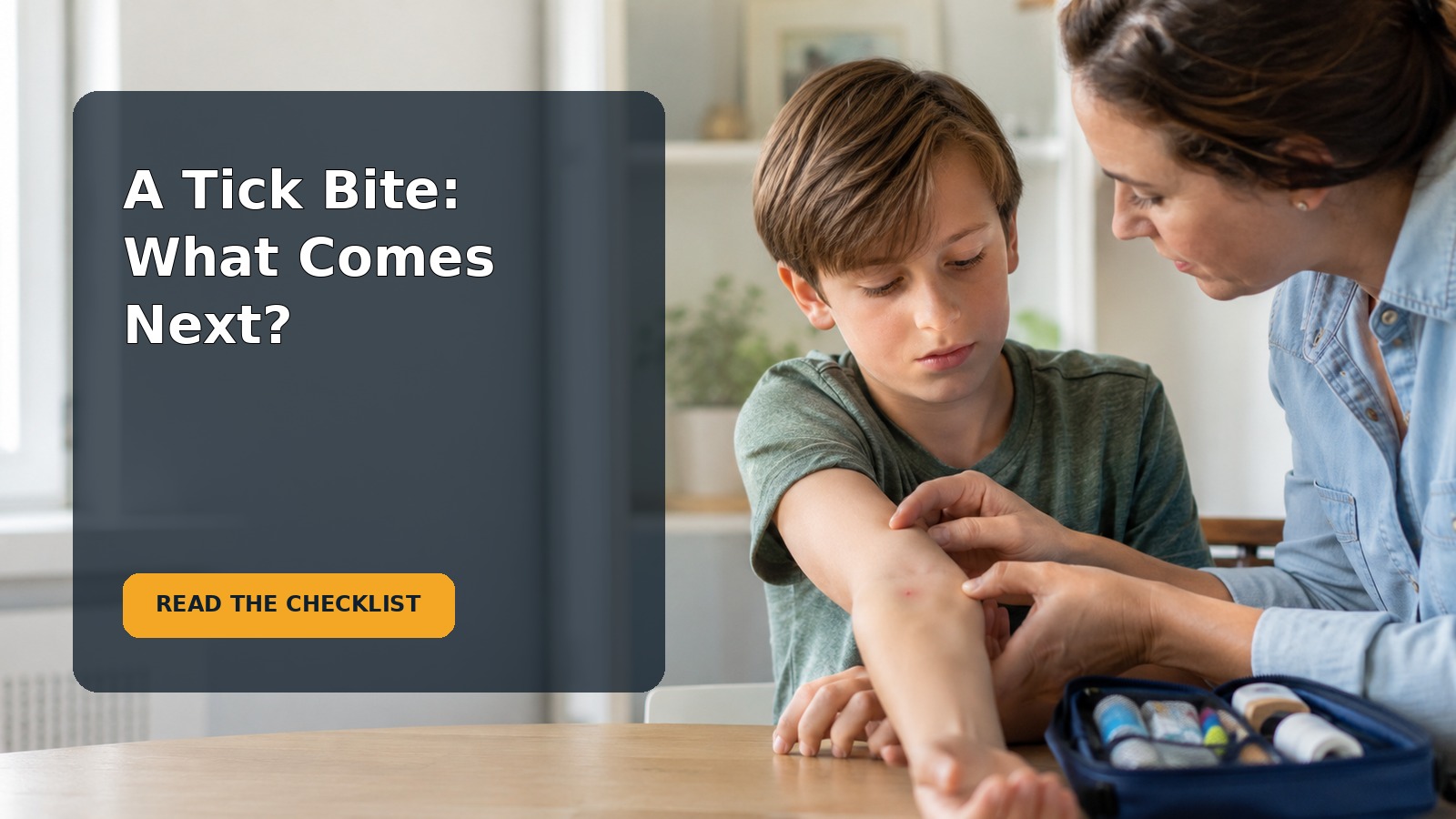
The 60-second safety check
Ask your child how they feel now. A small red bump right after removal can be a local skin reaction and often settles within a day or two. That is different from a rash that appears later and gradually expands. Get urgent medical help if your child looks or acts very sick, has trouble breathing, faints, is confused, develops a seizure, has a stiff neck with severe illness, or has new weakness or facial drooping.
Contact your child’s pediatrician or an urgent-care service promptly if you cannot remove the tick, the tick may have been attached for a long time, it was swollen rather than flat, the bite happened in an area where Lyme disease is common, or your child develops fever, headache, a spreading rash, or worsening redness. Preventive treatment is not appropriate after every bite. A clinician decides whether it is worth considering based on the tick, location, attachment estimate, timing, and the child’s health. Because that decision can be time-sensitive, do not wait for symptoms before making the initial call when the exposure seems high risk.
Record these details today
You do not need to identify the tick perfectly. You do need a useful record for a clinician if questions arise. Write down:
- the date and approximate time the tick was found and removed;
- where the camp was located and where the child may have picked up the tick;
- the bite location on the body;
- whether the tick was crawling or firmly attached;
- whether it looked flat or swollen with blood;
- the earliest possible attachment time, based on the last tick check, shower, or clothing change;
- how it was removed and whether visible mouthparts remained;
- any symptoms already present; and
- your child’s relevant medical conditions, medicines, allergies, and previous tickborne illness.
If you still have the tick, place it in a sealed container or bag and label it with the date and location. A clear photo next to a ruler or coin can also help with identification. The CDC generally does not recommend commercial testing of ticks to make treatment decisions: a positive result does not prove your child was infected, and a negative result can create false reassurance. Do not delay care while waiting for a tick test.
What to watch for over the next month
Use a simple daily check for 30 days rather than repeatedly questioning your child. Once a day, look at the bite and ask about fever, headache, unusual tiredness, muscle or joint aches, and feeling generally unwell. Take a temperature if your child feels hot or ill. Record new symptoms and photograph a changing rash in the same light with a size reference.
| Time after the bite | What may happen | What parents should do |
|---|---|---|
| First 1–2 days | A small bump or limited redness at the bite may occur and then improve. | Keep the area clean. Call if redness is spreading, pain or swelling is worsening, pus appears, or your child becomes feverish or unwell. |
| Days 2–14 | Some tickborne illnesses can begin with fever, headache, fatigue, muscle aches, nausea, or a widespread rash. | Seek prompt medical advice. Mention the tick bite, date, and camp location even if the bite looks normal. |
| Days 3–30 | Lyme disease can cause an expanding erythema migrans rash and may also cause fever, chills, headache, fatigue, aches, or swollen lymph nodes without a rash. | Contact a clinician promptly. Do not wait for a perfect “bull’s-eye” appearance. |
| Any time | Severe illness, confusion, fainting, facial droop, stiff neck, breathing difficulty, palpitations, marked weakness, or a rapidly worsening condition. | Obtain urgent or emergency care based on severity. |
The rash does not have to look like a bull’s-eye
The CDC says an erythema migrans rash usually begins 3 to 30 days after a bite, often around day 7, and expands gradually over several days. It may feel warm but is rarely itchy or painful. Some rashes clear in the center, but many do not. On darker skin, redness may look deeper red, purple, brown, or bruise-like rather than bright pink. Marking the edge of a suspicious rash with a pen is not a substitute for medical evaluation; a dated photo is often more useful.
A tiny spot that appears immediately and fades within one or two days is usually a local reaction, not the classic Lyme rash. However, parents should not diagnose a rash from appearance alone. Other tickborne illnesses and ordinary skin infections can also cause rashes. If a rash is expanding, widespread, paired with fever, or otherwise concerning, seek medical advice.
Symptoms can occur without a rash
Do not use “no bull’s-eye” as proof that everything is fine. Early Lyme symptoms can include fever, chills, headache, fatigue, muscle and joint aches, and swollen lymph nodes even when no rash is noticed. Other tickborne diseases can begin differently and can vary by region. Tell the clinician exactly where the exposure occurred because local tick species and diseases matter.
A practical three-step plan
Step 1: Finish removal and document the bite
Remove the tick promptly, clean the skin, do a full-body tick check, and make the short record described above. If tiny mouthparts remain and cannot be lifted easily with clean tweezers, the CDC advises leaving them alone; the skin will usually push them out as it heals. Do not dig deeply into the skin.
Step 2: Decide whether to call now
Call the pediatrician promptly when the tick was swollen, may have been attached for more than about a day, came from a Lyme-risk area, or the exposure details are uncertain enough to worry you. Also call if your child has immune-system problems, a history of serious tickborne illness, or symptoms. Share a photo and the timeline. Ask directly: “Does this exposure need a same-day assessment, and is any preventive treatment appropriate?” Do not use leftover antibiotics or another person’s prescription.
Step 3: Monitor once daily for 30 days
Choose one routine time—after the evening shower works well—to check the bite and ask one neutral question: “Any new headache, fever, aches, unusual tiredness, or spots today?” This keeps monitoring reliable without making your child feel watched every hour. If symptoms appear, record when they started and contact a clinician. Do not wait until the 30-day period ends.
How to talk with a worried 9-year-old
A school-age child may fear that the tick is still inside, that they caused the problem, or that illness is inevitable. Keep the explanation concrete:
“We removed the tick and cleaned your skin. Most tick bites do not make children sick. For the next few weeks, we’ll do one quick check each day. Tell me if you feel feverish, get a headache, feel unusually tired or achy, or notice a new rash. You are not in trouble, and you did the right thing by telling an adult.”
Avoid showing frightening images or repeatedly asking whether every normal ache is Lyme disease. Let the child return to ordinary activities if they feel well and no clinician has advised otherwise. Monitoring should feel like a simple safety routine, not a prediction that something bad will happen.
Common mistakes and better alternatives
- Waiting for a doctor to remove an attached tick: remove it promptly with tweezers unless you genuinely cannot.
- Using heat, petroleum jelly, nail polish, alcohol, or essential oils to force release: use steady mechanical removal instead.
- Squeezing the tick’s body: grasp close to the skin at the mouthparts.
- Assuming every red mark is Lyme disease: note timing, size, expansion, and other symptoms, then ask a clinician when concerned.
- Waiting for a perfect bull’s-eye: expanding rashes vary, and illness can occur without a rash.
- Relying on commercial tick testing: follow symptoms and clinical guidance instead.
- Starting unprescribed antibiotics: preventive and treatment decisions require an appropriate clinician.
- Forgetting the exposure location: the camp’s county or region can be important to risk assessment.
Parent checklist
Today
- Remove the tick with clean tweezers and clean the area.
- Check the rest of the body for other ticks.
- Record the date, place, body site, attachment estimate, and whether the tick was swollen.
- Save the tick or take a clear photo if practical.
- Call promptly if the exposure may be high risk or symptoms are present.
For the next 30 days
- Check once daily for fever, rash, headache, unusual tiredness, aches, or swollen joints.
- Photograph and measure a new or changing rash.
- Seek medical advice promptly for fever, headache, an expanding or widespread rash, facial weakness, joint swelling, or other new illness.
- Use urgent or emergency care for severe or rapidly worsening symptoms.
Frequently asked questions
Should I send the tick to a laboratory?
The CDC generally advises against using commercial tick testing for treatment decisions. A tick can test positive without having infected the child, while a negative result may falsely reassure you. A photo or saved tick may help a clinician discuss species and exposure, but symptoms and clinical risk guide care.
Does my child need antibiotics after every tick bite?
No. Most bites do not require preventive antibiotics. A clinician considers the tick type, exposure area, attachment estimate, time since removal, and the child’s medical situation. Call promptly when the tick was swollen, attached for a long time, or acquired in a higher-risk area because any prevention decision can be time-sensitive.
How long should I watch for symptoms?
Use a focused 30-day monitoring period. Call sooner for any concerning symptom; do not wait for the month to pass. Some later problems can occur beyond that window, so always mention the prior bite if a clinician evaluates unexplained facial weakness, joint swelling, heart symptoms, or neurologic symptoms later.
Can my child return to camp or sports?
If your child feels well and no clinician has restricted activity, a past tick bite alone usually does not require staying home. Continue the daily check and make sure your child knows to report fever, headache, unusual fatigue, aches, or rash.
The practical takeaway
For a 9 year old tick bite, what to watch for is straightforward: document the exposure, monitor once daily for a month, and act promptly if fever, headache, an expanding or widespread rash, unusual fatigue, aches, facial weakness, joint swelling, or other illness appears. Get help sooner when the tick was swollen or attached for a long time, the camp was in a higher-risk area, or your child looks unwell. Most importantly, do not wait for a classic bull’s-eye rash before calling.
Sources
- Centers for Disease Control and Prevention: What to Do After a Tick Bite
- Centers for Disease Control and Prevention: Signs and Symptoms of Untreated Lyme Disease
- American Academy of Pediatrics’ HealthyChildren.org: Tick Bite Symptom Checker
This article provides general education and does not diagnose illness or replace care from your child’s clinician. Tickborne-disease risks vary by region and exposure. Seek urgent help for severe or rapidly worsening symptoms.