Starting kindergarten can bring excitement, worry, pride, and uncertainty—sometimes all in the same morning. A child does not need to feel completely calm to be ready. The more useful goal is familiarity: knowing a little about the place, practicing a few everyday skills, and trusting that separation will be followed by reunion.
This two-week plan turns preparation into small, manageable steps. Adjust it to your child’s school calendar, disability or developmental needs, family circumstances, and the school’s own instructions. If you have less than two weeks, combine nearby steps rather than trying to complete everything at once.
What kindergarten confidence really looks like
Confidence is not the absence of nerves. A confident new student may still cling at the door, ask the same question repeatedly, or feel tired after school. What matters is that the child is gradually building a workable picture of the day and learning what to do when something feels unfamiliar.
Try not to turn preparation into a readiness test. Children begin school with different language, motor, social, and self-care skills. The teacher’s role includes helping the class learn routines. At home, focus on practical participation: carrying a backpack, communicating a need, trying a task, accepting help, and recovering after a mistake.
If your child tends to hold back while learning something new, Nappot’s guide to building preschool confidence without taking over offers a useful principle: give enough support to begin, then leave space for the child to practice.
The two-week starting-kindergarten plan
Use this as a flexible sequence, not a perfect schedule. Ten calm minutes of practice usually helps more than an hour of repeated reminders.
Days 14–11: Make the school more familiar
- Look at reliable school information together. Use the school website, welcome letter, teacher message, or family handbook. Point out the teacher’s name, start time, pickup plan, and what the child should bring.
- Visit what is publicly available. If the school permits it, walk or drive the route, notice the entrance, and visit the playground or building during an official orientation. Do not enter restricted areas or promise access the school has not offered.
- Describe a simple day. Say, “We will get ready, go to school, say goodbye, and you will have activities, food, and play. Then your pickup person will come.” Keep uncertain details uncertain.
- Invite questions without quizzing. Ask, “What are you wondering about?” If the child says “nothing,” let the topic rest and return to it another day.
Correct frightening guesses calmly. If your child asks whether you will forget pickup, name exactly who is coming and what the school does if an adult is delayed. Concrete information is more reassuring than “There is nothing to worry about.”
Days 10–8: Rehearse practical skills
Choose skills that match the school’s actual expectations. Practice one or two at a time:
- putting on and taking off the backpack;
- opening the lunch container or water bottle the child will use;
- recognizing personal belongings or a name label;
- managing easy fasteners on school clothing;
- washing and drying hands;
- using the toilet routine as independently as the child currently can;
- asking an adult for help in clear words or with the child’s communication system.
Practice should reveal what needs adjustment, not create embarrassment. Swap a difficult container, choose simpler clothing, or tell the teacher where help may be needed. For children with individualized education, health, toileting, feeding, allergy, or communication plans, confirm the required documentation and supports directly with the school.
Days 7–5: Practice separation and reunion
Create one brief goodbye ritual that can survive a busy first morning. It might be: hug, one sentence, wave, leave. For example: “I love you. You are safe with your teacher. Grandma will pick you up after school.” Avoid adding new promises each time the child protests.
If possible, practice the ritual during an ordinary separation with a trusted caregiver. Say goodbye rather than slipping away. Disappearing may stop an immediate protest, but it can make a child watch more closely for the next unexpected departure.
You can also rehearse what the child can do after goodbye:
- stand near the teacher or another named adult;
- hold a familiar transition object if the school allows one;
- take three slow breaths or squeeze hands together;
- begin the first available classroom task.
If drop-off has been difficult before, review this predictable goodbye routine for separation tears. The same calm handoff principles can help at kindergarten, although you should follow the new teacher’s arrival process.
Days 4–2: Protect sleep and simplify the routine
Move wake-up and bedtime toward the school schedule gradually if they are currently very different. A sudden large change the night before school is harder than several small shifts. Keep the final days reasonably quiet, especially if your child becomes overloaded by busy plans.
- Choose comfortable school clothing and one backup set if requested.
- Label belongings according to school guidance.
- Pack required supplies; leave toys and restricted items at home.
- Decide breakfast, transportation, drop-off, and pickup arrangements.
- Place essentials by the door and let the child help with one simple part.
Do a low-pressure practice morning. Use the real wake-up sequence, breakfast, dressing, bathroom, shoes, and backpack—but stop before it becomes a race. Notice where the routine stalls and remove one obstacle.
Day 1: Keep the plan warm and brief
Allow extra time without announcing a crisis. Offer ordinary choices—such as between two shirts or two breakfast options—but keep school attendance and safety decisions with the adult.
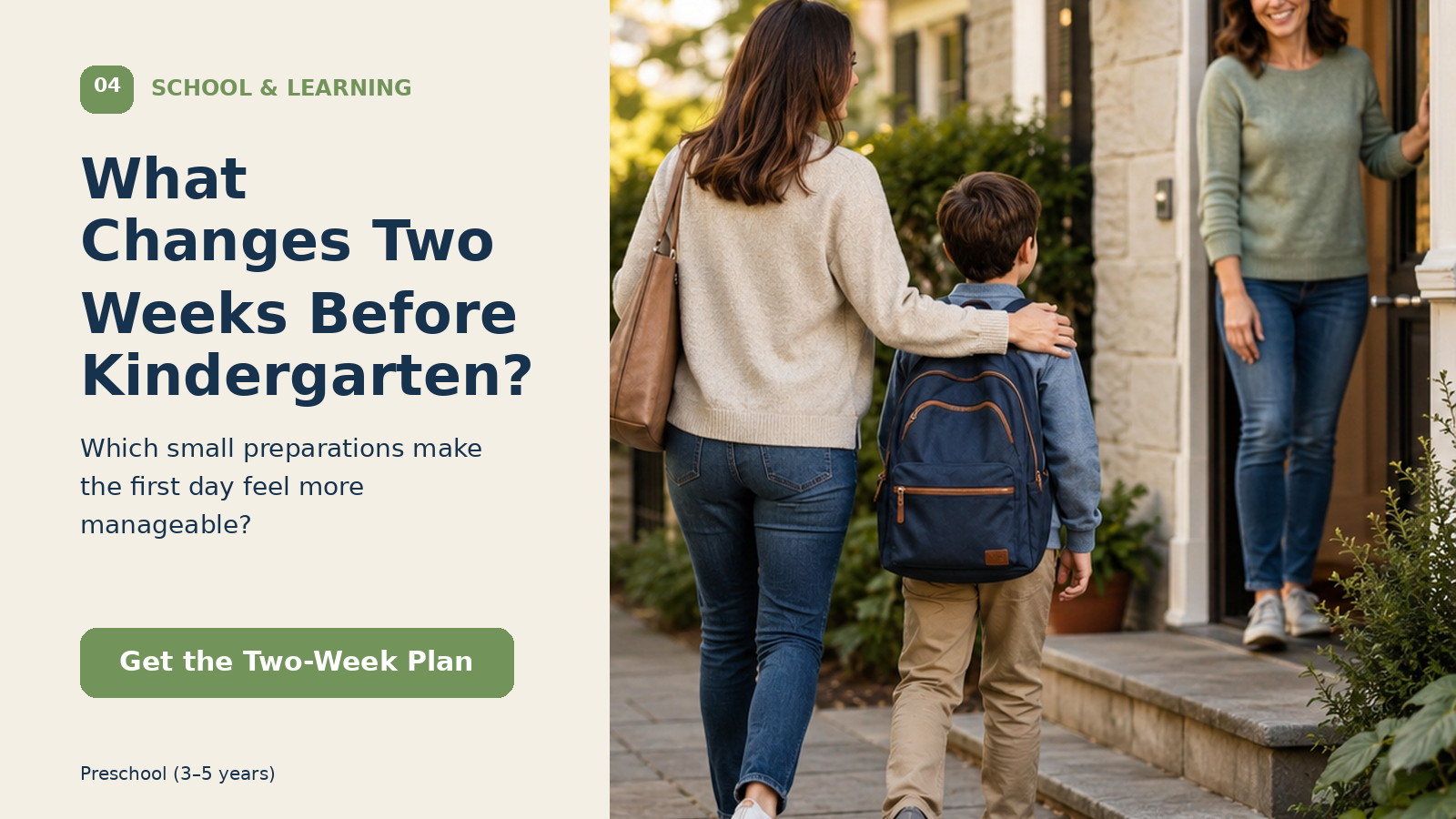
At the door, use the practiced goodbye. Acknowledge the feeling without reopening the decision: “You wish I could stay. It is hard to say goodbye. Ms. Lee will help you, and I will see you after school.” Then complete the handoff unless staff directs you differently.
Crying at separation does not by itself mean the day will go badly. Many children settle once the arrival routine begins. Ask the teacher how communication works rather than repeatedly calling or returning to the classroom.
A 14-day preparation snapshot
| Days | Main goal | One useful action |
|---|---|---|
| 14–11 | Familiarity | Review the route, teacher information, and basic shape of the day |
| 10–8 | Practical participation | Practice backpack, lunch, clothing, bathroom, and help-seeking skills |
| 7–5 | Separation | Rehearse one short goodbye and name the reunion plan |
| 4–2 | Routine | Adjust sleep gently, prepare supplies, and test the morning sequence |
| 1 | Handoff | Use the practiced plan and let school staff begin the day |
The first afternoon: expect decompression
The first school day asks a young child to absorb new people, sounds, rules, spaces, and transitions. Some children talk immediately. Others are quiet, irritable, energetic, tearful, or unusually clingy. Treat the first hour as recovery time rather than an interview.
Offer water or a familiar snack, connection, and either movement or quiet play. Instead of “Tell me everything,” try one low-pressure question later: “What was one thing you noticed?” “Where did you sit?” or “Who helped you today?” Accept “I don’t know” as a complete answer.
Keep the evening predictable. Prepare tomorrow’s items, use the usual bedtime sequence, and avoid making one difficult moment into a verdict about school.
What not to add to the countdown
- Do not threaten school as a consequence. Statements such as “Your teacher won’t put up with that” make school sound unsafe.
- Do not promise a worry-free first day. Promise the parts you control: a clear goodbye, honest information, and reliable pickup.
- Do not drill academics in a panic. Follow the school’s guidance and keep reading, conversation, play, and daily routines enjoyable.
- Do not compare siblings or classmates. Another child’s quick separation does not define your child’s progress.
- Do not hide important support needs. Early, respectful communication helps staff plan safe and appropriate support.
When to ask for more help
Some nervousness is expected during a major transition. Contact the teacher or school team when distress is intense, persists instead of gradually easing, interferes with attendance or daily functioning, or comes with repeated physical complaints, sleep disruption, panic, aggression, or regression. Ask what staff observe after the handoff; a child who is distressed for two minutes needs a different plan from one who remains unable to participate.
Speak with your child’s pediatrician or a qualified mental-health professional when anxiety is severe, appears across settings, or raises concerns about health or safety. Urgent threats of self-harm, harm from another person, abuse, or immediate danger require prompt local emergency or safeguarding support. This guide cannot diagnose anxiety or determine an individual child’s school readiness.
A calm definition of success
Success when starting kindergarten is not a flawless drop-off, a perfectly packed lunch, or a child who never feels nervous. It is a growing pattern: the school becomes more familiar, the child learns how to get help, the family keeps its promises, and each separation ends in reunion.
Use the two weeks to reduce uncertainty—not to eliminate every feeling. Practical rehearsal, a short goodbye, realistic expectations, and close communication with the school give your child a steady bridge into the new routine.
Sources
- American Academy of Pediatrics: Back-to-School Tips
- American Academy of Pediatrics: School Avoidance—Tips for Concerned Parents
This article provides general parenting education. School procedures and children’s developmental, health, and support needs vary; use guidance from your child’s school and qualified professionals.