Tween bedroom privacy boundaries work best when privacy grows with responsibility while parents remain clear about the few situations that require access. A 9- to 12-year-old may want a closed door, time alone, private conversations or a warning before someone enters. That request is not automatically secrecy or rejection. It can be part of developing independence, body awareness and a sense of personal space.
The answer is not “complete privacy” or “no privacy.” Build a predictable agreement: adults knock, the tween answers, shared safety rules still apply, and everyone knows when a parent may enter without waiting. The plan should protect dignity without asking parents to ignore urgent risks.
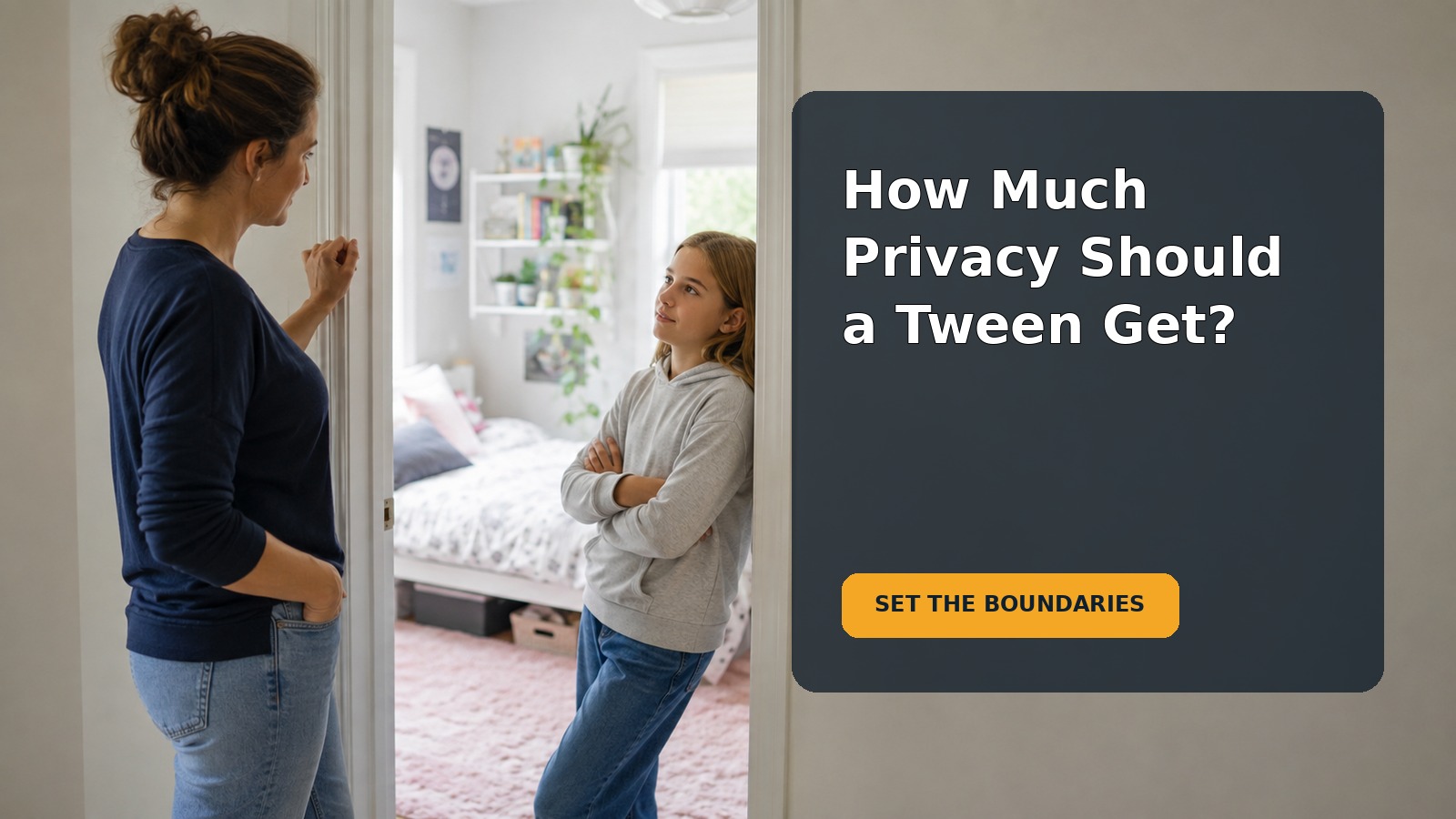
Start with the immediate question: what is your tween asking for?
Before setting a rule, ask what “more privacy” means. Your tween may want family members to knock, siblings to stay out, a place to change clothes, quiet time after school, or less commentary about their belongings. These requests require different solutions. A closed door for getting dressed is not the same issue as taking an internet-connected device into the bedroom overnight.
What can be typical at ages 9 to 12
Many tweens become more self-conscious about their bodies and more protective of conversations, journals, creative work and friendships. They may also need quiet after a stimulating school day. Respecting reasonable personal space tells a child that dignity matters inside the family, not only outside it.
The United Nations Convention on the Rights of the Child recognizes protection from arbitrary or unlawful interference with a child’s privacy, home and correspondence. In daily family life, parents still have a duty to provide age-appropriate care and protection. The practical goal is therefore proportionate supervision: enough access to keep a child safe, without treating routine privacy as suspicious.
What changes the answer for this child
Consider maturity, household layout, younger siblings, shared rooms, disability or care needs, device use, and any current safety concern. A tween who reliably follows household rules may manage more closed-door time than a child who repeatedly creates unsafe situations. However, ordinary untidiness, moodiness or a wish to be alone should not be treated as proof that secret searches are necessary.
Do a calm first-step check
Separate dignity, household access and digital safety
Write the request under one of three headings:
- Dignity: knocking, changing clothes, private journaling and sibling boundaries.
- Household access: cleaning, repairs, laundry, pets, shared storage and emergency exits.
- Digital safety: phones, gaming, cameras, messaging, nighttime use and contact with unknown people.
This prevents one concern from swallowing every other issue. You can respect a closed door and still require devices to charge in a shared location. You can avoid reading a journal while keeping medicine, weapons, alcohol and other hazards secured throughout the home.
Check for a specific risk, not a vague fear
Ask yourself what you have actually observed. Is there a direct threat, dangerous item, unsafe online contact, evidence of exploitation, talk of self-harm, or a child who cannot be reached during a possible emergency? Or are you reacting to a new closed door because it feels unfamiliar? Specific risks justify specific safeguards. Anxiety alone is a reason for conversation, not unlimited surveillance.
Build a tween bedroom privacy boundary plan
Step 1: Agree on the ordinary knock-and-answer rule
A practical rule is: family members knock, wait for an answer and announce why they need to enter. The tween responds within an agreed time. If they are changing, they can say, “One minute.” Adults model the same courtesy whenever possible.
“Your room is part of our home, and you deserve personal space in it. We will knock and wait. You need to answer us, follow the safety rules and let us in for agreed household needs. If we believe someone is in immediate danger, we will enter.”
If the bedroom is shared, each child still needs some protected space—a drawer, shelf, box or scheduled quiet period—even when neither can control the whole room.
Step 2: Define the exceptions before they happen
Keep exceptions short and concrete. A parent may enter without waiting when there is smoke, a medical concern, sounds of injury or violence, a credible immediate safety threat, or no response when urgent access is needed. Planned access for repairs or cleaning should usually be announced in advance rather than described as an emergency.
Avoid using “safety” as a catch-all for surprise inspections. If you need to check something because of a real concern, explain what you are checking and why, as soon as doing so is safe. Search the narrowest area necessary. Do not turn one broken rule into permanent loss of all privacy.
Step 3: Keep device rules separate and visible
The American Academy of Pediatrics recommends family discussion, age-appropriate parental controls and a family media plan rather than rules alone. For a tween, bedroom rules might include:
- devices charge outside the bedroom overnight;
- cameras stay off during changing and sleep;
- no secret accounts or contact with unknown adults;
- the child can bring upsetting content to a parent without automatic punishment;
- parents explain what controls or monitoring are active;
- the family reviews settings when a new app or device is added.
These rules address the actual digital risk without requiring adults to read every conversation. Nappot’s guide to social media boundaries without secret monitoring offers a useful framework that can be adapted as a tween gets older.
Step 4: Set a review date
Try the agreement for two weeks, then ask: Are adults knocking? Is the tween answering? Are sibling conflicts decreasing? Are devices where they belong at night? Has anyone used the emergency exception unfairly? Adjust one rule at a time. A regular review makes privacy something the child can practise, not a privilege that disappears whenever an adult is annoyed.
Common mistakes and better alternatives
- Removing the bedroom door as ordinary discipline. Use a consequence connected to the broken rule and preserve changing and sleeping dignity. A damaged door that creates an immediate hazard should be repaired.
- Demanding an unlocked door at every moment. Decide whether a lock is necessary at all. If one is allowed, adults should retain emergency access and the mechanism must comply with local fire and housing safety requirements.
- Reading diaries or messages “just in case.” Begin with conversation and disclosed safety controls. Intrusive checks should respond to a specific concern and be no broader than needed.
- Letting siblings ignore the rule. Enforce knocking and protected belongings consistently; otherwise the agreement has little meaning.
- Making privacy depend on a perfectly tidy room. Set a separate, realistic standard for food, laundry, walkways and hygiene.
- Promising absolute confidentiality. Tell your tween that you will respect private information but must act when someone may be unsafe.
When to involve a professional
Schedule support for persistent family conflict
Consider talking with a pediatrician, school counselor or licensed family therapist when privacy arguments dominate family life, the child’s need to isolate is intense and persistent, or ordinary limit-setting repeatedly becomes frightening or destructive. A professional can help distinguish a relationship pattern, stress response, care need or mental-health concern without assuming that wanting privacy is itself a problem.
Act promptly for clear safety concerns
Do not wait for a scheduled family meeting if you have credible evidence of self-harm, abuse, exploitation, threats, dangerous substances, a weapon, or an unsafe person contacting your child. Secure immediate hazards, stay with the child when necessary and contact appropriate local emergency, safeguarding or health services. If danger is not immediate but the concern is serious, contact the child’s pediatrician or another qualified professional promptly.
Tell the child what will happen next in simple language. Safety action can be firm without humiliation: “I am checking because I saw a message that someone plans to hurt you. I will explain each step, and we will get help.”
A one-page parent checklist
Before the conversation
- Define the exact request and the exact concern.
- Separate physical privacy, household access and device rules.
- Secure hazards throughout the home rather than relying on searches.
- Choose the few exceptions that truly require immediate entry.
During the agreement
- Let the tween explain what privacy would improve.
- Promise knocking and waiting during ordinary situations.
- Require an answer and reasonable access for planned household needs.
- State emergency exceptions clearly.
- Disclose device controls and nighttime locations.
- Set a two-week review date.
What success looks like
Well-designed tween bedroom privacy boundaries should become easier to follow as everyone practises them. Success is not a permanently open or permanently closed door. It is fewer surprise entries, fewer sibling intrusions, a tween who answers when called, safer device habits, and a child who still brings difficult experiences to a parent. If your family needs a calm place to review the agreement, use a short weekly family meeting rather than restarting the argument at the bedroom door.
Frequently asked questions
Should a tween be allowed to lock the bedroom door?
It depends on the child, the lock and the home. Many families can provide meaningful privacy through knocking without a lock. If a lock is used, adults need emergency access and the setup must not create a fire or caregiving hazard. Explain when locking is allowed and review the rule.
Do parents have the right to enter a tween’s room?
Parents remain responsible for safety and the household, but responsible access does not require unpredictable intrusion. Announce routine entry, agree on cleaning and repair times, and reserve immediate entry for clear safety needs.
What if my tween refuses to answer?
State the expectation once and allow the agreed response time. If there is no safety concern, address the broken answer rule later with a proportionate consequence. If there are signs of immediate danger, enter and respond to the risk.
Should I check my tween’s phone in the bedroom?
Use disclosed parental controls, shared rules and regular conversation first. A targeted check may be warranted when there is a specific safety concern, but explain what you are checking and avoid unrelated private material whenever possible.