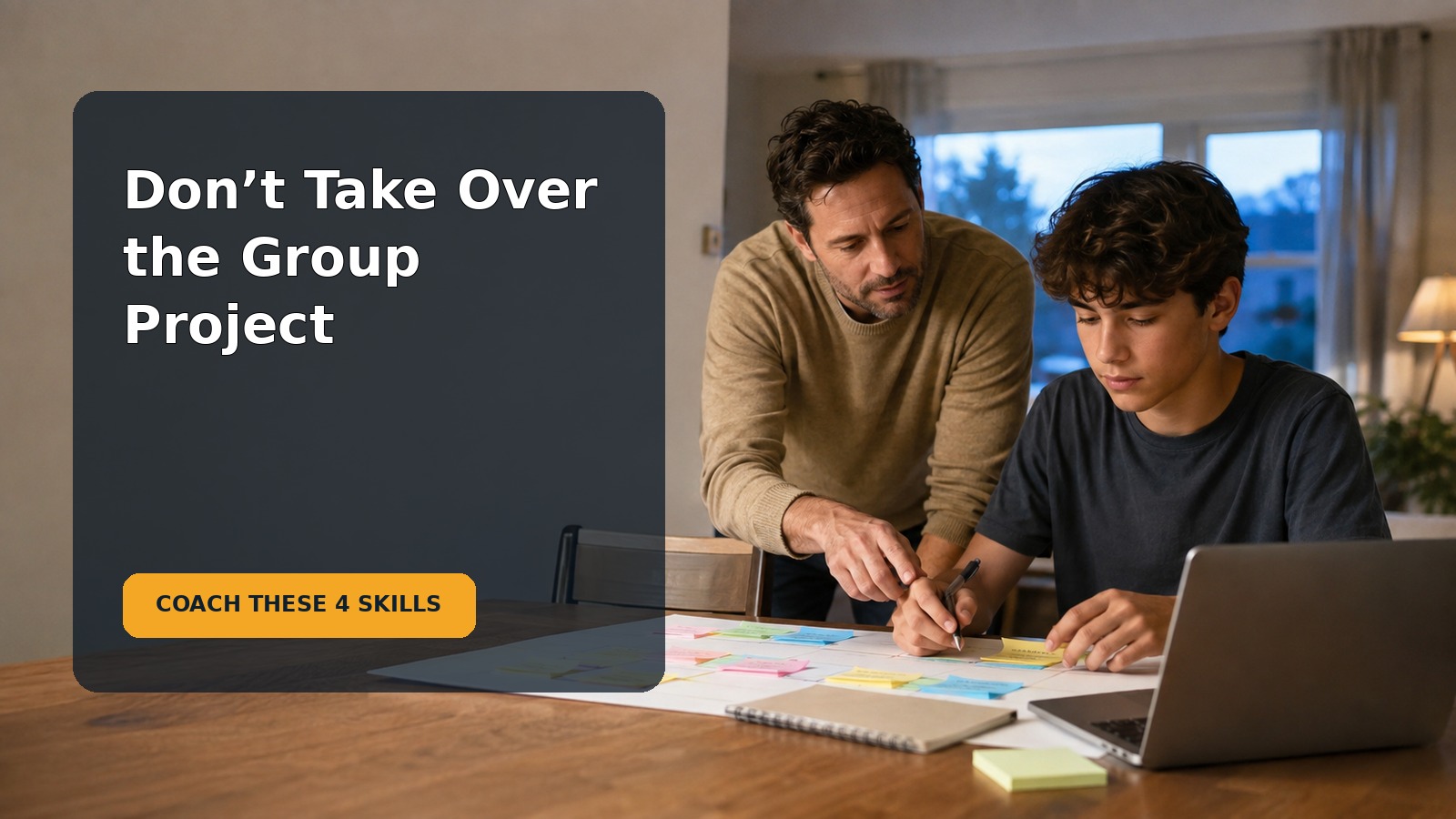
When a teen is overwhelmed by a group project, the most useful parent role is coach—not project manager. Help your teen calm the immediate stress, make the work visible, choose one communication step and decide when the teacher needs to know. Then let your teen send the message and do the work.
Group assignments can feel harder than individual work because the grade depends partly on other people. Roles may be vague, messages may go unanswered and a teen may fear sounding bossy. The goal is not to guarantee a perfect project. It is to help your teen practise planning, assertive communication and appropriate help-seeking without taking over.
Start with a 60-second stress check
Before discussing deadlines, ask what is happening right now: “Do you need me to listen, help you sort the tasks, or help you decide what to say?” This gives your teen a choice without leaving them alone with the problem.
Look for the source of the overwhelm
“The group project is a disaster” can describe several different problems:
- the assignment or grading criteria are unclear;
- the group has not divided the work;
- one member is missing meetings or not responding;
- two members disagree about the direction;
- your teen has taken on too much to avoid conflict;
- your teen is behind on their own part;
- there is exclusion, harassment, discrimination or another unsafe dynamic.
Ask for facts rather than a long defense: What is due? When? What has the teacher asked for? What has each person agreed to do? What has already been completed? The answer determines the next step.
Notice when this is more than ordinary workload stress
A difficult assignment can cause frustration, worry or a bad evening. Broader support may be needed when distress is persistent, disrupts sleep or eating, causes repeated school avoidance, or comes with panic-like symptoms, hopelessness or talk of self-harm. The American Psychological Association advises adults to notice changes in behavior and help young people use healthy coping strategies; the National Institute of Mental Health recommends seeking help when concerning signs last or interfere with life at home, school or with friends.
Make the project visible on one page
Do not begin by writing slides or contacting classmates. Begin with a short project map. Your teen can use paper, a shared document or a note on their phone.
Write down five facts
- Deliverable: What must the group submit or present?
- Deadline: When is it due, including any rehearsal or draft date?
- Requirements: What does the rubric say?
- Roles: Who currently owns each task?
- Blocker: What specific issue prevents the next step?
If nobody can explain the deliverable or the roles, that is the first problem to solve. If the project is clear but your teen has not begun their section, the next action belongs to your teen. A factual map reduces the temptation to blame the whole group for one solvable blockage.
Choose the smallest useful next action
Ask, “What could you complete or communicate in the next 15 minutes?” Examples include opening the rubric, drafting a role list, completing one paragraph, proposing a meeting time or asking the teacher one precise question. Small action restores a sense of control without pretending the entire project is fixed.
Coach four communication skills
1. Use a clear group check-in
A useful message names the task, the deadline and the requested response. It does not accuse people or send a vague “What are we doing?”
“Hi everyone. Our presentation is due Friday. I have Jordan on sources, Maya on slides 1–3 and me on slides 4–6, but slide 7 and the conclusion are still unassigned. Can everyone confirm their part by 6 p.m. today? If I missed an agreement, please correct the list.”
Your teen should adapt the wording and send it themselves. You can help shorten or soften a draft, but do not impersonate your teen or join the student chat.
2. Make an assertive request
Assertive communication is specific and respectful. It differs from aggression (“You never do anything”) and from avoidance (“It is fine, I will do it all”). A simple pattern is: observation, impact, request.
“The research section is not in the document yet, and we need it before we can finish the slides. Could you add your sources by tomorrow at 4 p.m., or tell us today if you need the task divided differently?”
This gives the classmate a clear way to respond. It also creates a useful record if the group later needs teacher support.
3. Set a boundary around extra work
Some teens rescue the group by completing every missing section. That may protect one grade, but it can increase resentment and hide the coordination problem. Help your teen state what they can do:
“I can finish my assigned slides and combine the final deck. I cannot write two additional sections tonight. If those parts are still unclaimed by 5 p.m., I think we should ask the teacher how to proceed.”
A boundary is not a threat. It identifies a limit and the next responsible step.
4. Escalate with facts, not a character judgment
The American Academy of Pediatrics encourages parents to stay involved in a teen’s education while helping the teen take increasing responsibility. For a group project, that usually means the student contacts the teacher first when possible.
“Our project is due Friday. We assigned roles on Monday and checked in again Wednesday. Two sections remain incomplete, and we have not received a response about them. I have completed my section and attached our task list. Could you advise us on how to handle the missing work and how individual contributions will be assessed?”
This message shows effort, provides evidence and asks for guidance. It is stronger than “My group is lazy.”
Know when the parent should step in
Let your teen lead ordinary school communication
For missed messages, uneven effort or a planning disagreement, coach privately and let your teen communicate. If they freeze, offer a menu: write a two-sentence draft together, rehearse what to say after class, or ask whether they want to copy a parent on a message only if school practice permits it.
The approach is similar to balancing support and autonomy in Nappot’s guide to teen independence and parental involvement: provide structure, keep safety limits clear and leave age-appropriate ownership with the teen.
Contact the school for safety, access or persistent impairment
A parent should contact an appropriate teacher, counselor or administrator when there is credible bullying, threats, harassment, discrimination, retaliation, coercion or another unsafe situation; when a disability or health need requires accommodations; or when distress is severe enough that the teen cannot manage the communication safely. Tell your teen what you plan to share unless doing so would increase immediate danger.
If the concern is not urgent, begin with the teacher closest to the assignment. Share dates, instructions and relevant messages rather than conclusions about another student’s motives. Ask what support and assessment options are available. School policies differ, so avoid promising that the grade or group will change.
A practical parent checklist
Before coaching
- Ask whether your teen wants listening, planning or message practice.
- Check the assignment, rubric and deadline.
- Separate the group’s missing work from your teen’s unfinished work.
- Identify any safety, bullying, access or mental-health concern.
During the plan
- Create a one-page task and role map.
- Choose one action that can happen within 15 minutes.
- Draft a specific check-in or request.
- Set a reasonable response deadline.
- Save relevant task lists and messages without secretly accessing accounts.
- Decide when your teen will ask the teacher for guidance.
After the project
- Review what communication worked.
- Name one skill your teen used well.
- Discuss what they would clarify earlier next time.
- Avoid turning the final grade into the only measure of success.
Common mistakes to avoid
- Doing the missing work yourself: it crosses the line from support to completing a student assignment.
- Messaging other students or parents immediately: let school channels and the student group process work first unless safety requires action.
- Calling a classmate lazy: describe missing tasks and missed check-ins, not a child’s character.
- Sending an emotional email at midnight: save a draft, reread it and send a short factual message during appropriate hours.
- Ignoring your teen’s own delay: accountability can be calm and honest.
- Treating every problem as a crisis: frustration is often part of learning collaboration; persistent impairment or unsafe behavior is different.
Frequently asked questions
Should I email the teacher for my overwhelmed teen?
Encourage your teen to send the first factual message when they can. A parent can help draft it. Step in directly for safety, accommodations, severe distress, repeated unanswered help requests or when the teen cannot reasonably manage the communication.
What if one group member does no work?
Your teen should document the agreed roles, send one clear check-in and notify the teacher before the deadline when possible. They should complete their own work but should not automatically absorb every uncompleted task without teacher guidance.
What if my teen refuses all help?
Respect a request for space while keeping a small door open: “I will not take over. If you want, I can listen for five minutes or help you shorten one message.” Revisit the issue if the deadline or distress creates a meaningful risk.
How do I help without making my teen more anxious?
When a teen is overwhelmed by a group project, keep questions concrete, limit the planning session and focus on one next action. A calm check-in may work better than repeated reminders. Nappot’s after-school check-in guide offers language for starting conversations without interrogation.