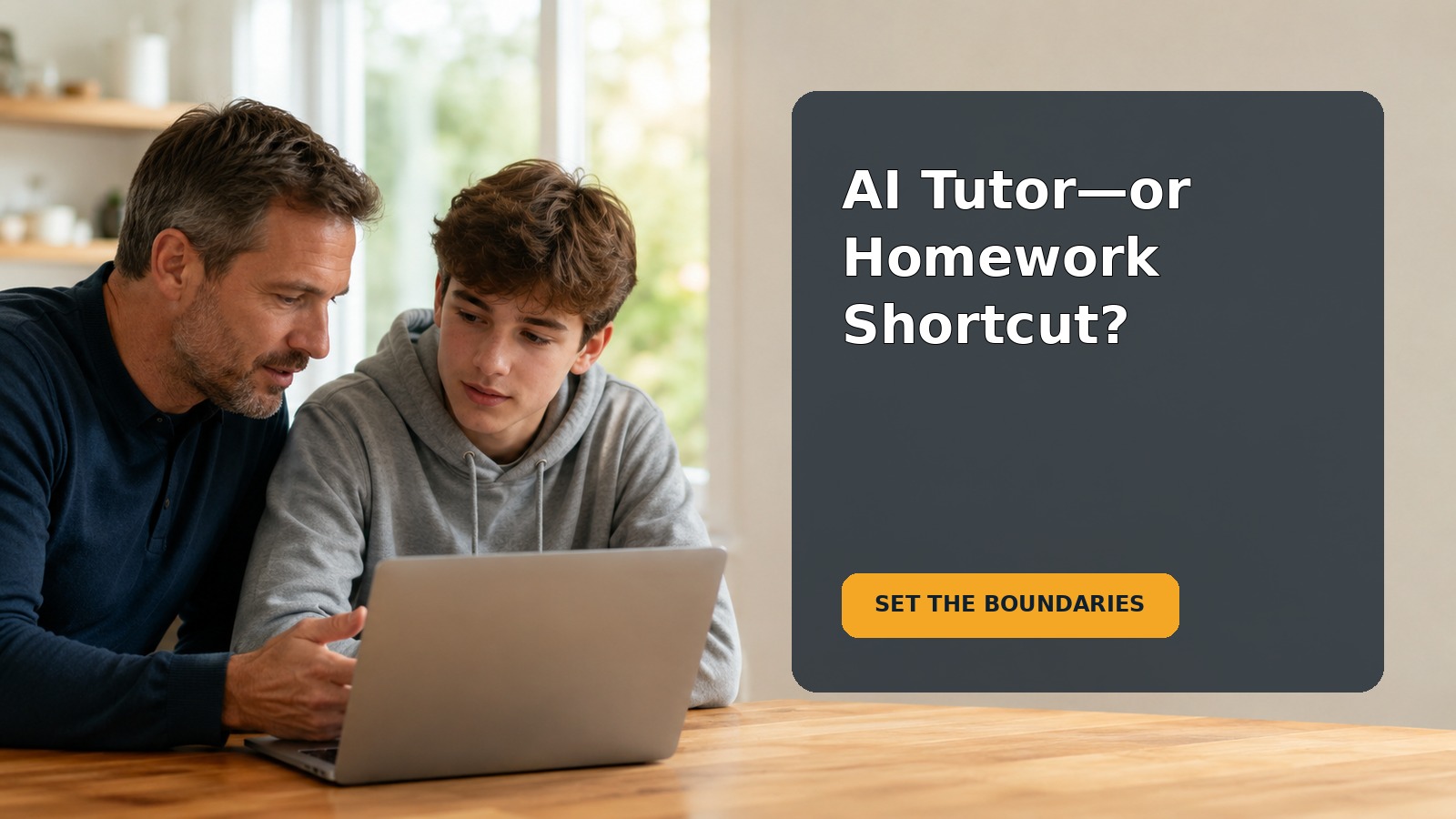
Your 14-year-old says the chatbot is “just helping,” but the finished paragraph sounds nothing like them. The right first move is not to ban every AI tool or accuse your teen of cheating. It is to pause, check the assignment rules, and ask your teen to show you how the work was made.
The line between teen AI homework tutoring vs cheating depends on what the teacher allows, what the tool actually did, and whether your teen can explain and take responsibility for the submitted work. AI can act like a tutor when it prompts thinking, explains a concept, or gives feedback. It becomes a shortcut when it replaces the thinking or produces work that a student submits as their own.
Why this question is now part of ordinary family life
AI use among teens is no longer unusual. In a 2026 survey, Pew Research Center reported that 54% of U.S. teens had used AI chatbots for help with schoolwork. That does not mean half of teens are cheating. “Help” can include explanations, brainstorming, translation, practice questions, editing, or complete answer generation. Those uses do not carry the same academic risk.
At 14 or 15, teens are also developing judgment, independence, and the ability to plan complex work. They may understand that copying is wrong while still missing less obvious problems: fabricated citations, confident factual errors, hidden bias, loss of privacy, or the way repeated shortcuts can weaken learning. Calm coaching works better than assuming bad intent.
The most important rule is assignment-specific: the teacher’s directions come first. One class may permit AI-assisted brainstorming with disclosure, while another may prohibit any generative tool. A family rule cannot give permission that the school or teacher has withheld.
A simple test: Did AI support the thinking or replace it?
Use four questions to judge a specific piece of homework.
1. Was the use allowed?
Read the assignment, rubric, class syllabus, learning platform notice, and school academic-integrity policy. If the rules are unclear, your teen should ask the teacher before using AI—not after submitting. “Everyone does it” and “the website was available” are not permission.
2. Who made the key decisions?
In tutoring-style use, the student chooses the claim, solves the problem, selects evidence, and writes the final response. The tool may ask questions or explain an unfamiliar step. In shortcut use, the tool chooses the argument, performs the reasoning, or drafts the answer while the student mainly copies, lightly edits, or disguises it.
3. Can your teen explain the work without the tool?
Ask for a two-minute explanation: “What is your main point? Why did you choose this evidence? Show me how you got that answer.” A teen does not need a polished speech. But if they cannot explain important words, reproduce the method, or identify where a claim came from, the tool probably did too much.
4. Is the use transparent?
If the teacher requires disclosure or citation, your teen must follow that format. Even when disclosure is not required, keeping a short process note can protect them: tool used, prompt purpose, output checked, and changes made. Hiding AI use, inventing sources, or falsely claiming entirely independent work is a warning sign.
Tutor-like uses, when the teacher allows them
- “Explain this algebra step without solving the next problem for me.”
- “Quiz me on these biology terms and wait for each answer.”
- “Give me three questions that could help me narrow my own essay idea.”
- “Point out where my paragraph is unclear, but do not rewrite it.”
- “Compare my solution with the rubric and tell me what I should check.”
Shortcut uses that commonly cross the line
- Generating an essay, code solution, lab conclusion, or discussion post for submission.
- Paraphrasing generated text only to evade detection.
- Using a tool during a quiz or assessment that requires independent work.
- Submitting citations, calculations, quotes, or facts without checking the original sources.
- Claiming the work is fully the student’s when required assistance was not disclosed.
The 10-minute homework process check
Do this beside your teen, not as a surprise inspection. The goal is to understand one assignment and create a workable boundary.
- Start without blame. Say, “I’m not trying to catch you. I want to understand what the class allows and make sure the final work is really yours.”
- Read the directions together. Look specifically for permitted tools, independent-work language, citation expectations, and teacher examples.
- Ask for a process replay. Have your teen show the original prompt, the AI response, their notes, drafts, version history, and sources. Do not demand unrelated private conversations or search the entire device.
- Mark each contribution. Identify what your teen planned, wrote, calculated, checked, and revised—and what the tool supplied.
- Test understanding. Choose one key idea or problem and ask your teen to explain or redo it without AI.
- Decide the repair. If the tool did too much, stop submission. Your teen can redo the affected section, verify sources, disclose assistance, or ask the teacher how to proceed.
If work has already been submitted, avoid helping your teen construct a cover story. A brief, honest message is safer: “I used an AI tool more than I should have on this assignment. I want to correct it. May I explain what I used and redo the affected part?” The teacher decides the academic response.
Build a family AI homework agreement
A useful agreement should be short enough to remember and flexible enough to match different classes.
Before using AI
- Check whether this teacher and this assignment allow it.
- Define the task you will keep for yourself.
- Do your first attempt, outline, or problem setup before asking for help when possible.
- Do not enter personal data, school login details, private messages, health information, unpublished student work, or another person’s identifying information.
While using AI
- Ask for explanation, questions, examples, or feedback—not a finished submission.
- Keep the prompt and useful output until the assignment is graded.
- Check factual claims against the textbook, teacher materials, and original reliable sources.
- Never invent a citation. Open every source and confirm that it exists and supports the claim.
Before submitting
- Make sure the final work reflects your own reasoning and voice.
- Explain every major claim, step, and source without relying on the chatbot.
- Follow the teacher’s disclosure or citation rule exactly.
- Ask the teacher when permission remains unclear.
The U.S. Department of Education’s report on AI and the future of teaching and learning emphasizes responsible use, privacy, and keeping people at the center of educational decisions. Families can apply the same principle at home: technology should extend learning, not quietly remove the learner from the process.
Use a traffic-light rule for quick decisions
| Level | Examples | Parent response |
|---|---|---|
| Green: usually tutor-like if permitted | Practice quiz, concept explanation, brainstorming questions, feedback on the student’s draft | Check understanding and accuracy; follow disclosure rules |
| Yellow: ask the teacher first | Outline generation, sentence rewriting, translation, coding suggestions, image generation, grammar edits that substantially change voice | Pause and clarify how much assistance is allowed |
| Red: usually replacement or deception | Finished answers, generated essay submitted as original, hidden AI use, fabricated sources, use on a closed assessment | Do not submit; redo or contact the teacher |
No chart can override the assignment instructions. A green-looking use can still be prohibited, and a yellow use may be explicitly taught and permitted in a particular class.
Common parent mistakes—and better alternatives
Do not rely on an AI detector as proof
Detection tools can be wrong. A score should not replace a conversation, assignment rules, document history, and your teen’s ability to explain the work. Avoid accusing a teen solely because writing sounds polished.
Do not make “never use AI” the only lesson
A total ban may push use underground and leaves teens unprepared to make responsible choices when AI is allowed. Teach boundaries, source checking, disclosure, privacy, and independent thinking. You can still prohibit a specific tool or use when the risks are too high.
Do not take over the assignment
Parents can help interpret a policy and plan a repair, but rewriting the paper creates another authorship problem. The same independence principle in our guide to coaching a teen through a difficult group project applies here: support the process without doing the work.
Do not turn one mistake into a character judgment
“You cheated, so you are dishonest” closes the conversation. Try: “This use crossed the assignment boundary. We need to correct the work and make a clearer plan.” Accountability and dignity can coexist.
When to involve the teacher or school
Contact the teacher when the policy is unclear, different teachers use conflicting rules, AI assistance may need disclosure, or your teen wants to repair submitted work. Ask concrete questions:
- Which AI uses are allowed for this assignment?
- May students use AI for brainstorming, feedback, grammar, translation, or coding help?
- How should assistance be cited or disclosed?
- What evidence of process should students keep?
- How can a student correct work if they misunderstood the rule?
If your teen uses AI because reading, writing, language, attention, or executive-function demands feel unmanageable, discuss support with the teacher or relevant school team. Do not use hidden AI assistance as a substitute for an approved accommodation. Likewise, repeated secrecy, panic about completing ordinary work, sudden grade changes, or broad school avoidance may signal a need for a wider check-in—not simply stricter device control.
For a calmer conversation, use the listening approach in our after-school teen check-in guide: begin with curiosity, keep questions specific, and leave room for your teen’s account.
A one-page parent checklist
- ☐ We read the actual assignment and class AI rule.
- ☐ My teen showed how the tool was used.
- ☐ My teen can explain the reasoning and verify the facts.
- ☐ Every quotation and citation was checked at the original source.
- ☐ No sensitive personal or school information was entered.
- ☐ The final work is primarily my teen’s thinking and expression.
- ☐ Required AI assistance was disclosed correctly.
- ☐ If the use crossed a line, the work was paused and repaired honestly.
- ☐ Unclear cases were taken to the teacher before submission.
Frequently asked questions
Is using AI for homework automatically cheating?
No. It depends on the assignment rules and what the tool does. An allowed explanation or practice quiz can support learning. Submitting generated work as independent work, hiding prohibited use, or using AI on a closed assessment generally crosses the line.
What if the school has no clear AI policy?
Ask the teacher about the specific assignment. Until you receive an answer, use the cautious rule: your teen should do the core thinking and writing, avoid generated submission text, protect private information, keep a record of any tool use, and disclose assistance.
Should my teen cite an AI chatbot?
Follow the teacher’s required format. A citation does not automatically make prohibited help acceptable. It only describes the assistance; permission and authorship still matter.
What if AI gives a convincing but false answer?
Treat chatbot output as unverified. Check claims against class materials and original reliable sources. If a source cannot be opened and confirmed, do not cite it.
How often should we review our family agreement?
Review it when a new term starts, a teacher changes the rules, your teen begins a new kind of assignment, or an AI tool adds new features. Keep the agreement practical rather than trying to predict every tool.
The goal is responsible independence
The clearest boundary for teen AI homework tutoring vs cheating is this: permitted AI may support a student’s learning, but it should not impersonate the student or replace the work being assessed. Check the teacher’s rule, preserve your teen’s ownership, verify every claim, and disclose assistance when required.
A 14-year-old will eventually make these decisions without a parent beside them. A calm process check today teaches a more durable skill than either panic or permission without limits: how to use a powerful tool honestly, thoughtfully, and in service of real learning.
Sources
- Pew Research Center: How teens use and view AI
- Pew Research Center: What parents say about their teen’s AI use
- U.S. Department of Education: Artificial Intelligence and the Future of Teaching and Learning
- UNESCO: Guidance for generative AI in education and research
This article provides general educational guidance. School and teacher rules vary, and AI products change quickly. Confirm the requirements for the specific class and assignment.