Are baby walkers safe? If you mean the seated kind with a wheeled base that lets a baby move around, the safest answer is no. The American Academy of Pediatrics (AAP) advises parents not to use mobile baby walkers. They can move quickly, reach stairs and give a baby access to hot, sharp or poisonous items that would otherwise be out of reach. Watching closely or using a gate does not remove every risk.
The good news is that babies do not need a wheeled walker to learn to stand or walk. Floor play, supported standing at sturdy furniture and closely supervised cruising give them useful practice without putting them inside a fast-moving frame.
Are baby walkers safe for a 6- to 15-month-old?
Mobile seated walkers are not a safe way to practise walking. The AAP explains that children in walkers can roll down stairs, be burned, drown or reach poisons. A baby in a walker can move faster than an adult can react, even when the adult is in the same room. The organization also notes that walkers do not help babies learn to walk and may delay walking.
This guidance applies to the product in which a baby sits in a suspended seat inside a wheeled frame. It is different from:
- A stationary activity centre: it stays in one place and has no wheels. It still needs correct assembly, age-and-size fit and direct supervision.
- A sturdy push toy: a child stands behind it and pushes. It can roll away or tip, so it is not automatically suitable for every new stander and should never be used near stairs.
- Stable furniture used for cruising: a child holds on and steps sideways. The furniture must not tip, slide or have sharp edges.
- An adult’s hands: brief support may help a baby explore balance, but there is no need to pull a baby upright or practise until they are tired.
Product standards can reduce some hazards, but they do not turn a mobile walker into a development tool. In Canada, baby walkers are prohibited from being manufactured, imported, advertised or sold. Rules differ by country, so the practical family rule is simpler: do not use a mobile seated walker.
Why supervision and stair gates are not enough
Parents sometimes plan to use a walker only in one room, only for a few minutes or only while standing nearby. The problem is that the device changes both speed and reach. A baby may cross a room in seconds, pull down a hot drink, reach a dangling cord or approach a threshold before an adult can stop them.
A stair gate is important for a mobile baby, but a walker can strike or put pressure on it. Doors may be left open, gates may be fitted incorrectly, and level changes can exist between rooms. Our room-by-room childproofing guide can help you check the wider environment, but childproofing should support safe movement—not make walker use seem safe.
Safer ways to practise standing and cruising
1. Start with unrestricted floor time
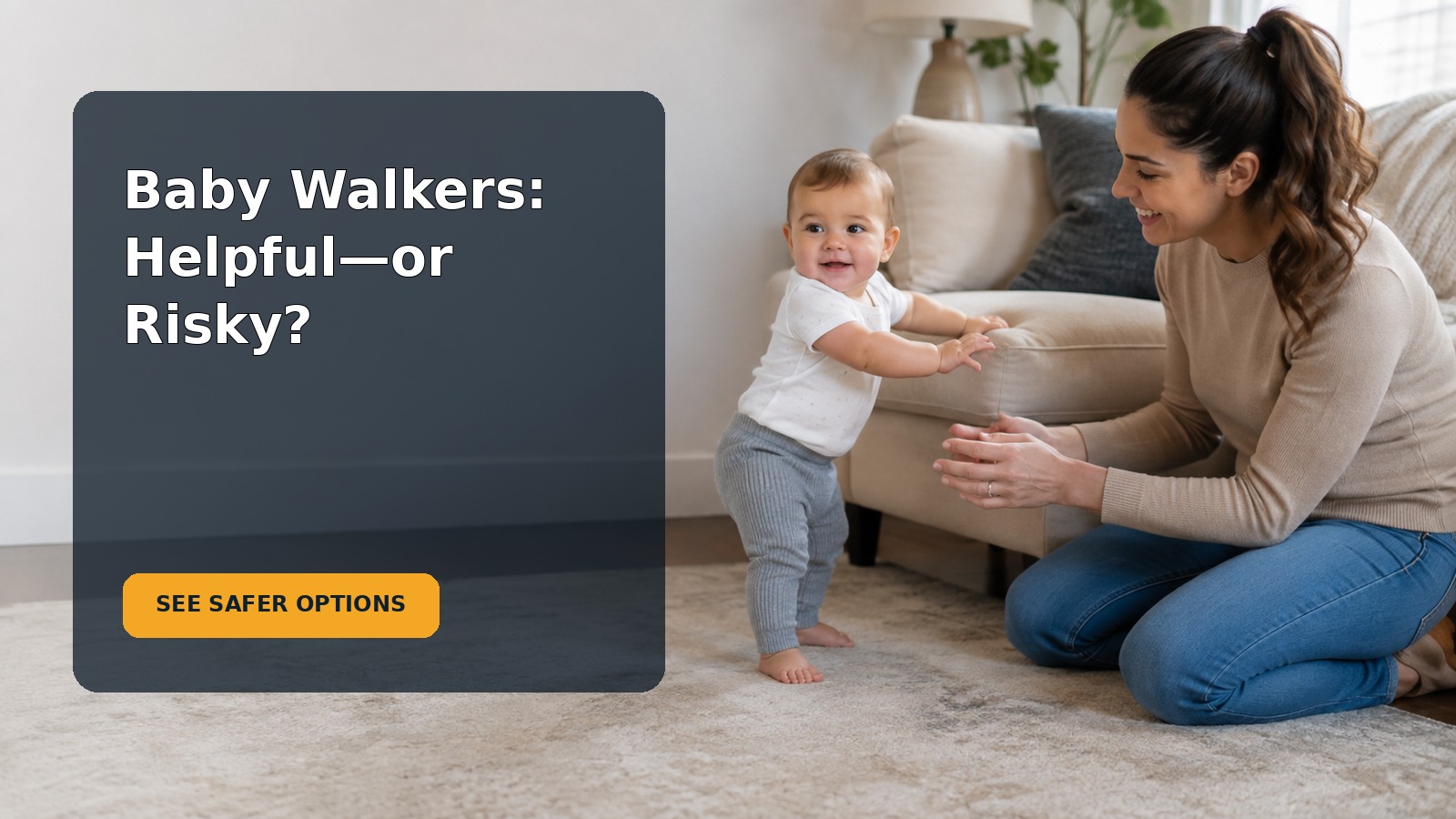
Give your baby daily chances to roll, pivot, sit, crawl or move in their own way on a firm, clear floor. Place an interesting toy just within reach rather than positioning the body for them. These ordinary movements help develop strength, balance and problem-solving. If you need ideas, try a few of these simple floor-play games.
Use a play yard when you need a contained safety zone and follow its instructions. Avoid long periods in equipment that restricts movement. A baby who is content on the floor does not need to be put upright for practice.
2. Create one stable pull-to-stand station
Choose low, heavy furniture that cannot tip or slide. Anchor furniture where appropriate, remove sharp and breakable objects, secure cords and keep hot drinks out of the area. Put one or two toys on the surface so your baby has a reason to reach while keeping both feet on the floor.
Stay within arm’s reach. Let your baby decide whether to kneel, pull up or sit back down. Learning how to lower safely is as useful as standing. Do not hold the baby upright by one arm or repeatedly place them in a standing position they cannot reach independently.
3. Support cruising without directing every step
Once your baby pulls to stand and begins moving sideways, clear a short route along stable furniture. Keep the surface free of cups, lamps, remotes, batteries and small objects. Put a toy a little to one side so the baby can choose whether to shift weight and step.
Close supervision matters because new cruisers fall often. Practise on a flat, uncluttered surface, away from stairs, fireplaces, pools and pets’ bowls. Bare feet on a safe, non-slip indoor floor can give useful sensory feedback. For outdoor protection and first-shoe fit, see our barefoot-first guide to baby shoes.
4. Treat push toys as an optional later tool
A push toy is not the same as a seated walker, but it can still move too quickly. Consider it only when your child already pulls to stand, bears weight, controls the trunk reasonably well and cruises with support. Choose a broad, stable model intended for the child’s age and size. Check that wheels and resistance work as designed.
Use it on a flat surface with an adult close enough to prevent a fall. Keep it completely away from stairs and level changes. If the toy shoots forward, tips or makes your baby hang from the handle, put it away and return to stable furniture practice.
A simple 10-minute movement routine
You do not need a formal exercise programme. Try this flexible sequence once or twice when your baby is rested and interested:
- Three minutes of floor exploration: offer space and one appealing toy.
- Two minutes of reaching: place the toy at different safe positions to encourage turning or moving.
- Three minutes near stable furniture: allow kneeling, pulling up or cruising without forcing a position.
- Two minutes of winding down: return to the floor, cuddle, talk or read.
Stop sooner if your baby turns away, cries, stiffens, arches, repeatedly falls from fatigue or simply loses interest. Progress is not measured by minutes upright. It is the baby’s growing ability to initiate movement, adjust balance and recover safely.
What development looks like in this age range
Children develop on individual timelines. Standing and walking emerge over months, not through one product or trick. The CDC milestone checklists can help families notice skills commonly seen at particular ages, but a checklist is not a diagnosis and should not be used to compare babies competitively.
Prematurity, muscle tone, joint mobility, vision, illness and other developmental factors can affect movement. Use your child’s corrected age if their clinician recommends it. If your child has a known medical or developmental condition, ask their pediatrician, physiotherapist or other treating professional which positions and equipment are appropriate.
When to ask the pediatrician
Bring movement questions to routine visits, especially if your baby:
- has lost a skill they previously used;
- seems unusually stiff or floppy;
- uses one side much more than the other;
- cannot bear any weight through the legs when supported at an age when the clinician expects it;
- shows pain, swelling or persistent distress with movement;
- is not meeting milestones or you have an ongoing concern about development.
Contact a clinician promptly after a fall if your baby has loss of consciousness, repeated vomiting, a seizure, worsening drowsiness, unusual behaviour, trouble breathing, significant bleeding or a limb that looks deformed or cannot be used normally. Seek emergency help for severe symptoms. This article provides general education and cannot assess an individual injury or development concern.
What to do with a walker you already own
Stop using the mobile seated walker rather than passing it to another family or leaving it at a grandparent’s home. Check your local waste or recycling service for safe disposal options. If the product has caused an incident or appears defective, report it to the relevant consumer-product safety authority in your country.
Have a brief, neutral conversation with every caregiver:
“We’re not using the wheeled seated walker because it lets the baby move fast and reach hazards. Please use the play yard, floor mat or stable activity station instead.”
This is a safety boundary, not a judgment about what anyone used in the past.
Parent checklist: safer standing practice
- Remove the mobile seated walker from use.
- Block stairs with correctly installed gates and keep stair doors closed.
- Anchor furniture and remove hot, sharp, small or poisonous items from reach.
- Offer daily floor time on a firm, clear surface.
- Use stable furniture for child-led pull-to-stand and cruising practice.
- Stay within arm’s reach of a new stander or cruiser.
- Keep all movement equipment away from stairs, water and heat.
- Stop when the baby is tired or upset.
- Discuss asymmetry, pain, loss of skills or milestone concerns with the pediatrician.
Frequently asked questions
Will a baby walker help my baby walk sooner?
No. The AAP states that walkers do not help children learn to walk and can delay walking. Babies learn through self-initiated floor movement, balance, supported standing and cruising over time.
Is a stationary activity centre safe?
It avoids the room-crossing hazard of wheels, but it is not risk-free or a substitute for floor play. Use an age-and-size-appropriate product exactly as instructed, inspect it regularly and supervise directly.
Is holding my baby’s hands to walk harmful?
Brief, gentle support is usually different from placing a baby in a walker. Let the child set the pace, keep their arms in a comfortable position and stop if they hang from your hands, resist or tire. Ask a clinician for individual guidance if movement looks painful or very uneven.
What if my baby is not cruising at 12 months?
One skill alone does not describe a child’s development. Review the whole milestone picture and share your observation with the pediatrician rather than trying to accelerate progress with equipment.
Sources
- American Academy of Pediatrics: Baby Walkers—A Dangerous Choice
- Centers for Disease Control and Prevention: Developmental Milestones
- Health Canada: Safety requirements for children’s products
General educational information only. Ask your child’s health professional for advice tailored to their health, development and circumstances.