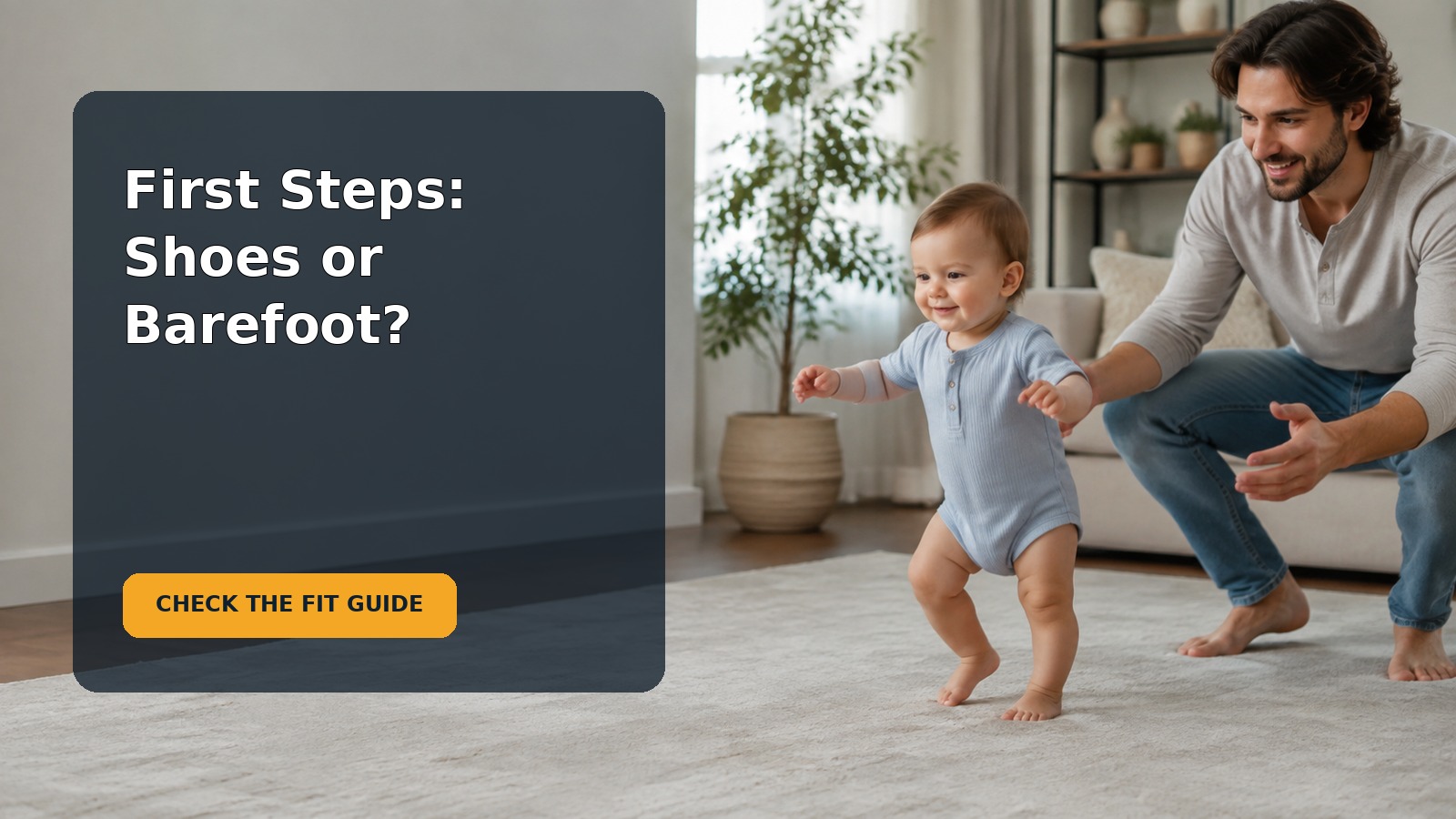
When a baby starts pulling up, cruising along furniture or taking first steps, buying tiny walking shoes can feel like the obvious next milestone. But does baby need shoes to learn to walk? Usually, no. In a safe indoor space, bare feet give a new walker direct contact with the floor. Shoes become useful mainly when your child needs protection from rough ground, sharp objects, heat or cold.
The practical answer is barefoot indoors when the surface is safe, and light, flexible, well-fitting shoes when protection is needed. A shoe should not force a baby to walk, correct a normal flat-looking foot or hold the ankle rigidly. Its job is to protect the foot without making natural movement unnecessarily difficult.
The short answer: barefoot first, shoes for protection
The Canadian Paediatric Society explains that a child who is not yet walking does not need shoes. Once walking begins, shoes can help prevent accidental injuries, but special or high-ankle footwear is not routinely needed to build the feet or prevent future walking problems. The Victorian Department of Health similarly recommends bare feet or a soft-soled shoe as much as possible while toddlers are learning to walk.
This does not mean that barefoot is best everywhere. A clean living-room floor is different from hot pavement, gravel, a splintered deck or a public play area. Think of first shoes as protective equipment for the environment—not as a device that teaches the walking skill.
What is typical from 9 to 18 months
Walking develops on a wide timetable. Many children begin independent walking between about 8 and 18 months, and their first gait often looks wide, wobbly and flat-footed. Babies may pull to stand, cruise sideways, squat while holding support and alternate between crawling and stepping. These are practice strategies, not signs that they need a firm shoe.
New walkers also fall often because balance and coordination are still developing. Shoes cannot remove that learning stage. A bulky, slippery or poorly fitted shoe may actually add another challenge because the child has to lift and place the foot while adapting to the shoe.
What changes the footwear decision
Consider the surface, weather and your child’s individual needs. Shoes make sense outside when there may be sharp debris, rough textures, hot or cold ground, or hygiene concerns. Indoors, socks alone can be slippery; bare feet or properly fitted non-slip footwear may be safer depending on the floor and temperature.
A baby with foot pain, unusual stiffness, a persistent limp, a sudden change in walking or a condition already followed by a clinical team needs individualized advice. Do not buy “corrective” shoes or inserts based only on advertising. Most young children do not need special footwear, and a pediatrician, pediatric physiotherapist, orthotist or podiatrist should guide exceptions.
A 60-second first-step check
Check the practice space
- Remove sharp objects, cords and unstable furniture.
- Block stairs and secure heavy furniture that could tip.
- Choose a dry, level surface with reasonable grip.
- Take off slippery socks when the room is warm and the floor is safe.
- Give your baby room to move between stable supports without pulling their hands upward.
If your baby is still crawling and pulling up, Nappot’s room-by-room crawling-baby safety sweep can help you prepare the wider space. For play that builds strength before and alongside cruising, try these simple floor-play games.
Observe without testing or comparing
Watch how your child moves barefoot on a safe surface. Can they place the whole foot down, shift weight and recover balance? Do both legs participate? Is there pain, swelling, skin irritation or repeated refusal to bear weight? A short video of ordinary play can help a clinician if you later have a concern, but there is no need to drill walking or repeatedly “test” the feet.
Also notice what happens in shoes. Red marks that persist, curled toes, tripping that appears only in the shoe, a heel that slips or resistance every time the shoes go on can point to a fit problem rather than a walking problem.
A practical barefoot-first plan
Step 1: Let safe indoor practice stay simple
Use bare feet for supervised practice on safe indoor surfaces. Place a favorite toy on a stable low surface, leave a small reachable gap to another stable support and let your child choose whether to cruise, crawl or pause. Avoid holding both hands high above the shoulders to make the baby walk. That position changes balance and may encourage steps before the child can control them independently.
Your role is to make movement possible, not to speed up the milestone. Sitting down, crawling again or asking to be carried are normal parts of practice. Praise effort in a neutral way: “You stood up and found your balance,” rather than making walking a performance your child must repeat.
Step 2: Add shoes only when the setting calls for them
For outdoor walking, choose a light shoe that bends near the toes and has enough grip for the surface. The front should be wide enough for the toes to spread. The fastening should hold the shoe securely without squeezing, and the heel should not slide excessively.
Have your child stand while checking length because the foot spreads under weight. The Canadian Paediatric Society suggests about 1.25 centimetres—roughly a thumb’s width—between the longest toe and the shoe tip, with space around the toes. Fit methods vary by shoe shape, so trying the shoe on is more reliable than buying only by the age printed on the box.
Step 3: Build up wear time gradually
Let your baby explore the shoes for a few minutes before expecting a full outing. Put them on while the child is calm, then try standing and several steps on a familiar surface. A simple script is: “Shoes keep your feet safe outside. We’ll put them on, walk a little and check your toes.”
New shoes may feel unfamiliar, but they should not need a painful “breaking-in” period. Stop and check the fit if your child cries with standing, repeatedly pulls at one area, develops a blister or suddenly walks very differently.
Step 4: Recheck often
Young children’s feet grow quickly, and a shoe that fit recently can become tight. Check the toe room, width, fastening and skin after active wear. Look inside for a folded insole, rough seam, pebble or damp area. Replace the shoe when the toes crowd the front, the upper presses the foot, the sole wears unevenly enough to affect stability or the shoe no longer stays secure.
Do not assume the same size fits in every brand. Measure both feet and fit the larger one. Hand-me-down shoes may be acceptable only if they are clean, structurally sound, not compressed into another child’s foot shape and still fit correctly; when in doubt, prioritize fit over the label or appearance.
How to choose a first walking shoe
- Flexible sole: it should bend near the ball of the foot rather than being rigid through the whole length.
- Wide toe area: toes need room to spread and move without rubbing.
- Secure heel and fastening: the shoe should stay on without squeezing or sliding.
- Low weight: avoid making each step harder with a heavy shoe.
- Useful grip: enough traction for the surface, without a bulky tread that catches easily.
- Breathable, comfortable material: check for irritating seams and moisture buildup.
- Correct current fit: do not buy several sizes too large to “grow into.” Excess length can contribute to tripping.
Price, brand and a stiff ankle cuff are not reliable signs of a better first shoe. High-cut shoes do not automatically provide superior developmental support. If a medical professional has prescribed a particular orthosis or shoe, follow that plan rather than general shopping advice.
Common mistakes and better alternatives
Using shoes to make walking happen sooner
Better alternative: offer safe floor time, stable supports and unhurried practice. Walking readiness comes from developing strength, balance, coordination and confidence—not from footwear.
Choosing a rigid sole for “support”
Better alternative: unless a clinician advises otherwise, select a flexible sole and secure fit. Protection does not require locking the foot into a stiff position.
Leaving slippery socks on for practice
Better alternative: use bare feet on a safe, comfortable indoor floor or choose a properly fitted non-slip option when warmth or the setting requires coverage.
Buying large shoes to save money
Better alternative: allow appropriate toe room, but avoid extra length that lets the foot slide and the toe catch. Recheck fit regularly and choose practical, affordable shoes rather than oversized ones.
Treating normal flat feet or in-toeing with store-bought “corrective” shoes
Better alternative: ask a qualified health professional if there is pain, stiffness, a one-sided pattern or functional difficulty. Flat-looking feet and some in-toeing are common in young children and often change with growth.
When to ask a professional
Arrange routine advice
Bring concerns to your child’s clinician if you are unsure about footwear because of prematurity, a known developmental or musculoskeletal condition, unusual muscle tone, or persistent difficulty bearing weight. Also ask if walking is not emerging within the range discussed at your local developmental visits. Developmental milestone guidance differs slightly by health system, so the clinician who knows your child can interpret the whole picture.
Book an assessment for foot pain, repeated blisters despite a careful fit, persistent stiffness, a gait that limits play, frequent falls beyond what seems typical for the child’s stage, or pronounced in-toeing or out-toeing that is severe, one-sided or not improving.
Seek prompt or urgent care
Seek prompt medical advice for a sudden limp, new refusal to stand or bear weight, swelling, redness, warmth, a wound, fever with a painful joint, or a sudden change after a fall or injury. Get urgent care when there is a visibly deformed limb, severe pain, an open injury, or the foot looks pale, blue, cold or unusually numb. Shoes are not the solution to an acute medical or injury concern.
One-page parent checklist
Before buying
- Decide where protection is actually needed.
- Measure both feet while your child is standing, if possible.
- Choose a light, flexible shoe with a wide toe area.
- Try both shoes on rather than relying only on age or size.
During the fit check
- Confirm appropriate space beyond the longest toe.
- Check that the heel is secure and the toes are not squeezed.
- Watch your child stand and take several natural steps.
- Reject shoes that slip, rub, pinch or make walking markedly harder.
After wearing
- Check the skin for persistent red marks, blisters or pressure areas.
- Remove debris and dry damp shoes.
- Recheck the fit every few weeks during rapid growth.
- Keep safe indoor practice barefoot when comfortable.
Success is not a certain brand of shoe or an earlier walking date. It is a child who can explore safely, move comfortably and use footwear as protection when the environment requires it.
Frequently asked questions
Does my baby need ankle-support shoes?
Not routinely. Higher ankle coverage does not necessarily provide better developmental support than a low-cut shoe. A higher shoe may simply be harder for a child to remove. Follow individualized clinical advice if your child has a diagnosed need.
Are bare feet safe at daycare?
That depends on the daycare’s rules, surfaces, temperature and activities. Ask what footwear is required and choose the lightest flexible option that meets the safety policy. Barefoot practice can still happen at home in a safe space.
Are soft-soled shoes the same as going barefoot?
No shoe gives exactly the same contact with the floor, but a light, flexible soft-soled shoe can provide some protection while allowing more movement than a rigid shoe. It still must fit securely and suit the surface.
What if my baby refuses shoes?
Start with short calm trials, check the fit carefully and avoid forcing a long outing in a new pair. Let the child touch the shoes, put them on before going outside and remove them after returning indoors. Persistent distress, pain or a sudden gait change deserves a closer fit check and, when needed, professional advice.
Sources
- Canadian Paediatric Society: Footwear for children
- Victorian Department of Health: Children’s feet and shoes
This article provides general education and does not diagnose a walking, foot or developmental condition. A qualified clinician who knows your child should guide concerns about pain, gait, injury or development.