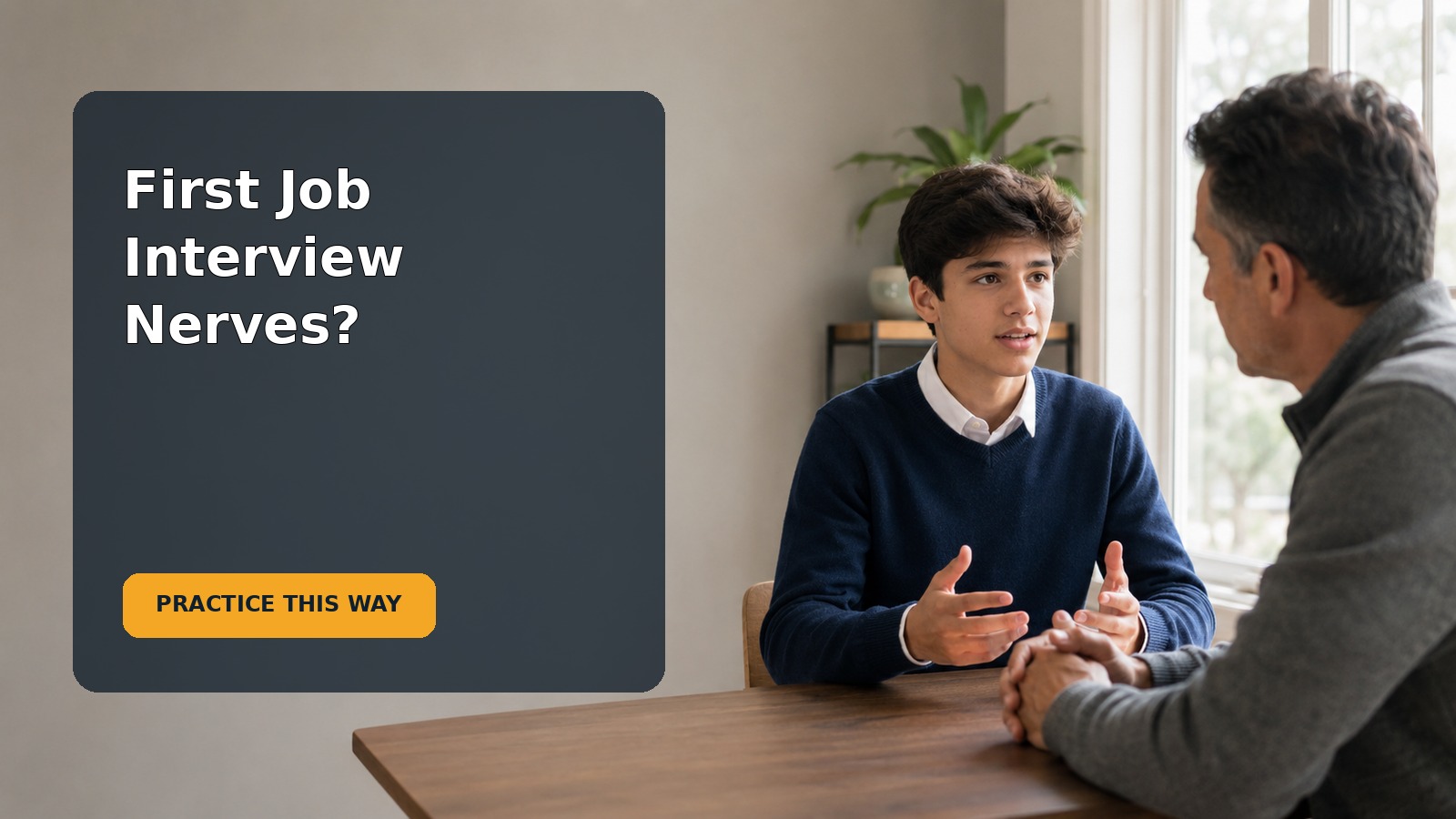
A teen first job interview can feel like a test with hidden rules. Your teen may be excited, worried about freezing, unsure what to wear, or convinced they need a perfect answer to every question. They do not. For most entry-level interviews, the employer is looking for signs that the applicant can arrive reliably, communicate respectfully, learn, and handle ordinary responsibilities.
The most useful preparation is flexible practice, not a script. Help your teen understand the role, collect a few true examples from school and everyday life, rehearse the shape of an answer, and then let them speak in their own words. The goal is a prepared teenager—not a parent-designed performance.
Start with a 60-second reality check
Before practicing answers, confirm the basics. Is the job posting real? Does your teen know the employer’s name, location, duties, expected hours, and how the interview was arranged? If the employer asks for money, banking credentials, gift cards, account passwords, or identity documents through an unexpected text before a legitimate hiring process is established, pause and verify the request independently.
Also check whether the work and proposed schedule are allowed for your teen’s age and location. In the United States, federal and state youth-employment rules can limit hours and types of work, and the more protective rule generally applies. Other countries and regions have their own requirements. Use an official labor-agency source rather than relying on a social-media post or another family’s experience.
Ask what your teen wants from you
Try: “Would you like me to help research the job, ask practice questions, listen to your answers, or just help with the ride?” A teen may want coaching on one part and independence on another. Agree that you will give one or two useful notes after each practice round instead of correcting every sentence.
What entry-level interviewers are usually trying to learn
A first employer knows that a teenager may not have paid experience. School projects, clubs, sports, volunteering, caregiving, household responsibilities, and personal projects can still show relevant habits. An interviewer may be listening for:
- Reliability: Can this person arrive when promised and communicate early if a problem occurs?
- Willingness to learn: Can they accept instruction, ask a sensible question, and try again?
- Communication: Can they listen, answer clearly, and treat customers and coworkers respectfully?
- Problem-solving: Can they describe a small challenge and what they did next?
- Fit with the schedule: Are their actual school and family commitments compatible with the hours?
Help your teen translate experience rather than dismiss it. Organizing equipment for a team can show responsibility. Completing a difficult group assignment can show communication. Regularly caring for a pet can show consistency. These examples should be truthful and specific; there is no need to inflate them into management experience.
A five-step teen first job interview practice plan
Step 1: research the role for 10 minutes
Read the posting together and circle three repeated ideas, such as customer service, punctuality, teamwork, food safety, stocking, or basic computer use. Visit the employer’s official website and note what the organization does. Your teen should be able to answer, in one or two sentences, “Why are you interested in this job?”
A natural answer might be: “I want my first work experience in a place where I can learn customer service. I also like that the shifts listed can fit around school.” That is stronger than exaggerated enthusiasm or a line copied from the company website.
Step 2: build a three-story example bank
Ask your teen to choose three true situations:
- a time they followed through on a responsibility;
- a time they worked with someone else or handled disagreement; and
- a time they made a mistake, received feedback, or learned something unfamiliar.
For each story, jot down four prompts: situation, task, action, result. This is often called the STAR structure. The notes should be keywords, not a paragraph to memorize. For example: “Science project—partner absent—divided remaining tasks—emailed teacher—submitted on time.”
If teamwork is the hardest area, Nappot’s guide to coaching a teen through an overwhelming group project offers practical language for clarifying roles and raising problems early.
Step 3: practice six likely questions
Use a relaxed setting first. Ask one question, allow a pause, and let your teen finish before offering feedback:
- Tell me a little about yourself.
- Why do you want to work here?
- Tell me about a time you were responsible for something important.
- Describe a time you worked as part of a team.
- What would you do if you did not understand an instruction?
- What days and hours are you genuinely available?
A good answer can be brief. “I don’t know yet, but I would ask my supervisor to show me” is often more credible than pretending to know everything. Teach your teen that a two- or three-second pause is acceptable. They can say, “Let me think of a good example,” rather than filling the silence with rushed words.
Step 4: add realistic pressure gradually
After the first round, repeat the questions in a different order. Then move to a chair across the room, use a video call if the real interview is online, or ask another trusted adult to conduct one short practice. Stop after 15 to 20 minutes. Several short sessions usually preserve confidence better than one exhausting rehearsal.
Give feedback in this order: one thing that sounded genuine, one thing that was clear, and one adjustment. For example: “Your example showed responsibility. I understood exactly what you did. Next time, add what happened at the end.” Avoid rewriting the answer in adult corporate language.
Step 5: prepare logistics the night before
- Confirm the time, location, contact name, and interview format.
- Plan transportation and aim to arrive about 10 minutes early—not 30 minutes early.
- Choose clean, comfortable clothing that suits the workplace and allows your teen to focus.
- Bring any requested materials, plus a simple résumé if they have one.
- Charge the phone, then silence it before the conversation.
- Prepare two questions for the interviewer.
Useful questions include: “What does a typical shift look like?”, “How are new employees trained?”, and “When should I expect to hear about the next step?” Questions about pay and scheduling are legitimate too; your teen can ask them calmly when those details have not been explained.
A practice script that stays flexible
For “Tell me about yourself,” use three anchors rather than a memorized speech:
“I’m a high-school student who enjoys [relevant interest or activity]. Through [school, volunteering, sport, caregiving, or project], I’ve learned [relevant habit]. I’m interested in this role because [specific, honest reason].”
For a behavioral question, use the four-story prompts:
“The situation was ____. I needed to ____. I decided to ____. The result was ____, and I learned ____.”
Encourage your teen to change the wording each time. If the meaning remains clear without identical sentences, they are learning the idea rather than reciting a script.
What parents should not do
Do not answer for your teen
Unless an agreed disability accommodation requires support, let your teen communicate directly with the employer. Do not call to explain every detail, sit in the interview uninvited, or negotiate ordinary questions over the interviewer’s head. You can help your teen draft an email and then let them send it.
Do not invent experience
Help identify real transferable skills, but never create roles, hours, awards, or responsibilities. A modest true example is safer and easier to discuss when the interviewer asks a follow-up question.
Do not rehearse a “perfect weakness”
Answers such as “I work too hard” sound rehearsed. A better response names a manageable growth area and an action: “I used to wait too long before asking questions, so now I check the instructions early.”
Do not make appearance the main lesson
Basic cleanliness and workplace-appropriate clothing matter, but harsh comments about weight, hair, skin, disability, gender expression, or expensive clothes can damage confidence. Focus on comfort, safety, and the employer’s actual work setting.
Privacy, disability, and inappropriate questions
Interview rules vary by country and jurisdiction. In the United States, federal equal-employment guidance generally restricts disability-related questions before a job offer, although an employer may ask whether an applicant can perform job duties and may describe those duties. Age-related questions can have legal implications, while employers may still need to establish that a minor meets a lawful minimum age.
Your teen does not need to volunteer private medical or family information just to seem cooperative. If they need an interview accommodation, help them make a concise functional request through the employer’s stated process. For a question that feels unrelated or intrusive, they can redirect: “Could you explain how that relates to the responsibilities of this role?” Seek local advice for a specific discrimination or employment concern.
After the interview
In the car or at home, do not begin with a critique. Ask: “What felt easier than expected?” and “What would you change next time?” Your teen can send a short thank-you message if they have an appropriate contact: thank the interviewer, name one detail they appreciated, and restate interest. It does not need to be elaborate.
If they are not selected, frame the interview as real practice rather than a verdict on their worth. Ask whether any feedback is available, then record two lessons while the experience is fresh. Hiring decisions may reflect scheduling, applicant volume, or prior experience—not simply the quality of one conversation.
One-page parent checklist
- Verify the employer, job posting, duties, and interview details.
- Check official youth-work rules for your location and the proposed schedule.
- Ask what kind of support your teen wants.
- Identify three truthful examples from school, home, activities, or volunteering.
- Practice six questions in short sessions.
- Use situation-task-action-result prompts instead of a script.
- Offer limited feedback and preserve your teen’s own voice.
- Plan clothing, transportation, documents, and two interviewer questions.
- Let your teen communicate directly when possible.
- Debrief with curiosity rather than judgment.
Frequently asked questions
What if my teen freezes?
Practice a recovery line: “Could you repeat the question?” or “Let me take a moment to think of an example.” Pausing is not failure. If anxiety is severe across school, social, and work settings, consider asking a qualified health professional about appropriate support.
How many times should we practice?
Two or three sessions of 15 to 20 minutes are often enough for a first interview. Stop if answers become robotic or frustration rises. A final five-minute review of story keywords is more useful than a late-night marathon.
Should a teen bring a résumé with no job history?
If the employer requests one, include education, relevant activities, volunteering, skills, and dependable responsibilities. Keep it accurate and simple. A résumé is not always required for entry-level work.
Should I drive my teen to the interview?
Provide transportation if needed, but normally wait elsewhere unless the employer or an agreed accommodation calls for your presence. Confirm the plan with your teen so they know where you will be afterward.
What if the proposed hours interfere with school or sleep?
Your teen should state their real availability rather than agreeing under pressure. Check applicable youth-work laws and household limits, then help them use a direct sentence such as, “On school nights, I am available until 8 p.m.”
Sources
- CareerOneStop: Interview and negotiate
- U.S. Department of Labor: YouthRules!
- U.S. Equal Employment Opportunity Commission: Pre-employment inquiries and age
- U.S. Equal Employment Opportunity Commission: Pre-employment inquiries and disability
This article provides general parenting and educational information, not individualized legal, employment, or mental-health advice. Youth-employment rules, interview practices, and accommodation rights vary by location.