If you receive a Meta AI distress alert about your teen, treat it as a prompt to check safety—not as proof of what happened and not as something to dismiss. Pause, find your teen, and begin with a calm, direct conversation. The first goal is to learn whether they are safe right now. Account settings, punishment and a detailed review of the chat can wait.
This guide explains Meta AI distress alert teen what to do steps for a parent of a 15-year-old. It offers general safety information, not a diagnosis or an individualized crisis assessment. If your teen may be in immediate danger, has made an attempt, has a current plan to hurt themselves or cannot stay safe, call local emergency services now. In the United States and its territories, call or text 988 for crisis support. Outside the U.S., use your local crisis line or emergency number.
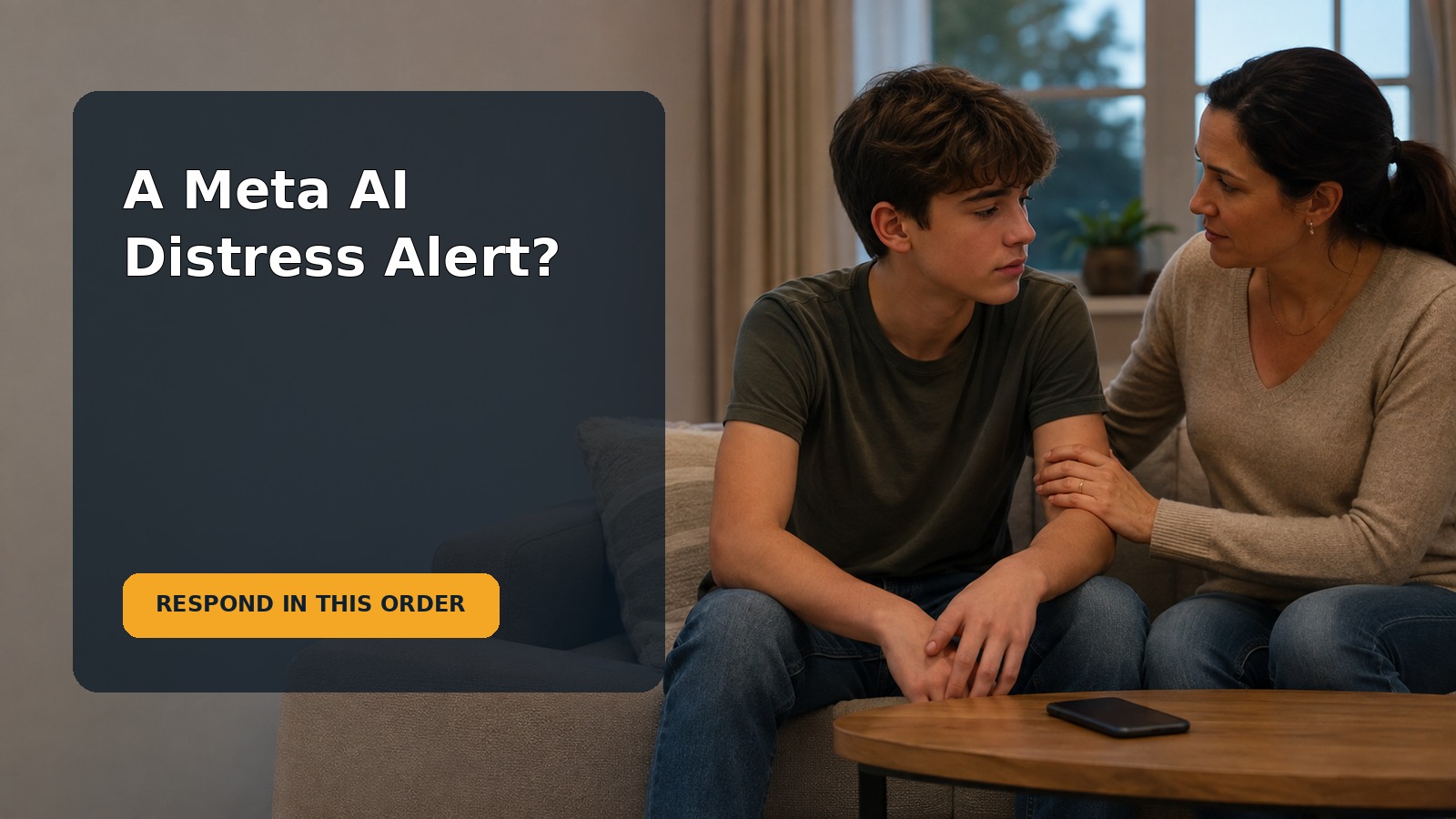
What a Meta AI distress alert means
Meta says supervising parents may receive an alert when a teen’s conversation with Meta AI suggests possible risk involving suicide or self-harm. According to the company’s July 2026 announcement, flagged chats are manually reviewed before an alert is sent. Meta also says it may alert a parent when intent remains ambiguous because its system is designed to err on the side of caution.
That distinction matters. An alert is not a clinical diagnosis, and it does not tell you by itself whether your teen is in immediate danger. It also should not be treated as a false alarm simply because your teen says they were joking, discussing a fictional story or asking for someone else. The safest response is a respectful, direct check.
Availability and settings can vary by country and account. Meta reported that these alerts initially applied to supervising parents using Instagram parental supervision in the U.S., U.K., Australia and Canada, with a broader rollout planned. Verify current details in the Family Center rather than assuming every teen account works the same way.
Do the first safety check now
1. Find your teen and lower the temperature
Go to your teen in person when possible. Move to a quiet place, put aside distractions and keep your voice steady. Do not begin by confiscating the phone, demanding the entire chat or announcing consequences. An angry interrogation can make an already distressed teen focus on avoiding punishment rather than telling you what is happening.
If your teen is not with you, call them. If they do not respond and you have a concrete reason to believe they may be in immediate danger, contact a trusted adult who is physically near them and emergency services as appropriate. Do not rely on repeated messages alone when there may be imminent risk.
2. Name the alert without accusation
Try a short opening:
“I received an alert saying a conversation may have involved suicide or self-harm. I’m not here to punish you or assume I know the whole story. I love you, and I need to check whether you are safe right now.”
Then let your teen answer. Avoid debating whether the platform should have sent the alert. You can address privacy, settings and what the system misunderstood later.
3. Ask directly about suicide and self-harm
Use plain questions rather than hints:
- “Are you thinking about hurting yourself?”
- “Are you thinking about suicide or wishing you were dead?”
- “Have you made a plan, or started doing anything to prepare?”
- “Do you have access right now to anything you might use to hurt yourself?”
- “Can you stay safe while we get help together?”
The 988 Suicide & Crisis Lifeline advises being direct and matter-of-fact, listening without judgment, taking action and connecting the person with specialized help. Asking clearly gives your teen permission to answer clearly. Do not promise to keep suicidal thoughts or a plan secret.
Choose the next step by the level of concern
Immediate danger: stay with them and get emergency help
Treat the situation as urgent if your teen has made an attempt, has a current plan and access to a method, says they intend to act soon, is severely intoxicated or agitated, is missing under concerning circumstances, or cannot agree to stay safe while help is arranged. Stay with them. Call emergency services or go to the nearest emergency department. In the U.S., call or text 988 for guidance; call 911 for an immediate life-threatening emergency.
Reduce access to firearms, medications and other potentially lethal items without leaving your teen alone to do it. If possible, ask another responsible adult to secure them. Follow crisis-professional or emergency-service instructions rather than trying to manage imminent risk by yourself.
Concerning but not clearly imminent: connect today
If your teen reports suicidal thoughts, recent self-harm, a past attempt, escalating hopelessness or uncertainty about staying safe—but no immediate action is underway—contact 988 or your local crisis service for a real-time assessment. Also contact your teen’s pediatrician, mental-health clinician or another qualified professional the same day. Ask what level of evaluation is appropriate and what supervision is needed until the evaluation happens.
The National Institute of Mental Health lists warning signs such as talking about wanting to die, feeling hopeless or trapped, making a plan, withdrawing, saying goodbye, giving away important items, taking dangerous risks, extreme mood changes and significant changes in sleep or eating. New or increasing signs deserve prompt attention.
No current suicidal intent disclosed: keep listening and arrange follow-up
Your teen may explain that the chat involved curiosity, schoolwork, fiction, concern for a friend or words the system interpreted cautiously. Listen to the context, but do not make your conclusion depend only on winning access to every message. Ask about recent mood, sleep, stress, bullying, relationships, substance use, losses and whether there has been any self-harm or suicidal thinking that the alert did not capture.
If there is no immediate risk but the conversation reveals distress, arrange a routine or prompt appointment with the pediatrician or mental-health professional. Tell your teen when you will check in again—later that day and over the next several days—not merely “sometime.” A platform alert cannot replace professional assessment.
Protect trust while taking safety seriously
A 15-year-old needs growing privacy, but privacy is not the same as secrecy around immediate safety. Explain the boundary:
“I want to protect your privacy. I also have to act when I think you may not be safe. I will involve as few people as necessary, tell you what I’m doing and listen to your preferences whenever we have a choice.”
Ask before examining messages unless urgent safety concerns make immediate review necessary. If you do need relevant information, focus narrowly on what helps assess risk: timing, whether there was a plan, whether another person is involved and whether access to a method exists. Avoid turning a safety check into a broad search of unrelated private conversations.
Do not shame your teen for using an AI chatbot for emotional support. Curiosity, convenience and fear of burdening another person may all play a role. Once immediate safety is established, help them identify human options: you, another trusted adult, a counselor, clinician, coach or crisis service. Nappot’s guide to AI chatbot emotional-support safety questions can help families discuss the limits of chatbot support without ridiculing the teen.
Make a short plan for the next 24 hours
Write down facts, not conclusions
Record when the alert arrived, its exact wording, where your teen was and what they told you. Note any warning signs, stated plan, access to a method, recent self-harm, substances or major stressors. This can help a clinician or crisis counselor understand what prompted the call. Do not circulate screenshots among relatives or post them online.
Build a supervision and support plan
Agree on who will stay nearby, who else should know, how the teen will ask for help and which professional you will contact. Keep the plan specific. “Come wake me, call Aunt Maya or call/text 988” is more useful than “make good choices.” If a clinician creates a formal safety plan, keep it accessible and review it with your teen.
A safety plan is not a substitute for urgent care when danger is imminent. Likewise, a verbal promise or “no-suicide contract” should not be used as proof that risk has passed. Base decisions on a qualified assessment and the situation you can observe.
Review technology only after safety
Once the immediate check is complete, review the supervising parent account, alert details and current Family Center controls together when appropriate. Confirm that contact information is current and discuss whether stricter content settings fit your family. Remember that controls can reduce exposure but cannot guarantee safety or replace attentive relationships and professional care.
Common mistakes and better alternatives
- Mistake: “You scared me, so you have lost your phone indefinitely.”
Better: separate the safety conversation from later decisions about technology. Sudden punishment can discourage future disclosure. - Mistake: assuming an alert proves suicidal intent.
Better: treat it as a serious signal and ask direct questions. Context and a proper assessment determine the response. - Mistake: accepting “I’m fine” and ending the conversation immediately.
Better: stay calm, ask the specific safety questions and arrange follow-up when distress or warning signs remain. - Mistake: demanding secrecy to protect the teen’s reputation.
Better: involve the smallest appropriate circle of trusted adults and professionals, while being honest with your teen about who needs to know. - Mistake: asking an AI chatbot to assess the crisis.
Better: use a crisis line, emergency service or qualified health professional for human assessment.
A parent checklist
- Pause and locate your teen.
- Say what the alert reported without accusing or shaming.
- Ask directly about self-harm, suicide, a plan, access and immediate safety.
- Stay with your teen and seek emergency help for imminent danger.
- Use 988 in the U.S. or the appropriate local crisis service for guidance.
- Secure potentially lethal means when risk is suspected.
- Contact the pediatrician or mental-health clinician at the urgency recommended.
- Document the alert and key answers without broadcasting private details.
- Agree on a specific check-in and support plan.
- Review platform controls only after the safety response is underway.
Frequently asked questions
Does a Meta AI distress alert mean my teen is suicidal?
No. Meta describes the alert as a cautionary signal based on a conversation that may indicate suicide or self-harm risk. It is not a diagnosis. The right response is to check directly and connect with qualified help when concern remains.
What if my teen becomes angry or refuses to talk?
Keep your tone calm and repeat the safety reason for asking. Offer limited choices, such as talking with you, another trusted adult or a crisis counselor. If you have reason to believe there is imminent danger, refusal does not remove the need to seek emergency help and maintain supervision.
Should I read the entire AI conversation?
Not automatically. Ask your teen to explain the context and, when useful, show the relevant portion. Narrow your review to safety information. In an urgent situation, obtaining necessary information may take priority, but explain what you are doing and why.
How long should I keep checking in?
There is no universal timeline. Check again the same day and follow the plan made with the crisis counselor or clinician. Continue noticing changes in mood, sleep, eating, withdrawal, substance use, risk-taking and talk about death. Escalate if signs are new, intensifying or connected to a painful event.
Sources
- Meta: Alerting Parents if Teens Show Signs of Distress in Conversations With Meta AI
- 988 Suicide & Crisis Lifeline: Help Someone Else
- National Institute of Mental Health: Warning Signs of Suicide
This article provides general educational information and does not replace emergency, medical or mental-health care. Crisis resources and platform features vary by country and can change. Use local emergency services and locally appropriate crisis support when needed.