Finding out that your teen uses an AI chatbot for emotional support can bring up fear, curiosity, and an urge to take the device away. Pause before reacting. A chatbot may feel available, private, and easier to approach than a person when a teen is embarrassed, lonely, or trying to put feelings into words. That does not make the tool a therapist, a trusted adult, or a safe place for every disclosure.
The most useful first step is a calm conversation about your teen’s actual use. The goal is not to approve every chat or secretly inspect every message. It is to understand whether the tool is helping with low-stakes reflection or beginning to replace sleep, relationships, professional care, or urgent human help. These seven questions can guide that check.
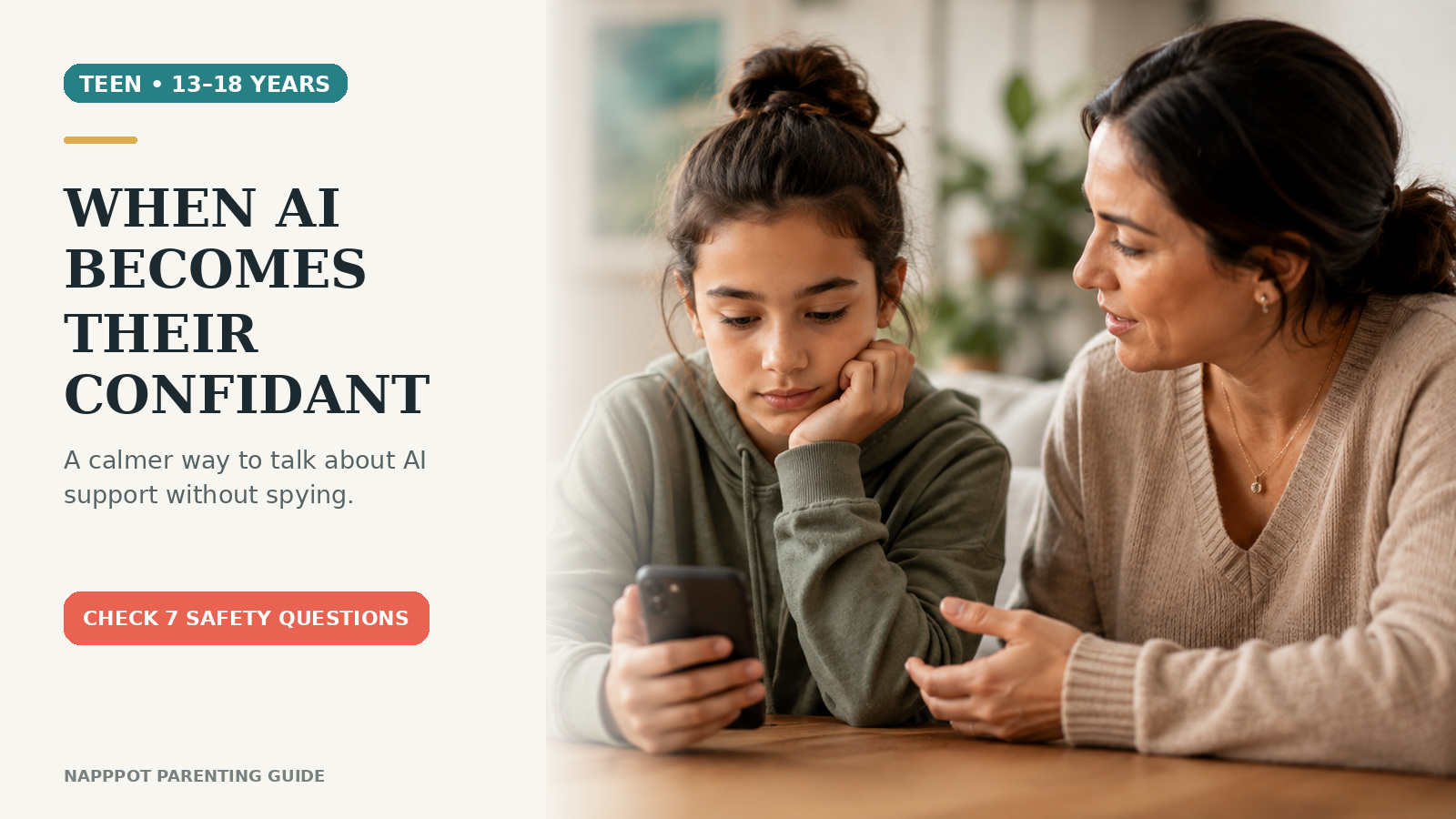
Start with curiosity, not confiscation
Choose a neutral moment, not the middle of an argument. You might say, “I know AI can be useful and also get things wrong. I’d like to understand what you like about talking with it.” Then listen. Ask when they use it, what they hope to get from it, and whether its replies generally leave them calmer, more confused, or more dependent on another response.
Avoid opening with “AI is dangerous” or “Show me every conversation.” A teen who expects automatic punishment may hide use rather than seek help when something goes wrong. Instead, explain your boundary plainly: private reflection deserves respect, but safety concerns cannot stay secret. This is similar to setting teen social-media boundaries without defaulting to secret monitoring.
The 7 safety questions to ask
1. Is the chatbot a tool, or does it feel like a trusted person?
Ask how your teen describes the relationship. Using AI to brainstorm journal prompts, rehearse a difficult conversation, or organize thoughts is different from believing the system truly knows, loves, or is responsible for them. Chatbots generate responses from patterns; they do not have human judgment, accountability, or a complete understanding of your child’s life.
Listen for language such as “It is the only one who understands me” or “I have to check with it before I decide.” Do not mock that attachment. Reflect the need underneath it—perhaps being heard without interruption—while widening the circle of real support.
2. What personal information are they sharing?
Discuss privacy without demanding a transcript. A sensible rule is not to share a full name, precise location, school, passwords, financial details, intimate images, identifying details about other people, or information that could expose someone to harm. Product data practices and settings differ, so review the service’s current privacy information together rather than assuming a chat is confidential.
Ask your teen to remove names and identifying details when a general description will do. If an account offers history, training, memory, deletion, or parental settings, check the current official instructions together. Settings can change and do not eliminate every privacy risk.
3. Do they verify important advice with a person?
AI can sound confident while being incomplete, outdated, or wrong. Create a “pause and ask” rule: medical symptoms, medicines, self-harm, abuse, sexual safety, legal problems, financial decisions, threats, and other high-stakes issues must go to a qualified person or trusted adult. A chatbot can help form a question, but it should not make the decision.
Ask, “If this advice were wrong, what could happen?” The higher the consequence, the stronger the need for human verification. Encourage your teen to compare claims with reliable sources and notice when the system fails to cite evidence.
4. Is chatbot use replacing important parts of life?
Look at patterns rather than one long conversation. Is use pushing bedtime later, interrupting schoolwork, reducing time with friends, or replacing appointments and family support? Can your teen stop when they planned to? Do they become distressed when the tool is unavailable?
A single late night does not prove dependence. Repeated displacement matters more. Agree on device-free sleep hours and protect offline routines. If conversation at home has become difficult, a low-pressure after-school check-in can make human connection easier without forcing an immediate disclosure.
5. What do they do when a reply feels wrong or upsetting?
Make a plan before this happens. Teach your teen to stop the conversation, take a screenshot only if needed for reporting or safety, use the platform’s report feature, and tell a trusted adult. They do not need to argue with the bot, follow a dare, or keep responding to “fix” the exchange.
Useful warning signs include advice that encourages secrecy from safe adults, presents an extreme action as the only answer, sexualizes the conversation, validates dangerous behavior, or pressures the user to stay engaged. The correct response is to leave and get human help—not test how far the conversation will go.
6. Can they report a problem and leave the conversation?
Ask your teen to show you where the block, report, delete, or feedback controls are without opening private chats. Confirm that they know how to close the account or app and whom to tell. Keep your response proportionate when they disclose a problem. Thank them for coming to you before deciding what needs to change.
This is also a good moment to agree that seeking help will not automatically mean losing every device privilege. Immediate safety may require temporary restrictions, but an automatic permanent punishment can discourage future honesty.
7. Who is the human-support plan for urgent distress?
Write down at least three reachable options: a parent or caregiver, another trusted adult, and an appropriate professional or crisis service. Include a school counselor, pediatrician, therapist, coach, relative, or community support when suitable. Your teen should know that urgent distress goes to people, even if the chatbot suggests otherwise.
If your teen may act on thoughts of suicide or self-harm, cannot stay safe, has taken an overdose, is experiencing abuse or exploitation, or faces an immediate threat, do not leave them alone with a chatbot. Contact local emergency services or urgent professional help. In the United States, call or text 988 Suicide & Crisis Lifeline; outside the United States, use the local crisis line or emergency number. This article cannot assess an individual emergency.
Red flags that need a faster adult response
Take a change in behavior seriously when it is persistent, worsening, or affecting daily functioning. The National Institute of Mental Health advises seeking help when emotional or behavioral signs last for weeks, cause distress, or interfere with life at home, school, or with friends. Get help sooner when behavior is unsafe.
- Your teen talks about suicide, self-harm, harming someone else, or being unable to stay safe.
- The chatbot gives dangerous instructions, sexual content, threats, or advice to hide risk from safe adults.
- Your teen is increasingly isolated, losing sleep, missing school, or unable to disengage.
- There is a disclosure of abuse, exploitation, coercion, or intimate-image sharing.
- Your teen treats AI guidance as more authoritative than medical or mental-health care.
- Use suddenly becomes highly secretive at the same time that mood or functioning worsens.
These signs do not establish a diagnosis. They are reasons to slow down, stay close, document immediate safety concerns, and involve an appropriate health or mental-health professional.
Build a family AI safety agreement together
Keep the agreement short enough to use. A collaborative version is more likely to survive than a long list imposed during a scare. Families can adapt the trust-first approach in this family technology agreement.
- Purpose: AI may support brainstorming, reflection, or question-building, but it is not therapy or emergency care.
- Privacy: Do not share identifying, sexual, financial, location, password, or other high-risk information.
- Verification: Pause and ask a person before acting on medical, legal, financial, sexual-safety, abuse, or crisis guidance.
- Time: Keep phones and chatbot conversations outside agreed sleep hours and responsibilities.
- Transparency: Parents explain what settings they review and why. Routine secret reading is not the default.
- Exit plan: Stop, report, and tell a trusted adult when a response feels dangerous, manipulative, sexual, extreme, or upsetting.
- Review date: Revisit the agreement in a month and whenever the product or your teen’s needs change.
Check current platform controls together. For ChatGPT specifically, use the official parental-controls documentation rather than relying on old screenshots or third-party instructions. Controls may help with selected settings, but they cannot replace conversation, judgment, or professional care.
Keep human support easier to reach
A rule is not enough if asking a person feels impossible. Give your teen more than one route: talking face to face, sending a text, writing a note, asking for a drive, or using a phrase such as “I need help, not a lecture.” Follow through by listening first unless immediate safety requires action.
You do not have to compete with a chatbot by having the perfect answer. Be the person who can tolerate discomfort, remember context, take responsibility, and connect your child with real care. Ask what made the AI conversation feel easier and whether you can bring some of those qualities—patience, time, less interruption—into your own check-ins.
Frequently asked questions
Are AI chatbots safe for teen mental-health support?
They can sometimes help a teen put feelings into words, but they can also provide inaccurate or unsuitable responses. They are not a substitute for a qualified mental-health professional, a trusted adult, or crisis support. Safety depends on the product, the way it is used, the teen’s situation, and whether important advice is verified with people.
Should I read my teen’s AI conversations?
Routine secret reading can damage trust and drive use underground. Start with transparent discussion of purpose, privacy, time, and safety. A specific, serious safety concern may justify closer supervision, but explain what you are doing and why whenever it is safe to do so.
What if my teen says the chatbot understands them better than I do?
Do not argue about whether that feeling is “true.” Say, “I can see that it feels easier to talk there. What does it do that helps?” The answer may reveal a need for less interruption, less judgment, more time, or access to another supportive adult or professional.
When should I involve a mental-health professional?
Seek professional guidance when distress lasts, worsens, disrupts sleep, school, relationships, or daily functioning, or when you are unsure how to keep your teen safe. Suicidal thoughts, self-harm, abuse, psychosis-like experiences, threats, or immediate danger require urgent human help.
Sources and further reading
- Common Sense Media: A Comprehensive Report on Teens, Tweens, and AI
- OpenAI Help Center: Parental Controls on ChatGPT FAQ
- National Institute of Mental Health: Child and Adolescent Mental Health
- 988 Suicide & Crisis Lifeline (United States)
This article provides general parenting education, not individual medical or mental-health advice. A chatbot cannot evaluate a crisis. Contact a qualified professional for concerns about your teen and use urgent local services when safety may be at risk.