If your toddler refuses to wash hands, the problem is rarely that they need a longer lecture about germs. At 18 to 36 months, stopping an activity, standing still, tolerating water and letting an adult guide several steps can feel like one large demand. A toddler may also dislike the sound of the tap, the temperature of the water, a slippery stool or wet sleeves.
You can respect those feelings while keeping the hygiene boundary. The goal is not to make every wash cheerful. It is to create a short, safe sequence your child can predict and gradually help complete: step up, wet, soap, scrub, rinse and dry. Offer small choices inside that sequence, use play to support cooperation and calmly help when washing cannot be skipped.
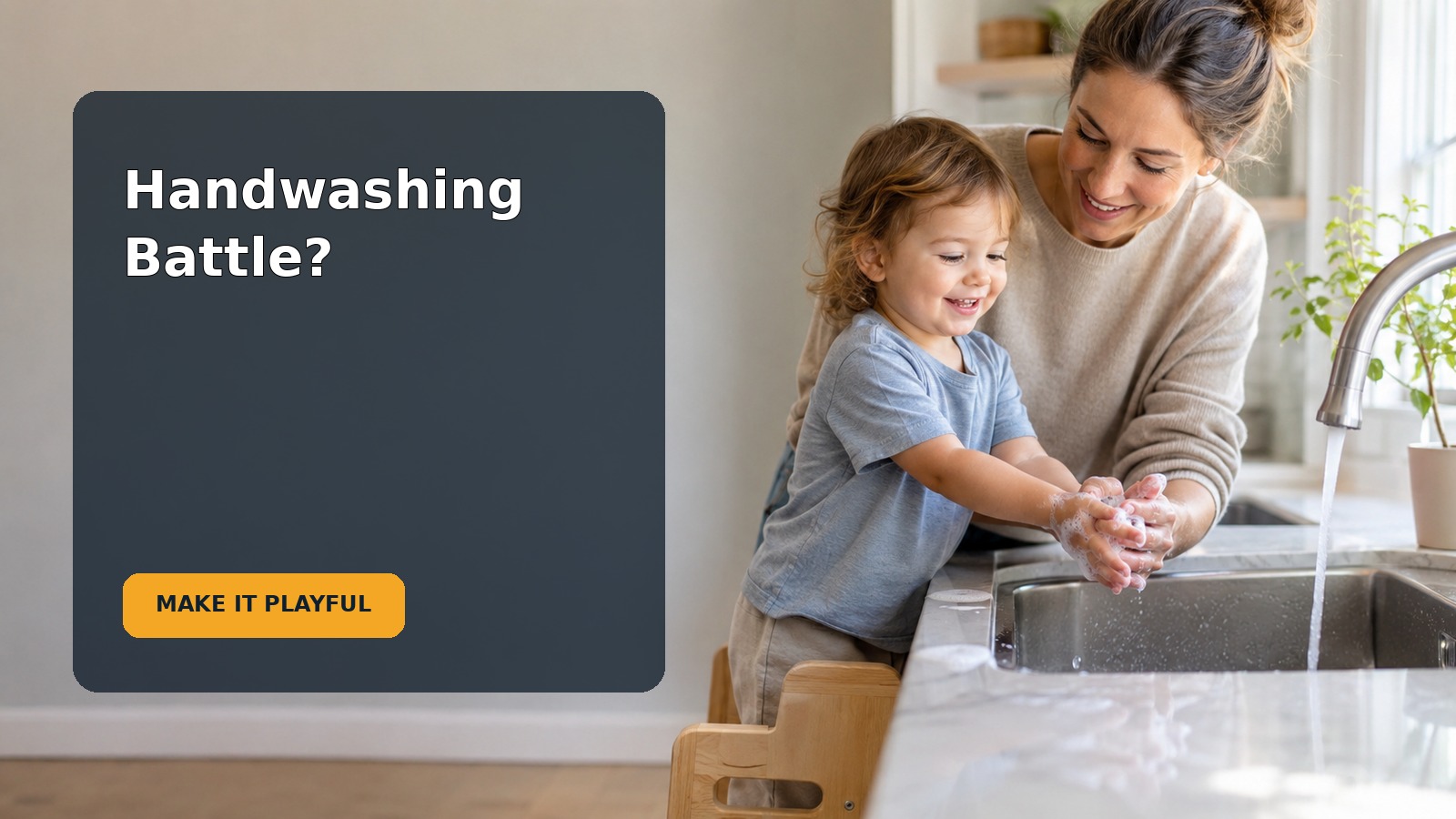
Start with a quick handwashing check
Before assuming your toddler is being defiant, watch one attempt without adding extra prompts. Where does the resistance begin? A child who refuses before entering the bathroom may struggle with the transition. A child who approaches but pulls away from the sink may be reacting to the setup or a sensory detail. A child who wants to leave after two seconds may simply need a clearer finish line.
Check the environment first
- Stool: It should be stable, dry and appropriate for the child. Stay close; a sink area can become slippery.
- Reach: Your toddler should not need to lean their body over a wide counter or pull on the faucet.
- Water: Use comfortably warm or cool running water, never hot water. An adult should control temperature and flow.
- Soap: Put ordinary soap within adult-controlled reach. A pump that is hard to press can turn the routine into a frustrating test.
- Clothing: Push sleeves up before the water starts and keep a dry towel ready.
- Sensory load: Notice loud water, strong fragrance, bright light, a hand dryer or fear of water running toward the drain.
Change one obstacle at a time. For example, reduce the tap flow, use an unscented soap or let the child dry with a familiar towel. You are not removing the expectation to wash; you are making the expected task physically manageable.
When toddlers need to wash their hands
The CDC recommends washing with soap and clean, running water at key times when germs are likely to spread. For family life, useful anchors include before eating or helping with food, after using the toilet or a diaper change, after touching animals or animal waste, after coughing or sneezing into the hands, after outdoor play when hands are dirty, and after contact with vomit, stool or other body fluids.
You do not need to interrupt every minute for a precautionary wash. Connect handwashing to a few consistent events: “Potty, wash, then play,” or “Shoes off, wash, then snack.” A routine attached to something that already happens is easier to learn than a changing set of warnings.
Soap and water are the main plan
According to the CDC, the basic method is to wet hands with clean running water, apply soap, lather the fronts and backs, between fingers and around nails, scrub for at least 20 seconds, rinse and dry. Ordinary soap is suitable; the American Academy of Pediatrics notes that antibacterial soap is not needed for routine washing.
If soap and water are not readily available, the CDC advises a sanitizer containing at least 60% alcohol. With toddlers, an adult must dispense and supervise it, rub it over all hand surfaces until dry, and store the product out of reach. Do not let a child lick, drink or play with sanitizer. Soap and water are the better choice when hands are visibly dirty or greasy. Follow childcare rules and product directions as well.
A playful routine when a toddler refuses to wash hands
Practice the sequence when nobody is rushed. Use the same words each time and keep your voice matter-of-fact. Play should make the task easier to enter; it should not turn handwashing into a long performance that you must recreate perfectly at every sink.
Step 1: give a brief transition cue
Move close, get to your toddler’s level and state what happens next: “Snack is ready. First we wash hands, then we eat.” Avoid asking, “Do you want to wash?” when washing is required. That sounds like refusal is an available choice.
For a child deeply involved in play, give one short warning: “One more block, then hands.” Follow through instead of extending the countdown repeatedly. A picture with six simple symbols—step, water, soap, scrub, rinse, towel—can show that the routine has an end.
Step 2: offer two real choices
Choices provide control without transferring the safety decision to the toddler:
- “Blue towel or yellow towel?”
- “Do you want to pump the soap, or should I?”
- “Quiet counting or the handwashing song?”
- “Will you climb onto the stool with my hand, or will I lift you?”
Offer only options you can accept. If your child does not choose, choose calmly: “I’ll pick the blue towel today.” Do not keep adding choices after the first two have been rejected.
Step 3: use one short scrub game
Choose a game that naturally covers about 20 seconds. Count fingers slowly, sing a familiar verse, look for “bubble mittens,” or pretend the soap is visiting the backs, palms, spaces between fingers and fingertips. Keep the order the same so the game also teaches technique.
A simple script is: “Palms, backs, between, fingertips. Rinse and done.” Your toddler does not need perfect independent technique. At this age, the adult is still responsible for ensuring the wash is complete.
Step 4: mark the finish clearly
Rinse, turn off the water, step down safely and dry. Then name completion rather than praising obedience: “Hands are washed. Now snack.” This keeps the routine focused on what happened and makes the promised next step dependable.
How to respond to refusal without shame
Acknowledge the feeling in one sentence and hold the limit in the next: “You do not want to stop playing. Hands need washing before we eat. You can walk with me or I can help you.” If your toddler still refuses, use the least physical help needed to move through the routine safely. Keep your body and voice calm, avoid rough scrubbing, and release the child as soon as the task is complete.
If the situation is not urgent and emotions are escalating, pause nearby for a brief reset, then try again. If contamination is significant—for example, stool is on the hands—prevent the child from touching food or shared surfaces and complete the wash with close assistance. Safety is the boundary; anger, threats and humiliation are not required.
What usually makes resistance worse
- Germ threats: Graphic warnings can create fear without teaching the sequence.
- Calling the child dirty: Describe the action—“hands need washing”—not the child.
- Repeated bargaining: A new reward or negotiation at every wash makes the routine less predictable.
- Forcing sensory surprises: Sudden loud water or hot water can strengthen avoidance.
- Expecting independence too soon: Toddlers need supervision and practical help.
- Using sanitizer as a toy or punishment: It must remain an adult-supervised hygiene product.
Choose the response that matches the problem
| What you observe | Possible barrier | Try this first |
|---|---|---|
| Refuses to leave play | Hard transition | Give one warning and use “first wash, then snack/play” |
| Pulls away when water starts | Sound, flow or temperature | Lower the flow and let the child watch you test the water |
| Fights the stool or leans over | Unstable or awkward setup | Use a stable child-appropriate step and stay beside them |
| Stops after a quick splash | No clear scrub duration | Use one 20-second song or the same four-part scrub script |
| Becomes distressed by soap | Fragrance, texture or skin discomfort | Try a gentle unscented product and discuss persistent skin symptoms with a clinician |
A seven-day handwashing practice plan
Days 1 and 2: simplify
Fix the stool, towel, sleeves and soap placement. Select two or three predictable washing anchors, such as after toileting, before meals and after outdoor play. Use the same six-word sequence every time.
Days 3 and 4: add participation
Let your child own one step: pushing a reachable soap pump with help, choosing the song or placing the towel back. Do not add all responsibilities at once.
Days 5 through 7: reduce prompts
Point to the picture sequence and wait a few seconds before speaking. Help only with the next unfinished step. Look for small progress: approaching the sink with less protest, tolerating water, completing the scrub or recovering more quickly afterward.
If the week is chaotic, keep the setup and try again later. A successful routine is repeatable, not perfect.
When to ask for professional guidance
Bring the concern to your child’s pediatric clinician if handwashing causes intense distress that does not improve with a safer setup, or if similar reactions occur across bathing, toothbrushing, clothing, food textures or everyday sounds. That broader pattern may deserve an individualized developmental, sensory, skin or anxiety assessment. It should not be diagnosed from one difficult routine.
Ask for medical advice if your child has painful cracks, bleeding, persistent rash, swelling, oozing, signs of infection or skin symptoms that worsen with washing. Seek urgent help according to local guidance if sanitizer is swallowed or gets into the eyes; contact your local poison center or emergency service and keep the product container available. Do not make a child vomit unless a qualified professional directs you to do so.
Frequently asked questions
Is it normal for a two-year-old to fight handwashing?
Resistance can be common because toddlers want control and find transitions difficult. The behavior does not mean you should drop the hygiene boundary. Simplify the setup, use a predictable cue and give limited choices.
How long should a toddler scrub?
The CDC recommends scrubbing with soap for at least 20 seconds before rinsing. An adult should supervise and help reach all hand surfaces.
What if my toddler only rinses with water?
Water alone does not provide the recommended routine. Calmly return to soap and the short scrub sequence. Make the pump easier to use or put a small amount of soap in the adult’s hand first.
Should I reward every handwash?
A sticker may help introduce a routine, but it should not become a required payment for essential hygiene. Immediate, natural follow-through—washed hands, then food or play—is usually easier to sustain.
Can my toddler use hand sanitizer?
When soap and water are unavailable, an adult may apply a sanitizer with at least 60% alcohol and supervise until hands are dry. Keep it out of reach and prevent swallowing. Use soap and water when hands are visibly dirty or greasy.
Sources
- Centers for Disease Control and Prevention: About Handwashing
- American Academy of Pediatrics: Hand Washing—A Powerful Antidote to Illness
This article provides general education and is not a diagnosis or individualized medical advice. A child’s skin, development, sensory needs and household circumstances can change the best approach. Consult a qualified healthcare professional when you have concerns.