If you are sick and still carrying the family’s planning, supervision and care, today is not a test of endurance. A sick default parent family plan is a temporary way to protect safety, cover essential needs and remove everything that can wait. The goal is not a normal day at lower speed. It is a minimum-viable day that helps you rest without leaving children unsure about what is happening.
Start with one question: Can I safely supervise and make decisions right now? If the answer is no—or you may faint, cannot stay awake, are confused, have trouble breathing, have persistent chest pain, or feel too unwell to care for yourself—bring in another capable adult and seek urgent medical help as appropriate. Do not try to “push through” impaired caregiving.
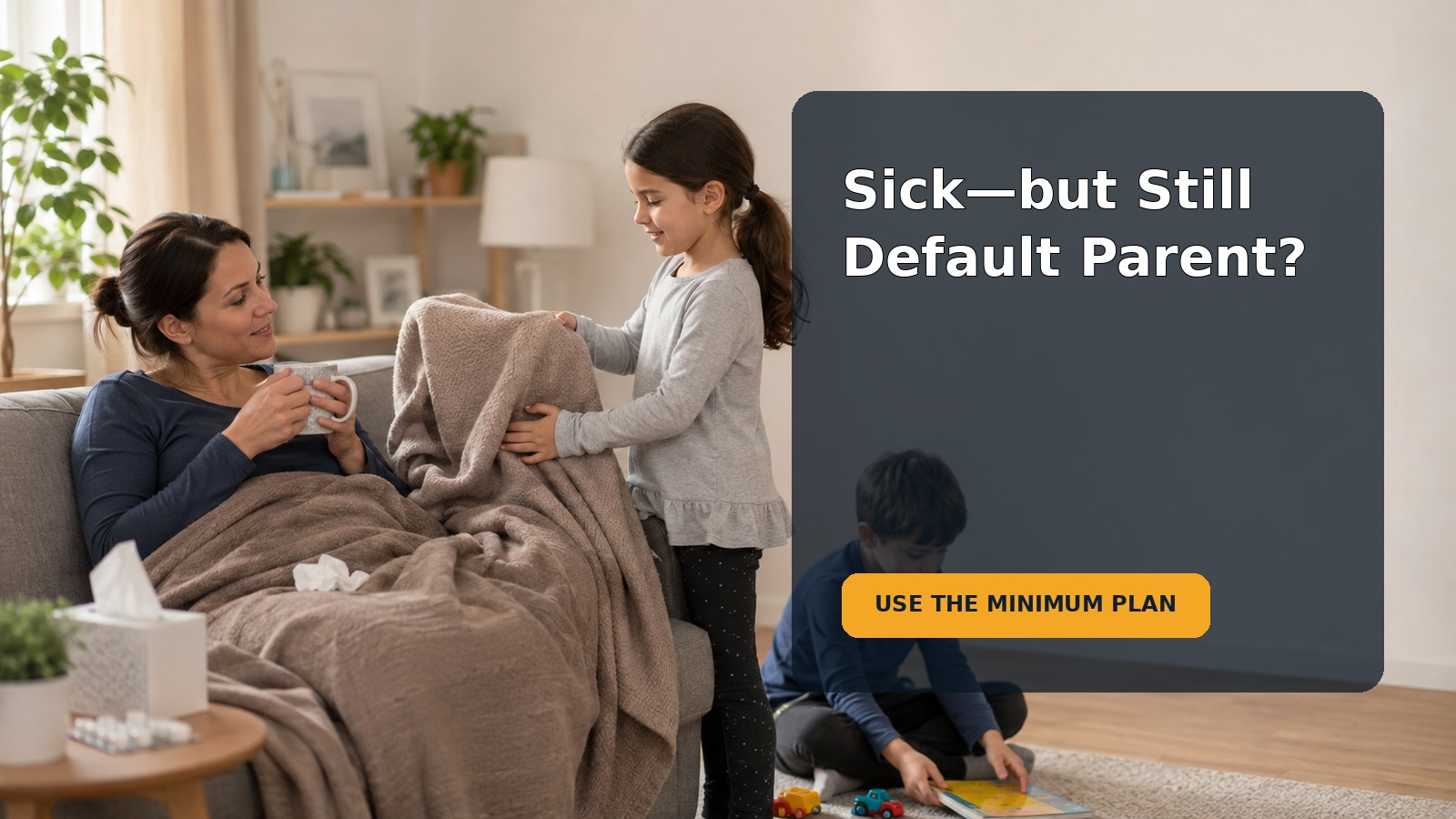
Make the 60-second safety check first
Before deciding what to cook or whether homework will happen, check the few conditions that change the whole plan:
- Your capacity: Are you alert, steady on your feet and able to respond to an emergency?
- The children: Is anyone very young, ill, injured, likely to leave the safe area, or needing hands-on care you cannot provide?
- The setting: Are medicines, cleaning products, sharp tools and hot appliances secured? Can everyone stay in one easy-to-supervise area?
- Backup: Who can come in person, take a child, deliver supplies or remain available by phone?
- Time-sensitive essentials: Which medications, feeds, school pickups or appointments truly cannot move?
If you are the only adult and your capacity is slipping, call for help before the situation becomes urgent. A clear request works better than a general “I’m struggling.” Try: “I am too unwell to supervise safely from 2 to 6. Can you take the children, or come here and be the responsible adult?” If your normal support people are unavailable, consider a trusted neighbor, school contact, faith or community network, childcare provider, or local health service.
Build a minimum-viable family day
A minimum-viable day has four priorities: safe supervision, food and fluids, necessary medicine, and a workable handoff. Cleaning, ideal screen limits, elaborate meals, nonessential errands and perfect routines can wait. That is not giving up. It is using limited capacity responsibly.
| Area | Minimum for today | What can wait |
|---|---|---|
| Supervision | Children stay in a safe, visible zone with an alert responsible adult | Separate activities in several rooms |
| Food | Simple familiar foods, easy snacks and regular drinks | Cooking from scratch or enforcing the usual menu |
| Routine | Keep only anchors such as medication, nap and bedtime | Chores, enrichment and a perfectly timed schedule |
| School | Send one brief absence or late-work message if needed | Managing every assignment while acutely ill |
| Household | Contain hazards and keep a clear walking path | Laundry folding, deep cleaning and inboxes |
| Connection | Explain the plan calmly and reconnect in small moments | Entertaining everyone all day |
Step 1: shrink the environment
Choose one comfortable home base where you can rest and children can be nearby. Bring water, tissues, a lined wastebasket, chargers, simple food, diapers if needed and quiet activities into that zone. Use gates and closed doors appropriately so a baby or young child cannot reach stairs, the kitchen, bathrooms, exits or other hazards without you noticing.
Keep all medicines—including your own cold, pain or prescription medicines—up, away and secured after every dose. Never ask a young child to fetch medication. The CDC notes that young children frequently reach medicines that adults leave within access, so a sick day is not the time to relax normal storage rules.
Step 2: lower demands by age
- Babies and toddlers: Prioritize direct supervision, feeding, diapers, sleep and a contained play area. If you cannot lift, carry or stay alert safely, another adult needs to take over.
- Preschool and school-age children: Offer two or three simple choices: audiobooks, a familiar movie, coloring, blocks or a floor picnic. Put easy food and filled water bottles where they can reach them safely.
- Tweens and teens: Ask for specific, reasonable help—making sandwiches, loading dishes, entertaining a sibling for 20 minutes—without quietly making them the substitute parent. An adult remains responsible for safety and major decisions.
A temporary increase in screens can be a practical tool, not a family-policy collapse. State the boundary: “Today is a sick-day plan. We are using extra quiet screen time while I rest, and our normal routine returns when I am better.”
Step 3: use the lowest-effort food plan
Choose familiar foods that require little preparation: cereal, yogurt, fruit, toast, sandwiches, cheese and crackers, reheated leftovers or a delivered meal. Follow allergy and choking precautions for your child’s age. Hydration matters for you too; keep a drink within reach and ask someone to deliver supplies if the house is short.
Do not cook at a hot stove if you are dizzy, very sleepy or taking medicine that impairs alertness. Older children can help only with tasks they already know how to do safely.
Step 4: make one clean handoff
A helper should not have to reconstruct the entire household from scattered messages. Send one short note with:
- where each child is and who is responsible;
- allergies and time-sensitive medicines;
- food, nap and pickup essentials;
- the pediatrician and emergency contacts;
- anything unsafe or off-limits;
- the next time you will reassess.
This is also a useful moment to borrow the specificity in Nappot’s guide to asking family for practical help. “Can you help?” is easy to postpone. “Can you bring dinner and supervise bath time?” gives the other person a job they can accept.
Reduce spread without making the day impossible
If your illness may be contagious, follow current guidance for that illness and any advice from your clinician. For respiratory symptoms, the CDC recommends staying home and away from others when possible, improving cleaner air, practicing hygiene and considering added precautions such as a well-fitting mask and distancing. In a home with young children, complete separation may not be realistic. Focus on practical layers:
- wash hands at key moments and cover coughs and sneezes;
- open windows or improve ventilation when weather and safety allow;
- avoid sharing cups and utensils;
- clean frequently touched surfaces when someone has the capacity;
- have a healthier adult handle close-contact care when possible;
- ask a clinician about testing, treatment or higher-risk household members when relevant.
Do not ask a child to manage infection control perfectly or imply that affection is dangerous. A simple explanation is enough: “I’m sick, so we’re giving my body rest and using a little extra space to help keep everyone well.”
Use a script that preserves security
Children often notice that the day feels different before they understand why. Give a short, truthful explanation without making them responsible for your emotions:
“I’m sick today, and my body needs extra rest. You did not cause it, and it is not your job to fix it. Our plan is simple food, quiet activities and help from Aunt Maya at 3. I will tell you if the plan changes.”
For a child upset by the change, acknowledge the feeling and repeat the boundary: “You wanted our usual park trip. It is disappointing to miss it. Today I am not well enough to go, so you may choose a movie or an audiobook here.” Calm limits are kinder than promising an activity you cannot safely manage.
Avoid the common default-parent traps
Do not coordinate every detail from bed
If another capable adult takes over, transfer responsibility—not just chores. Give the essential information, then let that adult decide whether lunch is sandwiches or leftovers. Continuing to approve every small decision prevents rest. Nappot’s guide to sharing the parenting mental load explains why ownership matters more than occasional assistance.
Do not turn the day into a lesson about gratitude
Children may complain, become noisy or need repeated reminders. Their imperfect response does not mean they are uncaring. Keep requests concrete and age-appropriate. Thank useful effort without making your care their responsibility.
Do not wait for a crisis to identify backup
When you recover, spend 15 minutes writing a family backup chain: first-call adult, second-call adult, school pickup option, medical contacts and where essential information lives. Ready.gov recommends that families make a communication and reunion plan before an emergency. The same principle helps during an ordinary illness. A shared family calendar can also keep pickups and appointments visible to more than one caregiver.
Know when the plan needs professional help
This article offers general planning guidance, not diagnosis or treatment. Contact a healthcare professional for advice tailored to your symptoms, pregnancy status, health conditions, medicines and exposure risks. Seek urgent or emergency help for warning signs such as trouble breathing, persistent chest pain or pressure, new confusion, inability to wake or stay awake, fainting, severe dehydration, or any symptom your local emergency guidance identifies as urgent.
Escalate the caregiving plan immediately if you cannot stay alert, cannot move safely, are repeatedly vomiting, feel likely to collapse, or cannot meet a child’s essential medical or supervision needs. If you believe a child has swallowed medicine, contact your local poison service or emergency service right away; do not wait for symptoms.
Your one-page sick-day checklist
- ☐ Decide whether I can supervise safely.
- ☐ Name the responsible adult and next reassessment time.
- ☐ Secure medicines, cleaners, exits, stairs and hot appliances.
- ☐ Gather water, simple food, diapers, tissues, chargers and quiet activities.
- ☐ Keep only essential medication, feeding, pickup and sleep anchors.
- ☐ Send one specific help request and one school/work message if needed.
- ☐ Use practical infection-control layers for the illness.
- ☐ Tell children what is changing, what is not their job and when help arrives.
- ☐ Seek clinical or emergency guidance when symptoms or caregiving capacity require it.
Success today is not a spotless home or a normal schedule. It is a safe family, covered essentials, children who understand the temporary plan, and a sick caregiver who gets meaningful rest. That is exactly what a sick default parent family plan is designed to achieve.
Frequently asked questions
Is it okay to use extra screen time when I am sick?
Yes. A temporary, clearly named sick-day exception can help reduce demands while maintaining safe supervision. Choose age-appropriate content, use normal device safety settings and explain that the usual routine will return.
How much should older children help?
Ask for limited tasks they can already do safely, such as filling water bottles or making a simple snack. Do not make a child responsible for medical decisions, all-day care of siblings, or monitoring an adult whose condition may become urgent.
What if nobody can come?
Shrink the plan to safe supervision and essentials, keep children in one secure area, use delivery if available and continue calling your backup chain. If you cannot safely supervise or meet essential needs, contact local health, emergency or community services rather than hoping your capacity improves.
When should we return to the normal routine?
Reassess rather than choosing a rigid deadline. Resume responsibilities in stages as your alertness, strength and symptoms improve, following current public-health guidance and clinical advice for contagious illness.