When people say, “Let me know if you need anything,” the offer may be sincere—but turning it into useful support can feel like one more job. You may be tired, recovering, learning your baby’s rhythms and unable to produce a task list on demand. Learning how to ask family for help after a new baby can reduce that decision burden. The key is to make the request specific, time-limited and easy to accept or decline.
You do not need to host, hand over the baby or explain every detail of your recovery. Helpful support should protect the recovering parent’s rest, privacy and medical care. It should also respect how the baby is fed, soothed and kept safe.
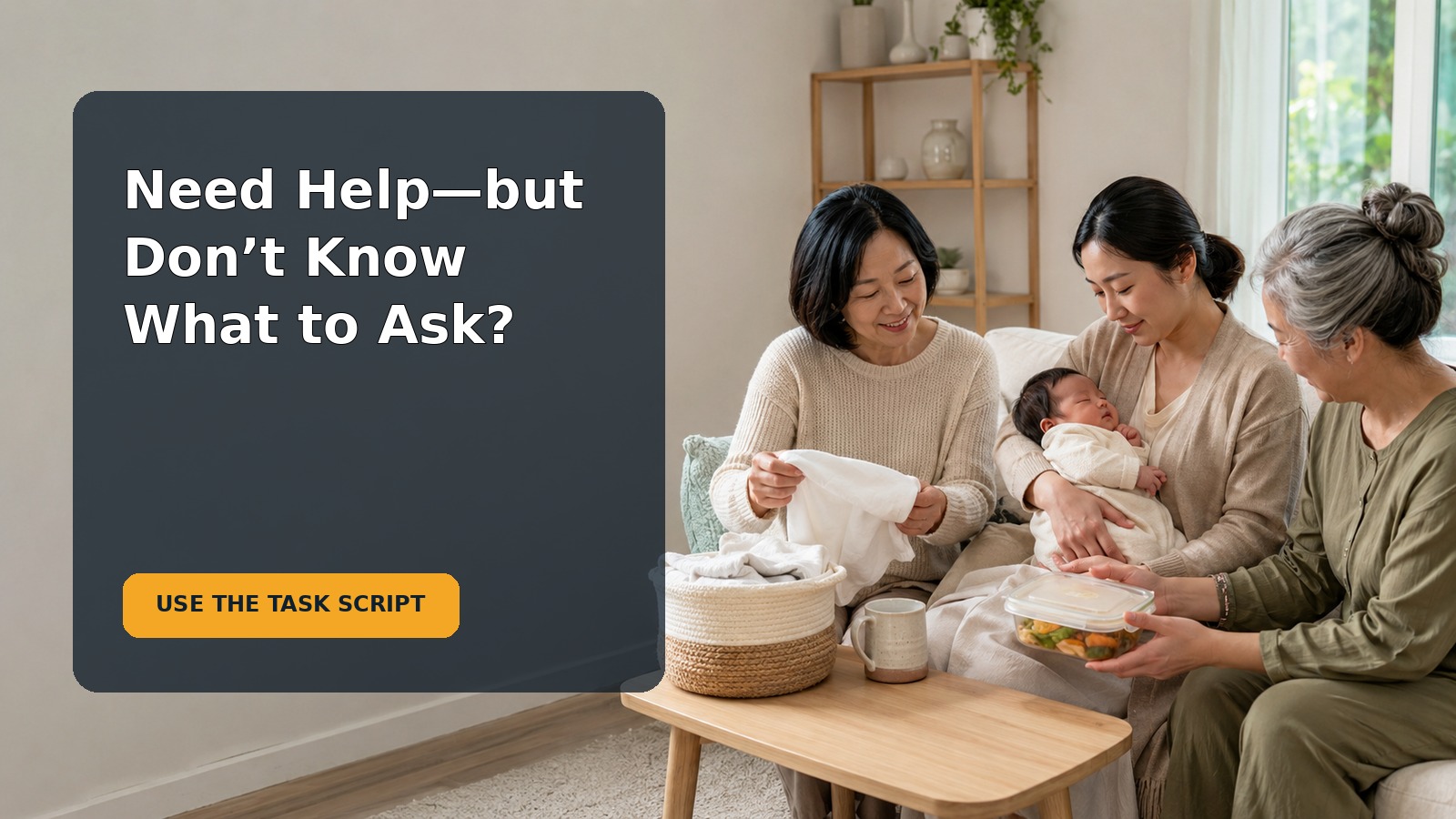
Start with the help you need most
Before contacting anyone, do a quick needs check. Do not try to design a perfect support system. Ask: What would make the next 24 hours noticeably easier? The answer may be food, sleep, clean clothes, a pharmacy pickup, transport to an appointment or someone taking an older child to the park.
Separate practical help from baby visits
A visit and a support task are not automatically the same thing. A relative may imagine holding the baby while you cook or tidy. You may need the opposite: someone to unload the dishwasher while you feed the baby, or to leave groceries at the door while you sleep.
Say what help means in your home. For example:
“We would love practical help this week. The most useful thing would be a prepared dinner dropped off on Tuesday. We are keeping visits short while we settle in, so a doorstep handoff would be perfect.”
This is clear without being unkind. It names the task, timing and visit boundary in one message.
Choose tasks that can be fully owned
The best task is one another person can complete without repeated questions. “Help with dinner” still leaves you choosing the meal, checking ingredients and deciding when it should arrive. “Could you bring a nut-free pasta dinner for two adults by 5:30 on Thursday?” transfers much more of the work.
This is the same principle used when sharing the parenting mental load: real help includes noticing, planning, doing and following up—not just the final visible step.
Build a small postpartum help menu
A short menu prevents you from having to invent a request every time someone offers. Keep it in a phone note and share only the items that fit the person, your relationship and your comfort level.
Low-contact tasks
- Leave a prepared meal or groceries at the door.
- Pick up prescriptions or household supplies.
- Return library books, parcels or borrowed baby equipment.
- Take out bins, water plants or walk a familiar dog.
- Coordinate a meal schedule with other relatives so deliveries do not pile up.
In-home tasks
- Run, dry and fold one load of laundry.
- Wash dishes, wipe the kitchen counters or empty the dishwasher.
- Change bed linens and start a fresh towel load.
- Prepare a simple snack tray and refill water bottles.
- Hold the baby only if the parent asks, while the parent showers, eats or rests nearby.
Help for the wider family
- Take an older child to school, practice or the playground.
- Bring an older child a meal and give them calm one-to-one attention.
- Drive the recovering parent to an appointment if requested.
- Manage a group update so the parents do not answer the same questions repeatedly.
- Help with paperwork or appointment notes, with the parent’s consent.
Not every task suits every helper. Give food requests to someone who reliably follows allergy instructions. Reserve transport, childcare and private paperwork for people you trust. If a relative tends to overstay or ignore boundaries, choose a doorstep task—or do not ask them.
Use the specific-task script
A useful request has five parts: appreciation, one task, a time window, any essential boundary and an easy way to decline.
“Thank you for offering to help. Could you [specific task] on [day/time]? We need [one essential detail or boundary]. If that does not work for you, no problem at all—please just let me know.”
Script for a meal
“Thank you for offering. Could you bring a dinner for two adults on Wednesday between 5 and 6? Please make it dairy-free and use disposable or clearly labeled containers. A doorstep drop-off would help us rest. If Wednesday is not convenient, no worries.”
Script for chores
“Could you come Saturday from 10 to 11 and do one load of towels plus the dishwasher? We are not ready for a social visit, so we may be quiet while you work. It is completely okay if that is not your kind of task.”
Script for an older child
“Would you take Maya to the playground on Sunday from 2 to 3:30 and bring her home afterward? Please keep your phone on and use her usual car seat. If you cannot, that is fine—we are asking a few trusted people.”
Script when you cannot decide
“I appreciate the offer. My brain is too tired to plan right now. Could you choose one of these: bring soup, pick up our grocery order or take the bins out? Any one of those this weekend would help.”
Set boundaries before the helper arrives
Clear expectations reduce resentment on both sides. They also make the task safer and easier to complete.
- Time: Give a start and finish time rather than “come whenever.”
- Health: Ask anyone who is unwell or recently exposed to an infectious illness to postpone. Follow your baby’s clinician’s guidance for visitors.
- Baby contact: State whether you are comfortable with holding, kissing, feeding or photographing the baby.
- Privacy: Say which rooms, health details and family updates are private.
- Advice: You can say, “We are following our clinician’s plan and are not looking for feeding or sleep advice today.”
- Photos and social media: Ask relatives not to post or forward pictures without permission.
If a boundary is ignored, end the task calmly: “This visit is not working for us today, so we need to stop here. We will contact you another time.” You do not have to debate the rule while exhausted.
Common problems—and a better response
“They might think I am demanding”
A request is not an order. The easy-out sentence—“If that does not work, no problem”—preserves choice. Specificity can actually make generosity easier because the helper knows what success looks like.
“They only want to hold the baby”
Offer a choice that still meets your need: “I am not ready to hand over the baby, but laundry or lunch would be wonderful.” If they decline, accept the answer and ask someone else. You are not required to exchange baby access for help.
“Managing helpers takes more energy than doing it myself”
Use repeatable instructions, group similar tasks and name one trusted coordinator. For example, one sibling can organize meals, confirm allergies and prevent duplicate deliveries. Keep the coordinator’s authority narrow: they can manage the task schedule, not share medical updates or invite visitors without consent.
“No one nearby can help”
Practical support does not have to come from relatives. A friend can order groceries from another city. A neighbor may take bins out. A faith or community group may provide meals. Your health care team may know local postpartum, lactation, mental-health, home-visiting or social-service resources. Ask what is available and what it costs; do not assume a program is free or suitable.
Know when family help is not enough
Relatives can cook, clean, drive and listen. They do not replace postpartum medical or mental-health care. Keep scheduled follow-up and contact your clinician when something feels wrong, even if other people tell you it is “normal.”
The CDC’s urgent maternal warning signs include a severe or worsening headache, vision changes, fever of 100.4°F (38°C) or higher, trouble breathing, chest pain, heavy bleeding, severe belly pain, extreme swelling of the hands or face, and thoughts of harming yourself or the baby. This is not the full list. Seek immediate medical help for urgent warning signs, tell the clinician that you recently gave birth and do not stay alone if you cannot keep yourself or the baby safe.
Persistent sadness, anxiety, hopelessness, loss of interest, frightening thoughts or difficulty functioning also deserve prompt attention. The American College of Obstetricians and Gynecologists’ postpartum depression guidance explains that postpartum depression is treatable. Contact your obstetric clinician, primary-care clinician or another qualified health professional rather than waiting for family support alone to fix it. If there is immediate danger, contact local emergency services.
A simple 15-minute setup
- Name three needs. Pick one food task, one household task and one rest or transport task.
- Choose three people. Match each person with a task they can reliably complete.
- Send one request. Use the five-part script and propose a specific time.
- Write one boundary. Decide your visit length, illness rule or baby-contact preference before anyone arrives.
- Add a professional-care note. Put clinician numbers and urgent-care instructions where both parents or caregivers can find them.
Success does not mean building a flawless village overnight. It means one useful task leaves your plate without creating another task in its place.
Frequently asked questions
Is it rude to ask someone to help without visiting the baby?
No. You can appreciate the offer while setting a doorstep or chore-only boundary. The helper can decline, and you can protect recovery time and privacy.
How much notice should I give?
Give as much notice as you can, but small same-day requests are reasonable when they include an easy way to say no. Avoid presenting a non-urgent request as an obligation.
What if a relative does the task differently?
Distinguish preferences from essentials. Give instructions for allergies, medication, car seats, baby safety and privacy. For lower-stakes details—how towels are folded, for example—accept “good enough” if it does not create more work or risk.
Should I make a public sign-up list?
Only if you are comfortable with who can see it. Share the minimum information needed. Do not place medical details, the baby’s routine, home-access codes or times the family will be away on a public page.
What if I feel guilty accepting help?
Try viewing the request as a clear invitation, not a debt. The other person chooses whether to accept. A simple thank-you is enough; you do not owe hosting, baby access or an immediate return favor.
Sources
- Centers for Disease Control and Prevention: Urgent Maternal Warning Signs and Symptoms
- American College of Obstetricians and Gynecologists: Postpartum Depression
This article provides general education and practical planning ideas. It is not a diagnosis or a substitute for individualized medical or mental-health care.