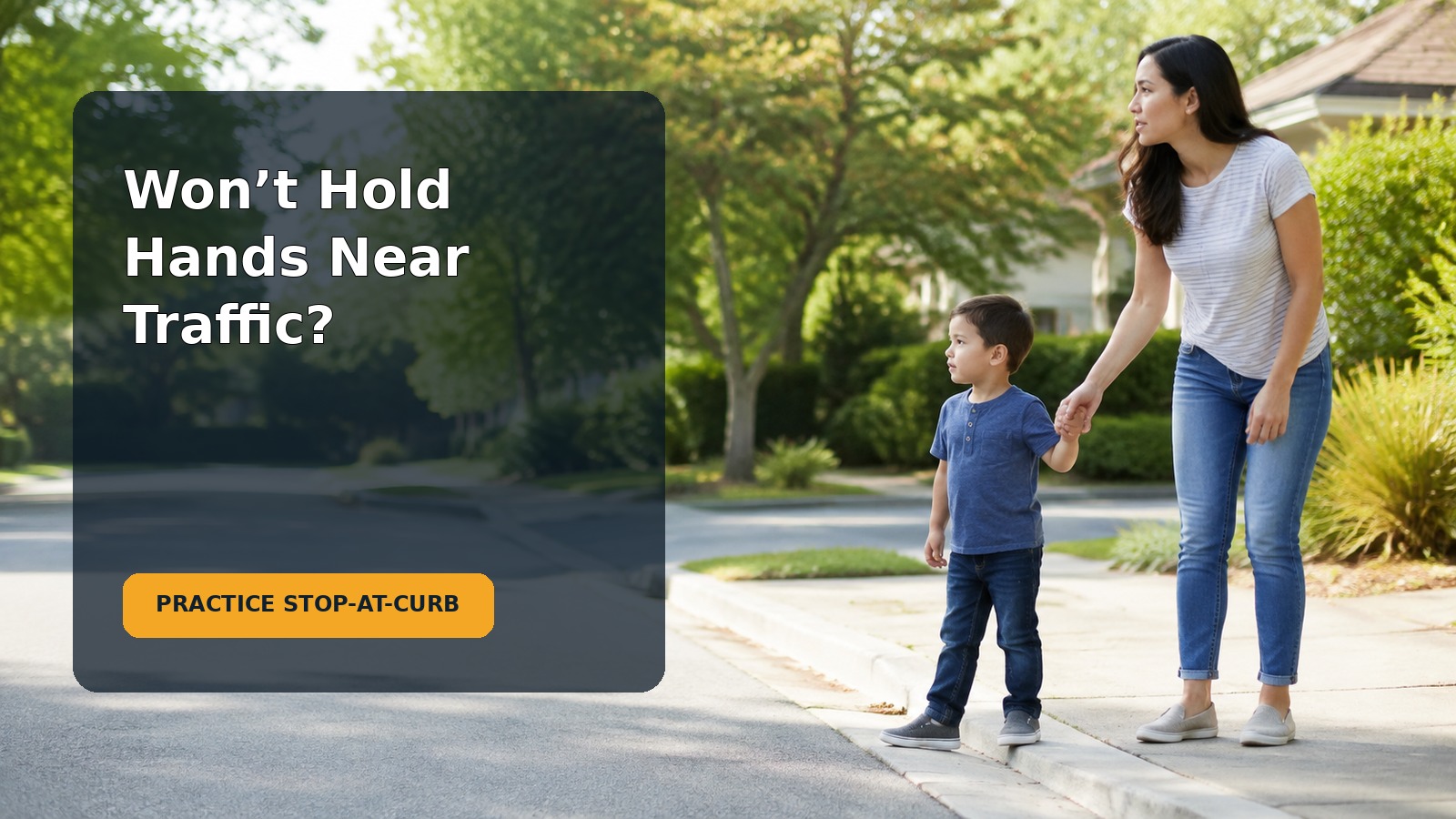
If your 3 year old won’t hold hands near traffic, treat it as a safety problem to manage—not a character problem to punish. Preschoolers can learn a simple curb routine, but they cannot reliably judge a vehicle’s speed, distance or stopping time. Near streets, driveways and parking lots, the adult keeps physical control. Practice builds the habit; it does not transfer traffic-safety responsibility to the child.
The immediate rule can stay short: “Near cars, you hold my hand, ride in the stroller, or I carry you.” Offer the choice before reaching the risky area. If your child refuses, follow through calmly with the safe option you can physically manage.
Start with a 60-second traffic-safety check
Before you work on cooperation, reduce the chance that one difficult moment becomes an emergency:
- Choose your control method: hand-holding, carrying, a properly used stroller, or another age-appropriate restraint for the setting.
- Keep the child on the inside: when possible, place your body between your child and moving vehicles.
- Free one hand: put your phone away and consolidate bags before leaving the building or car.
- Scan hidden movement: watch driveways, reversing vehicles, parking-space gaps and cars that may turn across a crossing.
- Plan the handoff: decide which adult is responsible before opening a car door or leaving a shop.
If your preschooler pulls free, runs toward traffic or drops to the ground in a live roadway area, do not debate there. Move them to a protected place, regain physical control and use the stroller or carry option. Teaching can happen after everyone is safe.
Why a 3-year-old may resist holding hands
Refusal is common for understandable developmental reasons. A 3-year-old wants independence, acts quickly, has limited impulse control and may not connect an invisible risk with the adult’s firm response. Hand-holding can also feel uncomfortable when an adult grips tightly, walks too fast or pulls the child’s arm upward.
The trigger may be highly specific: excitement on arrival, fatigue after preschool, a crowded parking lot, a rushed transition, wanting to carry a toy, or discomfort with touch. Observe the pattern without assuming manipulation. A child who accepts hand-holding in calm places but fights it after a long day may need a better transition plan. Nappot’s guide to toddler transitions without a power struggle offers useful preparation strategies.
Some children have motor, sensory, communication or regulation differences that change how they respond. The safety boundary remains, but the method may need help from the child’s pediatrician or another qualified professional.
Teach a stop-at-the-curb routine in a safe place
When a 3 year old won’t hold hands near traffic, practice should begin away from moving vehicles. Use a chalk line, the edge of a rug or a path in a fenced yard as the pretend curb. Keep sessions short enough to end successfully—often two or three minutes.
Step 1: teach one cue and one body action
Choose consistent words such as “Stop, feet together.” Walk toward the pretend curb, say the cue and stop with your toes behind the line. Help your child copy you. Praise the action precisely: “You stopped your feet behind the line.”
Avoid a long lecture about injury. The useful skill is responding to the cue immediately. Practice from only a few steps away at first, then add a little distance once the response is steady.
Step 2: add hand connection
After stopping, say, “Hand connects before we cross.” Let your child choose your left or right hand when both options are safe. Use a comfortable palm-to-palm hold rather than pulling at the wrist or arm. If carrying an object interferes, place it in a bag before approaching the curb.
Make the sequence predictable:
- Stop with feet behind the edge.
- Connect hands with the adult.
- Look left, right and left again together.
- Listen for engines and watch for moving or turning vehicles.
- Cross while continuing to hold hands.
Looking together is educational, but the adult still decides when and where to cross. A preschooler’s enthusiastic “no cars!” is not a safety clearance.
Step 3: practice the exact trip
Rehearse during a quiet walk with one focused adult, not for the first time while late, carrying groceries or managing siblings. Narrate the landmarks: “The shop door opens. We stop. Your hand connects. We walk to the car together.”
Use the same routine at curbs, parking-lot lanes and driveway edges. Driveways deserve special care because a vehicle may begin moving with little warning and a small child can be hard for a driver to see.
Step 4: rehearse refusal
Children need to know what happens if they say no. Practice the script in a safe place:
“You want your hands free. Near cars, I keep your body safe. You may hold this hand, hold the other hand, or ride in the stroller. If you cannot choose, I will choose the stroller.”
Then follow through without bargaining. The choices concern how the boundary happens, not whether the child is controlled near traffic.
Use the right plan for each high-risk setting
| Setting | Adult safety plan | Child’s practice job |
|---|---|---|
| Sidewalk near a road | Adult stays road-side and maintains hand contact | Walk beside the adult and stop at every edge |
| Parking lot | Connect before leaving the car or building; move directly to the destination | Use “stop, feet together” and keep the connected hand |
| Driveway | Supervise directly; confirm vehicles are not moving | Stop at the driveway edge and wait for the adult |
| Busy crossing | Choose the safest crossing, obey signals and scan turning traffic | Look and listen with the adult while holding hands |
| Child is tired or bolting | Use carrying or a stroller rather than testing cooperation | Regulate first; practice later in a protected place |
A bus stop adds waiting and vehicle movement to the challenge. For an older sibling’s route, Nappot’s school bus stop safety drill can help the family define a waiting spot and repeatable sequence, while the preschooler remains physically controlled by an adult.
What usually makes resistance worse
Do not threaten to leave the child behind
“I’m going without you” may create panic and can prompt a child to run after the adult. Say what you will do: “I will help your body into the stroller so we can cross safely.”
Do not shame or label
Words such as “naughty,” “babyish” or “you never listen” do not teach the movement sequence. Separate the child from the behavior: “You let go near the cars. I am going to carry you now.” Later, practice one successful repetition.
Do not turn a parking lot into a negotiation
Too many warnings can accidentally teach that the first several “no” responses do not count. Give the boundary once, offer two safe options, then act. Save discussion for a protected location.
Do not use practice as proof that supervision is no longer needed
A child may perform perfectly ten times and still run on the eleventh. Skill practice cannot overcome the developmental limits of a preschooler in unpredictable traffic. Continue direct adult supervision and physical control.
Make cooperation easier without weakening the rule
- Preview: “When the door opens, your hand connects to mine.”
- Offer a safe role: let the child press the crossing button while you maintain contact.
- Use specific praise: “You stopped at the edge and waited.”
- Slow the transition: allow an extra minute so safety is not competing with adult urgency.
- Match the equipment: bring the stroller when fatigue or repeated bolting makes hand-holding unreliable.
- Build independence elsewhere: offer meaningful choices in low-risk settings. Nappot’s article on supporting preschool independence explains how practice and responsibility can grow without handing over adult safety decisions.
When to ask for professional guidance
Raise the pattern with your child’s pediatrician if bolting is frequent across settings, your child seems unable to respond to a practiced stop cue, touch causes intense distress, coordination makes walking together difficult, or the behavior creates repeated near misses. Ask for strategies that fit your child’s communication, sensory and developmental needs.
Seek emergency help immediately after a traffic incident or impact, or when a child may be injured. Follow local emergency guidance rather than relying on an online article to assess an injury.
This guide provides general pedestrian-safety education. Road designs, crossing laws and transport recommendations vary by location. Follow local rules and current guidance from road-safety authorities.
Your stop-at-the-curb checklist
- ☐ Choose hand-holding, carrying or stroller control before entering the traffic area.
- ☐ Put the phone away and free one adult hand.
- ☐ Place the adult between the child and moving vehicles where possible.
- ☐ Say the same cue: “Stop, feet together.”
- ☐ Connect hands before looking or crossing.
- ☐ Let the adult judge traffic and choose the crossing time.
- ☐ Use two safe choices, then follow through calmly.
- ☐ Practice only in a protected place or quiet, fully supervised setting.
- ☐ Switch to carrying or a stroller when the child is tired, dysregulated or repeatedly pulling away.
- ☐ Ask for professional help when sensory, motor, communication or regulation needs complicate safety.
Success is not a preschooler managing traffic independently. It is a child beginning to recognize the stop cue while an adult consistently prevents access to moving vehicles. If your 3 year old won’t hold hands near traffic, a calm boundary, a rehearsed sequence and a dependable backup option are safer than repeated warnings.
Frequently asked questions
Should I use a wrist strap or harness?
Families may consider an age-appropriate product when bolting risk is high, but it should not replace direct supervision. Check current product instructions and safety notices, use the product only as designed, and ask a qualified professional for individualized guidance if your child has mobility or sensory needs.
What if my child drops to the ground when I ask for a hand?
Move out of the traffic area if possible, use few words and switch to the safe backup plan. Carry the child or use the stroller if you can do so safely. Discuss feelings and practice later; do not wait beside moving vehicles for agreement.
How long will the routine take to work?
There is no reliable deadline. Practice brief repetitions regularly and look for gradual gains: stopping more quickly, offering a hand with fewer prompts and recovering faster after disappointment. Keep adult control even when cooperation improves.
Can my preschooler cross after looking both ways?
Not independently. Looking both ways is a useful learning step, but young children cannot consistently judge speed, distance, turning traffic or whether a driver has seen them. The adult decides when to cross and maintains physical control.