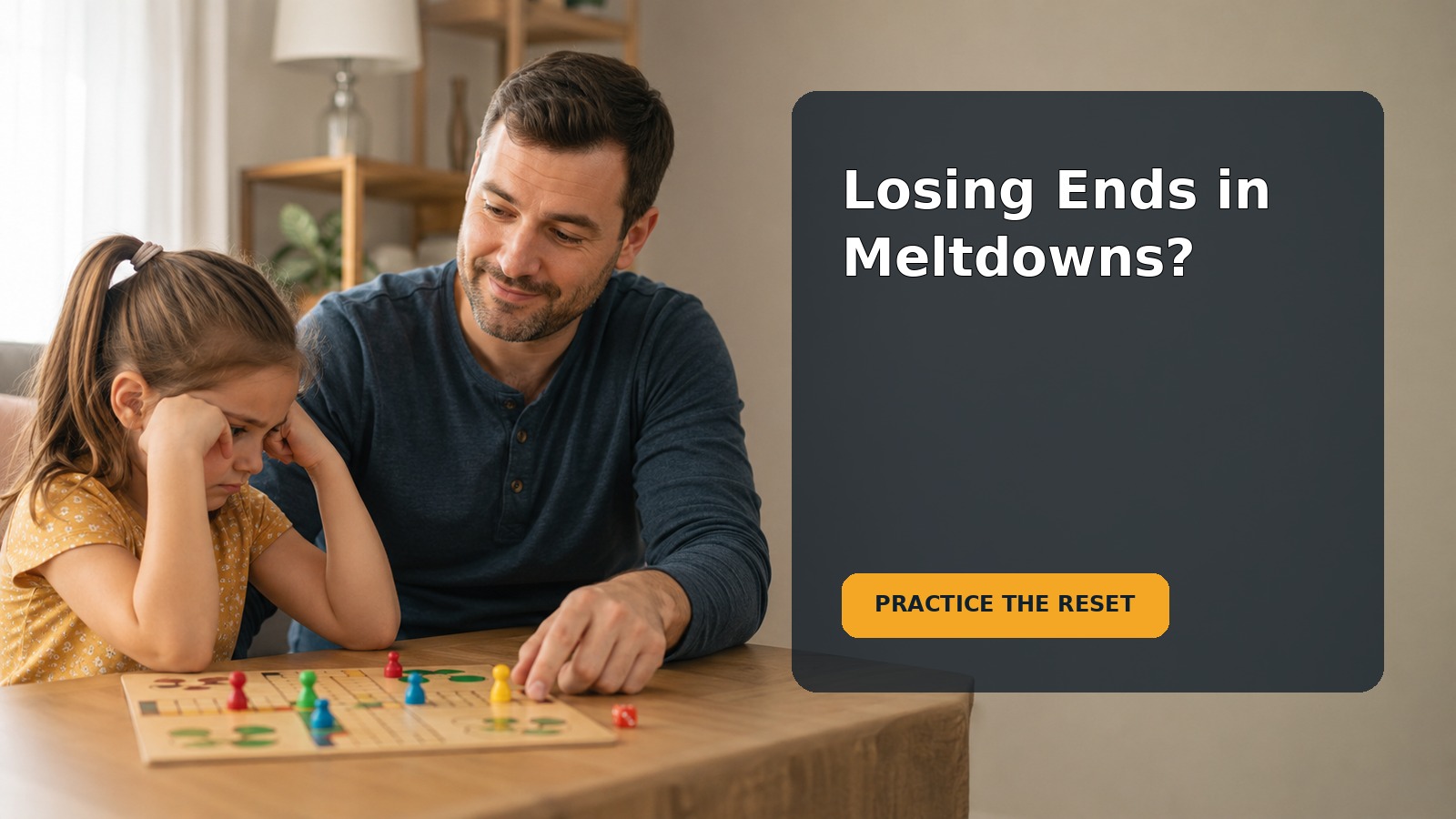
If you searched for help with a 7 year old sore loser, you may be seeing tears, accusations, quitting, rule-changing or a game piece pushed across the table. That does not mean your child is mean or doomed to poor sportsmanship. It usually means that disappointment is arriving faster than their coping skills.
The goal is not to make losing feel good. The goal is to help your child feel disappointed, stay safe and respectful, recover, and eventually try again. You can teach that sequence without shaming them and without secretly arranging a win every time.
Start With the Immediate Question: Is This Typical?
Strong disappointment can be common at seven. Children this age understand rules and care more about how they compare with peers, but knowing the rule is not the same as managing the feeling. A child may be gracious during an easy game and fall apart when they are tired, hungry, playing a sibling or worried about looking incapable.
The American Academy of Child and Adolescent Psychiatry notes that sports can teach fair play, teamwork and self-esteem. It recommends realistic expectations, positive feedback, praise for effort and improvement, and adult modeling of respectful behavior. Its useful distinction is that success is not identical to winning, and failure is not identical to losing.
Separate the feeling from the behavior
Say clearly: “It is okay to feel angry that you lost. It is not okay to insult someone, throw pieces or change the rules.” This protects your child from shame while preserving a firm boundary. The feeling is allowed; unsafe or hurtful actions are stopped.
Notice what changes the answer
Before deciding that every game is a problem, look for a pattern:
- Does it happen only with a sibling, one friend or one highly valued activity?
- Is it worse late in the day, before meals or after a demanding school day?
- Can your child recover with a short break, or does distress last a long time?
- Are adults teasing, arguing with officials or treating every result as a verdict?
- Does the same reaction appear with mistakes, homework, friendships and classroom feedback?
A narrow game-time struggle often responds to practice. A broad pattern may deserve a conversation with the teacher, coach or pediatrician.
Use a 60-Second Calm and Safety Check
When the loss has just happened, do less. Move breakable pieces aside, block hitting or throwing, lower your voice and reduce the audience. Do not lecture while your child is flooded.
Try this script:
“You really wanted to win. I will not let you throw the pieces. We are taking a reset. When your body is calmer, you can choose to finish the goodbye or talk about what happened.”
If another child is present, attend to safety and repair without making your seven-year-old perform an apology on demand. A sincere repair is more useful after regulation returns. If you need a model for calm boundaries around big behavior, Nappot’s guide to stopping aggression without shaming explains the same feeling-versus-action principle for a younger age.
A Practical Plan to Teach Losing Gracefully
Step 1: Agree on the reset before the game
Practice when nobody is upset. Choose one short game that includes both skill and chance. Keep the first session to about 10 minutes. Explain the three-part reset:
- Pause: hands on your own body or flat on the table.
- Breathe: take three slow breaths or get a drink of water.
- Close: say “good game,” “I need a break,” or “I want to try again later.”
Let your child choose which closing phrase sounds natural. The boundary is that the game ends safely; the child gets some ownership over how to exit.
Step 2: Practice low-stakes losses on purpose
Do not rig the game, but do not start with a championship either. Play short rounds so your child experiences winning and losing without a long buildup. Adults should model both outcomes:
“I wanted that point. I feel disappointed, so I’m taking one breath. Nice move. I’m ready for the next round.”
This is not a speech about being perfect. It is a live demonstration that disappointment can pass without attacking anyone. If your child uses even one part of the reset, name that specific skill: “You were upset and kept the pieces on the table. That was self-control.”
Step 3: Review one thing, not everything
After everyone is calm, ask only two questions: “What was the hardest moment?” and “Which reset step could help next time?” Avoid replaying every mistake. Choose one small goal for the next game, such as keeping hands safe or using the break phrase.
For a child who also rushes when they fear being wrong, the slow-down routine for careless mistakes offers another way to practice pausing without turning performance into a character judgment.
A Seven-Day Losing-Practice Ladder
| Day | Practice | Parent focus |
|---|---|---|
| 1 | Name disappointment and choose a break phrase. | No game required. |
| 2 | Role-play an adult losing one imaginary point. | Model pause, breath and close. |
| 3 | Play one five-minute round. | End while regulation is still possible. |
| 4 | Watch a brief game together. | Notice one respectful response to a result. |
| 5 | Play two short rounds. | Praise recovery, not the score. |
| 6 | Let your child teach the reset to an adult. | Build ownership without putting them on display. |
| 7 | Repeat the easiest successful setup. | Review one improvement and one next step. |
If a round falls apart, return to an easier step. Practice is not a pass-fail test.
Common Mistakes and Better Alternatives
Do not use the label as the lesson
Calling a child “a sore loser” may describe the problem, but repeating it to them turns a learnable behavior into an identity. Say, “Losing is hard for you right now, and we are practicing what to do,” rather than, “You are such a sore loser.”
Do not let them win to prevent every reaction
Occasionally choosing a cooperative game is fine. Quietly arranging constant victories is different: it removes the exact recovery skill your child needs to rehearse. Use manageable, honest games and stop before fatigue takes over.
Do not demand instant cheerfulness
Good sportsmanship does not require a smiling performance. A neutral “good game” or respectful request for space is enough. Warmth can return later.
Do not praise only talent or results
Focus on observable choices: waiting for a turn, following a disputed rule, staying near the game after a mistake, or coming back to repair. Nappot’s article on helping school-age children build healthy friendships can help when competition is affecting peer relationships.
Do not model the behavior you want stopped
Children notice adults blaming referees, mocking other players or making excuses. If you react badly, repair it aloud: “I complained about that call. I was disappointed, but that was not respectful. I am resetting.”
When to Involve a Teacher, Coach or Pediatrician
Start with a routine conversation if meltdowns are frequent, affect friendships, or happen in several settings. Ask the teacher or coach what happens before, during and after a loss. Compare notes without asking them to diagnose your child.
Schedule pediatric advice when reactions are intense or persistent, your child avoids normal activities because they might lose, or you see wider concerns with anxiety, attention, learning, mood or emotional regulation. Seek prompt help if behavior creates a real risk of injury, includes threats of serious harm, or cannot be contained safely. In an immediate danger, use local emergency services.
The American Academy of Pediatrics describes regulation skills such as slow breathing, noticing body sensations, seeking an adult and taking an active break. Its guidance is written for children coping with upsetting experiences, so it is not a diagnosis or a special treatment for game frustration; these are simply general coping skills families can practice during calm moments.
One-Page Parent Checklist
Before
- Choose a short, age-appropriate game and a calm time.
- Review pause, breathe and close.
- Agree on safe hands, respectful words and a break option.
- Set a small goal that does not depend on winning.
During
- Model your own disappointment without drama.
- Stop throwing, hitting or insults immediately and calmly.
- Use few words during the reset.
- End the round if regulation is no longer possible.
After
- Praise one specific recovery action.
- Make any needed repair after everyone is calm.
- Ask what was hardest and choose one next step.
- Record patterns if the problem is frequent or widespread.
Success is not a child who never minds losing. It is a child who gradually needs less help to keep people and property safe, use a respectful exit, recover and return. That is a real emotional skill—and it improves through many small repetitions.
Frequently Asked Questions
Is being a sore loser common at age seven?
Difficulty with disappointment can be common, especially when a child is tired, hungry, embarrassed or highly invested. What matters is the intensity, recovery time, effect on others and whether the same problem appears across settings.
What should I do first?
Pick one short game, teach the three-part reset before playing and set one behavioral goal unrelated to the score. Stop safely if your child cannot continue.
How long should we try this plan?
Look for small changes over several low-pressure sessions rather than expecting one perfect game. If there is no improvement, the reaction is escalating, or daily life is being affected, ask a teacher, coach or pediatrician for input.
What if my child refuses to say “good game”?
Offer a dignified alternative such as “I need a break” or “I’ll try again later.” Require safety and respect, not a cheerful performance.
Sources
- American Academy of Child and Adolescent Psychiatry: Sports and Children
- Centers for Disease Control and Prevention: Positive Parenting Tips
- American Academy of Pediatrics: skills that support regulation and resilience
This article provides general parenting education, not a diagnosis or individualized mental-health advice. A pediatrician or qualified child mental-health professional can help when emotional reactions are severe, persistent or affecting everyday life.