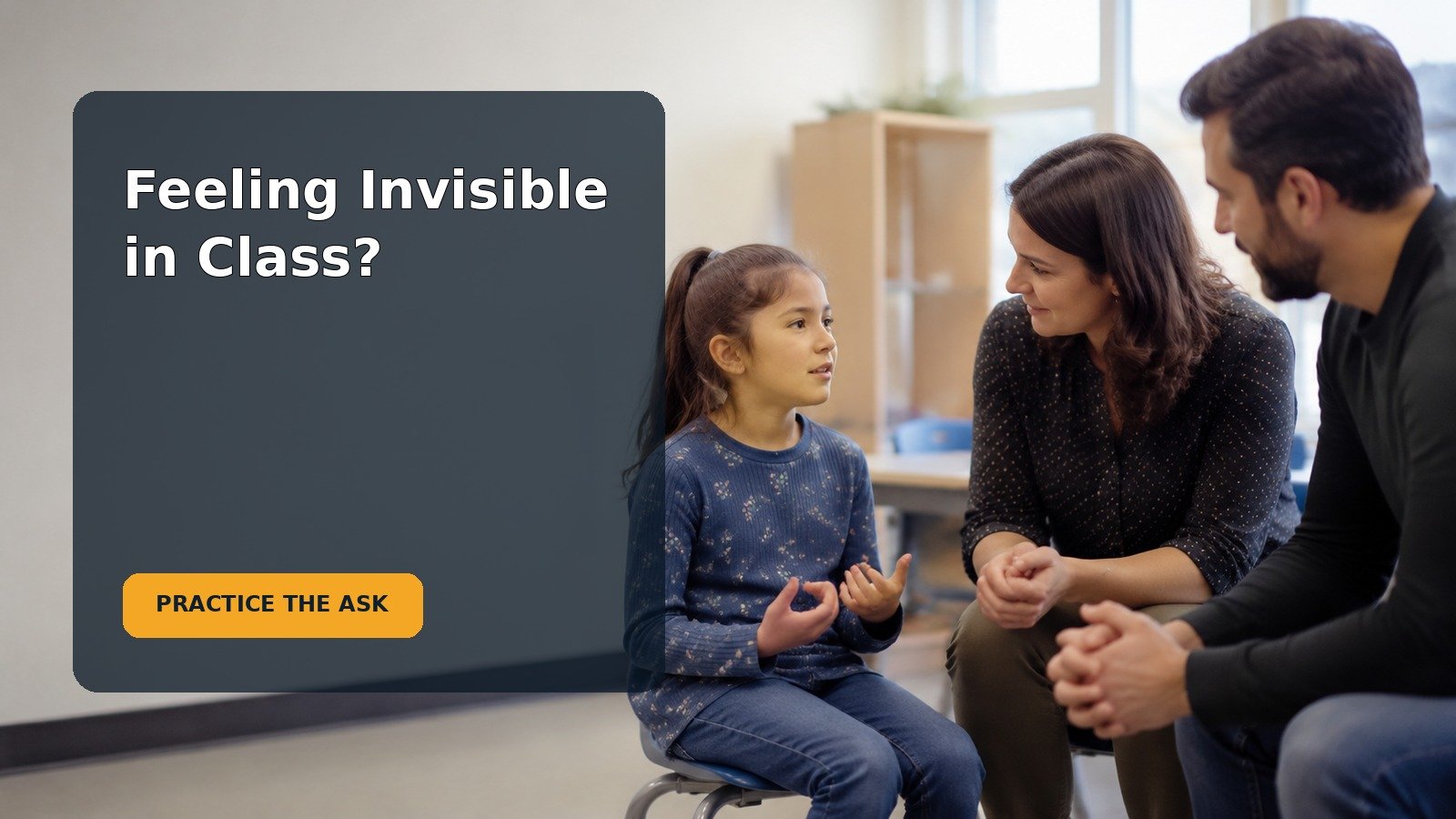
When a seven-year-old says, “My teacher never calls on me,” the feeling behind the sentence matters. They may be noticing a real classroom pattern, remembering a difficult moment, or using “never” to describe how invisible or worried they feel. A calm response to teacher never calls on my child starts with belief in the child’s experience without jumping to conclusions about the teacher’s intent.
Your job is not to coach a confrontation or promise that your child will be called on next. It is to help them describe what happened, practice a respectful way to ask for support, and invite the teacher’s perspective. That protects your child’s dignity and gives the adults a workable starting point.
Start with the parent’s immediate question
What can be typical at 7–8 years
Children at this age are becoming more aware of fairness, turn-taking and how adults respond to classmates. A busy teacher may call on children who volunteer quickly, rotate in ways a child cannot see, use small-group participation, or be managing a lesson where not every hand can be raised. A child who is shy, processing a question, learning English, worried about a wrong answer, or seated where they are less visible may experience that pattern more strongly.
Those possibilities do not mean a child should simply accept feeling overlooked. Classroom participation should be accessible and respectful. The useful question is: what is happening in this specific room, and what small change would help this child take part?
What changes the answer for this child
- Is this about one lesson, one subject, or most days?
- Does your child raise a hand, wait quietly, avoid answering, or say they are afraid to speak?
- Are there tears, stomachaches, school refusal, sleep changes, or a sudden drop in confidence?
- Have peers laughed, interrupted, used slurs, or discouraged them from participating?
- Could a learning difference, disability, hearing or vision concern, language need, anxiety, or recent change at home affect access?
Treat these as clues, not a diagnosis. A child’s report is important data; the next step is gathering a clearer picture with care.
A calm first-step check
Use a 60-second reassurance-and-safety check
Choose a quiet moment and say: “I’m glad you told me. I want to understand what class feels like for you. You do not have to figure this out alone.” Then ask open questions: “What was the question about? What did you do? What happened next? Has anyone said anything unkind?” Avoid “Are you sure?” or “Just raise your hand more.” Those responses can shut down useful details.
If your child reports threats, humiliation, discriminatory comments, physical aggression, sexualized behavior, being told to keep secrets, or fear of retaliation, contact the school promptly through its safeguarding or anti-bullying process. If there is immediate danger, use local emergency support. Repeated distress or avoidance deserves timely attention even when there is no emergency.
What to observe and write down
| Detail to note | Why it helps |
|---|---|
| Date, class, lesson topic and activity | It helps the teacher look at the right routine rather than rely on a general impression. |
| Your child’s exact words | It preserves their perspective without adding adult assumptions. |
| How they tried to participate | Hand-raising, wait time, seating and small-group roles may point to a practical adjustment. |
| Peer or adult responses | This helps distinguish a participation concern from bullying, bias or a safety issue. |
| Changes outside class | Sleep, mood, attendance and physical complaints show how much support may be needed. |
The practical self-advocacy plan
Step 1: prepare a small, realistic ask
Explain that self-advocacy means asking for what helps, not proving that anyone is bad. Let your child choose one low-pressure goal: putting a hand up once, using a participation card if the teacher offers one, asking a question after class, or telling the teacher privately that they need a few seconds to think.
Practice a short script at home, then stop. Rehearsal should build confidence, not feel like another test: “I have an idea, but I need a little time to think.” Or: “Could I have a turn to answer a question today?” If speaking is difficult, ask whether the teacher will accept a note, a signal, a partner response, or a written answer. The teacher decides what fits the classroom, but a child can still be part of the conversation.
Step 2: contact the teacher constructively
Send a factual, non-accusatory message. For example: “My child has said they often feel they do not get a chance to contribute in class. We are helping them practice a respectful request for a turn. Could you share what you are noticing about participation and whether there is a small, discreet way to support them over the next two weeks?”
Ask about the teacher’s routine: Do they track participation? Use think-pair-share? Call on students after wait time? Offer multiple ways to respond? This is a partnership, not a demand for equal airtime in every lesson. A teacher may be able to vary questioning, check sightlines and seating, provide more wait time, or create predictable opportunities to contribute.
Step 3: review the result and adjust
After two weeks or several relevant lessons, ask one simple question: “Did anything make it easier to join in?” Also ask the teacher what they observed. Look for progress such as your child feeling safer, attempting one answer, being included in a partner task, or knowing how to request help. If nothing changes, request a meeting with the teacher and the appropriate school support professional to agree on specific next steps and a follow-up date.
Common mistakes and better alternatives
Avoid shame, secrecy and all-or-nothing rules
- Instead of: “You need to speak louder.” Try: “Let’s find a way you can participate that feels manageable.”
- Instead of: emailing an accusation based on one report, try: sharing the concern and asking for observation.
- Instead of: telling your child to confront classmates, try: involving the adult responsible for the setting.
- Instead of: promising a quick fix, try: promising to listen, check in and keep working on access.
Do not make your child responsible for monitoring every call-on or collecting evidence in class. Adults should handle the school conversation. Keep your child informed about the plan in simple language and protect their privacy.
Keep the plan collaborative and age-appropriate
Children do best when they have choices that match their developmental stage. A seven-year-old may choose a script, a signal, or a safe adult. They do not need to negotiate policy, disclose private information to classmates, or explain a disability themselves. If the concern relates to a documented support need, ask the school how its formal accommodation or support process works.
When to involve additional support
Routine questions to raise
Schedule a conversation when the pattern is repeated, your child is losing confidence, classroom work is affected, or you wonder whether a learning, communication, sensory, health or access need is involved. Ask the teacher what they see, what participation options already exist, and who at school can help coordinate support. A pediatrician or qualified clinician can help assess broader health, hearing, vision, anxiety or developmental concerns; one classroom experience does not establish a diagnosis.
Red flags that deserve prompt action
Ask the school to act promptly when exclusion is repeated and targeted, or when there are slurs, threats, physical aggression, harassment, retaliation, discriminatory treatment, or a failure to provide an agreed support. Seek urgent mental-health help if your child talks about self-harm, suicide, or not wanting to live; in the United States, call or text 988, or use local crisis and emergency services elsewhere.
A one-page parent checklist
Before, during and after
- Listen to the child’s account and check for immediate safety concerns.
- Write down dates, exact words, lesson context and changes in mood or attendance.
- Practice one short, respectful request only if the child wants to.
- Ask the teacher for perspective and discreet observation.
- Agree on one practical support and a review date.
- Escalate through school procedures if safety, access, bias or persistent distress is involved.
What success should look like
Success is not being called on for every question. It is a child who knows they belong in the room, has a realistic way to contribute, receives respectful adult support, and can tell a trusted adult when something feels wrong.
Frequently asked questions
Is this common at 7–8 years?
Children this age are highly aware of fairness and participation. One missed turn can feel big; a repeated pattern should be explored with the teacher rather than dismissed.
What should I do first?
Listen without arguing, check for safety concerns, record a few details, and ask the teacher for their perspective.
How long should I try the plan?
Review after about two weeks or several relevant lessons, sooner if distress increases. Change the plan with the school if it is not helping.
What if my child becomes upset or refuses to speak?
Do not force a public response. Offer a private script, note, signal or adult-supported conversation, and ask the school what low-pressure participation options are available.
Sources
- StopBullying.gov: Research and resources
- U.S. Department of Education: Individuals with Disabilities Education Act
- HealthyChildren.org: Anxiety disorders in children
This article provides general education, not a diagnosis, safeguarding investigation, individualized legal advice, or a substitute for school policy and professional guidance.