# ETF Investing for Beginners: How to Build a Diversified Portfolio From Scratch
If you’re new to investing, ETFs are one of the easiest ways to get started.
An **ETF** is an **exchange-traded fund**: a basket of investments that trades on a stock exchange like a single stock. Instead of trying to pick one winning company, an ETF can give you exposure to many companies, bonds, or other assets in one purchase.
That makes ETFs appealing for beginners who want a **diversified portfolio**. Diversification means spreading your money across many investments so one bad pick does not hurt your whole plan.
This guide explains ETF basics in plain English and shows you how to build a simple long-term portfolio from scratch.
—
## What makes ETFs beginner-friendly?
ETFs are popular with long-term investors because they are usually:
– **Simple** — one ETF can hold hundreds or thousands of investments
– **Flexible** — you can buy and sell them during market hours
– **Low-cost** — many broad-market ETFs have low annual fees
– **Diversified** — your money is spread across many holdings
– **Easy to understand** — many ETFs track a market index
### Quick definitions
– **Index**: a list of investments used to measure a market, like large U.S. stocks.
– **Index fund / index ETF**: a fund that tries to follow an index instead of trying to beat it.
– **Expense ratio**: the annual fee a fund charges, shown as a percentage.
– **Stock**: ownership in a company.
– **Bond**: a loan you make to a government or company in exchange for interest.
– **Asset allocation**: how you divide your portfolio between stocks, bonds, and cash.
– **Rebalancing**: bringing your portfolio back to your target mix.
—
## Step 1: Start with the right foundation
Before buying ETFs, make sure your basics are covered:
1. **Emergency fund**: keep some cash available for surprises.
2. **High-interest debt**: if you have expensive credit card debt, that often deserves attention first.
3. **Long time horizon**: investing for 5+ years gives your portfolio more time to recover from market drops.
If you can invest for at least five years, a diversified ETF portfolio can be a practical starting point.
—
## Step 2: Decide what kind of portfolio you want
For most beginners, the goal is not to find the “best” ETF. The goal is to build a portfolio that is:
– broad
– low-cost
– easy to maintain
– suitable for the years ahead
A simple portfolio usually starts with two big questions:
### 1) How much risk can you handle?
Stocks can rise and fall a lot. Bonds usually move less, but they may also grow more slowly.
### 2) How much complexity do you want?
Some investors prefer one all-in-one ETF. Others like a few ETFs that separate U.S. stocks, international stocks, and bonds.
—
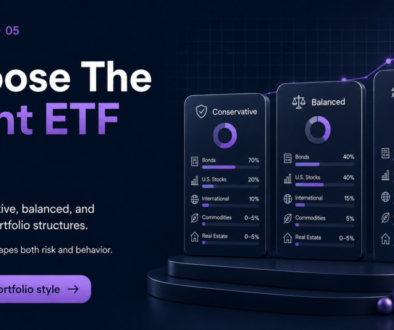
## Step 3: Pick a simple asset mix
A beginner portfolio often uses a mix like this:
– **Stocks** for long-term growth
– **Bonds** for stability
– **Cash** for short-term needs
Here’s the basic idea:
– More **stocks** = more growth potential, more ups and downs
– More **bonds** = less volatility, but usually slower growth
– More **cash** = safety and flexibility, but weaker long-term growth
For someone investing for 5+ years, a stock-heavy mix is common, but the right balance depends on how much fluctuation you can tolerate.
—
## Step 4: Choose the ETFs
You can build a diversified portfolio in different ways. The simplest versions are:
### Option A: One-fund solution
Some funds are designed to hold a mix of stocks and bonds in one ETF. This is the most hands-off approach.
### Option B: Three-fund style portfolio
A common beginner structure is:
– **U.S. stock ETF**
– **International stock ETF**
– **Bond ETF**
This gives you broad exposure without needing to buy lots of individual stocks.
### Option C: One broad stock ETF + one bond ETF
If you want even simpler, you can use:
– one total stock market ETF
– one bond ETF
This is easy to understand and easy to maintain.
—
## ETF vs. mutual fund vs. individual stocks
| Feature | ETF | Mutual Fund | Individual Stocks |
|—|—|—|—|
| Diversification | Usually high | Usually high | Low unless you buy many |
| Trading | Bought/sold during market hours | Bought after market close | Bought/sold during market hours |
| Fees | Often low | Can be low or higher | No fund fee, but trading risk is higher |
| Beginner-friendly | Yes | Yes | Usually less beginner-friendly |
| Best for | Simple, flexible investing | Automatic long-term investing | Investors who want to research companies |
**Bottom line:** for most beginners, ETFs are easier than picking individual stocks because they give you diversification right away.
—
## Worked example: building a simple ETF portfolio
Let’s say a beginner has **$10,000** to invest for the long term and wants a straightforward, diversified portfolio.
A sample structure could look like this:
– **60% U.S. stock ETF** = $6,000
– **20% international stock ETF** = $2,000
– **20% bond ETF** = $2,000
### Why this works as an example
– The **U.S. stock ETF** gives you exposure to large and small U.S. companies.
– The **international stock ETF** adds companies outside the U.S.
– The **bond ETF** adds some stability.
### What diversification means here
If one company struggles, the impact is smaller because the ETF holds many investments. If one country’s market is weak, your entire portfolio is not tied to that one market.
### If the market drops
A diversified portfolio can still fall in value. That is normal. Diversification helps reduce the impact of a single bad investment, but it does **not** remove all risk.
—
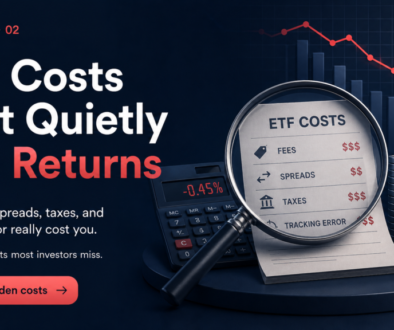
## Step 5: Keep fees low
Fees matter more than many beginners realize.
An ETF’s **expense ratio** is the annual fee you pay for the fund to operate. Even a small fee can add up over many years.
When comparing ETFs, look for:
– **Low expense ratio**
– **Broad diversification**
– **Clear index tracking**
– **Strong liquidity**
– **Liquidity** means how easily you can buy or sell without affecting the price too much.
In general, simpler and broader ETFs are often easier for beginners to live with.
—
## Step 6: Buy consistently and rebalance occasionally
A good portfolio is not only about choosing the right ETFs. It is also about staying consistent.
### A simple routine:
– Invest on a schedule, such as every month
– Add new money regularly
– Check your allocation once or twice a year
– Rebalance if one part grows much larger than planned
### Example of rebalancing
If your target is:
– 80% stocks
– 20% bonds
and stocks grow so your portfolio becomes:
– 88% stocks
– 12% bonds
you may sell some stock ETF shares or buy more bond ETF shares to get back to your target.
—
## Common mistakes beginners should avoid
### 1) Buying too many ETFs
More ETFs do not always mean more diversification. Sometimes they just create confusion.
### 2) Chasing recent winners
An ETF that performed well recently is not automatically the best long-term choice.
### 3) Ignoring fees
Even small fees matter over time.
### 4) Confusing price with value
A lower share price does not mean a fund is “cheaper” overall. Focus on what the ETF holds, its fee, and whether it fits your plan.
### 5) Panic-selling during downturns
Markets go down sometimes. A long-term plan helps you stay calm.
—
## Beginner checklist: before you buy your first ETF
– [ ] I have a basic emergency fund.
– [ ] I understand that I may lose money in the short term.
– [ ] I am investing money I do not need right away.
– [ ] I know whether I want one ETF or a small portfolio of ETFs.
– [ ] I understand the fund’s goal and what it holds.
– [ ] I checked the expense ratio.
– [ ] I know how this ETF fits my long-term plan.
– [ ] I have a plan to keep investing regularly.
– [ ] I know when I will review and rebalance my portfolio.
—
## FAQs
### What is the easiest ETF strategy for a beginner?
A simple broad-market ETF or a small 2–3 ETF portfolio is often easier than trying to pick individual stocks.
### How many ETFs do I need?
Many beginners can start with one, two, or three. You do not need a huge list to be diversified.
### Are ETFs safe?
ETFs are not risk-free. Their safety depends on what they hold. Stock ETFs can go up and down sharply. Bond ETFs are usually steadier but still have risk.
### Can I lose money in an ETF?
Yes. ETF prices can fall. If the market drops, your ETF value can drop too.
### Should I buy ETFs or individual stocks?
For most beginners, ETFs are easier because they provide diversification right away. Individual stocks require more research and carry more company-specific risk.
—
## Educational disclaimer
This article is for **educational purposes only** and is **not personalized financial advice**. Investing involves risk, including the possible loss of principal. Consider your own goals, time horizon, taxes, and risk tolerance before making investment decisions. If you are unsure, speak with a qualified financial professional.
—
## Sources
– U.S. Securities and Exchange Commission (SEC), ETF investor education: https://www.investor.gov/introduction-investing/investing-basics/exchange-traded-funds-etfs
– FINRA, ETFs overview: https://www.finra.org/investors/investing/investment-products/etfs
– Vanguard ETF education and product materials: https://investor.vanguard.com/investment-products/etfs
– iShares ETF education center: https://www.ishares.com/us/ideas/understanding-etfs
– S&P Dow Jones Indices, S&P 500 index information: https://www.spglobal.com/spdji/en/indices/equity/sp-500/
“`json
{
“seo_title”: “ETF Investing for Beginners: How to Build a Diversified Portfolio From Scratch”,
“meta_description”: “Learn ETF basics in plain English and build a simple diversified portfolio with a beginner-friendly step-by-step guide, example, checklist, and FAQs.”,
“slug”: “etf-investing-for-beginners-diversified-portfolio”,
“hero_image_filename”: “https://nappot.com/wp-content/uploads/2026/07/01-start-investing-with-etfs-beginner-diversified-portfolio-guide.png”,
“social_image_filename”: “https://nappot.com/wp-content/uploads/2026/07/01-start-investing-with-etfs-beginner-diversified-portfolio-guide.png”,
“source_urls”: [
“https://www.investor.gov/introduction-investing/investing-basics/exchange-traded-funds-etfs”,
“https://www.finra.org/investors/investing/investment-products/etfs”,
“https://investor.vanguard.com/investment-products/etfs”,
“https://www.ishares.com/us/ideas/understanding-etfs”,
“https://www.spglobal.com/spdji/en/indices/equity/sp-500/”
]
}
“`