A single high blood pressure reading at school does not mean your 11-year-old has hypertension. Blood pressure can rise temporarily because of worry, recent activity, pain, caffeine, medication, a full bladder or a cuff that does not fit correctly. The useful next step is not panic or a home diagnosis. It is to get the actual numbers, share them with your child’s pediatric clinician and arrange a correctly performed repeat measurement.
If you searched for “11 year old high blood pressure school screening what next,” this guide gives you a calm sequence: check for urgent symptoms, collect the screening details, schedule follow-up and help your child understand that the number is information—not a grade or a personal failure.
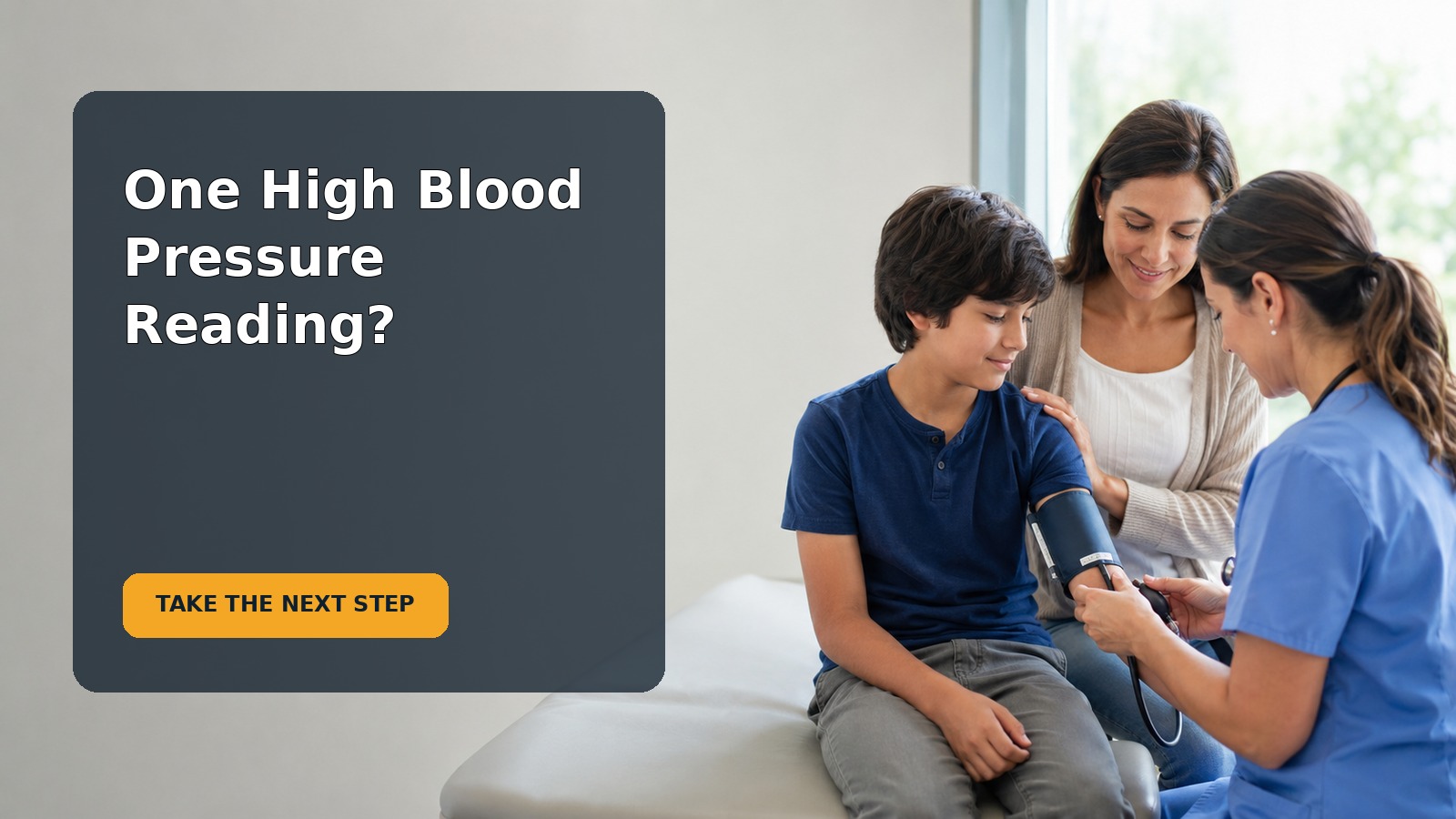
Start With the Immediate Question
Is one high reading an emergency?
Usually, an otherwise well child with one unexpected screening result needs prompt routine follow-up rather than emergency treatment. High blood pressure in children often causes no symptoms. However, the number must be considered alongside how your child feels and any instructions provided by the school nurse.
Seek urgent medical help now if your child has severe or rapidly worsening symptoms such as chest pain, trouble breathing, fainting, a seizure, confusion, weakness on one side, a severe headache, repeated vomiting or a sudden major vision change. Call emergency services if symptoms are severe. Do not wait for a routine appointment or try to lower the number with someone else’s medicine.
Why the school result is only a starting point
For children younger than 13, clinicians do not interpret blood pressure with one adult cutoff alone. They consider age, sex and height, as well as the systolic number (the top number) and diastolic number (the bottom number). The American Academy of Pediatrics’ parent guidance explains that persistently elevated readings—not one isolated number—lead to an evaluation.
Technique matters too. A cuff that is too small can produce a falsely high result. Talking, moving, sitting without back or foot support, measuring over clothing or checking immediately after rushing in from recess can also affect the reading. None of this means the school check was useless; it means the result should be confirmed under standardized conditions.
A Calm First-Step Check
Ask for the complete screening record
Contact the school nurse or health office and ask for:
- the exact systolic and diastolic readings;
- whether the measurement was repeated and, if so, all results;
- which arm was used and whether the cuff size was appropriate;
- whether the first reading came from an automatic device;
- whether your child had rested quietly before the check;
- what your child was doing and feeling just beforehand; and
- the nurse’s recommended follow-up timeframe.
Write the information down rather than relying on “a little high” or “very high.” The actual numbers and circumstances help the pediatric clinician decide how soon to recheck.
Check what might have influenced the reading
Without interrogating your child, ask whether they had just exercised, felt anxious, were in pain or needed the bathroom. Make a current list of prescription medicines, over-the-counter medicines, supplements and energy products. Some decongestants, stimulants and other medicines can affect blood pressure, but do not stop a prescribed medicine unless the prescriber advises it.
Also note relevant health history: kidney or heart problems, diabetes, sleep problems or loud snoring, premature birth, and a family history of high blood pressure or early cardiovascular disease. These details do not diagnose the cause; they help the clinician plan an appropriate assessment.
The Practical Follow-Up Plan
Step 1: Contact your child’s clinician
Call the pediatrician or primary-care office with the exact reading and any symptoms. Ask how soon your child should be seen. The right timing depends on how high the result was, whether a repeat was also high, your child’s medical history and how they feel now. Do not delay simply because your child looks well; pediatric high blood pressure is commonly symptom-free.
A useful message is: “The school measured my 11-year-old’s blood pressure at ___/___, then repeated it at ___/___. They feel ___. The nurse recommended ___. When should we come in for a correctly performed recheck?”
Step 2: Prepare for an accurate repeat measurement
Follow the clinic’s instructions. In general, avoid rushing immediately before the appointment. Let the staff know about recent exercise, illness, pain, caffeine or medicines. Your child should have a chance to use the bathroom and sit quietly before the measurement.
For a standard office check, the child is usually seated with back supported, feet supported and uncrossed, the arm supported near heart level and the correct-size cuff placed on bare skin. If an automatic reading is high, the clinician may confirm it manually. A calm repeat is not a “test” your child must pass.
Step 3: Follow the repeat-measurement pathway
The clinician will interpret the result on a pediatric chart and decide what comes next. Depending on the category and history, that may include another office check on a recommended schedule, measurements in both arms or a leg, laboratory tests, or referral. Some children are offered ambulatory blood pressure monitoring—a device that records readings over day and night—to help distinguish sustained hypertension from readings that rise mainly in clinical settings.
The American Heart Association notes that healthy ranges in children depend on sex, age and height. Let the clinician apply those standards instead of comparing your 11-year-old with an adult chart or a sibling.
Should You Check Blood Pressure at Home?
Ask the pediatric clinician before starting a home log. Home measurements can be useful in some cases, but many cuffs and monitors are designed for adult arms and may not be validated for children. Rechecking repeatedly when your child is worried can also create confusing numbers and unnecessary stress.
If the clinician recommends home monitoring, ask which device and cuff size to use, which arm to measure, how long your child should rest, what time of day to check, how many readings to take and which result should trigger a call. Bring the device to an appointment so staff can compare it with clinic equipment. Record every reading rather than keeping only the highest or lowest one.
Talk to Your Tween Without Creating Fear or Shame
At 11, children may hear “high” as “bad” and assume they caused the result. Keep the explanation factual and brief:
“The school got one blood pressure number that needs a careful recheck. Lots of things can change a reading. This is not your fault, and it does not mean you have a disease. We’ll take the numbers to your doctor and find out what they mean.”
Avoid discussing weight, food or fitness as punishment for the result. If long-term changes are recommended later, make them household routines rather than singling out one child. Children should not be placed on a restrictive diet or intense exercise plan based on a school screening alone.
Common Mistakes and Better Alternatives
Mistake: treating the first reading as a diagnosis
Better: preserve the exact result and obtain clinician-guided repeat measurements. Pediatric hypertension is established through proper interpretation and confirmation, not a single school value.
Mistake: dismissing it because your child feels fine
Better: arrange the advised follow-up. Most children with high blood pressure do not have obvious symptoms.
Mistake: using an adult cuff or checking over and over
Better: ask whether home monitoring is appropriate and use pediatric-suitable equipment and a written schedule.
Mistake: changing medication independently
Better: give the clinician a complete medication and supplement list. Continue prescribed treatment unless the prescriber tells you otherwise.
Mistake: blaming stress, weight or behavior
Better: treat the result as neutral health information. Many factors can affect blood pressure, and determining a cause belongs in a clinical evaluation.
What the Clinician May Ask About
Expect questions about previous readings, growth, sleep and snoring, kidney or urinary problems, headaches, medicines, family history, nutrition, activity and possible exposure to nicotine or stimulants. The clinician may examine pulses and listen to the heart. Tests are individualized; one elevated reading does not automatically mean extensive testing or medication.
If repeat measurements confirm a concern, care may include family-wide sleep, activity and eating routines, assessment for an underlying condition and, in some cases, medicine. The plan depends on the severity, persistence and cause. General web guidance cannot choose the right treatment for an individual child.
One-Page Parent Checklist
Today
- Check for severe symptoms; use emergency services when needed.
- Get the exact school reading and any repeat readings.
- Ask about cuff size, rest, arm and device.
- Call your child’s clinician with the numbers and symptoms.
- Reassure your child that one result is not a diagnosis.
Before the appointment
- List medicines, supplements, caffeine or energy products.
- Gather prior blood pressure readings if available.
- Note relevant medical and family history.
- Write down the school nurse’s observations.
- Do not start restrictive diets, extra workouts or borrowed medicine.
At follow-up
- Ask how the result compares with pediatric standards for your child.
- Ask when and where it should be rechecked.
- Ask whether home or ambulatory monitoring is appropriate.
- Ask which symptoms or readings require an urgent call.
- Request the plan in writing so home, school and clinic use the same steps.
Frequently Asked Questions
Can anxiety cause a high reading at school?
It can contribute, as can activity, pain and measurement conditions. Anxiety should not be assumed to be the whole explanation. A properly performed repeat measurement is how the care team sorts out a temporary rise from a persistent pattern.
What number is high for an 11-year-old?
There is no single answer that fits every 11-year-old. For children under 13, interpretation uses age, sex and height percentiles as well as the measured numbers. Give the exact result to a pediatric clinician rather than applying an adult threshold yourself.
Will my child need medicine?
Not necessarily. One school screening cannot answer that question. Treatment decisions follow confirmed measurements and an individualized assessment of severity, cause and health risks.
Should my child attend school while waiting for follow-up?
Ask the clinician or school nurse if the reported number was markedly high or if your child has symptoms. An otherwise well child with one mildly elevated reading may not need to miss school, but only the professionals who know the number and the child’s history can give case-specific advice.
The Bottom Line
For an 11-year-old with a high school blood pressure reading, the safest next move is confirmation—not panic and not dismissal. Get the actual numbers, check for urgent symptoms, contact the pediatric clinician and arrange a measurement with the right cuff and technique. Keep the conversation neutral so your tween understands that follow-up is ordinary health care, not a judgment.
This article provides general education and cannot diagnose or treat a child. Follow the advice of your child’s clinician and seek urgent care for severe symptoms.