When a preschooler is bossy during playdates, it can sound like a stream of commands: “You have to be the baby,” “Put that there,” or “No, we’re playing my game.” It is understandable to worry that other children will stop wanting to play. But labels such as “bossy,” “controlling,” or “mean” do not teach the missing skill. At ages 3 to 5, children are still learning how to combine their own exciting ideas with another person’s ideas.
The goal is not to make your child passive or to stop them from leading. It is to help them practice flexible play: proposing an idea, noticing a friend’s response, taking turns with decisions, handling “no,” and repairing a moment that went badly. Those skills grow through short, repeated practice—not one long lecture after an awkward playdate.
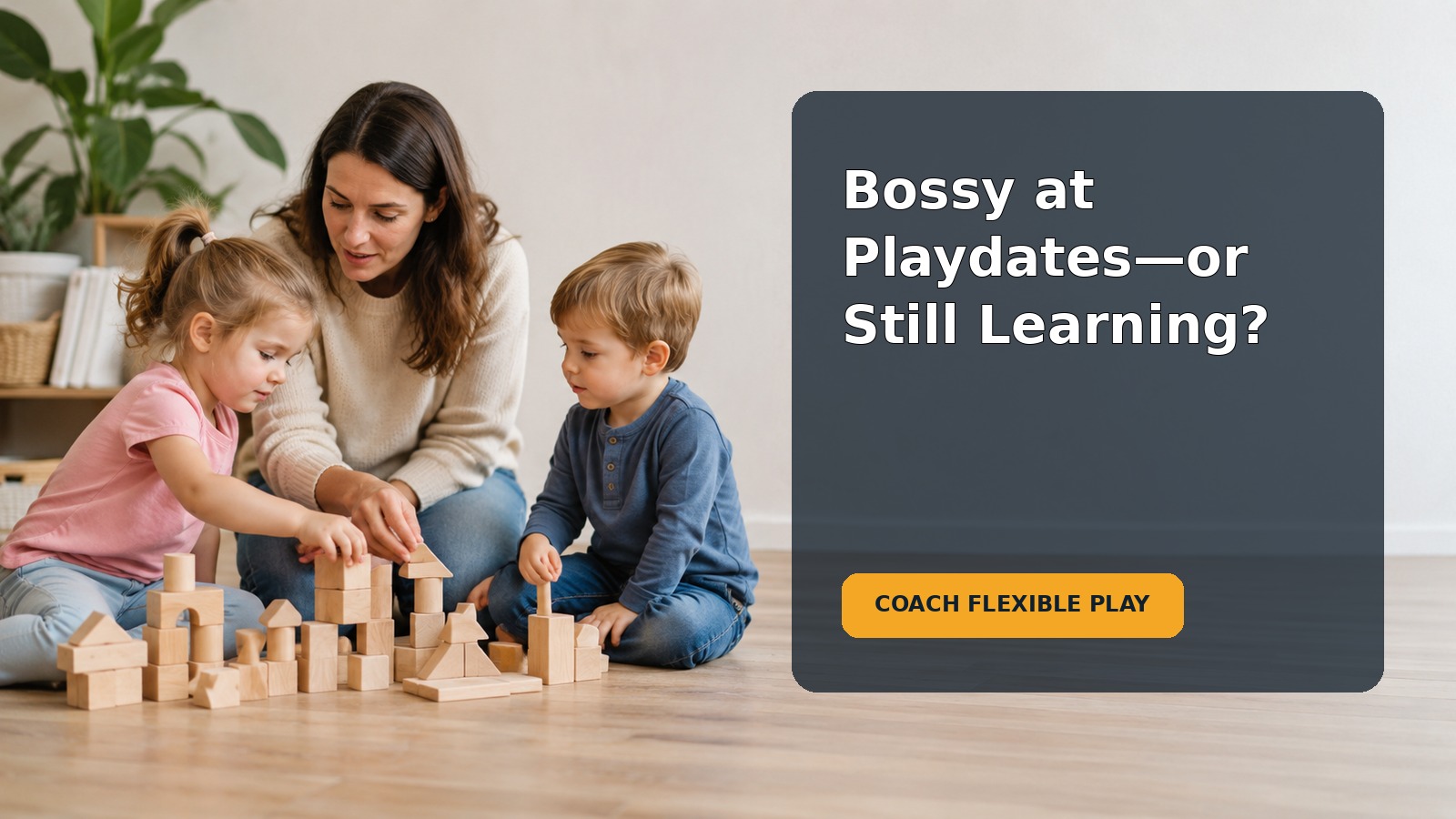
Start with what is happening, not a label
Why preschool play can look controlling
Preschoolers often have strong pretend-play plans but limited ability to explain, negotiate, and revise them. A child may also become rigid when excited, tired, hungry, overwhelmed by noise, unsure how to join, or worried that a favorite toy will be taken. Some children can cooperate at school yet struggle at home, where they feel ownership over the space and toys.
Development is uneven. The U.S. Centers for Disease Control and Prevention lists social-emotional milestones for young children, including seeking out play with other children and changing behavior based on the setting. Milestones are useful conversation points, not pass-fail tests or diagnoses. Look at patterns over time and across settings rather than judging your child by one difficult afternoon.
Observe the sequence
For the next playdate, notice what happens immediately before the commands. Does the struggle begin with a special toy, a complicated pretend game, a transition, or a visit that has run too long? Also notice what your child is trying to accomplish. “You must be the dog” may be an unskilled attempt to share a detailed story, while grabbing every block may signal difficulty waiting.
Write down only a few facts: the trigger, the exact behavior, the friend’s response, and what helped. This keeps the focus on teachable actions. “Gave five commands after the game changed” is more useful than “was bossy all afternoon.”
A low-pressure plan before the playdate
Choose an easier setup
Start with a short visit—often 60 to 90 minutes is easier than an open-ended afternoon. Offer a snack beforehand, keep the number of children small, and put away any toy your child truly cannot share yet. Set out activities with room for parallel and cooperative play, such as blocks, art materials, dress-up items, or outdoor equipment.
Avoid planning every minute. Children need space to negotiate naturally, but an easy setup reduces the amount of self-control required all at once. Have one neutral reset activity ready, such as bubbles outside or a simple snack, if the play becomes stuck.
Preview one simple rule
Give a brief, specific instruction before the friend arrives. Long warnings can make a child feel they are expected to fail. Try:
“You can have big ideas, and your friend can have big ideas too. Ask, ‘What do you think?’ If you both want different games, you can take turns choosing.”
Ask your child to show you what that sounds like. Practice two useful phrases:
- “Do you want to play my idea or your idea first?”
- “What could we change so it works for both of us?”
Keep the rehearsal playful and under two minutes. The purpose is to put words within reach, not to demand a perfect performance.
Coach flexible play in the moment
Pause before stepping in
If both children are safe and still engaged, wait a few seconds. Preschoolers need chances to respond to each other. Step in when commands continue, one child looks distressed, the play repeatedly excludes someone, or the situation is moving toward grabbing or hitting.
Move close and describe what you see without blame: “You both have different ideas for the blocks.” Then name the skill: “We need a way for both ideas to fit.” A calm voice helps more than calling across the room.
Use a short three-part prompt
- Reflect: “You want to build a zoo. Sam wants a garage.”
- Invite: “Ask Sam which idea to start with.”
- Offer a fallback: “You can connect the zoo and garage, or take turns choosing for five minutes.”
Offer no more than two workable options. Too many choices can increase frustration. If your child uses a collaborative phrase, acknowledge the action specifically: “You asked for Maya’s idea and waited for her answer. That kept the game going.” This is clearer than general praise such as “Good job.”
Protect the other child’s boundaries
Flexible play does not mean forcing the visiting child to negotiate indefinitely. Every child can decline a role, stop a game, or ask for space. Say, “Leo said no to being chased, so chasing stops. You can ask about a different game.” If one child repeatedly ignores a clear no, pause the activity and help the children reset separately.
For physical aggression, unsafe throwing, or frightening play, intervene immediately. State the limit simply—“I won’t let you hit”—and create enough space for everyone to calm down. Skill coaching comes after safety.
What to do when your child refuses the coaching
A child who is already upset may not be able to negotiate. Do not turn the playdate into a public lecture. Use a brief private reset: “Your body looks frustrated. Come with me for a drink of water.” Once calm, repeat one next step: “Ask what your friend wants to play.”
If your child cannot return safely or respectfully, end that activity without shame. You might say, “Playing together is too hard right now. We’ll take a break and try again another day.” Ending early is not a punishment or proof that your child is bad; it is a boundary when the available skills are temporarily used up.
Common mistakes and better alternatives
Avoid calling the child bossy
Labels can become an identity and do not explain what to do differently. Describe the behavior instead: “You chose every role without asking.” Follow it with the replacement: “Ask your friend which role they want.” Discuss the moment privately rather than correcting your child in front of peers whenever safety allows.
Do not require constant sharing
Children can have a few protected belongings. Put those away before the visit. For shared play materials, teach turn-taking with a clear endpoint rather than demanding immediate surrender. A timer can help when both children understand that it signals a turn change, not a winner and loser.
Do not take over the whole game
Adult narration can rescue one moment but prevent children from practicing. Give the smallest prompt that helps, then step back. The sequence is support, observe, and reduce support—not direct every line of play.
Review the playdate without shame
Later, keep the review short. Begin with one thing that worked: “You let Amir choose the second game.” Name one moment to practice: “When he changed the train track, you shouted and moved the pieces back.” Ask a problem-solving question: “What could you say next time?”
If your child cannot answer, supply a phrase and role-play it once. Then move on. Repeated post-play interrogations can make friendship feel like a test. Success is gradual: fewer commands, faster recovery, one accepted alternative, or one genuine question about a friend’s idea.
A practical flexible-play checklist
Before
- Choose a short visit and a manageable number of children.
- Put away special items that are not available for shared play.
- Set out open-ended activities with more than one possible role.
- Preview one rule: both children’s ideas matter.
- Practice one question your child can use.
During
- Notice the trigger before correcting.
- Allow a few seconds for safe peer problem-solving.
- Describe the conflict neutrally and prompt one skill.
- Honor each child’s “no” and intervene immediately for unsafe behavior.
- Use a brief reset before deciding whether to end the activity.
After
- Name one cooperative action you observed.
- Practice one difficult moment without replaying the whole visit.
- Adjust the next playdate’s length, activities, or timing.
- Look for progress across several visits, not perfection in one.
When to ask for professional support
Bring the pattern to your child’s pediatrician or preschool teacher if conflict is frequent across settings, your child rarely joins reciprocal play, cannot tolerate small changes even with support, repeatedly hurts or frightens peers, seems unusually distressed, or is regularly excluded. Also ask for help if language, hearing, sensory needs, attention, anxiety, or developmental differences may be making social negotiation harder.
A teacher can describe what happens with classmates and what prompts work in the classroom. A pediatrician can consider the whole developmental picture and, when appropriate, recommend further evaluation. Seeking support is not assigning a label; it is finding the right way to teach a skill.
Frequently asked questions
Is controlling play common at ages 3 to 5?
Strong ideas and uneven turn-taking skills are common in preschool. What matters is whether the child is gradually learning to notice peers, accept limits, recover from disagreement, and use more collaborative language. Persistent difficulties across settings deserve a conversation with the adults who know the child.
Should I cancel playdates?
Usually, shorter and better-supported practice is more useful than avoiding peers completely. Choose a compatible friend, keep the visit manageable, and stay close enough to coach. Pause playdates temporarily if there is repeated unsafe behavior that you cannot reliably manage.
What if the other parent hears my child giving commands?
Respond calmly and focus on action: “They are practicing taking turns with ideas. I’m going to help them reset.” There is no need to apologize for your child’s personality. Do acknowledge harm, repair it, and supervise appropriately.
How long should improvement take?
There is no fixed timetable. Look for small changes over multiple opportunities. If there is no progress despite consistent support—or the behavior is causing significant distress or exclusion—ask the preschool teacher and pediatrician what they observe.
The main takeaway
When a preschooler is bossy during playdates, treat the behavior as information about an emerging skill. Prepare an easier setting, teach one collaborative phrase, coach briefly in the moment, protect every child’s boundaries, and review without shame. Your child does not need to stop having big ideas. They need practice making room for someone else’s ideas too.
Sources
- Centers for Disease Control and Prevention: Positive Parenting Tips—Preschoolers (3–5 years)
- American Academy of Pediatrics/HealthyChildren.org: How to Give Instructions
This article provides general parenting and developmental education. It is not a diagnosis or a substitute for advice from your child’s pediatrician or another qualified professional.