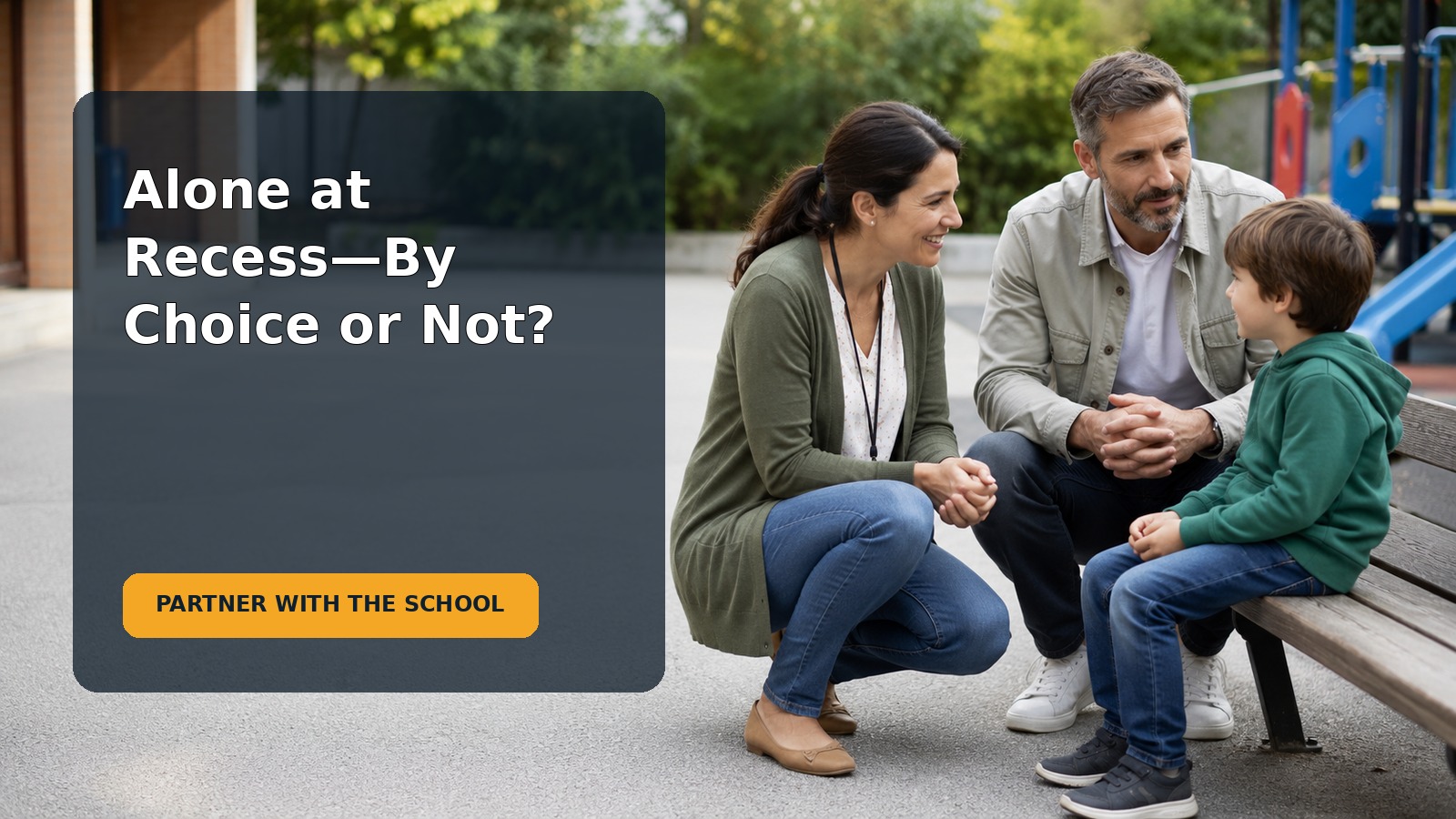
Seeing your child by themselves on the playground can stir up worry quickly. But a 7 year old alone at recess is not automatically lonely, excluded or being bullied. Some children enjoy a quiet reset, are waiting for a preferred friend, or feel unsure how to enter a fast-moving game. The useful first question is not “How do I get my child into a group?” It is “What is recess like from my child’s point of view?”
Your role is to listen, check safety, and help the school create low-pressure opportunities for connection. The aim is not to assign a friend or make your child perform sociability. It is to make sure they have safe choices, access to welcoming activities, and an adult who notices if exclusion or bullying is happening.
Start with your child’s experience, not the playground picture
Alone does not always mean lonely
At seven, friendships can shift from day to day. Games have rules that change midstream, established groups can be hard to enter, and a child may need time to watch before joining. Solitary play may feel restful to a child who has spent the morning following instructions and managing a busy classroom.
Choose a calm moment rather than questioning your child immediately after school. Try a neutral observation: “I heard you sometimes spend recess on your own. What is that time like for you?” Then pause. Avoid leading questions such as “Why won’t anyone play with you?” because they can add shame or suggest an answer.
Questions that invite useful detail
- “What do you usually do first when recess begins?”
- “Is being alone something you choose, something that just happens, or something you wish were different?”
- “Which parts of recess feel good? Which parts feel hard?”
- “Is there anyone you sometimes like to be near or play with?”
- “Has anyone told you that you cannot join, laughed at you, threatened you or taken your things?”
- “If you wanted help, which adult outside would feel easiest to ask?”
Do not require a complete report in one conversation. Children may need several short talks, drawing, pretend play or a walk side by side before they can explain a social situation.
Do a calm safety and wellbeing check
Notice patterns, not one isolated day
Write down what you know without interpreting it yet: how often your child is alone, whether it happens only at recess, who supervises, what your child says, and whether mood or school attendance has changed. Also notice whether your child has satisfying relationships in other settings. A child who happily connects with a cousin, neighbor or club friend may be choosing quiet at recess. A child who wants connection everywhere but repeatedly cannot access it may need more support.
Pay attention to headaches or stomachaches on school mornings, sleep changes, tearfulness, lost belongings, unexplained injuries, falling grades, sudden school refusal or fear of a particular person. These signs do not prove bullying, but they justify timely follow-up. Nappot’s guide to bullying warning signs and how to respond can help you organize that conversation.
Separate chosen solitude, social difficulty and mistreatment
| What you hear or observe | A helpful next step |
|---|---|
| “I like drawing alone. Recess is my quiet time.” | Respect the choice while confirming that welcoming options and adult help remain available. |
| “I want to play, but I don’t know how to get in.” | Practice one entry phrase and ask the school for a structured, low-pressure activity. |
| “They say the game is full every day.” | Ask staff to observe the pattern and whether rules are being used to exclude one child. |
| Threats, humiliation, repeated targeted exclusion or physical harm | Use the school’s safeguarding or bullying process promptly; document specifics and request a protection plan. |
| Broad distress across school, friendships or everyday activities | Discuss the pattern with the teacher and your child’s pediatrician or another qualified professional. |
Partner with the school without forcing friendships
Ask for observation before conclusions
Send a short, factual message to the classroom teacher or recess lead. For example:
“My child says they are often alone at recess and is not sure how to join. Could someone discreetly observe for several days? I would appreciate knowing what they choose, whether they attempt to join, how peers respond, and which activities or adults seem to help. Please avoid announcing the observation or assigning another child to be their friend.”
Observation should cover more than whether your child stands alone. Useful details include how recess begins, whether equipment is accessible, whether games have clear entry points, whether the same child is repeatedly excluded, and how supervisors respond. StopBullying.gov recommends schoolwide attention to bullying hot spots and active adult supervision rather than placing the whole burden on a child to manage mistreatment.
Request environmental supports, not a designated friend
Schools can make recess easier to enter without publicly singling out your child. Ask what is already available before proposing a new program. Helpful options may include:
- a visible choice board with two or three recess activities;
- a supervised chalk, ball, skipping, building or nature activity with an obvious start;
- an identified adult your child can approach;
- equipment that does not depend on joining an established team;
- a quiet area that is treated as a valid choice, not a punishment;
- classroom teaching about welcoming language and fair game entry for everyone.
Avoid asking the teacher to order another child to include yours. A “buddy” arrangement can feel artificial, burden the other child, or make your child feel publicly identified. Adults can create conditions for contact; genuine friendship still needs mutual interest and time.
A three-step practice plan at home and school
Step 1: choose one small recess goal
Let your child choose a goal that feels manageable. It might be saying hello to one classmate, asking “Can I have a turn after you?”, standing near a familiar activity for two minutes, or asking the recess adult what choices are available. “Spend the whole recess with friends” is too large and difficult to measure.
Use language that preserves dignity: “You do not have to become friends with anyone today. We are practicing one way to find out whether an activity is open.”
Step 2: rehearse an entry and an exit
Role-play for a minute or two, then stop. Practice a simple entry:
- “What are you playing?”
- “Can I join next round?”
- “Do you need another person?”
- “Can I draw/build/skip here too?”
Also rehearse what to do if the answer is no: “Okay, I’ll try something else,” followed by walking to the chosen activity or adult. This is not teaching your child to accept repeated unfair exclusion. It is giving them a graceful exit from one ordinary social disappointment while adults monitor for a pattern.
Step 3: review without grading
After school, ask one brief question: “What happened with your plan?” Reflect effort rather than popularity: “You asked clearly,” “You noticed that game was already underway,” or “You used the adult help we planned.” If the step was too hard, make it smaller. If it went comfortably several times, invite the next step.
For broader friendship coaching, see helping school-age children build healthy friendships.
Common mistakes and better alternatives
Do not turn friendship into a performance target
Counting friends, demanding daily reports, comparing siblings or promising rewards for group play can make normal social uncertainty feel like failure. Do not describe your child as shy, awkward or a loner in front of them. Describe the skill or situation instead: “Joining a game is hard when the rules are already moving.”
Do not solve the problem through another parent first
Contacting a classmate’s family without school context can create embarrassment or conflict. Start with your child and the school’s observations. A one-to-one invitation outside school may help when both children already show mutual interest, but it should not be used to manufacture a friendship.
Do not confuse resilience with tolerating harm
Children can learn to handle an occasional “not this time.” They should not be expected to absorb repeated targeted exclusion, insults, threats, coercion or physical aggression. If mistreatment is alleged, ask the school how it will protect your child now, investigate, document incidents, communicate with you, and prevent retaliation. Do not tell your child to fight back or meet privately with the child who may be harming them.
When to involve additional support
Routine help
Ask for a meeting with the teacher, school counselor or relevant student-support professional if your child wants friends but remains isolated despite several weeks of support, cannot identify any safe adult, or struggles with social communication across settings. A pediatrician can help when anxiety, attention, language, hearing, development or mood may be affecting participation. This does not mean one quiet recess indicates a diagnosis.
Urgent concerns
Act promptly if your child reports threats, physical harm, sexual behavior or harassment, extortion, stalking, severe humiliation, or fear of immediate retaliation. Follow the school’s safeguarding procedures and local emergency guidance. Seek urgent mental-health help if your child talks about self-harm, suicide or not wanting to live. In the United States, call or text 988 for the Suicide & Crisis Lifeline; use local crisis or emergency services elsewhere.
A one-page parent checklist
Before contacting school
- Ask whether being alone is chosen, unwanted or unsafe.
- Record specific words, dates and changes without coaching the story.
- Check for pain, sleep changes, school avoidance or wider distress.
- Agree on what your child is comfortable sharing.
During the school plan
- Request discreet observation across several recess periods.
- Identify one approachable supervising adult.
- Offer structured activities with easy entry points.
- Practice one entry phrase and one exit plan.
- Set a date to review what staff and your child notice.
What progress can look like
Success may be choosing quiet time confidently, approaching an adult, trying one activity, recovering from a declined invitation, or finding one mutually enjoyable connection. The target is not constant group play. It is safe access, growing choice and less distress.
Frequently asked questions
Should I insist that my child join a group?
No. Offer skills and opportunities, but do not force social contact. First find out whether solitude is a comfortable choice or an unwanted pattern.
How long should we try the plan?
Agree on a short review point, such as one or two school weeks. Review sooner if there are safety concerns, escalating distress or school avoidance. A plan should change when observation shows it is not helping.
What if my child refuses to talk?
Keep the door open without repeated interrogation. Say, “You do not have to explain now. If recess feels unsafe or lonely, you can tell me, write it, or choose another trusted adult.” Then ask the school for discreet observation.
Does playing alone mean my child lacks social skills?
No. One setting or one behavior cannot establish that. Look at your child’s preference, distress, attempts to connect, peer responses and relationships across settings.
Sources
- StopBullying.gov: Prevention at School
- HealthyChildren.org (American Academy of Pediatrics): School-age school guidance
This article provides general education and is not a diagnosis, safeguarding investigation or individualized medical or mental-health advice. School procedures and local reporting requirements vary.