If your child can explain that three groups of four make 12 one day and then cannot recall 3 × 4 the next, it is understandable to worry. But a child who can’t remember multiplication facts does not need more pressure. At age eight, multiplication fluency is still developing, and quick recall grows more reliably when practice keeps the meaning of the numbers in view.
This low-pressure plan is for families whose child is working on multiplication at school. When a child can’t remember multiplication facts, the most useful next step is usually to strengthen the meaning behind a few facts rather than adding more pressure. It supports classroom learning; it does not diagnose a learning difference or replace a conversation with the teacher when the struggle is broad or persistent.
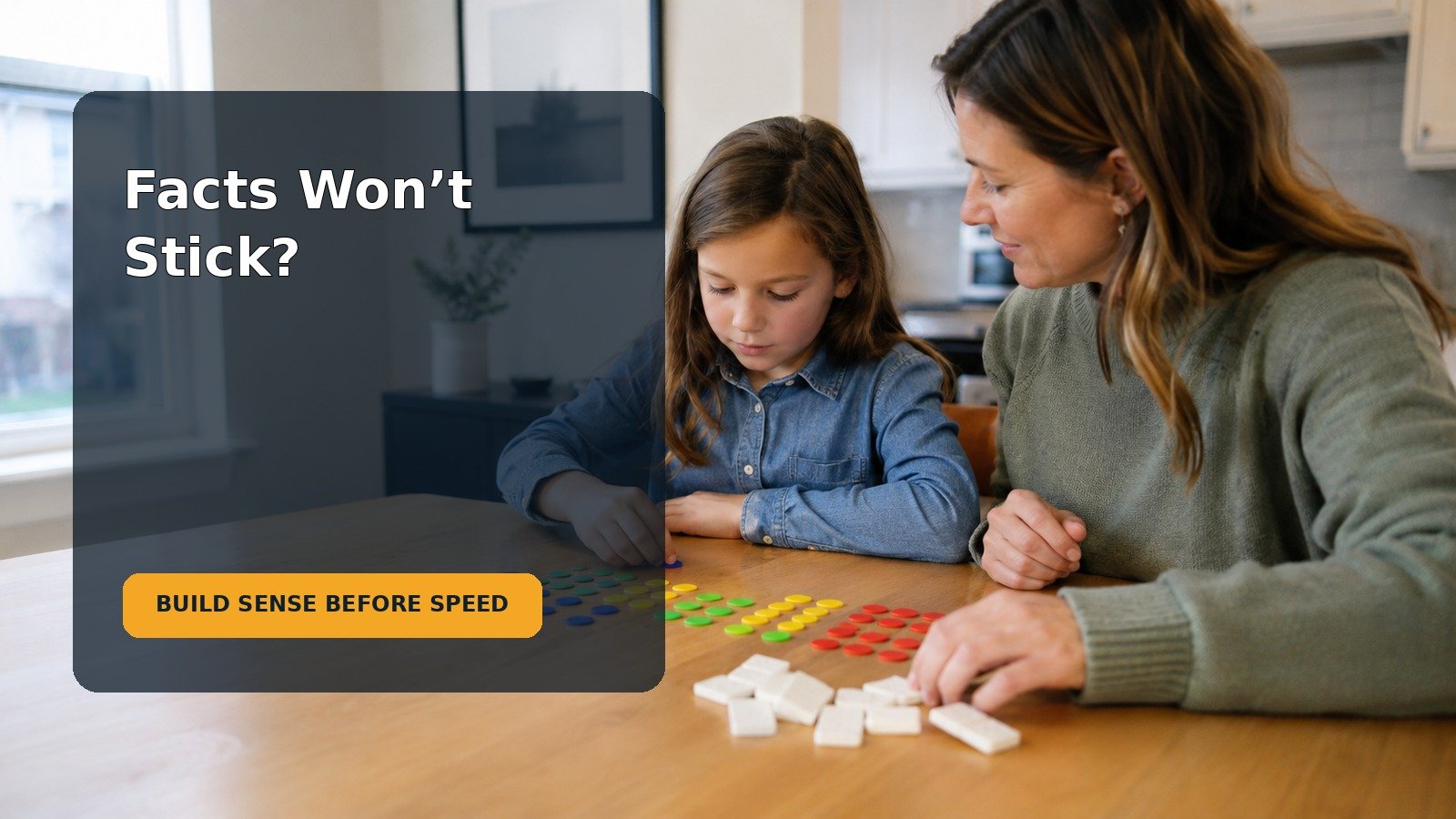
When a child can’t remember multiplication facts yet, the aim is steady familiarity: a fact should become easier because it makes sense, not because they were pushed through a timer.
Start with meaning, not a timer
Multiplication describes equal groups. Before asking for an answer from memory, invite your child to build or draw the fact. For 4 × 3, they might make four rows of three coins, draw four groups of three dots, or hop by threes on a number line. Then say the whole thought aloud: “Four groups of three make 12.”
This is not a detour from fact practice. The What Works Clearinghouse practice guide on teaching elementary mathematics recommends helping students connect mathematical language, representations and symbols. The National Council of Teachers of Mathematics also distinguishes procedural fluency from speed alone: students benefit from efficient methods that are accurate, flexible and based on understanding.
Notice what your child already knows
Begin with facts that have a useful pattern. A child may know ×2 as doubles, ×5 from counting by fives, and ×10 from place-value patterns. The commutative property can reduce the list: once 3 × 4 is understood, 4 × 3 names the same total. Keep a small “known facts” list so practice starts with success instead of a wall of unfamiliar cards.
A 10-minute multiplication facts routine
Try this routine three or four times a week, ideally at a calm time rather than immediately after a difficult school day. Stop while your child is still able to succeed. A short, repeatable practice period is more useful than a long session that ends in frustration.
Step 1: Choose one family of facts
Pick one related set, such as ×3, or two facts that connect to a known fact. Put away the full stack of flashcards. Say: “Today we are exploring threes, not proving how fast you are.” Let your child choose counters, graph paper, a whiteboard or a number line.
Step 2: Build, draw and say the fact
For 3 × 6, make three equal groups of six. Ask, “How many are in each group? How many groups?” Count the total together, then write 3 × 6 = 18. Reverse the representation: draw an array with three rows and six columns. This helps the symbol carry a clear meaning.
Step 3: Find a shortcut your child can explain
Ask, “What do you notice?” For 6 × 3, a child may see that it is double 3 × 3, or three more than 5 × 3. A strategy does not have to be the fastest one. It needs to be one the child can use and explain. Record the strategy beside the fact: “6 × 3: five groups of three plus one more group.”
Step 4: Practice retrieval gently
After building several examples, cover the answer and ask one or two facts. Give think time. If the answer does not come, say, “Let’s use your drawing,” rather than announcing that it was missed. Return to that fact later in the session. Retrieval practice is useful when it is paired with feedback, not when it becomes a test of worth.
Step 5: End with a quick reflection
Ask, “Which fact felt easier today, and what helped?” Write down one fact and one strategy to revisit next time. This gives both child and parent a concrete record of growth.
Use games that preserve number sense
A game can add repetition without making multiplication feel like a race. Roll two dice, build the matching array, and claim a square on paper only after explaining the total. Play “array hunt” by noticing rows and columns in egg cartons, window panes or snack trays. Use a deck of cards to make equal groups, but let the child use a drawing whenever they need it.
Be careful with apps or games that reward only a fast answer. They can be enjoyable for some children, but a child who is already anxious about multiplication may read the timer as proof that they are behind. Choose tools that allow pauses, hints and explanation.
What to say when frustration rises
Try a neutral script: “You do not have to know this instantly. Show me a way to figure it out.” If your child says, “I’m bad at math,” respond with something specific: “You just used doubles to solve 4 × 6. That is a math strategy.” Avoid promises that every fact will feel easy quickly; instead, focus on a next step they can control.
It also helps to separate home practice from consequences. Withholding play, treats or rest after a wrong answer can make the subject feel unsafe. If the child is upset, pause, do something else, and try a smaller amount another day.
Partner with the teacher
Before introducing a new method, ask the teacher which representations and vocabulary the class is using. A brief message can help: “We are practicing multiplication facts at home. What strategy or fact family is the class working on, and is there a way you would like us to reinforce it?”
Share useful observations rather than labels: whether your child understands equal groups, which facts are easier, whether reading directions adds difficulty, and whether anxiety appears only during timed work. The teacher can place those observations alongside classroom work and recommend an appropriate next step.
When to ask for more support
Needing time to learn multiplication facts is common. It is worth checking in with the teacher or pediatrician when difficulty persists across several number ideas, causes substantial distress, or is accompanied by concerns about attention, language, vision, hearing or day-to-day learning. A professional can help sort out what support is useful; fact recall alone cannot identify a learning disability.
For now, the goal is modest: help your child connect a multiplication fact to a picture, a pattern or a strategy, then give that connection time to become familiar.
A one-page parent checklist
- Choose one small fact family rather than drilling every fact.
- Begin with objects, drawings, arrays or number lines.
- Ask your child to explain a strategy in their own words.
- Practice retrieval after the meaning is clear and allow thinking time.
- Keep sessions short, end with a success, and record one next fact.
- Match home practice to the teacher’s approach.
- Ask for support if the concern is broad, persistent or distressing.
Frequently asked questions
Should my 8-year-old memorize every multiplication fact?
Fluency matters, but it develops from patterns and practice as well as memorization. Start by helping your child make sense of the facts and use efficient strategies. Their teacher can explain the expectations for the current grade and curriculum.
Are flashcards bad for multiplication facts practice?
No. Flashcards can be useful for brief retrieval practice after a child has explored the fact’s meaning. Use only a few at once, allow a strategy when needed, and avoid turning the activity into a high-stakes speed test.
How long should we practice?
About 10 calm minutes, three or four times a week, is a reasonable starting point for many families. Shorter sessions are fine when attention is limited. Stop if frustration is rising and return another time.