When your baby laughs at peekaboo or searches for a toy that slipped under a cloth, they are exploring a powerful idea: people and objects can still exist even when they cannot be seen. Object permanence games for babies give them playful chances to notice this pattern. They do not need flash cards, special products or a lesson plan—just a safe object, an attentive adult and a few relaxed minutes.
Keep these activities responsive rather than turning them into tests. A four-month-old may simply watch the cloth move. An older baby may pull it away, look toward the place where a toy disappeared or crawl after it. All of those responses can be part of useful play. Follow your baby’s attention, make the game easier when needed and stop when they look away, fuss, stiffen, rub their eyes or seem tired.
What Object Permanence Means in Everyday Play
A useful idea, not a pass-or-fail milestone
Object permanence is the understanding that something continues to exist when it is out of sight. Babies build this understanding gradually. You may first notice anticipation during a familiar peekaboo routine, then reaching for a partly covered toy, and later searching where an object was fully hidden. Progress is not always tidy: interest, tiredness, hunger, temperament and the difficulty of the game can change what a baby does from one moment to the next.
The CDC explains that developmental milestones describe things most children—75% or more—can do by a certain age. Its current nine-month checklist includes looking for objects that fall out of sight. That is helpful context, but one activity at home cannot assess development. A baby who does not search during today’s game may simply be finished, distracted or unsure what happened.
Why the back-and-forth matters
The Harvard Center on the Developing Child describes “serve and return” as responsive exchanges between a young child and a caring adult. A baby looks, reaches, babbles or smiles; the adult notices and responds. Peekaboo naturally creates this rhythm. The relationship and shared attention are more important than making the baby perform a particular response.
| What your baby does | How you can respond | How to adjust |
|---|---|---|
| Watches your face or the moving cloth | Smile, pause and narrate: “Here I am.” | Keep the hiding very brief |
| Reaches for a partly covered toy | Wait a moment, then celebrate the discovery calmly | Leave more of the toy visible |
| Looks toward where a toy disappeared | Name what happened: “The ball rolled away.” | Repeat the same path slowly |
| Turns away, fusses or becomes tense | Stop and reconnect without demanding another turn | Try another day or choose a simpler game |
Start With a 60-Second Safety and Readiness Check
Prepare a safe play space
Choose a time when your baby is awake, comfortable and supervised. Play on the floor or another stable surface where falls are not a concern. Use a familiar toy that is too large to fit through a toilet-paper tube and has no loose pieces, accessible batteries, magnets, long cords, ribbons or sharp edges. A lightweight, breathable play cloth can be used over a toy, but do not leave fabric on your baby’s face or use a blanket that could obstruct breathing.
- Stay within arm’s reach and watch the entire game.
- Use clean, age-appropriate objects in good condition.
- Keep plastic bags, button batteries, magnets and small objects out of the play area.
- Keep sessions short—often a few turns are enough.
- Let your baby control whether the game continues.
Notice the baby’s signals before adding difficulty
Begin with connection. Say your baby’s name, smile and wait for a look, sound or movement. If they are interested, start. If they look away, give them time. Looking away can be a way of taking a break, not a problem to correct. The best level is one that produces curiosity without distress.
Six Object Permanence Games for Babies
1. Slow, predictable peekaboo
Hold your hands beside your face, say “Where’s Mum?” or “Where’s Dad?”, cover your face briefly, then uncover it and say, “Here I am.” Use a calm voice and the same rhythm. For a younger baby, hide for less than a second. Pause after each return so your baby has time to look, smile, move or vocalize.
If hands are confusing, move partly behind a doorway while keeping some of your face visible. Never surprise a baby with a loud shout. The aim is anticipation and shared fun, not startling them into a reaction.
2. Partly cover a favorite toy
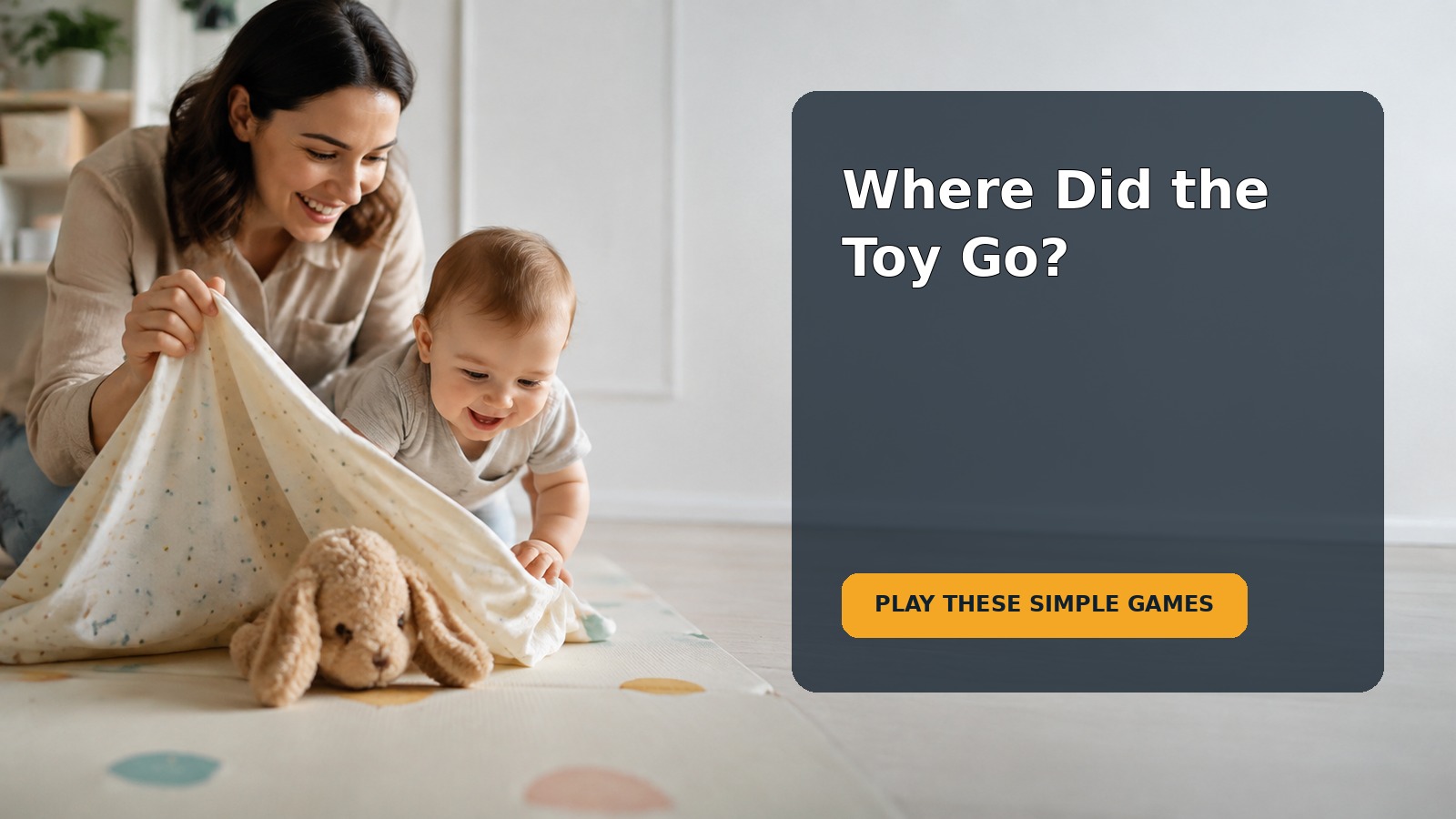
Place a familiar toy within easy reach and drape a small cloth over only one corner. Ask, “Where is the bear?” Wait. If your baby reaches, let them uncover it. If not, slowly reveal the toy yourself and say, “There it is.” Repeat only while the baby stays engaged.
Over several sessions, cover a little more—not all at once. Success may look like watching your hand, touching the cloth or smiling when the toy appears. Do not pull your baby’s hand toward the answer.
3. The rolling-ball disappearance
Sit on the floor and slowly roll a large soft ball so it passes partly behind a cushion or sturdy box. Make sure the barrier cannot tip over. Say, “The ball went behind the box,” then retrieve it. An older baby may lean, turn or crawl to look. Keep the path the same for several turns before changing it.
4. Cup-and-toy reveal
Place a large toy on the floor and cover it with a lightweight, unbreakable cup or bowl big enough that neither item is a choking risk. Leave an edge showing at first. Help only as much as needed: tap the cup, lift it slightly or model one reveal. Avoid a shell-game challenge with several cups; one clear hiding place is enough.
5. Drop and retrieve
When your seated baby drops a safe spoon or toy from a high chair, narrate before returning it: “The spoon fell. It is on the floor. Here it is.” Babies often repeat dropping because the result is interesting and predictable. Set a reasonable limit if you need to end: “One more drop, then the spoon stays on the table.” Never attach toys to the high chair with a long cord.
6. Find the familiar person
Have a familiar caregiver move just behind a doorway, then reappear promptly when the baby looks toward them. Keep the adult close, visible at first and cheerful. This is a play activity, not separation practice. If the baby becomes upset, the person should return and reconnect immediately.
Use a Simple Three-Step Progression
Step 1: Make the answer obvious
Hide only a small part of the toy or your face. Use the same words and position each time. Repetition helps the sequence become familiar. Try two or three turns, then move on while the game is still pleasant.
Step 2: Pause and follow the baby’s response
After hiding the object, wait three to five seconds. A pause gives your baby room to respond. If they look, reach or vocalize, answer that “serve” with words and a reveal. You might say, “You found the cup,” or “You looked behind the cushion.” Naming what the baby sees and does supports the back-and-forth interaction.
Step 3: Change one feature at a time
When the current version is easy and enjoyable, make one small change: cover more of the toy, increase the pause slightly or move the barrier a little farther away. Do not change the toy, hiding place and timing together. If interest drops or frustration rises, return to the easier version.
A helpful caregiver script is: “You are looking for the ball. It rolled behind the box. Shall we find it together?” This describes rather than quizzes. Questions such as “Where is it?” are fine when playful, but avoid repeating them as if there is a correct answer the baby must produce.
Common Mistakes and Better Alternatives
Turning play into a development test
Repeating a task until the baby “passes” can create frustration and tells you little. Instead, notice broad patterns across ordinary routines and share concerns with a pediatric professional. Responsive play should feel safe, flexible and enjoyable.
Hiding for too long or too completely
A difficult game may cause a baby to lose interest rather than search. Start with partial hiding and a quick reveal. Build challenge gradually. If your baby cries during peekaboo, uncover immediately, comfort them and choose face-to-face play without hiding.
Using unsafe props
Small toys, coins, food pieces, deflated balloons, battery-operated objects with unsecured compartments and long ribbons do not belong in this game. Check the floor before and after. Choose large, simple objects and supervise continuously.
Comparing babies
One baby may love searching games while another prefers songs, movement or face-to-face conversation. Variation does not mean a parent has failed or a baby needs more drilling. Follow your child’s interests and use milestone guidance as a conversation tool, not a competition.
When to Discuss Development With a Professional
Bring broad patterns, not a game score
Talk with your baby’s pediatrician whenever you are concerned about how your child plays, learns, communicates, moves or responds to people. Mention what you observe across different settings: whether your baby follows moving objects, reaches for toys, responds to familiar voices, exchanges sounds or expressions, and uses both sides of the body. A short video of natural play may be useful if obtained without distress.
The CDC advises acting early if a child is not meeting one or more milestones, has lost skills they once had, or a caregiver has other concerns. Do not wait for the next game to prove or disprove a worry. Ask about developmental screening and appropriate local early-intervention resources. Screening and evaluation are more reliable than a home challenge.
Seek urgent care for safety—not for a missed peekaboo turn
Not searching for a toy is not an emergency. Urgent care is appropriate for immediate health or safety problems such as choking, trouble breathing, a serious injury, unusual unresponsiveness or suspected ingestion of a battery or magnet. Follow local emergency guidance in those situations.
A Quick Parent Checklist
- Before: choose an alert moment, clear the floor and inspect every prop.
- Start: connect face to face and hide only part of an object.
- During: pause, notice and respond to your baby’s look, reach, sound or smile.
- Adjust: make it easier if the baby loses interest or becomes frustrated.
- Stop: end when the baby looks away, fusses, stiffens or seems tired.
- Reflect: look for patterns across daily life rather than scoring one game.
- Ask: contact the pediatrician for concerns, lost skills or questions about screening.
Frequently Asked Questions
When do babies develop object permanence?
It develops gradually rather than switching on at one exact age. During the 4–12 month range, babies may show increasingly purposeful attention to partly hidden, dropped or disappeared objects. Avoid using one deadline or game result to judge an individual baby.
What if my baby does not like peekaboo?
Stop when they show discomfort. Try a gentler version with part of your face visible, or choose a different back-and-forth activity such as copying sounds, rolling a ball or taking turns tapping a toy. The responsive exchange matters more than peekaboo itself.
How often should we play?
There is no required schedule. A few turns during ordinary floor play can be enough. Repeat when your baby seems interested, and end before either of you is frustrated.
Should I correct my baby if they look in the wrong place?
No. Show the result calmly: “The toy is under this cup.” Make the next turn easier. Exploration includes predictions that do not work, and there is no need for praise or correction tied to a right answer.
Do special object-permanence toys work better?
No special purchase is necessary. Your hands, a familiar large toy, a safe cup, a soft ball and a sturdy barrier provide plenty of variation. Safety and responsive interaction are more important than a product label.
Sources
- CDC: Milestones by 9 Months
- Harvard Center on the Developing Child: Serve and Return
- Nappot: Floor Play Made Simple
This article offers general developmental education, not an assessment or diagnosis. If you have concerns about your baby’s development or notice a loss of skills, contact your child’s pediatrician and ask about developmental screening.