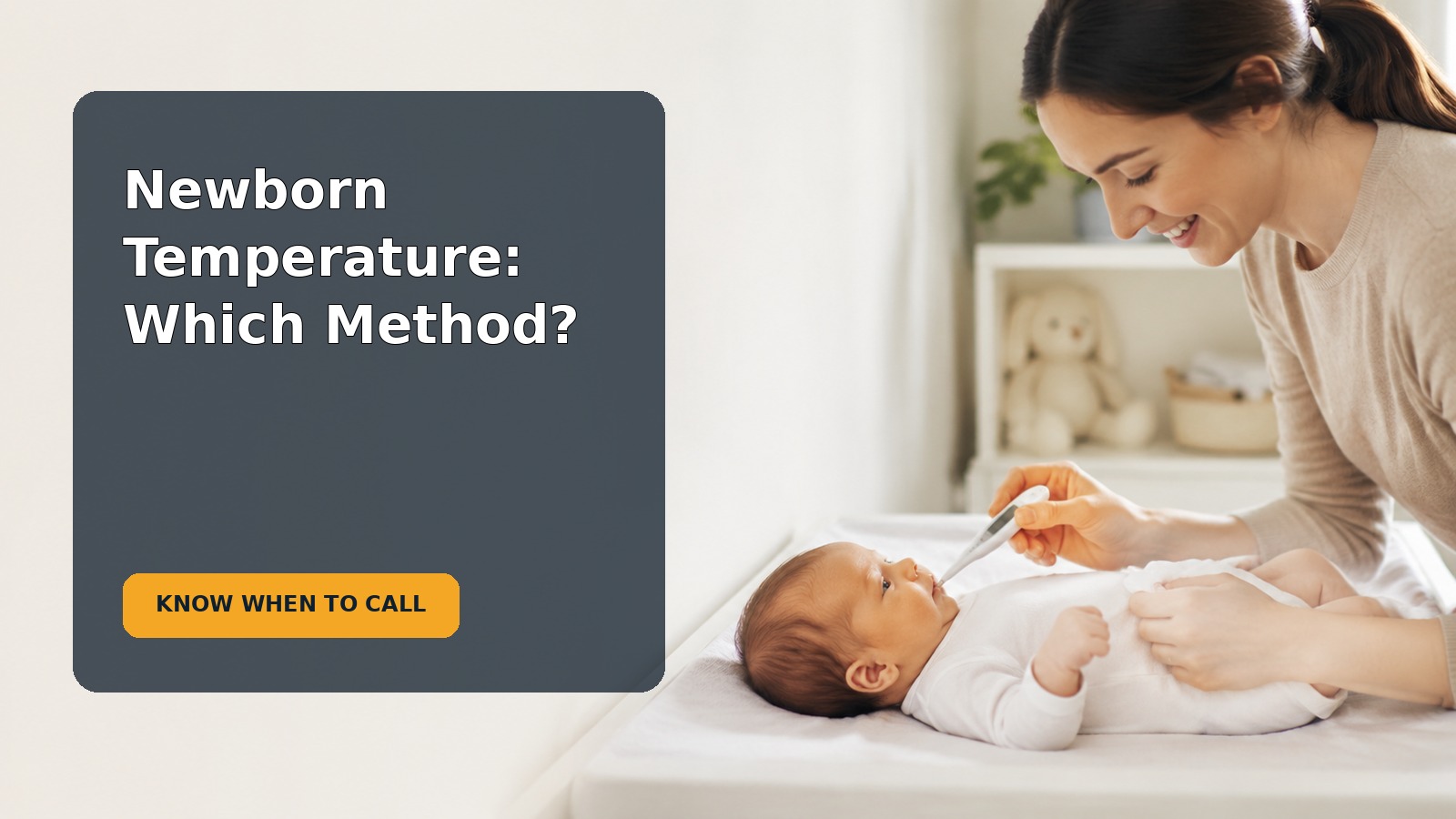
Knowing how to take a newborn’s temperature gives you one reliable number when your baby seems unwell. The key safety rule is simple: for a baby 3 months old or younger, a temperature of 100.4°F (38°C) or higher needs immediate guidance from the baby’s pediatrician or another appropriate urgent medical service—even when the baby otherwise looks comfortable.
Do not wait for the temperature to climb higher, and do not rely on touching the forehead. A newborn can have a serious infection without dramatic symptoms. If your baby is difficult to wake, struggles to breathe, has blue or gray lips, has a seizure, or seems dangerously ill, call emergency services rather than spending more time repeating measurements.
Choose a Thermometer Before You Need It
Use a digital thermometer
The American Academy of Pediatrics (AAP) recommends a digital thermometer and advises against mercury thermometers. Glass mercury devices can break and release toxic mercury. If you have one, follow local hazardous-waste guidance rather than placing it in ordinary trash.
A simple digital multi-use thermometer can measure rectal or underarm temperature. Label a thermometer used rectally so it is never later used in the mouth. Clean it according to the manufacturer’s instructions before and after each use, and keep it where an adult can find it quickly.
Understand what each method can tell you
| Method | Use in a newborn? | What parents should know |
|---|---|---|
| Rectal digital | Yes, when you have been shown or feel able to do it safely | AAP guidance describes it as the most accurate method for infants under 3 months. |
| Forehead/temporal artery | Some devices can be used at any age | Follow the exact device directions; technique and positioning affect the reading. |
| Underarm/axillary | Yes, as a screen | Easy and noninvasive, but the AAP describes it as the least accurate. A concerning reading or sick-looking baby needs medical advice. |
| Ear/tympanic | No | Not reliable under 6 months because the ear canal is too narrow. |
| Oral, pacifier or fever strip | No | Oral measurement is not appropriate for a newborn; pacifier thermometers and forehead strips are less reliable. |
Recommendations vary by country and clinical setting. For example, NHS parent guidance commonly explains underarm measurement in young children, while AAP guidance identifies rectal measurement as most accurate in infants under 3 months. Ask your newborn’s clinician which method they want you to use at home. The urgent threshold remains important: a measured or suspected temperature of 100.4°F (38°C) in a baby under 3 months requires prompt professional guidance.
Do a 60-Second Check Before Measuring
Look at the baby, not only the number
- Is the baby breathing comfortably, with their usual color?
- Can the baby wake and respond in their usual way?
- Are they feeding, and are wet diapers continuing?
- Is there repeated vomiting, a new rash, unusual limpness or an abnormal cry?
- Was the baby recently bathed, tightly bundled, in a hot room or held skin-to-skin?
If there are emergency warning signs, seek emergency help now. Otherwise, remove extra blankets, move to a comfortable room and let the baby settle briefly if they were just bathed or heavily bundled. Do not deliberately cool a newborn or delay a call when the baby looks ill.
Prepare everything first
Gather the thermometer, its instructions, lubricant if using the rectal method, a clean tissue or cloth, and your phone or notes. Wash your hands. Check that the device works and is set to the units you understand. Having supplies ready helps you keep one hand on the baby throughout.
How to Take a Rectal Temperature Safely
If your clinician has advised rectal measurement, use a digital thermometer intended for that purpose and follow its instructions. Do not use a rectal method if your baby’s clinician has told you to avoid it because of a medical condition, recent surgery, bleeding risk or another individual concern.
Step 1: Position and steady your newborn
Place the baby on their back with legs gently raised toward the chest, or belly-down across your lap or on a firm surface. Keep a hand on the baby at all times. If possible, have another calm adult help steady and comfort the baby.
Step 2: Lubricate and insert gently
Put a small amount of petroleum jelly or another manufacturer-approved lubricant on the tip. Turn the thermometer on. Following AAP instructions, gently insert the tip about one-half inch for a baby under 6 months. Never force it. If you feel resistance, the baby moves suddenly, or you are uncertain, stop and use the method your clinician recommends instead.
Step 3: Hold, read and record
Hold the thermometer in place without letting go until it signals. Remove it gently, read the display and write down the exact temperature, time and method. Clean the device as directed, wash your hands and label the thermometer “rectal.”
How to Take an Underarm Temperature
Use it as a low-pressure screen
Place the digital tip high in the center of the dry armpit, directly against skin. Bring the baby’s arm snugly against the chest and keep the thermometer still until it signals. Record that the measurement was underarm. Do not add or subtract degrees; report the actual number and method.
Because an underarm result can be less accurate, a normal-looking number should not overrule concerning symptoms. Call the pediatrician if the baby seems ill or you suspect fever. The clinician may ask for a more accurate repeat or direct evaluation.
What to Do With the Result
100.4°F (38°C) or higher
For a baby 3 months old or younger, call the pediatrician immediately. If the office is closed, use its after-hours instructions or an appropriate urgent medical service. Tell them the baby’s exact age, temperature, measurement method, time, symptoms, feeding, wet diapers, medical history and any medicines given.
Do not give acetaminophen, ibuprofen or another fever medicine to a newborn unless a qualified clinician gives instructions for this baby. Medicine can be inappropriate at this age, dosing depends on individual factors, and lowering the number does not address the reason for the fever.
Below 100.4°F, but the baby seems unwell
Call for medical advice. Temperature is only one sign. A very young baby with poor feeding, unusual sleepiness, breathing difficulty, repeated vomiting, fewer wet diapers, a spreading rash or a marked change in behavior needs professional assessment even without a recorded fever.
A normal result and a comfortable baby
Continue to observe feeding, breathing, alertness and wet diapers. Repeat the temperature only when symptoms change or a clinician advises it. Constant rechecking can upset the baby and introduce inconsistent readings without adding useful information.
Common Mistakes and Better Alternatives
Judging fever by touch
A warm forehead can prompt you to check, but touch cannot confirm or exclude fever. Use a digital thermometer and record the method.
Comparing numbers from several devices
Switching among ear, forehead, underarm and rectal devices can produce confusing differences. Use one age-appropriate method correctly. When speaking with a clinician, give the actual reading and where it was measured.
Forcing the thermometer
Stop immediately if there is resistance. Do not insert farther to chase a reading. If rectal measurement feels unsafe, ask the clinician how they want you to screen and whether the baby should be evaluated directly.
Waiting for other symptoms
A newborn with a rectal temperature of 100.4°F (38°C) or higher needs immediate pediatric guidance even if feeding and behavior still seem normal. The threshold—not the presence of a cough or rash—is enough to call.
A Parent Call Checklist
- Baby’s age in days or weeks
- Exact temperature and time
- Rectal, forehead or underarm method and device type
- Whether the reading was repeated and why
- Feeding and number of recent wet diapers
- Breathing, color, alertness, vomiting, rash or unusual behavior
- Recent vaccines, known exposures and medical conditions
- Any medicine given, including name, dose and time
Frequently Asked Questions
Should I take a newborn’s temperature every day?
No. Routine daily measurement is not needed for a well baby unless your clinician has given a specific reason. Check when the baby seems unwell or you have a concrete concern.
Can I use an ear thermometer?
Not for a newborn. AAP guidance says ear thermometers are not reliable under 6 months because young infants’ ear canals are too narrow.
Should I subtract or add a degree to an underarm reading?
No. Record the number the device shows and tell the clinician it was measured under the arm. They can interpret the method and decide whether another measurement or examination is needed.
What if I cannot get a reliable reading?
If the baby appears seriously ill, seek emergency help. If fever is suspected in a baby under 3 months, call the pediatrician or urgent medical service and explain that you could not obtain a reliable measurement. Do not let repeated attempts delay care.
Sources
- American Academy of Pediatrics: How to Take Your Child’s Temperature
- American Academy of Pediatrics: Fever and Your Baby
- NHS: High Temperature (Fever) in Children
This article provides general education and does not replace care from your baby’s clinician. Newborns can become unwell quickly; when you are worried, seek professional guidance.