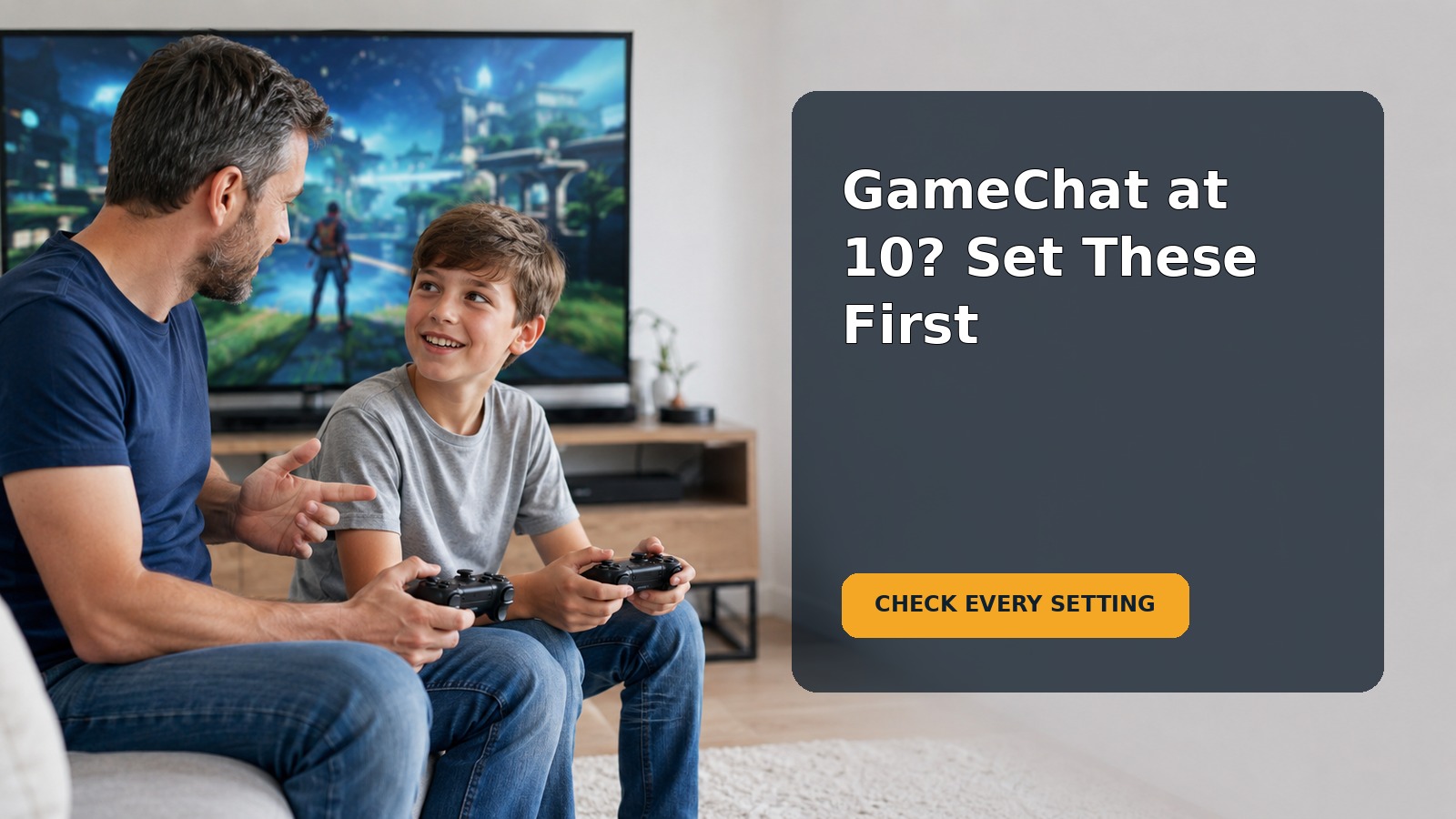
The short answer: a 10-year-old can use GameChat only after a parent or guardian sets up the required controls, but “allowed” should not mean “wide open.” Start with voice chat, approve only people you can identify, keep video off at first, set a clear end time and practice how to leave and report an uncomfortable chat.
For a child under 16, Nintendo requires the Nintendo Switch Parental Controls smart-device app to manage GameChat. The parent approves specific friends, and video can either be blocked or require approval for each session. Those gates are useful, but they do not replace family rules or supervision. This guide explains a practical Nintendo Switch 2 GameChat parental controls child setup for ages 10–12.
Start with the immediate question: is GameChat appropriate at 10?
What GameChat actually allows
GameChat is a Nintendo Switch 2 system feature for voice chat, game-screen sharing and, with a compatible camera, video chat. Nintendo says a voice chat can include up to 12 people, while up to four people can share a game screen or use video at once. Online features require an internet connection, a Nintendo Account and a Nintendo Switch Online membership; video also requires a compatible USB-C camera. Availability and requirements can vary by country.
The important distinction is that GameChat is not simply another switch inside a game. Nintendo’s general “In-Game Communication with Others” restriction does not control GameChat. GameChat permissions for a child are managed separately in the parental-controls app.
Readiness matters more than pressure from friends
A child does not need GameChat merely because classmates use it. Consider whether your child can follow a stop time, keep personal information private, recognize when a joke becomes cruel, leave without waiting for permission from peers and tell you when something feels wrong. Also ask who they want to chat with and how they know each person.
Delay setup if the answer is vague, if the proposed contact is known only through an online username, or if your child is already struggling with late-night play, secrecy or distress after online interactions. Waiting is a safety decision, not a punishment.
A calm first-step check before changing settings
Verify the account and app setup
- Confirm the child uses the correct supervised Nintendo Account in your family group.
- Install or update the official Nintendo Switch Parental Controls app and link the correct Switch 2 console.
- Confirm the console, app and account are updated before relying on the menus in this guide.
- Register the parent or guardian’s phone number to the Nintendo Account; Nintendo requires phone verification for GameChat setup.
- Keep the parental-control PIN private and do not enter it where the child can watch.
Most console restrictions apply to the whole system, so set them with the youngest user in mind. GameChat permissions, however, are managed for the individual user in the app. If siblings share the console, review both layers rather than assuming one setting covers everything.
Ask four questions about each requested friend
- What is this person’s real name?
- How do you know them offline?
- Which adult can confirm the connection?
- What games and times do you expect to chat?
Nintendo’s approval flow lets a parent add a note about who the friend is and why approval was given. Use it. Approve a known cousin or verified classmate individually; do not approve a long list just to finish setup quickly. A friend-list entry is not proof of identity by itself.
The safer GameChat setup for a 10-year-old
Step 1: approve only verified friends
Open the parental-controls app, choose the child’s user, open GameChat and review new chat-approval requests. Ask your child about each request before deciding. Add a useful note, such as “Sam R.—classmate; confirmed with parent on 10 Aug.” Withdraw permission if the relationship changes, the account seems compromised or the chat becomes unkind.
Nintendo limits younger users to friends a parent has approved for GameChat. That reduces random contact, but an approved friend can still invite social pressure, repeat private information or show unsuitable material. Keep the list short enough to review.
Step 2: begin with video chat off
For a first trial, choose Do not allow video chat. Voice chat and game-screen sharing already create enough new skills to practice. Video can expose a child’s face, family members, school items, mail, windows and the layout of the room.
If you later enable video, use Nintendo’s per-session approval option rather than standing permission. Place the camera in a shared space with a plain background, remove identifying items and check who is in the session before approving. Nintendo’s app can adjust the camera field of view during an active session and can withdraw current video permission.
Step 3: set play time and a bedtime boundary
Choose a predictable window, such as one 30-minute session after homework and before the evening routine. Use the app’s play-time and bedtime tools as a backup, then give a five-minute verbal warning so the ending is not a surprise. Remember that play-time limits generally apply to the whole console, not only one user.
Decide in advance whether “time is up” should only display a notice or suspend play. An abrupt suspension can end a game without a goodbye, while a notice can be ignored. Match the setting to your child’s ability to stop, and review the result after the first week.
Step 4: keep general communication restrictions age-appropriate
Use the Pre-Teen preset or custom restrictions suitable for your household, including game ratings and in-game communication. Do not turn on broad communication in every game just because you approved GameChat. These are separate surfaces with different contact patterns.
Review Nintendo Account restrictions for eShop purchases, friend suggestions and third-party information sharing as well. A complete setup uses the console, the parental-controls app and the account settings rather than expecting one menu to control all online activity.
Teach the behavior that settings cannot enforce
Use one simple family script
“You may GameChat with the people we approve, in the family room, during the agreed time. Keep your full name, school, address, phone number, passwords and live location private. If anyone pressures you, shows something upsetting or asks you to keep a secret, mute or leave and tell me. You will not lose GameChat just for telling me the truth.”
That final sentence matters. Children are more likely to ask for help when disclosure does not automatically lead to blame. Consequences can still address deliberate rule-breaking, but reporting an uncomfortable interaction should be treated as a protective action.
Practice mute, leave and report before the first chat
Run a two-minute rehearsal. Ask your child to find the C Button, mute the microphone, leave a chat and show where reporting is available. Nintendo states that users can report a person who made them uncomfortable or harassed them. A child should not stay in a bad interaction to collect evidence or win an argument.
Use a clear ladder:
- Awkward but safe: mute, leave and talk about it later.
- Mean, sexual, threatening or pressuring: leave, tell an adult promptly, block or withdraw permission and report through the platform.
- Immediate danger or a credible threat: preserve relevant account details, contact local emergency services if needed and seek appropriate professional help.
Review activity without turning it into secret surveillance
Use the app’s records for a weekly check-in
Nintendo says GameChat activity appears in Play Activity and Monthly Summary, including who the child chatted with and for how long. Tell your child that you will review this information. A transparent check is different from pretending there is no oversight.
Once a week, ask: “Did every chat include only the people you expected? Did anyone pressure you to stay longer, use video or keep a secret? Is there anyone we should remove?” Keep the conversation brief unless there is a concern.
Increase freedom in small steps
After several weeks of safe use, you might extend session length or consider per-session video. Change one privilege at a time and set a review date. Nappot’s step-down plan for parental controls uses the same principle: expand freedom in response to demonstrated skills, not a birthday or repeated pressure.
If this is your child’s first online communication tool, the family tech agreement guide can help you define privacy, repair and review rules beyond one device.
Common mistakes and better alternatives
Do not treat “friends only” as risk-free
Better: confirm identities, approve individually and revisit the list. Known peers can still bully, share accounts, use hurtful language or bring an unapproved person into the room. Ask your child to leave if the people present do not match the approved plan.
Do not enable video by default
Better: start with voice, then use per-session video permission only after the child demonstrates privacy habits. Check the camera view and use a shared family area.
Do not rely on one broad restriction
Better: review GameChat permissions, in-game communication, game ratings, play time, bedtime and Nintendo Account settings separately. Product menus and regional rules can change, so check Nintendo’s current support pages after major updates.
Do not use monitoring as a surprise
Better: explain what activity information you can see, what you will review and what would cause a permission to change. Predictable oversight protects trust better than hidden checking followed by confrontation.
One-page parent checklist
Before the first GameChat session
- Link the official parental-controls app to the correct console and supervised user.
- Register the parent’s phone number and keep the PIN private.
- Approve only friends whose identity you can verify.
- Keep video off for the first trial.
- Set a play-time window and bedtime boundary.
- Keep general in-game communication restricted unless separately approved.
- Choose a shared-space location and protect background privacy.
- Practice mute, leave and report.
- Explain that Play Activity will be reviewed together.
- Set a one-week review date.
What success should look like
Success is not simply a quiet child using the console. It means the approved list stays accurate, the child stops on time, video remains within the agreed rule, personal information stays private and the child tells you about uncomfortable moments. If those skills weaken, narrow access and practice again rather than moving straight to shame or permanent bans.
Frequently asked questions
Does the “In-Game Communication with Others” restriction block GameChat?
No. Nintendo’s support guidance says that restriction does not apply to GameChat. Manage GameChat for the child’s user in the Nintendo Switch Parental Controls app.
Can a child under 16 use GameChat without the parental-controls app?
Nintendo says the app must be linked and GameChat-specific parental controls must be set for users under 16 and supervised users. A parent or guardian approves the child’s GameChat contacts.
Should I allow video chat for my 10-year-old?
A cautious default is no video during the first trial. If your child later shows good privacy and stopping skills, consider approval for each individual session in a shared space. Video is optional and requires a compatible camera.
Can my child chat with strangers?
GameChat sessions use people on the friend list, and younger users can use GameChat only with contacts approved by a parent. Still verify every person’s identity; a username or friend entry alone is not enough.
What if a friend behaves badly?
Teach your child to mute or leave immediately and tell you. Withdraw that friend’s GameChat permission, use the platform’s report feature when appropriate and contact the other family or relevant authorities according to the seriousness of the behavior.
Sources
- Nintendo Support: Set up, adjust or remove parental controls on Nintendo Switch 2
- Nintendo Support: Parental Controls overview and GameChat FAQ
- Nintendo: GameChat features, requirements and safety information
Product features, membership requirements, age rules and regional availability can change. Check Nintendo’s current support guidance for your account and country before setup. Parental controls reduce risk but cannot prevent every harmful interaction.