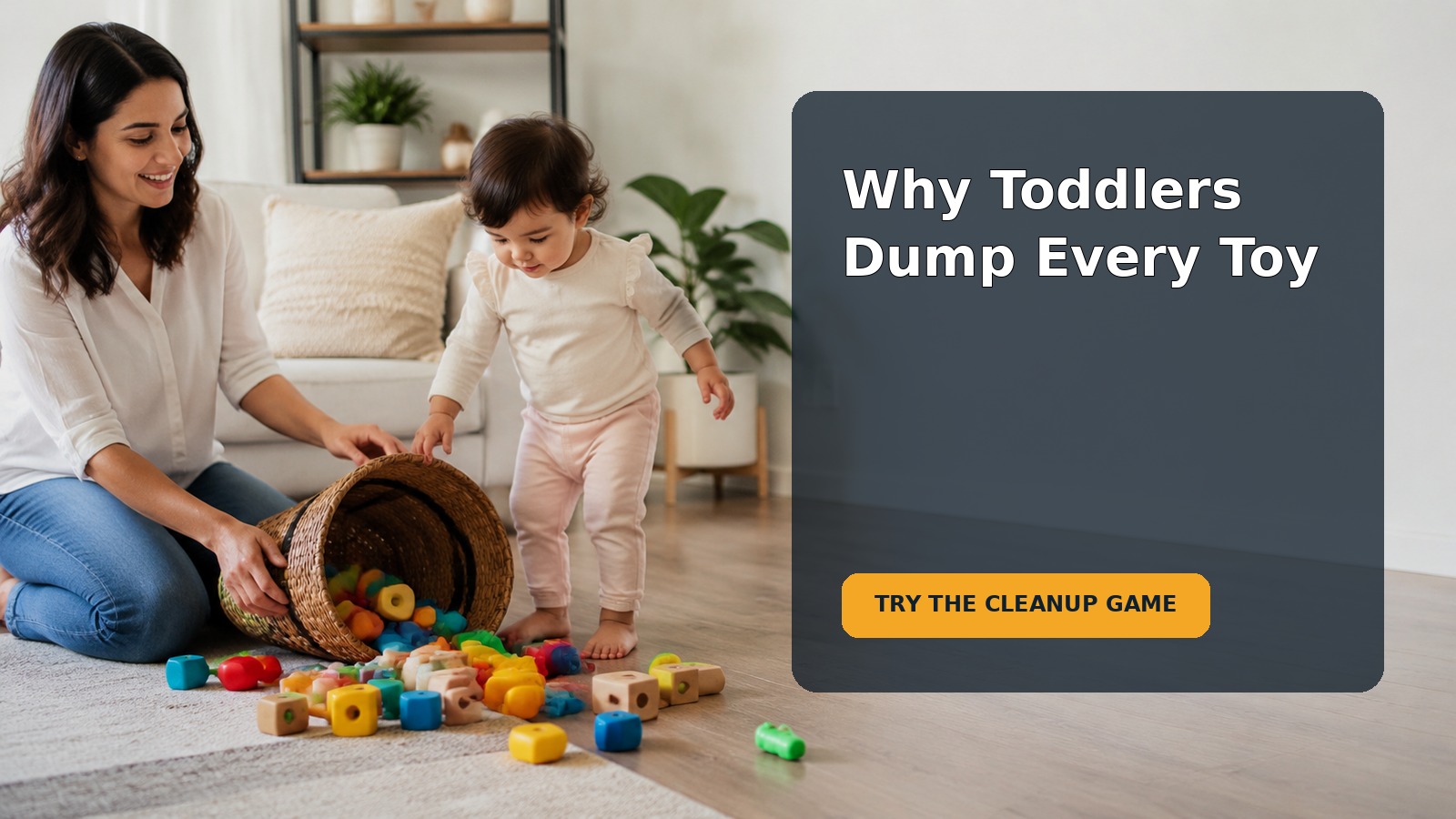
If your toddler empties every basket, bin and shelf within minutes, you are not looking at proof that they are “bad at cleaning.” Dumping is quick, interesting and easy for an 18- to 36-month-old. Putting everything back requires stopping an enjoyable activity, remembering several steps, sorting objects and staying with a job that an adult chose.
A workable toddler dumps toys cleanup routine starts by making the task much smaller. Keep fewer toys available, give one concrete direction, clean beside your child and repeat the same short sequence every day. The first goal is participation—perhaps placing three blocks in a bin—not an independently spotless room.
Why toddlers dump toys faster than they put them away
Dumping is exploration, not a character flaw
A container offers an immediate experiment: tip it, hear the crash, watch the pieces scatter and discover what was hidden underneath. A toddler may repeat the action because repetition is how young children explore cause and effect. The behavior can also appear when a child wants one buried object but cannot yet plan a tidy way to find it.
Cleanup is more demanding. It asks a toddler to shift attention, hold the instruction in mind, resist the impulse to return to play and complete several movements. The Center on the Developing Child at Harvard explains that executive-function skills help people plan, focus, switch gears and manage information—and that these skills develop rather than arriving fully formed. A young toddler therefore needs an adult to provide much of the structure.
What is realistic from 18 to 36 months
The CDC notes that toddlers ages 2 to 3 are becoming more independent and can follow simple instructions and imitate adults. That supports inviting them to help, but it does not mean they can organize a whole playroom after a busy afternoon. Ability also changes with hunger, fatigue, language development, sensory needs and how many objects are on the floor.
Expect a younger toddler to copy one action while you do most of the work. An older toddler may put one type of toy into a clearly marked bin with reminders. Both may refuse, wander away or dump the bin again. Progress looks like more familiarity and participation over weeks, not perfect compliance every day.
Start with a 60-second setup check
Reduce the size of the problem
- Put out only a few toy choices at one time.
- Use low, open bins that your toddler can reach safely.
- Give each broad toy type one obvious home rather than creating a detailed sorting system.
- Attach a simple photo label to the front of a bin when useful.
- Store toys with many small pieces out of reach and bring them down for supervised play.
Toy rotation is optional; the important point is that the visible amount is manageable. A room with six clear homes is easier to reset than one packed with overflowing baskets. If you want age-appropriate ideas for a smaller play menu, Nappot’s guide to simple indoor toddler activities can help you choose what to keep available.
Look for the pattern before correcting it
For a few days, notice when dumping happens. Is your child searching for a favorite vehicle? Enjoying the sound? Emptying bins during a transition? Repeating the behavior when tired? Getting overwhelmed by too many choices? The answer determines the adjustment.
If the child wants one hidden toy, use shallower bins. If the sound is the attraction, offer a safe “dump and fill” activity with large soft items. If the problem peaks before dinner, begin the reset earlier and make it shorter. If transitions are difficult generally, use the same warning and closing ritual described in Nappot’s guide to toddler transitions without a power struggle.
A cleanup routine your toddler can learn
Step 1: Use one predictable cue
Choose a cue you can repeat: a short song, a timer sound or the phrase “Play is finished; blocks go in.” Use it at one or two natural points in the day instead of interrupting every few minutes. For example, reset before lunch and before bedtime.
Give a brief warning when possible: “Two more turns, then blocks in the basket.” Toddlers do not understand five minutes precisely, so pair time words with something concrete: one last tower, one last car trip or the end of a short song.
Step 2: Get close and give one specific direction
Move near your child, say their name, wait for a glance or pause, and point to the object and container. Replace “Clean this whole mess” with “Put this red block in the block bin.” Avoid stacking several requests together. A short direction makes the next action visible.
Offer a limited choice when both options work: “Cars first or blocks first?” The choice gives useful control without turning cleanup into a debate about whether it will happen. Then pause long enough for your toddler to process the words and begin.
Step 3: Work beside them
At this age, shared cleanup is teaching. Sit on the floor and alternate: “My block, your block.” Hand your toddler one item at a time, or hold the bin while they drop objects in. Make the task easier than the original mess.
A simple game can maintain attention:
- Choose one category, such as blocks.
- Set a tiny target: “Let’s find five.”
- Take turns placing pieces in the bin.
- Name what is happening: “You found the last blue block.”
- Stop at the agreed target or finish together if your child is still engaged.
Do not secretly turn “five blocks” into the entire room after your child succeeds. Keeping the promise builds trust in the routine.
Step 4: Notice the action, then move on
Use specific, low-key feedback: “You put the animals in their basket,” or “We cleaned together.” The CDC recommends attention and praise when toddlers follow instructions and show positive behavior. Specific feedback tells a child exactly what worked without making cleanup a performance.
Then close the routine with the next predictable event: wash hands, choose a book or go to lunch. This sequence helps cleanup become part of the day rather than an open-ended punishment. A flexible daily rhythm can support that predictability; see Nappot’s daily routine for toddlers for a broader framework.
What to do when your toddler refuses
Stay calm and shrink the job again
Refusal may mean the direction is too broad, the child is absorbed in play or their capacity is low at that moment. Repeat one short instruction once, point to the next item and begin alongside them. If needed, reduce the request to one object: “You put in this bear; I will do the rest.”
You can hold the boundary without a lecture: “Toys stay here until we make a safe path. I’ll help.” If the floor must be cleared quickly, the adult can finish. Teaching does not require waiting through a prolonged standoff.
Use a neutral, related limit
If your toddler repeatedly dumps a bin after you have shown how it is used, calmly remove that bin for now: “The blocks are being dumped, so they will rest on the shelf. We can try again later.” This is a direct environmental limit, not shame or retaliation.
Avoid threats to throw away every toy, long time-outs for a developmental behavior or labels such as “messy,” “lazy” or “naughty.” Those responses do not teach the missing sequence. They can also turn cleanup into a contest over control.
Common mistakes and better alternatives
Expecting independent cleanup too soon
Try instead: treat cleanup as a shared routine. Gradually transfer one step when your child can do it reliably.
Giving a room-sized instruction
Try instead: name one object and one destination. Keep language and gestures consistent.
Keeping too many toys available
Try instead: reduce the visible choices and use broad, easy categories. The storage system should fit the child’s current skills, not an adult’s ideal organization.
Turning every dump into a confrontation
Try instead: redirect appropriate dumping to a safe activity, adjust the container or remove the bin briefly. Save firm intervention for safety and repeated destructive behavior.
Doing everything secretly after bedtime
Try instead: include your toddler in one short reset while accepting that the adult will still complete much of the work. Participation is how the routine becomes familiar.
Safety checks for the play and cleanup space
- Follow the toy’s age guidance and inspect pieces for breakage.
- Keep choking hazards, button batteries, magnets and adult objects completely out of reach.
- Anchor tall or climbable storage furniture to the wall as recommended by the manufacturer.
- Avoid heavy bins that can fall on a child or lids that can pinch fingers or trap a child.
- Keep a clear path through the room to reduce trips, especially near stairs.
- Supervise cleanup rather than asking a toddler to handle sharp, broken or unknown objects.
If you find a dangerous item, remove it yourself. Safety is the adult’s job; cleanup practice never requires a toddler to manage hazards.
When to ask for extra support
Occasional toy dumping, short attention and resistance to stopping play are common toddler challenges. Bring the pattern to your child’s pediatrician or other qualified developmental professional if you also have concerns about language, play, movement, hearing, understanding simple directions or a loss of skills. Mention behavior that is unusually intense across settings, causes frequent injury or prevents ordinary family activities despite consistent support.
A childcare provider can also offer useful context. Ask how your child joins cleanup there, what cues work and whether the behavior looks different in a smaller group or with a visual routine. The aim is not to diagnose a child from one habit but to understand the whole developmental picture.
A one-week cleanup practice plan
Days 1–2: Prepare
- Choose one play area and one daily cleanup time.
- Reduce the number of available toys.
- Set up easy, reachable homes for two or three categories.
- Observe what your child likes to dump and why.
Days 3–4: Teach one step
- Use the same closing cue.
- Give one specific direction.
- Alternate placing five items in a bin.
- End with specific feedback and the next routine.
Days 5–7: Repeat and adjust
- Keep the task at the same small size.
- Notice whether the container, timing or number of toys needs changing.
- Let your toddler complete one familiar step while you handle the rest.
- Measure success by participation and less conflict—not a perfect room.
Frequently asked questions
Should a 2-year-old clean up all their toys?
No. A 2-year-old can begin helping with simple, concrete steps, but an adult should expect to guide the routine and do much of the work. Increase responsibility gradually as the child’s understanding and attention grow.
What if my toddler dumps the bin again immediately?
Keep your response brief. If dumping is safe and clearly part of play, redirect it to a permitted container activity. If play has ended, remove the bin calmly and try the routine again later. Do not repeatedly refill it while becoming more frustrated.
Do cleanup songs really help?
A short, consistent song can act as a transition cue and make the sequence familiar. It is not magic; your toddler will still need a small task and adult help. Use the same simple song rather than extending it until the room is perfect.
How long should toddler cleanup take?
Start with a few minutes or a tiny target, such as five objects. Stop while your toddler can still succeed. A short routine repeated daily teaches more than an occasional 20-minute battle.
Sources
- Centers for Disease Control and Prevention: Positive Parenting Tips—Toddlers (2–3 years)
- Center on the Developing Child at Harvard University: A Guide to Executive Function
This article provides general parenting and developmental education. It does not diagnose a developmental or behavioral condition. Ask a qualified professional who knows your child if you have concerns about development, safety or a persistent behavior pattern.