A note saying your child may have scoliosis can sound much more definite than it is. A school screening is designed to notice signs that deserve a closer look; it does not diagnose a spinal curve. The most useful next step is usually a routine appointment with your child’s pediatrician or primary care clinician, who can review the screening result, examine your child and decide whether any follow-up is needed.
If you are searching for “11 year old scoliosis school screening what happens next,” start here: keep the letter, ask what the screener observed, and arrange the recommended clinical follow-up. Do not blame posture, backpacks, sports or anything your child did. The American Academy of Orthopaedic Surgeons (AAOS) explains that idiopathic scoliosis—the most common type in adolescents—has no known exact cause and often first becomes noticeable during the growth spurt.
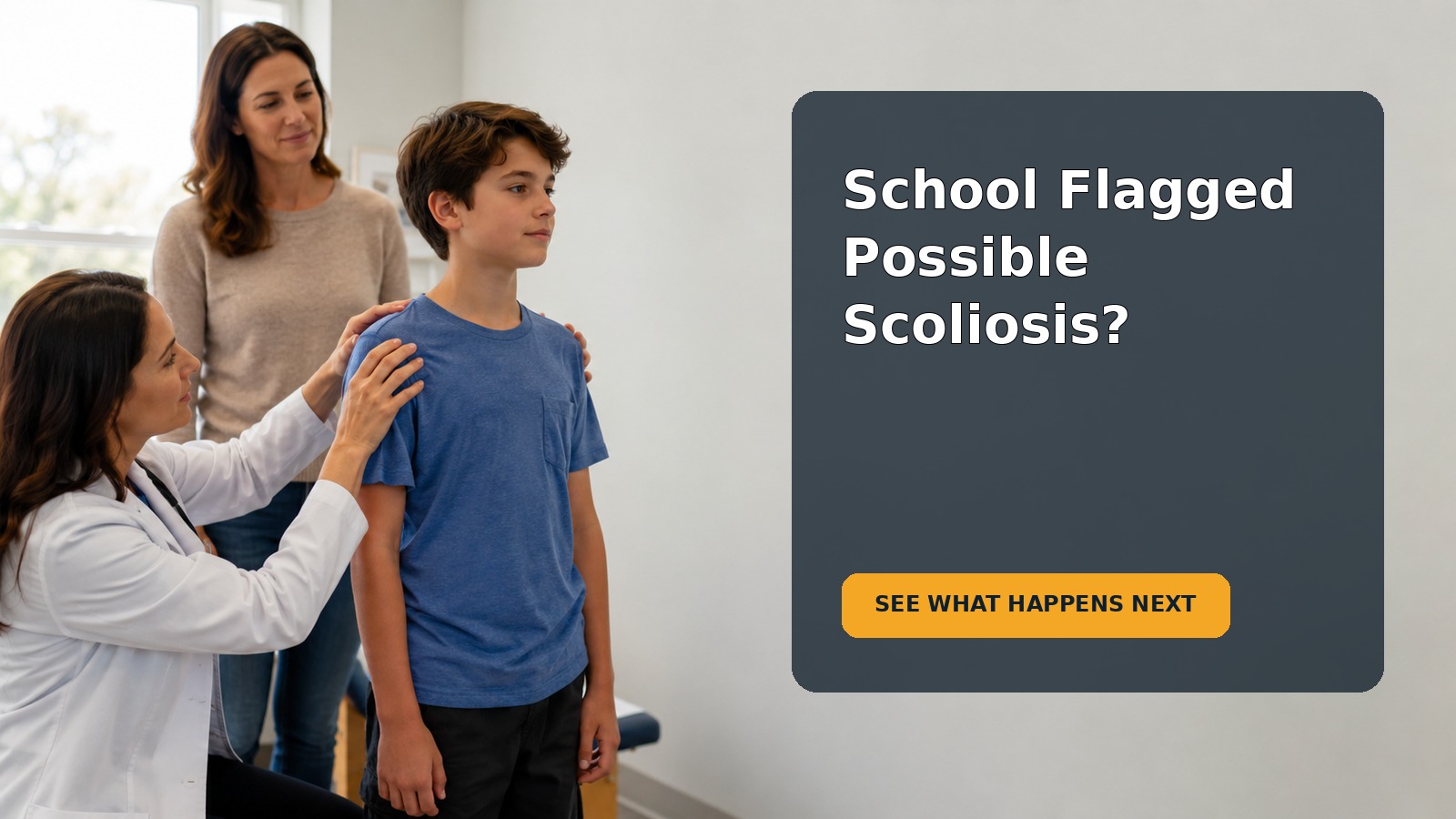
What a possible scoliosis screening result means
Scoliosis is a sideways curvature of the spine. In adolescent idiopathic scoliosis, the curve appears in an otherwise healthy child or teen and its cause is unknown. AAOS notes that most idiopathic cases emerge between age 10 and the end of growth, which is why an 11-year-old may be screened at school or checked during a routine physical.
A school screener may look for uneven shoulders, shoulder blades, ribs, waist or hips. Many programs also use the forward-bend test: the child bends at the waist while the screener looks for trunk or rib asymmetry. Some programs use a scoliometer, a small tool placed across the back to measure trunk rotation. These observations can identify asymmetry, but they cannot by themselves confirm scoliosis or measure a spinal curve.
A flag is not a diagnosis
Screening programs intentionally refer some children who turn out not to have scoliosis. Body position, leg-length differences, normal asymmetry, measurement thresholds and the way a program is organized can all affect a referral. The U.S. Preventive Services Task Force (USPSTF) says screening tests can detect adolescent idiopathic scoliosis when used in combination, but it also concludes that evidence is insufficient to determine the overall balance of benefits and harms of routine screening in symptom-free children ages 10 to 18.
That debate is about whether every symptom-free adolescent should be screened. It does not mean you should ignore a result already reported for your child. It means the letter should be treated as a prompt for an individualized clinical assessment rather than proof that imaging, a brace or surgery is required.
Your calm first-step check
Read the school notice carefully
Before calling the clinic, look for the date, the screening method, the side or area of asymmetry, any scoliometer measurement, the school’s follow-up deadline and contact details for the nurse or screening team. If the letter only says “possible scoliosis,” it is reasonable to ask the school for the recorded findings. Do not ask your child to repeat forward bends over and over or try to estimate a curve from a photograph.
Ask about symptoms without creating alarm
Most adolescents with idiopathic scoliosis have no symptoms, and AAOS says it does not usually cause back pain. Ask one neutral question: “Have you noticed back pain, weakness, numbness or anything that makes sports or daily activities harder?” Then listen. Avoid inspecting your child’s body in front of siblings or making comments about appearance, weight or “standing straight.”
You can say:
“The school noticed that your shoulders or back looked a little uneven during a quick check. That does not mean anything is definitely wrong. We’ll let your doctor examine you and tell us whether we need to do anything else.”
This protects your child’s dignity and keeps a screening result from becoming a body-image label.
What happens at the pediatrician or primary care visit
Bring the school letter and any relevant health history. The clinician may ask about recent growth, when puberty-related changes began, family history of scoliosis, pain, neurologic symptoms and earlier examinations. Family history matters because AAOS reports that scoliosis can run in families, but having a relative with scoliosis still does not establish a diagnosis.
The clinical examination
The clinician will usually observe your child standing and may compare shoulder height, shoulder blades, waist, hips and overall balance. They may repeat a forward-bend test and use a scoliometer. They may also check leg length, strength, sensation, reflexes or gait when the history or examination calls for it.
The examination should be explained to your child before it begins. An 11-year-old can ask for a parent or chaperone to remain in the room, and the clinician can provide a gown or other appropriate covering. If your tween is becoming more private at medical visits, our guide to private time with the pediatrician can help families prepare for age-appropriate confidentiality without making the visit feel secretive.
Will my child automatically need an X-ray?
No. Imaging is not automatic after every school referral. The clinician decides whether the examination is reassuring, should be rechecked during growth, needs referral to a specialist or warrants standing spinal radiographs. If scoliosis is suspected, radiographs can confirm and measure the curve using the Cobb angle. The clinician should balance the value of imaging against radiation exposure and avoid unnecessary repeat images.
Ask these practical questions:
- What did you find on today’s examination?
- Does my child need observation, a recheck, imaging or a specialist referral?
- If we are observing, when should the next examination happen?
- Is my child still growing rapidly, and how does that affect follow-up?
- Are there any activity restrictions? If so, why?
- Which symptoms should make us call sooner?
What the possible outcomes look like
The next step depends on the examination, the size and pattern of any confirmed curve, how much growth remains and whether the curve changes over time. A screening letter cannot predict any of these.
Reassurance or routine observation
The clinician may find no meaningful asymmetry and recommend ordinary well-child care. A very small confirmed curve may simply be monitored during growth. Observation is active follow-up: it means checking at an appropriate interval rather than assuming the curve will or will not change.
Specialist assessment
A referral to pediatric orthopedics does not mean surgery is likely. The specialist may review growth, repeat measurements, assess curve type and decide whether periodic observation is enough. Most children with adolescent idiopathic scoliosis can lead normal, active lives. AAOS states that children can generally participate in sports to their own level of tolerance unless their clinician gives a specific restriction.
Bracing or surgery
These treatments are not decisions made from a school screen. Bracing may be considered for certain curves in a child who is still growing, with the goal of reducing progression. Surgery is generally reserved for much larger or progressive curves after specialist evaluation. Exact thresholds and choices depend on the child, curve and growth remaining, so online numbers should never substitute for the treating team’s recommendation.
Common mistakes—and better alternatives
Mistake: blaming posture, a backpack or sports
Bad posture does not cause idiopathic scoliosis. AAOS also says heavy backpacks and sports do not cause scoliosis or make a curve worse, although an overloaded backpack can contribute to back discomfort. A better message is: “You did not cause this, and we are just checking what the school noticed.”
Mistake: buying a brace or starting treatment without an evaluation
A brace must be prescribed and fitted for a specific child and curve. Do not buy an online posture corrector, start chiropractic manipulation or promise that exercises will straighten the spine based only on a school notice. Keep your child active as tolerated and wait for individualized clinical guidance.
Mistake: treating the screening flag as an emergency
For a comfortable child with no concerning symptoms, this is usually a routine follow-up rather than an emergency. Schedule the recommended appointment instead of repeatedly checking your child’s back or restricting normal life while you wait.
Mistake: ignoring the letter because your child feels fine
Adolescent idiopathic scoliosis often causes no pain, so feeling well does not answer the screening question. Complete the follow-up, just as you would after another school screening result. Our article on what to do after a school vision screening referral explains the same useful principle: screening identifies who needs a closer check; a clinician determines what the result actually means.
When to call sooner or seek urgent help
Contact your child’s clinician promptly rather than waiting for a routine appointment if your child has significant or worsening back pain, pain that wakes them, fever or unexplained illness with back pain, a rapidly changing visible deformity, or difficulty with normal activities. AAOS advises calling a doctor when severe back pain is associated with limb weakness or numbness.
Seek urgent medical care for new weakness, numbness, trouble walking, loss of bladder or bowel control, breathing difficulty, or severe pain after an injury. These symptoms are not typical signs of uncomplicated adolescent idiopathic scoliosis and need assessment for other causes.
A parent checklist for the next seven days
- Keep the notice: Save the original school screening letter or take a clear photo.
- Get the details: Ask what asymmetry or measurement led to the referral.
- Book follow-up: Arrange an appointment with your child’s pediatrician or primary care clinician within the timeframe given.
- Write down context: Note recent growth, family history, pain, weakness, numbness or activity changes without repeatedly testing your child.
- Prepare your tween: Explain that the visit is a closer check, not proof of a diagnosis.
- Protect privacy: Avoid body comments, public comparisons and unnecessary photos.
- Ask for a plan: Leave the appointment knowing whether the result is reassuring, needs observation, imaging or referral—and when to follow up.
Success is not getting an instant yes-or-no answer. Success is moving from a broad school screening flag to a documented, individualized plan while your child feels informed rather than blamed.
Frequently asked questions
Is scoliosis common at age 11?
Adolescent idiopathic scoliosis most often becomes noticeable from age 10 through the growth years. Many curves are small, and most do not cause serious problems. A screening referral does not tell you whether a curve is present or how significant it might be.
Should I check my child’s back every day?
No. Repeated home checks can increase anxiety and cannot replace a clinical examination. Record any clear concerns once, complete the recommended visit and follow the clinician’s monitoring schedule.
Can my child keep playing sports?
Usually yes while waiting for a routine evaluation if they feel well and have not been given a restriction. AAOS says children with idiopathic scoliosis can generally participate in sports to their tolerance. Pain, weakness, numbness, injury or a clinician’s specific instructions may change that advice.
Does a positive screen mean my child will need a brace?
No. Some referrals are false positives, some examinations are reassuring, and many small curves only need observation. Bracing is considered only after a curve is clinically confirmed and the care team considers its size, progression risk and remaining growth.
What if my child is embarrassed or refuses the examination?
Tell the clinic before the visit. Ask the clinician to explain each step, provide appropriate covering, pause when requested and offer a chaperone. Give your child limited choices—such as whether you stay nearby or which shirt to bring—without presenting necessary follow-up as a punishment.
Sources
- American Academy of Pediatrics: Health Screenings at School
- American Academy of Orthopaedic Surgeons: Scoliosis Overview
- U.S. Preventive Services Task Force: Adolescent Idiopathic Scoliosis Screening
This article provides general education and does not diagnose scoliosis or replace care from your child’s clinician. Screening practices, referral thresholds and follow-up plans vary by location and child.