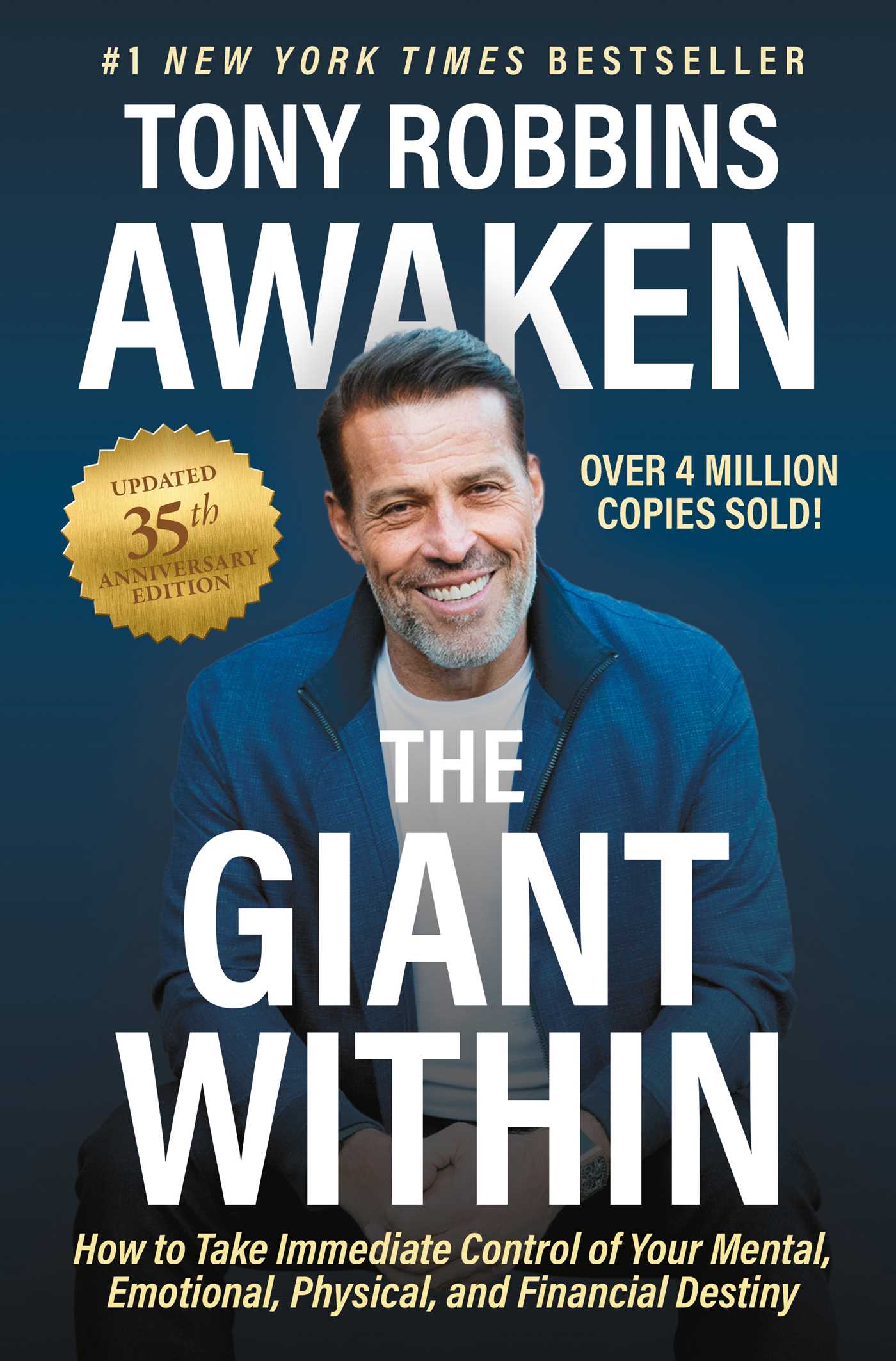
Awaken the Giant Within by Tony Robbins is a practical book about taking responsibility for the choices that shape your life. Its central idea is powerful: lasting change begins when you stop treating your results as fixed and start directing your beliefs, emotions, standards, and daily actions.
Although Robbins writes about the whole person, the book has a direct financial message. Your income, spending, saving, and investing are influenced by the meanings you attach to money and by the standards you repeatedly accept. Changing those patterns does not guarantee wealth, but it can make better financial behavior easier to repeat. This article turns the book’s broad ideas into useful steps for building a stronger relationship with money.
What the book is about
Robbins presents personal change as a process of learning how to make decisions, manage emotional states, and follow through. He argues that people are often moved less by facts alone than by the meaning they give those facts. The same financial event can feel like proof of failure to one person and feedback for a better plan to another.
The book explores beliefs, values, standards, questions, goals, and conditioning. It also discusses “neuro-associations”—the learned links between an action and the pleasure or pain we expect from it. In money terms, overspending may provide immediate relief or status, while saving may feel restrictive. Changing the pattern requires creating a more compelling reason to act differently and then practicing the new behavior.
Five ideas that matter for wealth
1. Your decisions shape your direction
A goal is not enough. The repeated choices behind it matter: what you buy, what you learn, which opportunities you accept, and whether you review your numbers. Financial progress is usually a decision process before it becomes a balance-sheet result.
2. Beliefs can be upgraded
A belief is an assumption you treat as true. “I am bad with money” can become an identity that excuses avoidance. A more useful belief is specific and testable: “I can improve my money skills by reviewing one account and one decision every week.” The point is not positive thinking without evidence; it is adopting a belief that supports learning and action.
3. Standards govern behavior
Goals describe what you want. Standards describe what you refuse to tolerate. A goal may be to save more; a standard might be never carrying a credit-card balance for discretionary purchases, or always keeping a cash buffer before upgrading your lifestyle. Standards turn intentions into boundaries.
4. Better questions produce better choices
Questions direct attention. Instead of asking, “Why can I never get ahead?” ask, “What is one expense I can redesign?” or “What skill could increase my value over the next year?” A good question does not deny difficulty; it makes the next useful action visible.
5. Change is strengthened by action
Insight matters, but a new financial identity is built through evidence. Each paid bill, avoided impulse purchase, completed course, or automatic investment is a vote for the person you are becoming. Small wins are not the whole strategy, but they help make the strategy believable.
Simple terms from the book
- Belief: an idea you accept as true that influences your behavior.
- Value: something important to you that helps guide decisions, such as security, freedom, family, or growth.
- Standard: the minimum behavior or result you are willing to accept.
- Conditioning: repeated experiences and habits that train your automatic responses.
- Leverage: a change that makes one decision or action produce a larger result, such as automation, education, or a repeatable system.
A practical seven-step money reset
- Define the outcome. Write a financial result in concrete terms: a cash reserve equal to three months of essential expenses, a debt balance reduced by a target amount, or a consistent monthly investment. Give it a date and a reason.
- Find the real rule. Complete this sentence: “When I have money, I tend to…” Look for the pattern rather than judging yourself. Do you spend to reward yourself, avoid checking statements, or postpone investing until everything feels perfect?
- Replace the story. Write one accurate belief that supports action. For example: “I do not need to understand every investment today; I need to learn the basics, control costs, diversify appropriately, and keep improving.”
- Set a non-negotiable standard. Pick one rule you can actually keep. Automate a transfer on payday, wait 24 hours before nonessential purchases, or review your net worth on the first weekend of each month.
- Ask a better weekly question. Use: “What decision this week will make next month easier?” It could mean cancelling a fee, negotiating a bill, learning a valuable skill, or having a clear conversation about shared spending.
- Make progress visible. Track only a few numbers: cash reserve, high-interest debt, savings rate, and invested assets. A simple dashboard turns vague anxiety into information you can use.
- Reward the process. Celebrate consistency without using celebration as an excuse to undo the result. The reward might be time with people you love, a low-cost experience, or recognition that you kept a promise to yourself.
How to apply the lessons at work
Robbins’s framework also applies to earning power. List the problems your employer, customers, or community most urgently needs solved. Then identify one skill that would make you more useful in that area. Practice it in a visible way: complete a project, publish a case study, improve a process, or ask for feedback from someone who understands the market.
Do not confuse activity with value. Working longer is not automatically the same as producing more value. Look for leverage: a documented process, a reusable piece of content, a technical skill, a trusted relationship, or a result that can be delivered repeatedly. Higher income is more sustainable when it comes from solving better problems, not merely from adding hours.
What to be careful about
The book is energetic and motivational, but personal responsibility should not be confused with total control. Economic conditions, health, discrimination, family obligations, and chance all affect financial outcomes. Mindset can improve decisions; it cannot erase structural constraints or guarantee a particular income.
Some of Robbins’s exercises are broad and emotionally intense. Keep the useful core while grounding it in evidence. A new belief should be paired with a budget, an emergency plan, appropriate risk management, and investment decisions suited to your time horizon and circumstances. Never take financial risk simply because a motivational message makes it feel exciting.
Bottom line
Awaken the Giant Within is best read as a book about agency: the ability to choose a response, create standards, and practice better decisions. For wealth building, its most useful lesson is that money habits are not a permanent personality trait. Clarify what matters, change the rules that guide your behavior, automate the good choices, and collect enough small pieces of evidence to make progress feel normal.
Sources and credits
- Simon & Schuster publisher page — book and author details.
- Amazon.com product page — matched updated edition/product reference.
- Open Library edition record — ISBN and cover reference.
- Cover image credit: Open Library cover record for ISBN 9781982121831.