Search intent: what this guide answers
If you searched for a Thinking in Bets summary, you probably want two answers quickly: what Annie Duke argues, and how the ideas might improve decisions about investing, work, or a business when the facts are incomplete. This guide gives a concise, evidence-bounded overview of the book and then adds a separate Wealthy I AM application. It is general education, not individualized financial advice, and it does not promise better returns or outcomes.
The problem: a good result can hide a bad decision
A profitable investment can be lucky. A losing investment can be sensible. If you judge only by the result, you can copy luck, blame skill, and repeat the same mistake under a new set of circumstances. That is the decision problem at the center of Thinking in Bets: Making Smarter Decisions When You Don’t Have All the Facts by Annie Duke.
Why it matters for wealth
Money decisions are usually made before the future is known. You choose a savings rate, price a service, hire someone, buy an asset, or keep cash available without knowing exactly what will happen. Better reasoning cannot remove uncertainty, but it can make assumptions visible, improve learning, and reduce overconfidence.
The honest curiosity gap
The book is associated with poker, but its useful question is broader: how can you tell whether your reasoning was sound when the outcome may be influenced by luck? The answer is not to become certain. It is to treat decisions as bets, express what you believe and how strongly you believe it, and update as evidence arrives.
The early answer and promise
The early answer is simple: separate decision quality from outcome quality. Before acting, write what you believe, why you believe it, what would change your mind, and how uncertain you are. Afterward, review the reasoning—not just whether you won or lost. In the lessons below, you will get seven practical applications, a cautious beginner workflow, mistakes to avoid, FAQs, and a low-risk next step.
> Evidence boundary: The research inventory and reliable sources verify the book’s identity, publication context, broad subject, and decision-making themes. The numbered lessons, exercises, and examples below are a Wealthy I AM synthesis, not a claim that Duke presents this exact seven-part sequence.
Book facts: what is verified
- Book: Thinking in Bets: Making Smarter Decisions When You Don’t Have All the Facts
- Author: Annie Duke
- Publication context: 2018 English-language edition; the inventory records Portfolio/Penguin editions and ISBN 9780735216358 for a 2018 edition.
- Broad subject: Decision-making under uncertainty, probability, behavioral finance, and investing mindset.
- Source-level description: The research inventory describes the book as using poker, psychology, and real-world cases to explain decision quality, outcomes, and updating beliefs with evidence.
The edition details above identify the selected work; they do not establish every chapter claim or every example in the book. Consult the book itself for the complete treatment.
The book’s central idea in plain language
A bet is not only a wager for money. It is a decision made with incomplete information. When you decide that a fund, business idea, career move, or negotiation is more likely to help than hurt, you are implicitly betting on a future. Making the bet explicit helps you see the assumptions underneath it.
Probability is a way of describing uncertainty. It is not a guarantee. Saying “I am 70% confident” means you are leaving meaningful room to be wrong. The value is not the number’s false precision; it is the discipline of acknowledging uncertainty and defining what evidence would move your view.
Seven practical lessons from the book’s decision framework
1. Judge the reasoning before judging the result
A decision can be wise even when an unfavorable event occurs. Conversely, a reckless decision can produce a good result. A Wealthy I AM application is to keep a decision journal: record the choice, the assumptions, the alternatives considered, and the risks you noticed before acting.
Action: After an outcome, ask: “What did I know then?” rather than “How did it turn out?” This protects learning from hindsight bias—the tendency to see a past event as more predictable than it really was.
2. Replace certainty language with calibrated confidence
Words such as “definitely,” “obviously,” and “can’t lose” can hide weak reasoning. Calibrated confidence means matching the strength of your language to the strength of your evidence.
Action: For a major money decision, write a confidence range such as low, medium, or high, then list two reasons you could be wrong. Do not use a confidence label as a license to take a risk you cannot afford.
3. State what would change your mind
A belief becomes easier to test when it has a disconfirming condition. This does not mean abandoning a plan at every setback. It means defining the evidence that would show the original assumption is failing.
Action: Before committing money or time, complete this sentence: “I would reconsider if…” For a business, it might be a sustained lack of customer demand. For an investment thesis, it could be a material change in the business facts—not merely a frightening headline. These are examples of questions, not universal thresholds or recommendations.
4. Seek disagreement without turning it into a fight
Groups can protect a shared story instead of testing it. A respectful dissenting view can expose an overlooked cost, alternative explanation, or downside scenario.
Action: Ask one trusted person to argue the strongest case against your plan. Their role is not to predict the future; it is to identify assumptions you may have treated as facts. Reward accuracy and candor, not agreement.
5. Separate facts, interpretations, and forecasts
A fact is an observed or reliably documented input. An interpretation is what you think the input means. A forecast is a statement about what may happen next. Confusing these categories makes opinions feel like evidence.
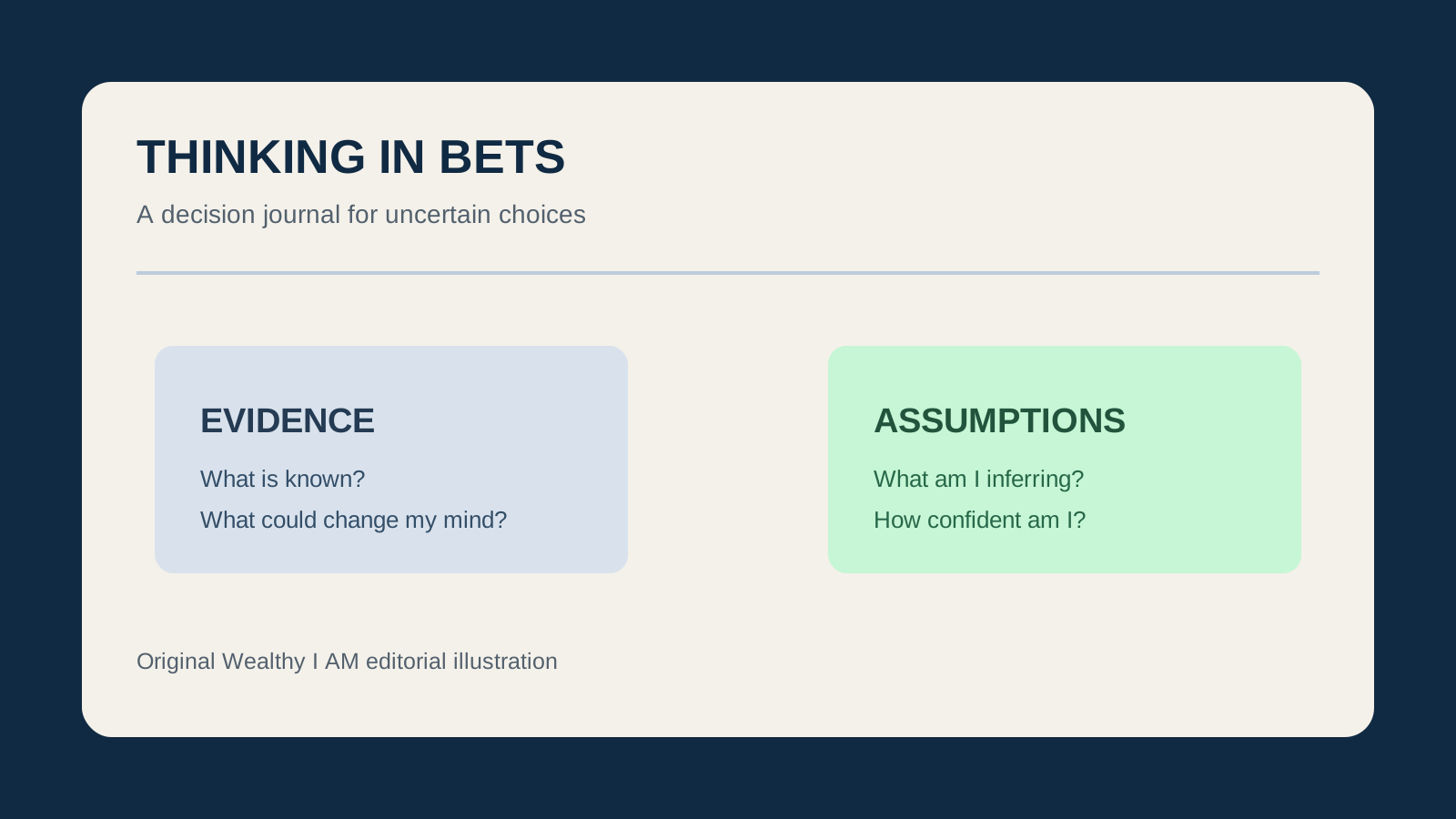
Action: Put three labels in your notes: known, inferred, and uncertain. For example, a company’s reported revenue may be known from a dated filing; your view about its durability is an inference; and a future return is uncertain. Verify current financial information from authoritative, dated sources before acting.
6. Update beliefs as evidence arrives
Updating is not flip-flopping. It is changing your view when relevant evidence changes the balance of reasons. The challenge is to avoid both stubbornness and emotional overreaction.
Action: Set a review date and define which evidence matters. Review on schedule rather than every time a market price, comment, or notification triggers fear. If the decision involves material money, consider qualified professional advice suited to your jurisdiction and situation.
7. Use process to make uncertainty manageable
Uncertainty is easier to handle when a repeatable process limits impulsive choices. A process may include a cooling-off period, a written downside case, a position-size limit, or a second review.
Action: Build a one-page pre-decision checklist: objective, alternatives, evidence, confidence, downside, exit or review condition, and the amount of money or time at risk. A checklist does not make a decision safe by itself; it makes omissions easier to notice.
A beginner’s ordered workflow: the 30-minute uncertainty check
This is original Wealthy I AM advice, not a quoted routine from Duke. Use it for a decision that matters but is not an emergency.
- Describe the decision in one sentence. Avoid vague goals such as “get rich.” Write the specific choice and deadline.
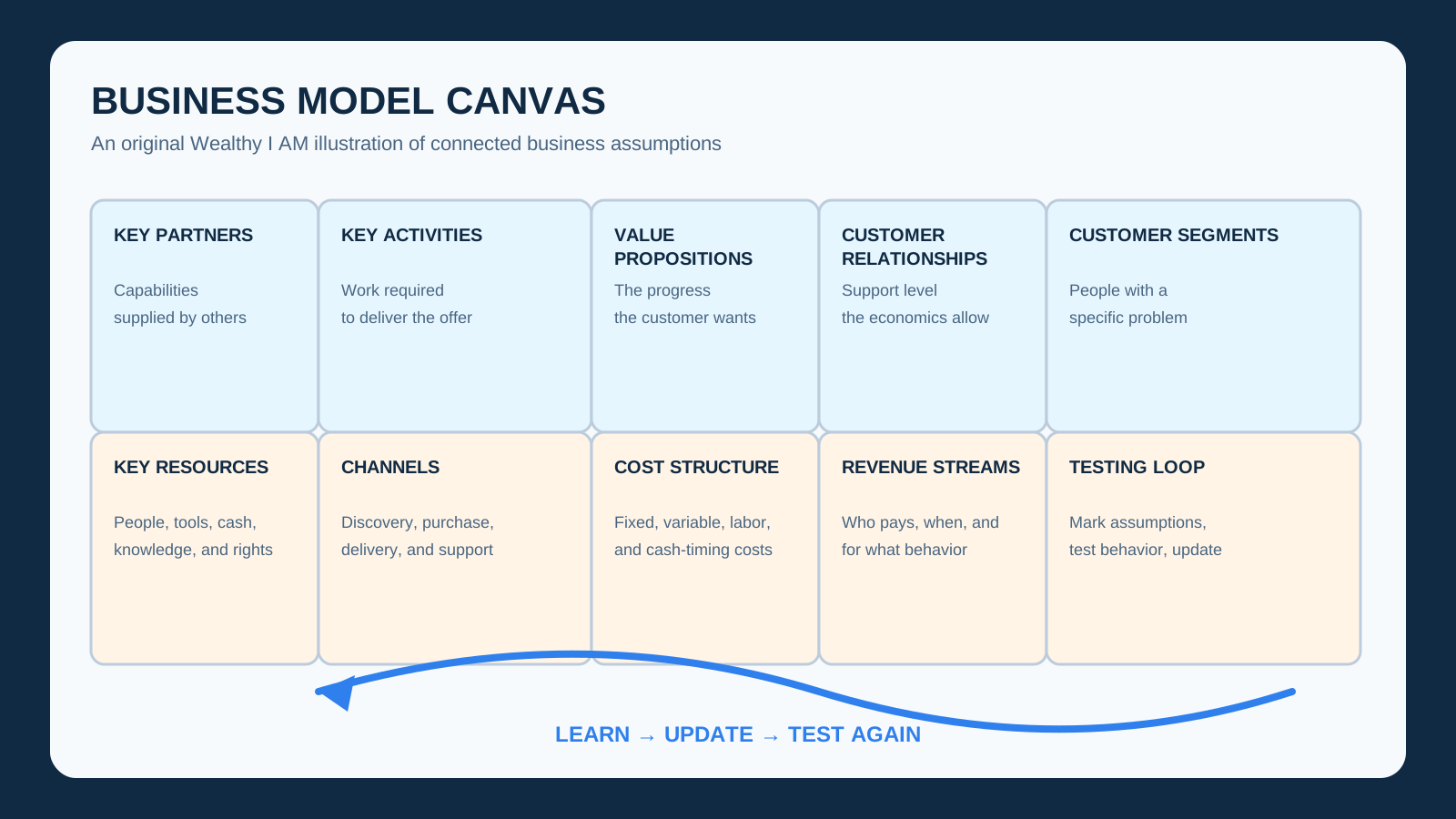
- List three to five value drivers. These are the conditions that need to be true for the decision to help: customer demand, cash flow, affordability, time, or skill fit, as relevant.
- Separate the evidence. Mark each item as known, inferred, or uncertain. Attach a reliable source to time-sensitive financial or legal facts.
- Write the base and downside cases. Keep both hypothetical. Do not turn them into forecasts or guarantees. Ask what loss of money, time, reputation, or flexibility you could tolerate.
- Record confidence and an opposing view. State why you believe the plan may work and what a thoughtful critic would say.
- Name the update condition. Write one fact or event that would cause a review, pause, or change.
- Choose a proportionate next action. Prefer a reversible, low-cost test when possible. Do not borrow, invest, sign a long contract, or make a major life change solely because of this article.
- Schedule the review. Record what happened and whether the reasoning—not just the result—deserves to be retained.
Hypothetical illustration: a freelance service
Suppose a freelancer is considering a new service package. This is hypothetical and not a business forecast. The freelancer might separate known facts—available hours and current costs—from inferences, such as whether a target customer values the package. A cautious test could be a small number of customer conversations and a clearly scoped paid pilot, subject to applicable contracts, privacy duties, and tax rules. The result would provide evidence; it would not prove that the larger business will succeed.
Mistakes to avoid
- Outcome bias: Treating a win as proof that the process was good.
- Hindsight bias: Saying an event was predictable only because you now know it happened.
- False precision: Using an exact percentage without evidence that supports that level of precision.
- Confirmation seeking: Collecting only arguments that support the decision.
- Emotional updating: Changing a long-term view because of one dramatic headline.
- Risk-budget blindness: Taking a risk that could damage essential housing, health, debt, or emergency reserves.
- Book-to-advice confusion: Treating a general framework as a personalized recommendation.
FAQs
Is Thinking in Bets an investing book?
It is relevant to investing because investing requires decisions under uncertainty, but the framework is broader. It applies to business, careers, negotiations, and everyday choices. It is not a recommendation to trade, speculate, or adopt a particular asset allocation.
Does thinking probabilistically guarantee better decisions?
No. A careful process can still produce an unfavorable result, and probabilities can be wrong. The aim is better calibration and learning, not certainty or guaranteed wealth.
How can a beginner practice without risking money?
Keep a journal of non-financial predictions or decisions, state confidence in broad categories, and review the result later. You can also test a business assumption with research or conversations before spending materially. Protect privacy and do not present a small exercise as proof of future performance.
What is the difference between risk and uncertainty?
In everyday language, risk is the possibility of harm or loss, while uncertainty is not knowing exactly what will happen. The terms overlap, and technical definitions vary by field. For personal decisions, identify both the possible downside and what you do not know.
Should I use this framework for a major investment or legal decision?
Use it as a question-structuring tool only. For material investments, taxes, contracts, regulated activities, or personal legal matters, consult a qualified professional who can consider your facts and jurisdiction. Diversification, liquidity, time horizon, and capacity for loss matter.
Related Wealthy I AM guides
- Thinking, Fast and Slow: protect your money from predictable thinking errors
- The Four Pillars of Investing: understand the forces behind every portfolio
- Business Model Generation: test how a business creates value
One practical CTA
Try the 30-minute uncertainty check on one upcoming decision, write down what would change your mind, and schedule a review. Keep the test proportionate to your risk capacity; if the stakes are material, get qualified advice.
Conclusion
Thinking in Bets offers a useful discipline for a world that does not provide complete information. Its central lesson, as applied here, is to judge decisions by the reasoning and evidence available at the time—not by the outcome alone. Make assumptions visible, express uncertainty honestly, invite disagreement, and update when relevant evidence arrives. Those habits cannot guarantee financial success, but they can help you make fewer avoidable decisions with money, time, and trust.
Reliable sources
- Penguin Random House: https://www.penguinrandomhouse.com/books/552885/thinking-in-bets-by-annie-duke/
- Annie Duke official book page: https://www.annieduke.com/thinking-in-bets/
- Open Library work record: https://openlibrary.org/works/OL19736287W
- Harvard Kennedy School author profile: https://www.hks.harvard.edu/about/annie-duke
- Open Library cover record used for the image: https://covers.openlibrary.org/b/id/8792782-L.jpg