Productivity & Personal Growth
Productivity & Personal Growth is the beginner-friendly hub for readers who want to focus better, build stronger habits, and make steadier progress without burning out.
A lot of people think productivity means cramming more tasks into the day. In reality, the goal is to spend your limited time and attention on the work that matters most, then support that work with habits, energy, and a clear sense of identity. When productivity is done well, life feels less chaotic because your actions start matching your priorities.
This guide connects the most useful productivity and self-development book summaries on Wealthy I AM into one practical roadmap. Some books explain how to create habits. Others show how to protect attention, beat procrastination, and work with more intention. Together, they form a simple idea: better systems produce better results.
If you are new to this topic, a good starting point is Atomic Habits, Deep Work, and Essentialism. Those three books give you the most direct foundation for daily change: build small systems, protect focus, and remove unnecessary noise.
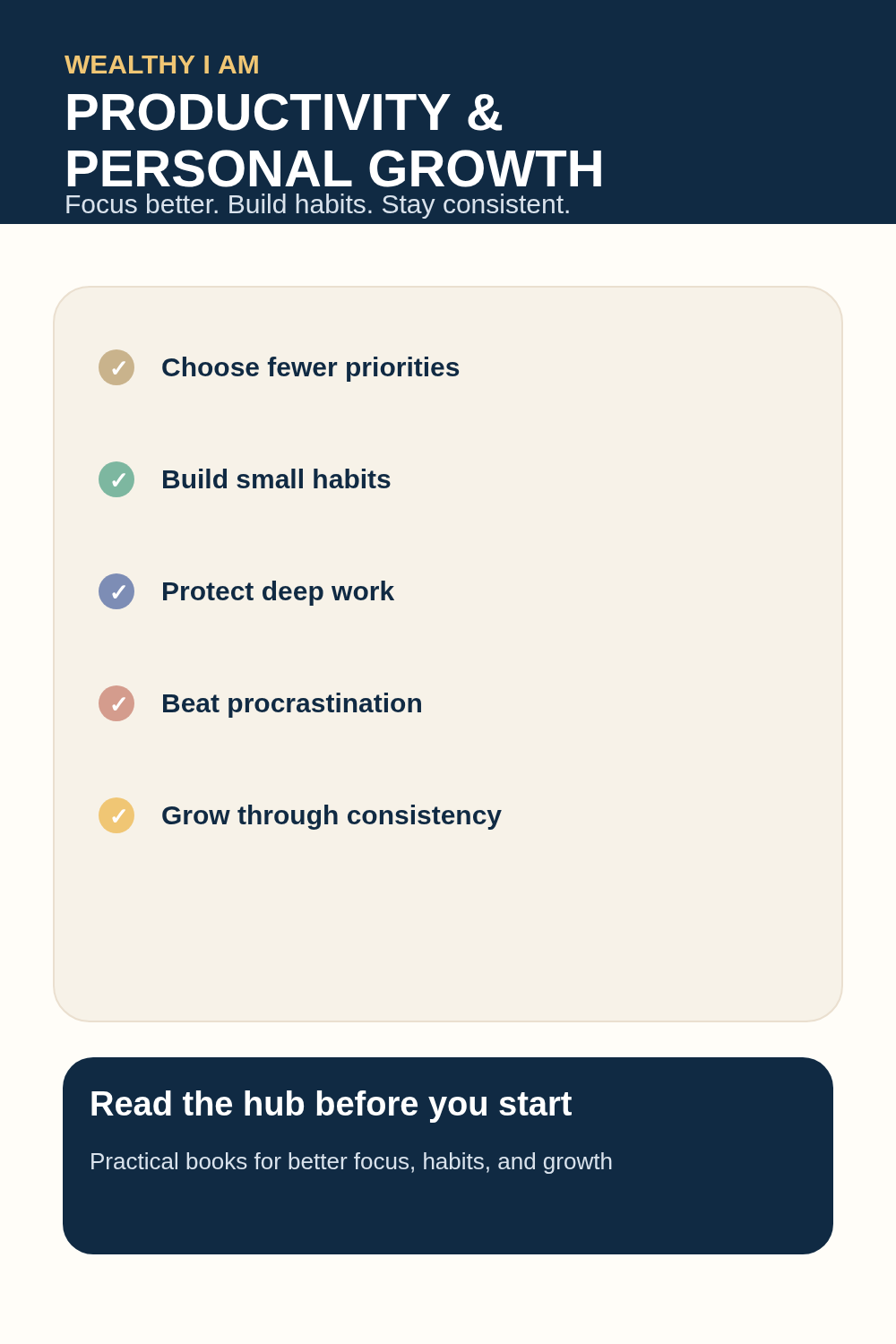
Why Productivity Matters
Productivity matters because most people are not short on ambition; they are short on clarity, structure, and follow-through. A person can care deeply about health, work, family, learning, and financial stability, but still feel stuck if every day gets consumed by distractions and unfinished tasks. Better productivity gives you more room to act on what matters.
It also improves confidence. When you keep small promises to yourself, your self-trust grows. That is one reason habit and mindset books matter so much here. The goal is not to become a machine. It is to become dependable, consistent, and calm enough to keep going when motivation fades.
The Compound Effect and Mindset reinforce this idea from different angles. One emphasizes the power of repeated actions, while the other reminds you that growth is something you can develop over time.
What Productivity Really Means
Productivity is the skill of choosing, sequencing, and completing the right work in a way that fits real life. It is not just “doing more.” It is deciding what deserves attention, what can be delayed, and what should be removed entirely.
A productive person does not necessarily work the longest. They often work with more intention. They know the difference between urgent and important, between motion and progress, and between being busy and being effective.
The One Thing is useful because it strips productivity down to one clear question: what is the most important thing I can do right now? Getting Things Done adds the operational side: how do you capture tasks, organize them, and trust your system instead of keeping everything in your head?
Setting Meaningful Goals
Good goals are specific enough to guide action and meaningful enough to survive a bad day. A useful goal is not just “be better” or “work harder.” It names the result, the reason, and the next step. When goals are too vague, the mind keeps renegotiating them. When goals are clear, decisions become easier.
The One Thing helps here by encouraging readers to focus on the domino that makes the next few actions easier. Essentialism adds a warning: if everything is a priority, nothing is. The best goals guide your calendar, not just your intentions.
A strong goal also fits your season of life. If you are overwhelmed, a smaller goal that you can actually complete may be more valuable than an impressive goal you never start. Momentum comes from finishing.
Building Effective Habits
Habits are the invisible architecture of daily life. They matter because they reduce the amount of decision-making required to do useful things. If you have to negotiate with yourself every morning, progress becomes expensive. If the habit is already designed, follow-through becomes easier.
Atomic Habits is the best first stop for this topic because it focuses on small improvements, identity-based change, and environment design. The Power of Habit explains how cues, routines, and rewards work together, while The Compound Effect shows why small habits matter even when progress feels slow.
The practical lesson is to make good behavior obvious, easy, and satisfying. That usually means reducing friction around the habit you want and increasing friction around the habit you want to avoid.
Breaking Unhelpful Habits
Breaking a bad habit is not only about willpower. You also have to understand what the habit is doing for you. People do not repeat unhelpful behavior because they enjoy suffering. They repeat it because it offers relief, distraction, comfort, or a quick hit of certainty.
If you want to break a habit, replace the reward, not just the behavior. Make the old pattern harder to begin, and make the new one easier to repeat. That might mean changing the environment, changing the time of day, or changing the trigger that starts the loop.
The Power of Habit is especially helpful for understanding the loop itself. Mindset adds the bigger psychological lesson: people can change, but they usually change more effectively when they stop treating failure as proof that they are broken.
Managing Time and Attention
Time management is really attention management. Time is fixed; attention is what moves. If your attention is split across notifications, interruptions, and low-value tasks, even a long day can feel empty. The trick is to decide in advance where your attention should go, then build a day that supports that decision.
Getting Things Done is a practical system for reducing mental clutter. Essentialism asks you to trade scattered effort for focused contribution. Used together, they help you stop treating every request as equally important.
A simple rule helps: protect your best thinking time for your best thinking work. Use lower-energy periods for shallow work, admin, or maintenance.
Deep Work and Focus
Deep work is the ability to concentrate without distraction on a cognitively demanding task. It is valuable because meaningful results usually require uninterrupted thought. If your work depends on strategy, writing, coding, analysis, design, or learning, then focus is not a luxury. It is a competitive advantage.
Deep Work shows why distraction is expensive and why deliberate focus blocks can transform output. The book pairs well with The One Thing because both push you to choose fewer, more important tasks. The Accidental Creative is useful when your work depends on producing ideas rather than just completing tasks.
Focus improves when you create rituals: a clear start time, a clean workspace, a defined target, and a way to stop. Focus is easier to maintain when the environment already says “this is the work.”
Overcoming Procrastination
Procrastination is often a fear problem wearing a time-management mask. People delay work because the task feels unclear, emotionally uncomfortable, or tied to a possible failure. The fix is not to shame yourself. The fix is to make the first step small enough that the task loses some of its emotional weight.
The War of Art is the clearest book here because it treats resistance as the normal enemy of important work. The book’s core lesson is simple: do the work before you feel like doing it.
A useful trick is to define the first two minutes of the task. If you can begin clearly, momentum often follows. Many projects are not resisted because they are huge; they are resisted because the next action is fuzzy.
Motivation Versus Discipline
Motivation is helpful, but it is inconsistent. Discipline is what keeps your promises alive when motivation disappears. The best approach is not to wait for a “motivated” state. It is to design a life that makes the right action more likely regardless of mood.
Grit teaches that persistence matters because worthwhile goals usually take longer than we want them to. The War of Art adds urgency. Together they show that a serious life requires both perseverance and action.
Discipline becomes easier when your identity supports it. Instead of saying “I am trying to be disciplined,” say “I am someone who finishes what I start.” Identity changes behavior because it changes what feels normal.
Energy and Daily Routines
Productivity is not just about hours. Energy matters. If your routine leaves you mentally foggy, physically drained, and emotionally reactive, your best systems will still struggle. That is why sleep, movement, food, breaks, and recovery are part of productivity, not distractions from it.
The Power of Full Engagement reminds readers to manage energy intentionally. The lesson is to cycle effort and recovery rather than trying to be “on” all the time. That principle also makes habits easier to maintain because you stop treating rest as laziness.
Atomic Habits and The Compound Effect both support this view: small routines repeated with consistency create stronger days, and stronger days create stronger years.
Continuous Learning
Personal growth is not separate from productivity. The better you learn, the better you can solve problems, adapt to change, and improve your systems. Continuous learning is especially important because most worthwhile goals require new skills.
Mindset is the key reading here because it explains why learning is part of identity, not just achievement. A growth-oriented person treats mistakes as information. They do not love failing, but they do learn from it faster than someone who only wants to look competent.
The habit to build is simple: review, reflect, and apply. Read a little, think a little, then use one idea in real life. Growth becomes sticky when knowledge turns into behavior.
Personal Growth and Identity
Identity answers the question, “Who am I becoming?” This matters because productivity is easier when your behavior feels consistent with who you believe you are. If you identify as a person who writes, studies, trains, or creates, then the related actions feel more natural.
Atomic Habits explains identity-based habits directly, while Die Empty reminds readers to take their best work seriously and not postpone meaningful action forever. This is where productivity becomes personal development: your systems are not only helping you do more, they are helping you become more aligned with your values.
The healthiest version of growth does not require comparing yourself with everyone else. It asks whether you are moving in the right direction with consistency and honesty.
Common Productivity Mistakes
One common mistake is confusing motion with progress. Another is trying to fix everything at once. People also underestimate how much their environment influences behavior, which is why a “better plan” often fails in a messy system.
A second mistake is using productivity to support the wrong priorities. If the goals are not meaningful, even very efficient work can feel empty. The point is not to be busy in a more organized way. The point is to make useful progress on work that matters.
Essentialism is the antidote to overcommitment, while The One Thing keeps attention from being diluted.
How These Books Complement One Another
These books work best as a system, not as a pile of advice. Habit books help you start. Focus books help you protect time. Task-management books help you trust your workflow. Mindset books help you stay resilient. Energy books help you stay sustainable.
For example, you might use Atomic Habits to design a morning routine, Deep Work to protect a focus block, Getting Things Done to clear mental clutter, and Grit or The War of Art to stay in motion when the work gets uncomfortable. That combination is stronger than any single book alone.
How to Choose the Right Productivity Book
Not every productivity book solves the same problem. Some readers need help starting. Others already start but cannot stay consistent. A third group has enough ideas and ambition but too much mental clutter. The point of this pillar is to help you match the right book to the right problem instead of reading randomly and hoping it all sticks.
If you feel overwhelmed, begin with one book that simplifies life, such as Essentialism or The One Thing. If your challenge is actually changing behavior, Atomic Habits and The Power of Habit are stronger starting points. If your issue is distraction and shallow work, Deep Work may be the most useful first read. If your brain is overloaded with loose tasks and half-finished projects, Getting Things Done is the cleanup book that makes everything else easier.
Use the comparison table below as a filter, not as a ranking. A good productivity library works like a toolbox: the best tool depends on the job. You do not need to master every book before taking action. You need one good idea, applied repeatedly, until it becomes part of how you work.
- Need better habits? Start with Atomic Habits and The Power of Habit.
- Need more focus? Start with Deep Work and The One Thing.
- Need less overwhelm? Start with Essentialism and Getting Things Done.
- Need more courage? Start with The War of Art, Mindset, and Grit.
- Need sustainable performance? Add The Power of Full Engagement and The Compound Effect.
Comparison Table
| Book | Main lesson | Best for | Difficulty | Primary topic | Link to summary |
|---|---|---|---|---|---|
| Atomic Habits | Make small changes that compound into lasting identity shifts | Beginners who want simple routines that stick | Easy | Habits | Atomic Habits |
| Deep Work | Protect uninterrupted focus for meaningful output | Knowledge workers and students | Moderate | Focus | Deep Work |
| Essentialism | Do less, but better, and remove low-value commitments | People who feel overcommitted | Easy | Priorities | Essentialism |
| The One Thing | Narrow attention to the most important next action | Goal-driven readers who need clarity | Easy | Prioritization | The One Thing |
| Getting Things Done | Capture, clarify, organize, review, and execute | Readers who want a trusted system | Moderate | Task management | Getting Things Done |
| The Power of Habit | Use cues, routines, and rewards to reshape behavior | Anyone changing daily behavior | Easy | Behavior change | The Power of Habit |
| The War of Art | Ship the work instead of waiting for inspiration | Creators and procrastinators | Easy | Procrastination | The War of Art |
| Mindset | See ability as something you can develop through practice | Readers rebuilding confidence | Easy | Growth mindset | Mindset |
| Grit | Sustain effort over long periods with purpose | People working toward long-term goals | Moderate | Persistence | Grit |
| The Compound Effect | Tiny consistent actions create large results | Readers who like simple math and repetition | Easy | Compounding | The Compound Effect |
| The Power of Full Engagement | Manage energy, not just time | Busy professionals and high performers | Moderate | Energy | The Power of Full Engagement |
| The Accidental Creative | Build rituals that produce reliable creative output | Writers, makers, and entrepreneurs | Moderate | Creativity | The Accidental Creative |
| Die Empty | Use your best energy on work that matters now | Readers who want meaning and urgency | Moderate | Meaningful work | Die Empty |
Recommended Reading Order
- Atomic Habits — start with behavior and systems.
- Essentialism — learn to focus on fewer priorities.
- Deep Work — protect your attention for meaningful work.
- Getting Things Done — organize tasks and reduce mental clutter.
- The Power of Habit — understand behavior loops.
- The War of Art — deal with resistance and procrastination.
- Mindset and Grit — build resilience for long-term growth.
- The Power of Full Engagement and The Compound Effect — make progress sustainable.
Frequently Asked Questions
What is the fastest way to become more productive?
Start with one small habit and one protected focus block. Big changes usually come from repeatable systems, not one heroic day.
Which book should a beginner read first?
Atomic Habits is the best first step for most readers. If your biggest issue is distraction, start with Deep Work instead.
How do I stop procrastinating?
Make the first action embarrassingly small, reduce friction, and begin before the task feels emotionally comfortable.
Do I need a strict morning routine to be productive?
No. You need a routine that fits your life and supports your highest-priority work. Consistency matters more than perfection.
Can productivity help personal growth too?
Yes. Productivity is one of the main ways personal growth becomes visible in everyday life, because your habits and choices start reflecting your values.
Practical 30-Day Action Plan
- Week 1: Choose one meaningful goal, write it down, and define the next action clearly.
- Week 1: Pick one habit to build and one habit to reduce. Make the new habit tiny enough to repeat daily.
- Week 2: Create one daily focus block with no notifications and one short review at the end of the day.
- Week 2: Remove one source of friction from your environment and one source of temptation.
- Week 3: Use a simple task list or capture system so your brain stops holding everything at once.
- Week 3: Read or revisit one chapter from a focus or habit book and apply one idea immediately.
- Week 4: Track what changed, keep the routines that worked, and simplify anything that felt heavy or unrealistic.
- Week 4: Decide what the next 30-day cycle should improve, then repeat the process with one new priority.
What Progress Looks Like in Real Life
Progress is often quieter than people expect. It may look like a steadier morning routine, fewer abandoned tasks, less anxiety about unfinished work, or a cleaner relationship with your phone. These are not small wins. They are the foundation that makes larger goals possible because they reduce the friction that normally drains your best effort.
The biggest shift is usually not that you become perfect. It is that you become more consistent, more self-aware, and less reactive. Once that happens, the rest of the books in this cluster become easier to use because you already have a basic system for showing up and improving.
Conclusion
Productivity and personal growth are not separate goals. Productivity gives your growth a structure; growth gives your productivity a purpose. When you focus on meaningful goals, build supportive habits, protect your attention, and recover well, you create a life that is both more effective and more sustainable.
If you want the simplest path forward, begin with Atomic Habits, then move to Essentialism, Deep Work, and Getting Things Done. Add The War of Art when procrastination gets in the way, and return to Mindset and Grit whenever you need a reminder that real growth takes time.
The goal is not to become busy. The goal is to become deliberate.