Atomic Habits by James Clear makes a powerful promise: meaningful change does not require a dramatic reinvention. It can begin with a behavior so small that it feels almost too easy to matter. Repeated consistently, however, small actions shape identity, results, and eventually the way you handle money and opportunity.
That message is especially useful for wealth building. A budget, a new skill, a business habit, or a regular investment may look unimpressive on a single day. Over months and years, those choices can compound. Clear’s contribution is a practical framework for designing the system around those choices instead of relying on motivation alone.
Book facts
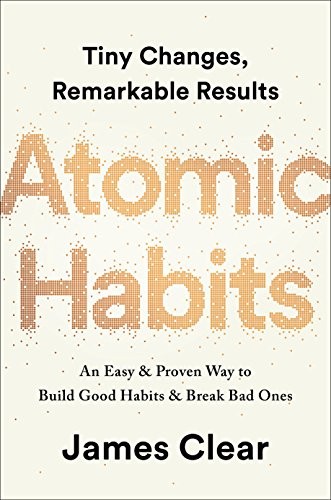
- Title: Atomic Habits: An Easy & Proven Way to Build Good Habits & Break Bad Ones
- Author: James Clear
- Publisher: Avery
- First published: 2018
- Core subjects: habit formation, behavior change, systems, identity, environment, and continuous improvement.
What the book is about
Clear explains habits as a four-part loop: a cue, a craving, a response, and a reward. A cue signals an opportunity; the craving supplies motivation; the response is the action; and the reward teaches the brain whether the loop is worth repeating. This model helps explain why a behavior can become automatic—and how changing the surrounding conditions can make a different behavior more likely.
The book also separates goals from systems. A goal names an outcome, such as paying off debt or increasing income. A system is the recurring process that moves you toward it: checking spending each Friday, learning a marketable skill for thirty minutes, or contacting potential customers every morning. Goals provide direction; systems determine what happens on ordinary days.
The four laws of behavior change
1. Make it obvious
Good habits need a visible starting point. Habit stacking connects a new action to one you already do: after morning coffee, review today’s top financial priority. A clear time and place reduce the number of decisions required.
2. Make it attractive
We repeat behaviors that feel rewarding or meaningful. Pair a necessary action with something enjoyable, or connect it to the identity you want to build. “I am becoming a careful steward of money” is more durable than “I should stop wasting money.”
3. Make it easy
Reduce friction. Keep a savings transfer automatic, place a book beside your chair, prepare the tools for tomorrow’s work, and start with a version of the habit that takes two minutes. Ease is not laziness; it is intelligent design.
4. Make it satisfying
Immediate feedback helps a long-term habit survive. Track deposits, completed study sessions, or sales conversations. The reward should reinforce the behavior without undermining the goal—for example, celebrate a week of consistent saving with a low-cost experience rather than a costly impulse purchase.
Why tiny habits matter for wealth
Money results are often delayed. Saving today may not change your life this week, and learning a skill may not raise your income next month. That delay makes it easy to abandon good behavior. Small, visible actions bridge the gap between present effort and future benefit.
There is also a useful compounding effect. A modest contribution made regularly can grow through time and returns; a modest improvement in sales, writing, negotiation, or technical ability can increase the value you create. The book does not promise that every tiny action will produce wealth. It argues for building a repeatable process that gives good outcomes more chances to appear.
Simple terms explained
- Habit: a behavior repeated often enough to become more automatic.
- System: the process and environment that produce recurring behavior.
- Identity: the way you see yourself, such as saver, builder, learner, or dependable professional.
- Friction: anything that makes an action harder to start or finish.
- Compounding: growth that builds on previous growth over time.
A practical seven-step wealth habit plan
- Choose one identity. Write a sentence such as, “I am a person who pays future-me first,” or, “I am a founder who listens to customers every week.” Choose an identity you can prove through action.
- Pick one keystone behavior. Select a small action with several benefits: recording every purchase, transferring money on payday, studying a valuable skill, or reviewing business cash flow.
- Give it a cue. Attach it to an existing routine and specify when and where it happens. “I will save more” is weak; “On payday, I will review the transfer before opening social media” is concrete.
- Lower the starting cost. Automate the transfer, remove distracting apps, prepare the spreadsheet, or keep the course open. Make the desired action the convenient option.
- Use a two-minute version. Read one page, record one expense, or write one customer question. The purpose is to establish the rhythm; the habit can grow after it becomes reliable.
- Track the behavior, not only the outcome. Mark each completed action. A streak is not the goal, but it makes consistency visible. If you miss once, restart quickly; never turn one missed day into a new identity.
- Review monthly. Ask what worked, what created friction, and whether the habit still serves the larger goal. Increase the challenge gradually, and stop habits that consume effort without creating value.
How to break an unhelpful money habit
Reverse the four laws. Make the cue invisible by removing shopping notifications and unsubscribing from promotional emails. Make the behavior unattractive by writing down its trade-off—what the same money could do for debt reduction, a safety reserve, or a meaningful goal. Add friction with a waiting rule or a separate account. Finally, make restraint satisfying by recording the amount kept and celebrating progress in a responsible way.
Be careful not to treat every financial problem as a willpower problem. If income is insufficient, housing is unaffordable, or debt costs are extreme, a tiny habit is not a substitute for structural action. It is one tool alongside earning more, negotiating, refinancing where appropriate, seeking qualified advice, and making a realistic plan.
What the book gets right—and what to question
Atomic Habits is strongest when it turns vague self-improvement advice into environmental design. It reminds readers that a good intention is fragile when the default choice points in the opposite direction. It is also encouraging: progress can begin before confidence arrives.
The caution is that not all results are within personal control. Markets, health, family obligations, discrimination, economic conditions, and plain luck matter. “One percent better” should not become a reason to blame yourself for every setback. Use the framework to improve your choices, not to pretend that circumstances do not exist.
Bottom line
James Clear’s central lesson is practical: make the right action obvious, attractive, easy, and satisfying until it becomes part of who you are. For wealth, that may mean an automatic transfer, a weekly money review, a daily learning block, or a consistent customer-building process. The action may be small, but the direction is not. Build a system that makes tomorrow’s better decision easier than today’s impulse, then give compounding time to work.
Sources and credits
- Penguin Random House: official book page and bibliographic details
- Amazon.com: Atomic Habits, ISBN 9780735211292
- James Clear: author book page
- Open Library: matched cover image for ISBN 9780735211292
Wealthy I AM Action Card
Wealthy I AM Pinterest Copy
TITLE
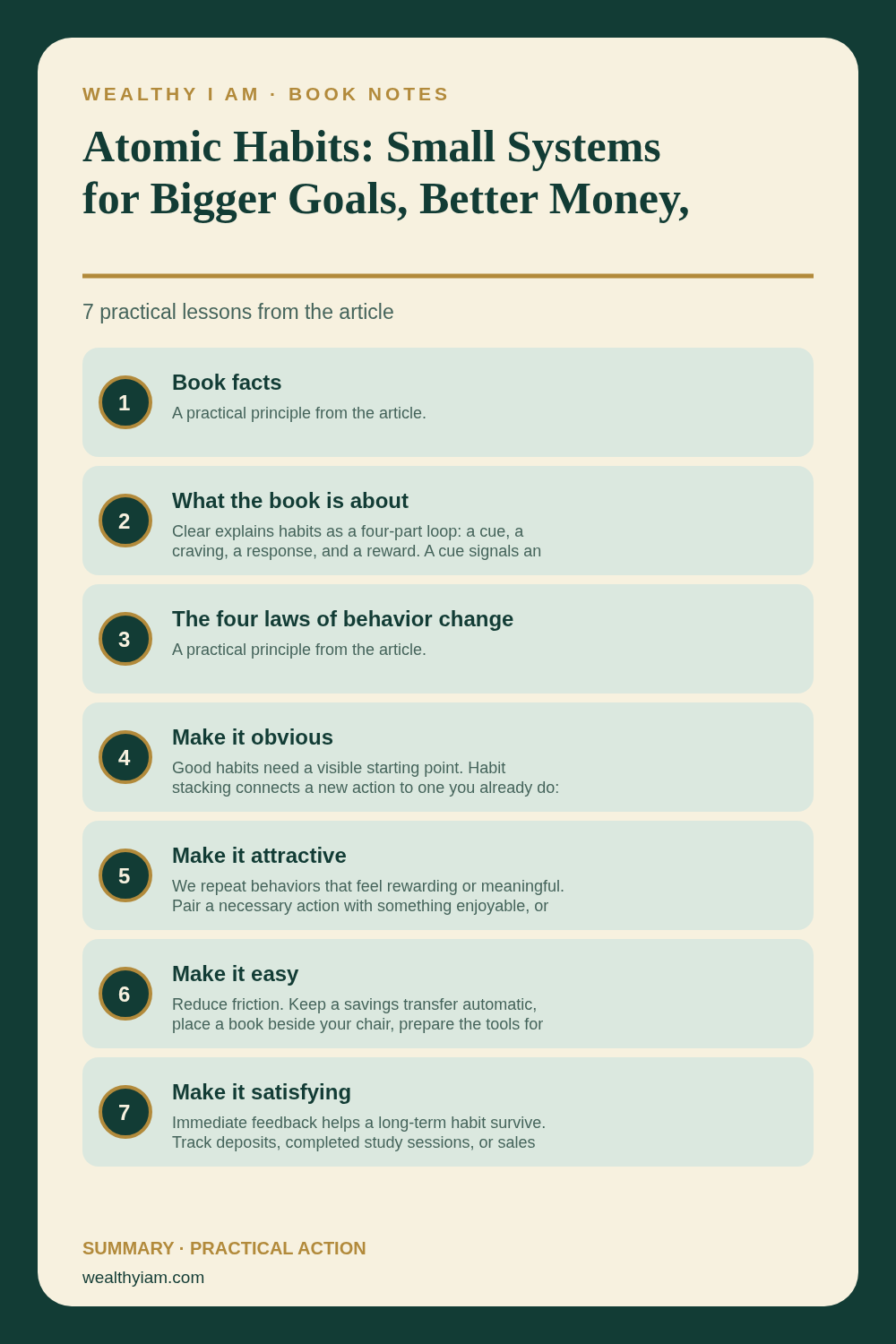
Atomic Habits: Small Systems for Bigger Goals, Better Money, and Wealth
DESCRIPTION
James Clear’s Atomic Habits offers a practical system for turning tiny improvements into better money habits, useful skills, and long-term.
KEYWORDS
Atomic Habits book summary, Atomic Habits lessons, personal development, wealth building, productivity books
ALT TEXT
Wealthy I AM visual summary of Atomic Habits: Small Systems for Bigger Goals, Better Money, and Wealth
ARTICLE URL
https://nappot.com/atomic-habits-small-systems-bigger-goals-better-money-wealth/