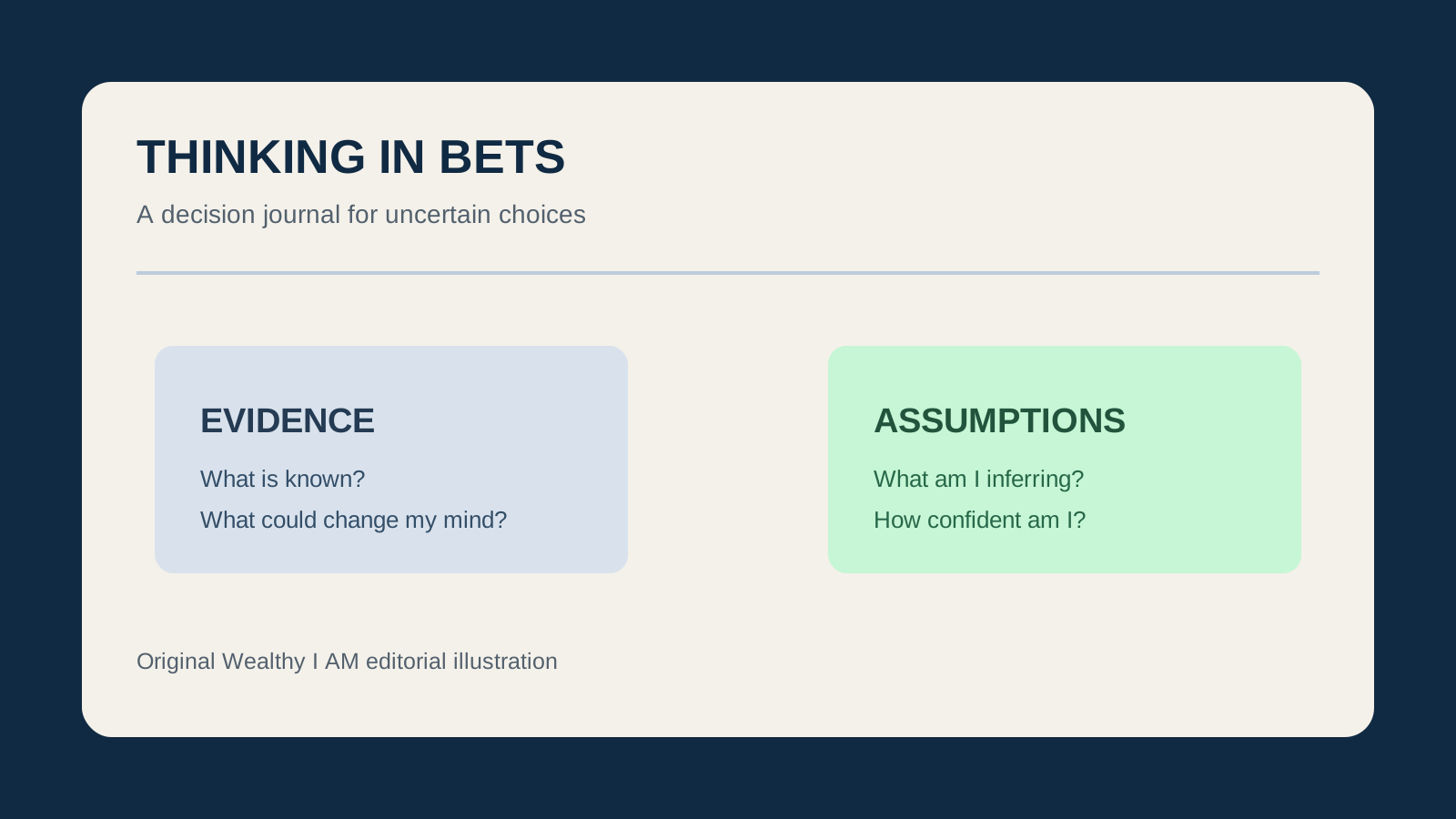
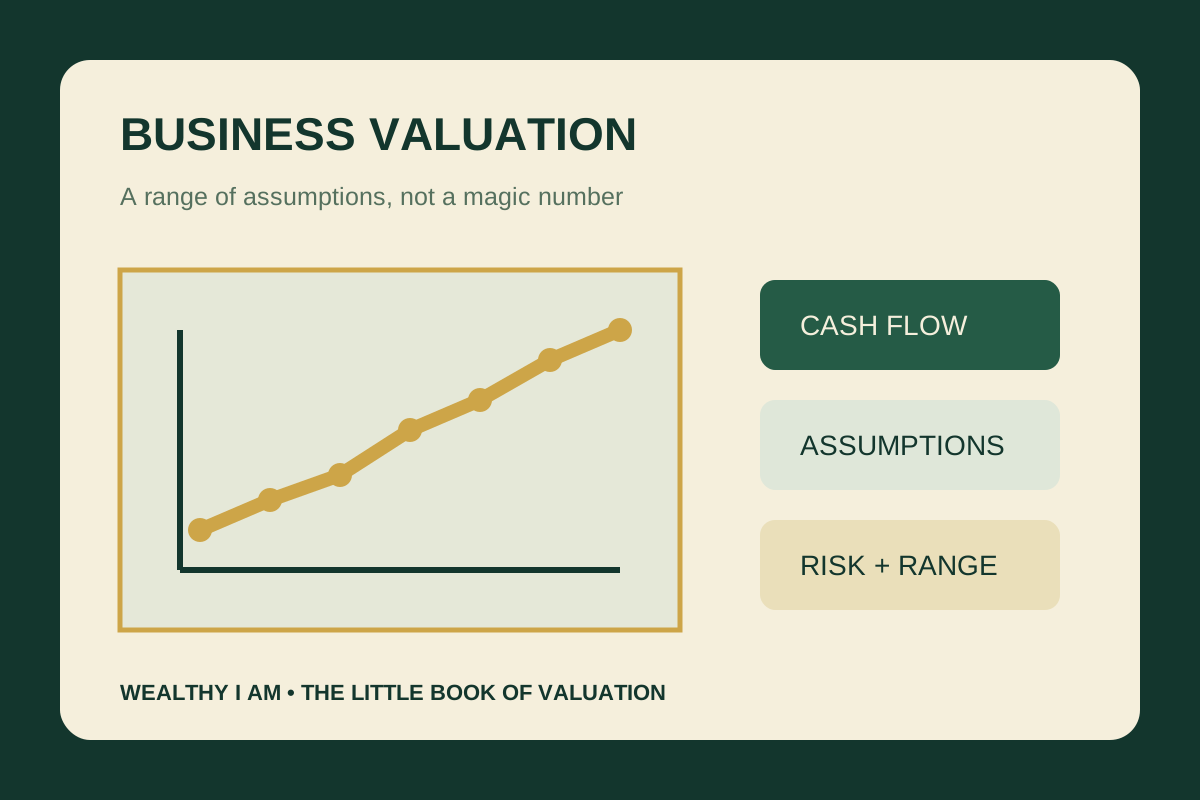
Many business ideas sound attractive until you ask three basic questions: Who is the customer? What exactly is being offered? How will money come in while costs go out? Business Model Generation by Alexander Osterwalder and Yves Pigneur is built around making those questions visible before a founder commits too much time or capital.
This article is a practical interpretation, not a complete reconstruction of the book. The publisher and Strategyzer describe the book as a visual guide to designing and analyzing business models, including the Business Model Canvas. The nine-part canvas is used here as a practical tool, but the applications and testing sequence are Wealthy I AM synthesis rather than a claim about the authors’ exact teaching order.
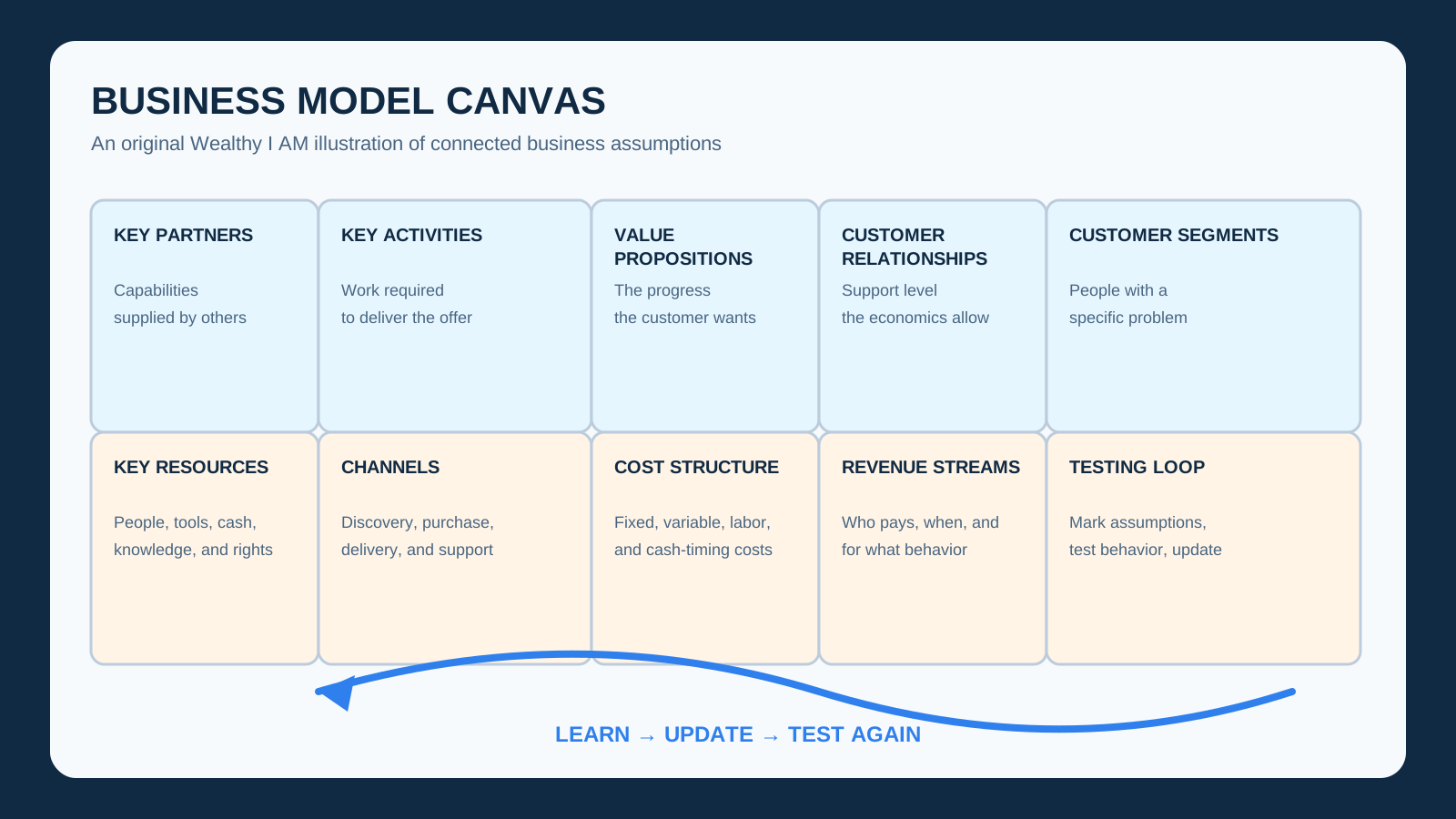
Image note: This is an original Wealthy I AM illustration created for this article. It is not the book’s cover and does not reproduce a publisher graphic.
Who this book is for
The book is useful for founders, small-business owners, product teams, and professionals evaluating a new service. It is especially helpful when a team has a product idea but has not yet explained how the parts fit together.
It is not a guarantee of product-market fit, profit, funding, or investment returns. A clear canvas can expose an assumption; it cannot prove that the assumption is true.
The core idea: a business model is a connected system
A business model explains how an organization creates, delivers, and captures value. “Creates value” means helping a customer solve a meaningful problem. “Delivers value” means making the offer available and usable. “Captures value” means receiving enough revenue, after relevant costs, to sustain the activity.
The Business Model Canvas gives those connections a shared page. Its nine blocks are customer segments, value propositions, channels, customer relationships, revenue streams, key resources, key activities, key partnerships, and cost structure. The point is not artistic neatness. The point is to see dependencies and contradictions.
For example, a premium service may promise personal attention, but its revenue and cost structure may not support the staff time required. A low-price offer may reach many people but fail if distribution costs are high. The canvas makes the tension discussable.
Nine practical lessons from the canvas
1. Name the customer before polishing the offer
A customer segment is a group with a relevant problem, context, or buying behavior. “Anyone who wants to save money” is too broad to guide a first test.
Write one initial segment and describe its situation, urgency, current workaround, and buying authority. This is not a permanent label. It is a deliberate starting hypothesis.
2. State the value proposition as progress
A value proposition is the reason a customer chooses one offer over alternatives. Describe the progress the customer wants, not merely the features you plan to build.
Use a sentence such as: “For [customer] facing [situation], this helps them [desired progress] by [distinct approach].” Then ask what they use today. A new offer must compete with the status quo, including doing nothing.
3. Treat channels as part of the product experience
Channels cover how people learn about, evaluate, buy, receive, and get support for an offer. A strong product with an expensive or confusing route to the customer is not a complete model.
Map the first five interactions: discovery, evaluation, purchase, delivery, and support. Identify which step is most uncertain and test that step before spending heavily on broad promotion.
4. Choose relationships the economics can support
Customer relationships range from self-service to high-touch support and ongoing community. The appropriate choice depends on what customers need and what the business can afford.
Estimate the time required per customer under the proposed relationship. If the offer promises personal help, include that labor in the model. “Free support” is still a cost when it consumes owner or employee time.
5. Separate revenue from wishful pricing
Revenue streams describe how money is received: a sale, subscription, usage charge, licensing arrangement, or another documented mechanism. A price is not evidence that customers will pay it.
List who pays, when they pay, what triggers payment, and what refunds or collection problems could occur. Then test willingness to pay in a suitable, ethical way. A compliment, email signup, or free trial is not the same evidence as a completed purchase.
6. Count the resources and activities the promise requires
Key resources may include people, equipment, software, knowledge, cash, or rights. Key activities are the important things the business must do repeatedly to deliver its promise.
Circle the three resources and activities that would stop delivery if unavailable. This often reveals a hidden dependency: a founder who must personally perform every task, a supplier with no backup, or a tool whose cost grows faster than revenue.
7. Use partners to improve the model, not to hide its weakness
Key partnerships can provide capability, distribution, supply, or risk sharing. They can also create dependency, quality problems, and contractual obligations.
For each proposed partner, write the job they perform, the cost, the switching difficulty, and the failure backup. Do not outsource a core uncertainty before understanding it yourself.
8. Make cost structure visible early
Cost structure includes fixed costs, variable costs, labor, acquisition, delivery, technology, compliance, and support. Cash flow is timing: when money arrives versus when bills must be paid. A model can appear profitable on paper and still create a cash shortfall.
Build a simple monthly view with low, middle, and high cost assumptions. These are scenarios, not forecasts. Include owner time honestly even if it is not yet paid. If the offer only works when labor, returns, support, or taxes are ignored, the model is incomplete.
9. Change one assumption at a time when learning
A canvas is not a business plan carved in stone. It is a compact map of assumptions. When everything changes simultaneously, a positive or negative result becomes hard to interpret.
Choose the riskiest block, design one inexpensive test, record the result, and update the canvas. Keep the old version so the team can see what changed and why. This creates a learning record instead of a series of memory-based opinions.
A 30-day Business Model Canvas experiment
This is an original Wealthy I AM application, not a claimed program from the book.
Days 1–4: Draft one canvas. Use plain language and no more than a few notes per block. Mark each note as a fact, an observation, or an assumption. Do not fill empty space with guesses.
Days 5–11: Test the customer and problem. Talk with people who recently faced the problem. Ask what they did, what it cost, and what made the problem urgent. Do not lead them toward your preferred answer.
Days 12–18: Test the offer and channel. Show a narrow, understandable offer and ask for a real next step: a paid pilot, scheduled trial, deposit where appropriate, or another behavior that carries more evidence than praise. Avoid taking money you cannot responsibly refund or service.
Days 19–24: Test delivery and costs. Deliver manually if necessary. Record time, materials, support, acquisition effort, refunds, and delays. Compare the actual work with the promise.
Days 25–30: Update and decide. Mark each block as supported, uncertain, or contradicted. Continue with a narrower test, revise the model, pause it, or stop. Set a spending limit and a decision date before beginning another cycle.
What the canvas cannot tell you
The tool cannot establish demand by itself, eliminate competition, resolve legal or tax obligations, or make a weak offer profitable. Interviews can be biased; early customers may not represent a larger market; and a business can have revenue without healthy profit or cash flow.
A canvas also should not become a permission slip for reckless experimentation. Protect emergency reserves, avoid unaffordable debt, and keep commitments proportionate to evidence. Check consumer-protection, privacy, intellectual-property, employment, licensing, and tax requirements. Seek qualified advice for issues specific to your business or jurisdiction.
For investors, a promising business model is only one input. Consider valuation, balance-sheet risk, governance, competition, concentration, liquidity, and the possibility of permanent loss. Do not treat a completed canvas as an investment recommendation.
The practical takeaway
Business Model Generation is valuable because it turns a vague idea into a set of inspectable relationships. Customer, offer, channel, delivery, revenue, resources, partners, and costs must fit together.
Start with one page, one customer segment, and one uncertain assumption. Test that assumption with a real behavior—not just an opinion—then update the page. Better decisions usually come from a sequence of modest, honest learning steps rather than from a beautifully formatted plan.
Financial and health safety note: This article is general educational commentary on a business book. It is not individualized financial, investment, tax, legal, employment, or medical advice. Do not make a business or investment decision solely from this summary. Verify current information, protect cash reserves, avoid unaffordable debt, and consult qualified professionals for decisions specific to your circumstances.
Sources
- Wiley, Business Model Generation: https://www.wiley.com/en-ie/Business%2BModel%2BGeneration%3A%2BA%2BHandbook%2Bfor%2BVisionaries%2C%2BGame%2BChangers%2C%2Band%2BChallengers-p-9780470876411
- Strategyzer, Business Model Generation: https://www.strategyzer.com/library/business-model-generation