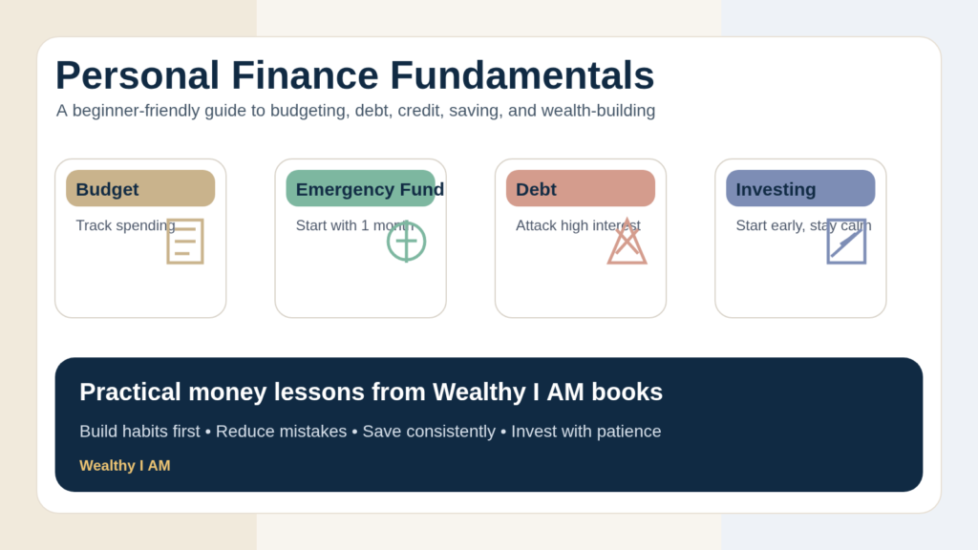
Personal Finance Fundamentals is the beginner-friendly starting point for anyone who wants better control over money without turning life into a spreadsheet contest. Personal finance is not just about cutting coffee or chasing the hottest investment. It is the practical system you use to decide how to earn, spend, save, borrow, protect, and grow your money so that everyday choices support your long-term goals.
This guide brings together the most useful lessons from the site’s personal finance books and turns them into one simple framework. If you are starting from zero, that is a good place to be. Beginners often do best when they focus on a few basics: understand where your money goes, create a plan you can follow, build a cushion for surprises, pay down expensive debt, use credit carefully, and start investing early enough for compounding to work in your favor.
The books linked throughout this page take different angles on the same problem. The Psychology of Money shows how behavior shapes results. Rich Dad Poor Dad pushes readers to think about assets, liabilities, and cash flow. The Millionaire Next Door reminds us that quiet habits usually beat flashy spending. Read together, they form a practical education in money that is more useful than most people get in school.
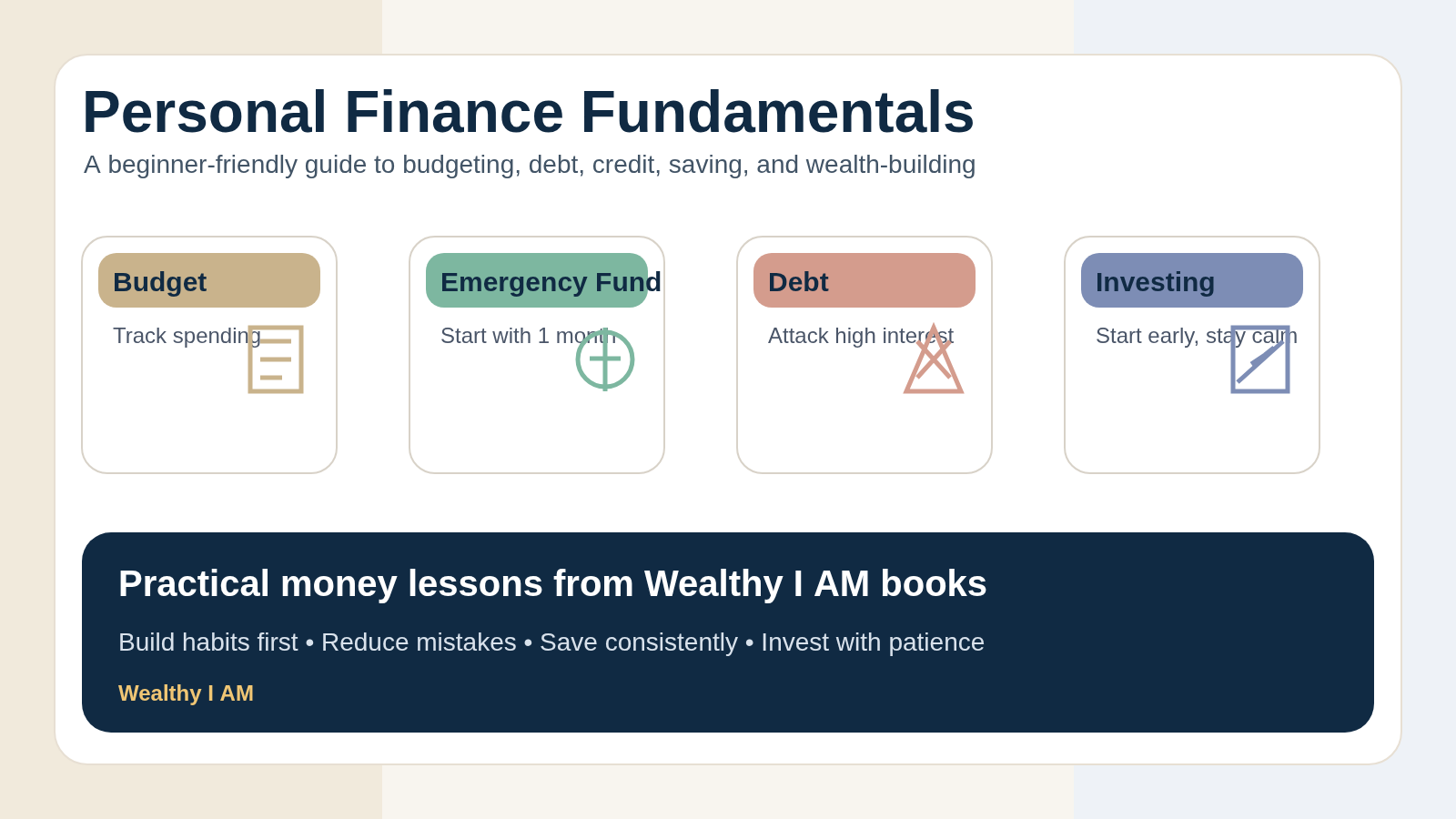
Personal Finance Fundamentals
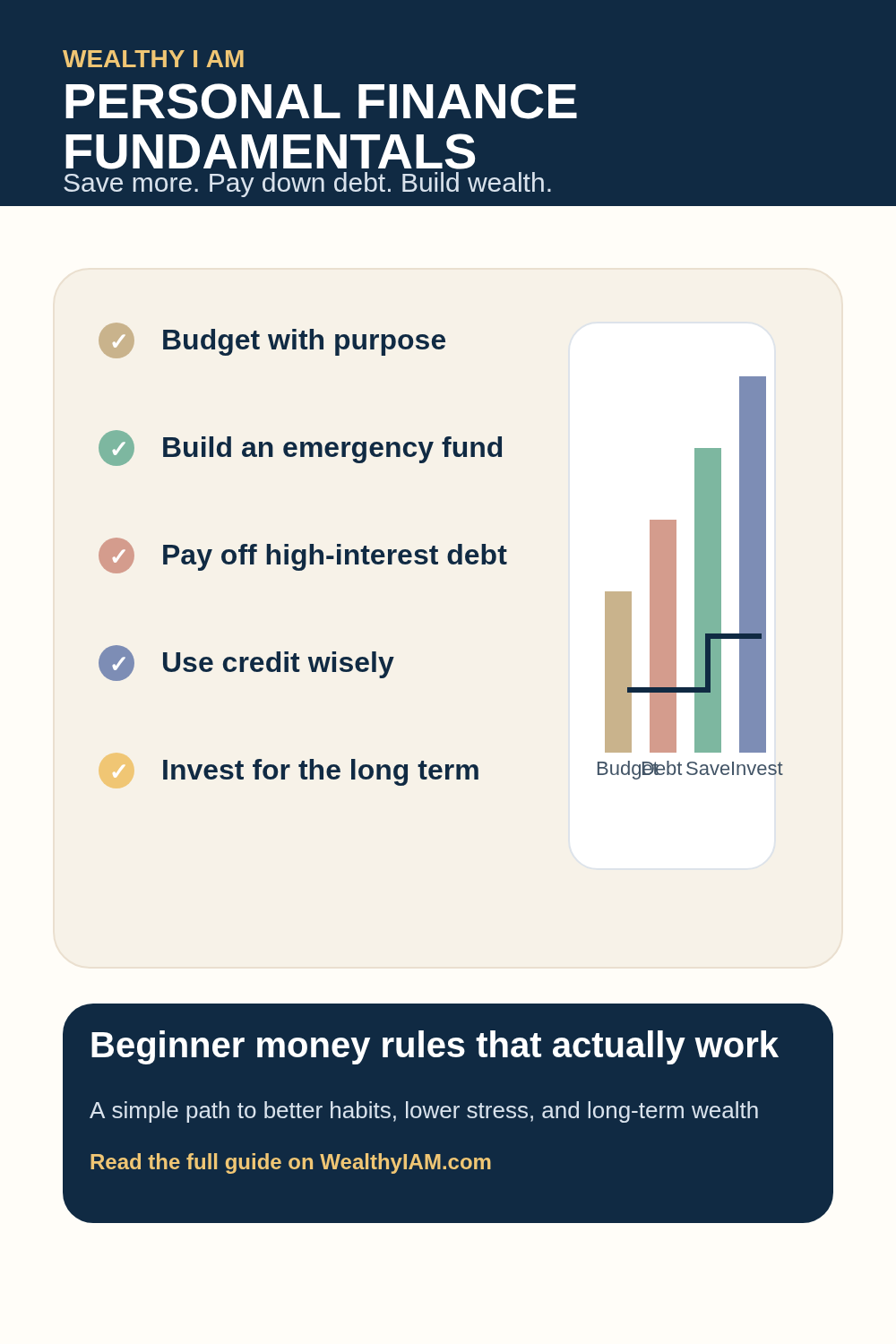
What Personal Finance Really Means
Personal finance is the day-to-day and year-to-year management of your money life. It is not a secret formula, and it is not reserved for people who already feel “good with money.” It is a set of habits and decisions that help you align your income with the life you want. That includes budgeting, saving, handling debt, using credit, preparing for emergencies, investing, and planning for the future.
The deeper lesson from books like The Psychology of Money is that money choices are rarely purely logical. Fear, pride, habit, stress, and family history all influence what people do. That is why the best personal finance system is usually the simplest one you can actually stick to. A plan that looks elegant on paper but collapses under real life is not a good plan.
In practice, personal finance means learning to answer a few basic questions honestly: How much do I earn? Where is it going? What am I protecting? What am I building? When you can answer those questions clearly, the rest of money becomes much easier to manage.
Why Personal Finance Matters
Personal finance matters because money is not just a number. It affects your options, your stress level, and your ability to handle surprises. A solid money system can help you move from reacting to problems to planning for them. That shift is powerful. It means the next emergency is less likely to derail you, and the next opportunity is more likely to be available to you.
Books like The Automatic Millionaire and Your Money or Your Life make the same point in different ways: the goal is not to look rich, but to make life easier and more meaningful. Good personal finance gives you breathing room. It can reduce arguments, reduce anxiety, and create enough margin to think long term.
It also matters because small decisions compound. A little savings habit, a little debt reduction, and a little investing discipline can become a major life difference over time. Beginners often underestimate this because the first results feel slow. But money rarely changes because of one dramatic move. It changes because of repeated choices made with patience.
Setting Financial Goals
Good goals make money decisions easier. Without them, every financial choice becomes vague and emotional. With them, you can tell the difference between a helpful expense and a distracting one. Your goals do not need to be complicated. Start with a few simple priorities: an emergency fund, lower debt, a stronger credit profile, regular investing, and a retirement path that feels realistic.
The strongest goal-setting lesson from Think and Grow Rich is not hype; it is clarity. Vague wishes do not move money forward. Specific goals do. If you want to save for a home, write down how much, by when, and what monthly action gets you there. If you want to become debt-free, define the exact debts and the payment order. Specific goals create momentum.
A useful rule is to separate your goals into three timeframes:
- Short term: the next 12 months, such as building a small emergency fund or paying off one card.
- Medium term: the next 2 to 5 years, such as eliminating consumer debt or funding a home deposit.
- Long term: the next 10+ years, such as retirement investing or financial independence.
Budgeting Basics
Budgeting is simply telling your money where to go before it disappears. Beginners often hear “budget” and imagine restriction, but a budget is really a plan for freedom. It prevents you from drifting. It also shows you whether your current spending matches your real priorities. If the numbers do not match your goals, the budget reveals the gap.
The Total Money Makeover is a useful reminder that you do not need a fancy system to get started. You need a simple one you can review regularly. One common approach is to divide your money into broad buckets: necessities, savings, debt repayment, and lifestyle. That way, you are not guessing every month.
For beginners, the best budgeting method is the one you will actually use. Some people like zero-based budgeting. Others do better with a 50/30/20 style structure. The label matters less than the behavior: track your money, notice leaks, and make choices on purpose instead of by accident.
Budgeting rule of thumb
If you do not know where to start, begin by tracking your spending for 30 days. Then cut one wasteful category, increase one savings category, and automate at least one transfer. A budget becomes powerful only when it changes behavior.
Saving Money Effectively
Saving money is not about depriving yourself. It is about creating future options. Every euro you save buys a little more flexibility. The best savings habits are usually the ones that are invisible after setup: automatic transfers, separate accounts, and simple rules that reduce decision fatigue.
The Millionaire Next Door is one of the clearest reminders that ordinary saving habits can build extraordinary results. The people who do well with money are often not the ones with the biggest income. They are the ones who avoid lifestyle inflation and keep their spending below their means. That idea is echoed in I Will Teach You to Be Rich, where automation helps people save without relying on willpower every month.
A good saving system usually includes three things:
- automatic transfers to savings soon after payday
- a separate account for goals so savings are not mixed with daily spending
- a clear reason for each savings bucket, such as travel, home repair, or investing
Building an Emergency Fund
An emergency fund is money set aside for surprise expenses and temporary income loss. It is one of the most practical foundations in personal finance because it reduces panic. Without it, even a small setback can push you into debt or force you to sell investments at the wrong time. With it, you can respond calmly.
The Total Money Makeover and The Psychology of Money both support this principle in different ways. One emphasizes order and protection. The other emphasizes behavior and resilience. In both cases, the message is the same: cash in reserve buys peace of mind.
Beginners do not need a perfect emergency fund immediately. A starter fund of one month of essential expenses can already make a meaningful difference. Then you can grow it toward three to six months as your income becomes steadier. The point is not to maximize yield. The point is to keep life from breaking your financial system.
Paying Off Debt
Debt is not always bad, but expensive debt is a drag on every other goal. High-interest consumer debt makes saving harder, investing slower, and stress higher. If you are carrying card balances or other costly loans, reducing that debt should usually come before aggressive investing. Getting out of debt is not just math. It is freedom.
Rich Dad Poor Dad pushes readers to think carefully about what creates value and what drains cash. Meanwhile, The Total Money Makeover focuses on simple payoff discipline. The lesson for beginners is to stop adding new debt while you attack the existing problem. A clean strategy beats a complicated one.
If you need a straightforward payoff approach, choose one of these:
- Debt snowball: pay the smallest balance first for psychological momentum.
- Debt avalanche: pay the highest-interest balance first to reduce cost.
Either method works if you stay consistent. The best method is the one you will keep following.
Understanding Credit
Credit is borrowed money, but in personal finance it is also a reputation system. Your credit profile can affect the cost of borrowing, the approvals you receive, and in some cases the choices available to you. That makes understanding credit useful even for people who do not want to carry balances.
I Will Teach You to Be Rich does a good job of showing that credit should be managed, not worshipped. Use it carefully. Pay on time. Keep balances low. Avoid carrying expensive revolving debt just because a card limit is available. Good credit is a tool, not a goal by itself.
The simplest credit habits are also the most important: pay every bill on time, keep utilization under control, avoid opening unnecessary accounts, and check your statements for errors. If you use credit well, it can remain a quiet support system rather than a source of stress.
Investing for Beginners
Once your basic cash flow is under control, investing is how you make money work over a longer horizon. Beginners do not need to become stock-picking experts overnight. In fact, the biggest early mistake is often trying to be clever before understanding the basics. Simplicity usually wins.
The Simple Path to Wealth is a strong companion for beginners because it turns investing into a calm, repeatable process. The book teaches that low costs, broad diversification, and patience can matter more than trying to outguess the market. That message fits nicely with The Psychology of Money, which reminds readers that behavior often matters more than intelligence.
A beginner investing system can be very basic:
- build an emergency fund first
- invest regularly, not occasionally
- keep costs low
- prefer broad diversification over concentrated bets
- avoid panic-selling during short-term market swings
If you are new to investing, your goal is not to be brilliant. It is to be consistent.
Retirement Planning
Retirement planning is really long-term freedom planning. It asks a simple question: what will support your life when earned income is lower or gone? That question is about more than account balances. It is about contribution habits, investment choices, spending expectations, and the kind of lifestyle you want later.
The Simple Path to Wealth is again a useful guide because it connects retirement saving to low-cost investing and steady accumulation. At the same time, Die With Zero adds an important counterbalance: retirement should not mean postponing all enjoyment until an age that may not feel the same. Good planning supports the future, but it should not ignore the present.
For beginners, retirement planning usually comes down to three decisions: how much to save, where to invest it, and how to keep your spending habits aligned with your future income needs. If you start early, even modest contributions can become meaningful. If you start late, the same principles still help, but consistency becomes even more important.
Financial Independence
Financial independence means having enough resources that you are less dependent on every paycheck and every emergency. For some people, that means early retirement. For others, it means the freedom to work differently, take a sabbatical, or simply feel safer. The exact definition varies, but the core idea is the same: more choices, less pressure.
The Millionaire Fastlane is a useful reminder that some people build freedom through business ownership and leverage rather than waiting decades. Your Money or Your Life approaches the same idea from a different angle by connecting money to time and life energy. Both books help beginners see that financial independence is not just about accumulation. It is about designing a life that costs less than your available options.
A simple way to think about independence is to keep expanding the gap between what you earn, what you spend, and what your money can do for you in the background. That gap is where freedom begins.
Common Money Mistakes
Most money mistakes are not dramatic. They are small habits repeated long enough to matter. Chasing status, ignoring fees, delaying savings, carrying expensive debt, and guessing instead of planning can all quietly block progress. Beginners should not feel ashamed of these mistakes; they should learn to spot them early.
The Psychology of Money is especially helpful here because it normalizes the emotional side of money. People often overspend when stressed, overshare when confident, and under-save when life feels comfortable. The fix is not perfection. The fix is awareness and better systems.
Other common mistakes include:
- waiting for the “perfect” time to start
- keeping too much money idle while high-interest debt grows
- mixing emergency savings with regular spending
- trying to invest before understanding cash flow
- making goals too vague to measure
Comparison Table: Featured Personal Finance Books
Use this table to decide which book matches your current stage. Some books are better for mindset. Others are better for action. A few are ideal if you want a broader system rather than a single tactic.
| Book | Main Lesson | Best For | Difficulty | Who Should Read It | Link to Summary |
|---|---|---|---|---|---|
| The Psychology of Money | Behavior matters more than cleverness | Mindset and money habits | Easy | Beginners who want to make better decisions | Read summary |
| Rich Dad Poor Dad | Learn the difference between assets and liabilities | Cash flow awareness | Easy | Readers who want a simple introduction to money thinking | Read summary |
| The Millionaire Next Door | Quiet habits beat flashy spending | Frugality and consistency | Easy | Anyone who wants a real-world look at wealth-building behavior | Read summary |
| The Automatic Millionaire | Automation reduces willpower problems | Habit systems | Easy | People who need a practical saving plan | Read summary |
| The Total Money Makeover | Simple steps beat complicated excuses | Debt payoff and stability | Easy | Anyone trying to get out of consumer debt | Read summary |
| The Simple Path to Wealth | Low-cost, long-term investing is hard to beat | Index investing | Easy | Beginners who want a calm investing roadmap | Read summary |
| Your Money or Your Life | Money should support life, not consume it | Time-value perspective | Easy | Readers who want to rethink spending and work | Read summary |
| I Will Teach You to Be Rich | Automate the boring parts of money | Systems and cash flow | Easy | Young adults and busy beginners | Read summary |
| Die With Zero | Time matters as much as money | Life design and spending balance | Easy | Readers who want a healthier view of wealth and enjoyment | Read summary |
| Millionaire Fastlane | Ownership can create faster freedom than waiting | Business and leverage | Medium | Readers interested in entrepreneurship | Read summary |
| Think and Grow Rich | Clarity and persistence shape outcomes | Goal setting and motivation | Easy | Readers who want mindset support and direction | Read summary |
Recommended Reading Order
If you want the fastest path from beginner confusion to practical confidence, start with the books that teach behavior, automation, and simple systems. Then move into long-term investing and broader life design. A sensible order is:
- The Psychology of Money — understand the behavior side first.
- I Will Teach You to Be Rich — automate your basic money system.
- The Total Money Makeover — attack debt and build order.
- The Automatic Millionaire — strengthen saving habits.
- The Simple Path to Wealth — start investing with a long-term mindset.
- The Millionaire Next Door — reinforce the habits that keep wealth growing.
- Your Money or Your Life — align money with time and life goals.
- Die With Zero and Millionaire Fastlane — expand your view of wealth and freedom.
- Rich Dad Poor Dad and Think and Grow Rich — revisit money mindset from a broader angle.
Frequently Asked Questions
What is the first thing a beginner should do with money?
Start by understanding your cash flow. Know what comes in, what goes out, and what debt or savings gaps need attention. That one step gives you the clearest picture of your financial position.
Should I save or invest first?
For most beginners, build a starter emergency fund first and then begin investing while keeping debt under control. If you are carrying expensive debt, reduce that as a priority before taking big investment risks.
How much should I keep in an emergency fund?
A starter fund of one month of essentials is a strong beginning. Over time, many people aim for three to six months. The right amount depends on income stability, family responsibilities, and job risk.
Do I need to be wealthy to start personal finance?
No. Personal finance is most useful when you are starting from ordinary circumstances. Small improvements in saving, debt, and investing can change your future dramatically over time.
Which book should I start with?
If you want the most beginner-friendly entry point, start with The Psychology of Money or I Will Teach You to Be Rich. If your biggest problem is debt, start with The Total Money Makeover.
Final Action Plan
If you only do five things after reading this page, make them these:
- Track your spending for one month so you know where your money goes.
- Set one clear goal for savings, one for debt, and one for investing.
- Automate a transfer into savings on every payday.
- Build or grow your emergency fund before taking on more risk.
- Pick one book from this page and finish it before you move to the next.
That is the real point of personal finance fundamentals: not perfection, but progress. If you can make your money system calmer, simpler, and more intentional, you are already ahead. The books on this page are here to help you do exactly that.