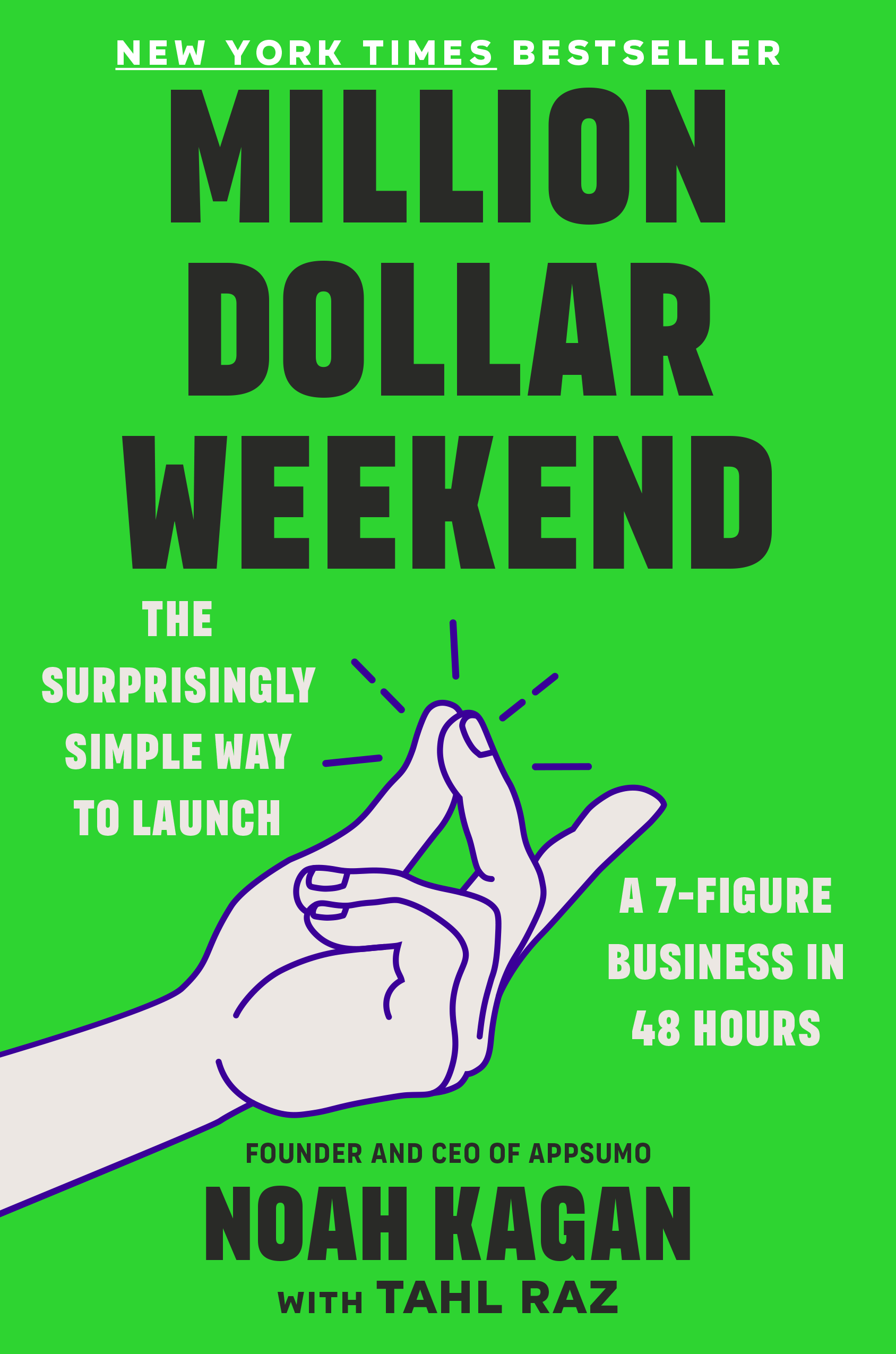
Million Dollar Weekend by Noah Kagan with Tahl Raz is an energetic guide for people who have a business idea but keep waiting for the perfect time, product, website, or plan. Its central challenge is simple: stop guessing in private and test whether real people value an offer.
The book is not a promise that anyone can earn a million dollars in two days. It is a practical argument for reducing entrepreneurial risk through small experiments, direct customer conversations, early sales, and systems that can eventually scale. Durable wealth usually begins with creating useful value—not with polishing an idea nobody has asked for.
What the book is about
Kagan draws on his experience building companies including AppSumo and presents entrepreneurship as a learnable process. Rather than beginning with branding, a complicated product, or a large investment, he emphasizes finding a problem, identifying a likely customer, making a clear offer, and asking for a meaningful commitment.
The book’s “weekend” is best understood as a forcing function. A short deadline makes it harder to hide behind research and preparation. By Monday, the goal is not necessarily a finished company; it is evidence. You should know more about who might buy, what they want, what they will pay, and what must change next.
The big ideas, in plain English
- Action beats anxious planning. Planning has value, but it becomes avoidance when it never reaches a customer. Take the smallest step that produces new evidence.
- Ask before you build. A polite compliment is not demand. A deposit, paid pilot, signed commitment, or repeated request is stronger evidence that the problem matters.
- Build creator’s courage. Courage is practicing uncomfortable actions—asking, selling, publishing, and hearing “no”—until they become normal.
- Solve a painful problem. A painkiller addresses an urgent need; a vitamin may be pleasant but optional. The more costly or frustrating the problem, the easier it is to explain value.
- Use leverage and systems. Once an offer works, document repeatable steps, use appropriate technology, and reduce dependence on the founder.
- Know your freedom number. Define the income or financial cushion that would materially change your choices. A specific number is more useful than the vague wish to be rich.
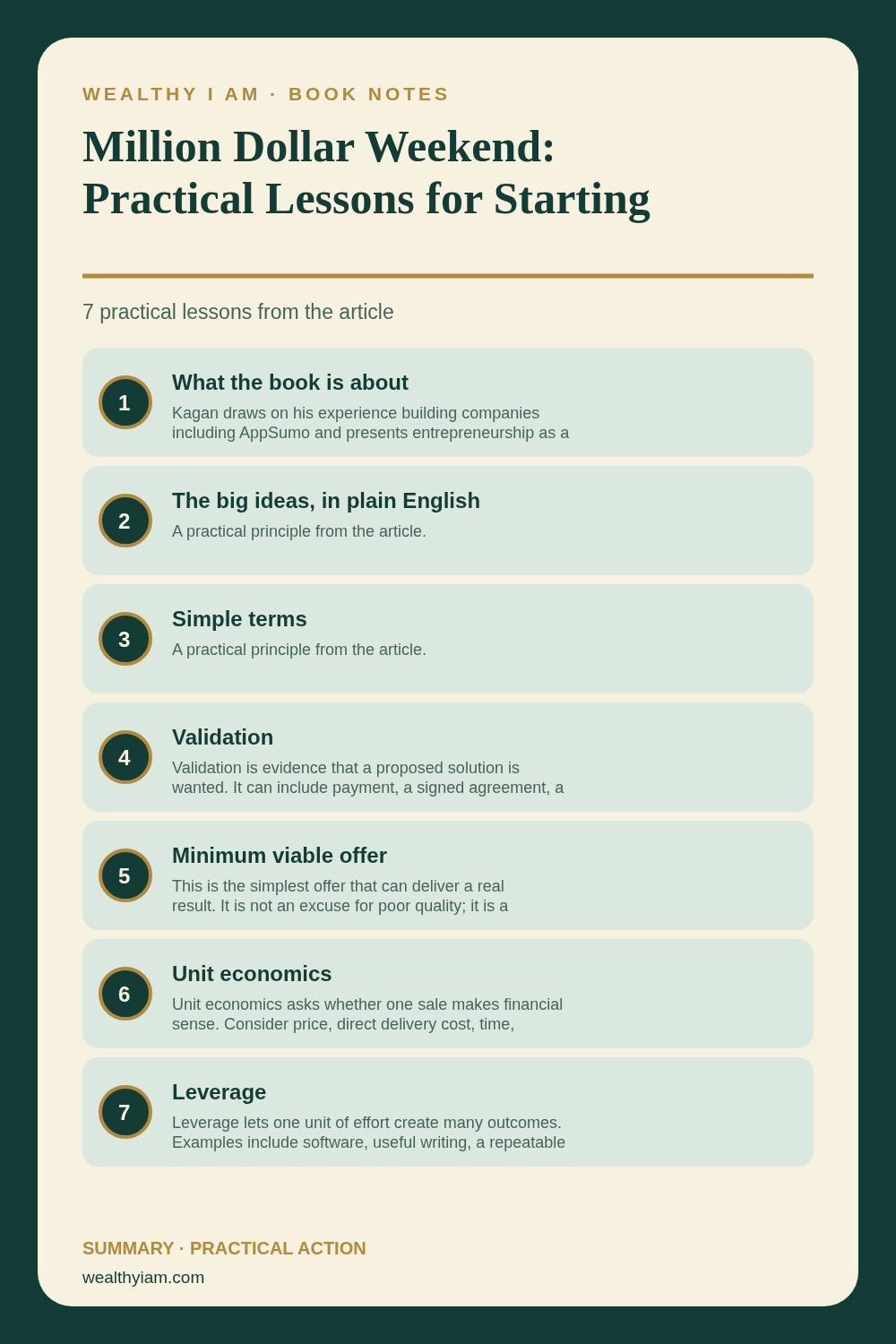
Simple terms
Validation
Validation is evidence that a proposed solution is wanted. It can include payment, a signed agreement, a scheduled pilot, or repeated use—not merely saying an idea sounds good.
Minimum viable offer
This is the simplest offer that can deliver a real result. It is not an excuse for poor quality; it is a way to learn before spending heavily on features customers may not need.
Unit economics
Unit economics asks whether one sale makes financial sense. Consider price, direct delivery cost, time, customer-acquisition cost, and likely repeat business.
Leverage
Leverage lets one unit of effort create many outcomes. Examples include software, useful writing, a repeatable sales process, a team, or a trusted audience.
A practical weekend plan
- Friday evening—define the target. Write your freedom number and choose one customer group you understand. Describe its problem in the customer’s words.
- Saturday morning—generate options. List ten problems or offers. Rank them by urgency, your ability to reach buyers, and the likelihood of profitable delivery.
- Saturday afternoon—talk to people. Ask potential customers what they have tried, what the problem costs, and how they solve it now. Avoid leading questions.
- Saturday evening—make an offer. State the result, price, timing, and next step clearly. Ask for payment, a deposit, or a scheduled pilot when appropriate.
- Sunday morning—deliver manually. Serve the first customer with the simplest reliable process. Notice repeated, confusing, expensive, or founder-dependent steps.
- Sunday afternoon—measure the economics. Record revenue, direct costs, hours, conversion rate, and feedback. A sale is encouraging, but healthy businesses also need acceptable margins.
- Sunday evening—systemize. Keep what worked, change what did not, and write a one-page checklist. Continue, revise, or stop before spending more.
How these lessons build wealth
The wealth connection is not the dramatic promise in the title. It is the habit of converting uncertainty into affordable learning. A founder who speaks with customers before buying equipment protects capital. An employee who tests a paid service before quitting protects income. An investor in a small business can ask the same questions: who pays, why do they stay, what does delivery cost, and can the process grow?
Customer validation improves focus. Instead of chasing every idea, allocate time and money toward problems with evidence behind them. Over time, a useful offer, trusted reputation, repeatable operations, and retained profits can become assets. None is guaranteed, but each is more grounded than a business built around appearance.
What to be careful about
Speed is useful, but speed is not recklessness. Do not take money for work you cannot deliver, ignore legal or tax obligations, borrow money you cannot repay, or treat one enthusiastic response as proof of a scalable market. A weekend test should reduce risk, not transfer it unfairly.
The examples are entrepreneurial, so adapt them to a career, freelance practice, nonprofit, or local business. Automation cannot rescue a weak offer. First create genuine value and a repeatable process; then automate what is stable enough to deserve it.
Bottom line
Million Dollar Weekend is an antidote to perfectionism. Choose a real problem, speak with real people, ask for a real commitment, measure the economics, and improve from evidence. That cannot guarantee seven figures, but it can help you protect capital, learn faster, and build on value rather than wishful thinking.
Sources and credit
- Penguin Random House publisher page: title, authors, edition, and description
- Amazon.com product page: ISBN 9780593539774 and book details
- Noah Kagan official book page
- Cover image credit: Penguin Random House
Wealthy I AM Action Card
Wealthy I AM Pinterest Copy
TITLE
Million Dollar Weekend: Practical Lessons for Starting a Business
DESCRIPTION
Practical lessons from Million Dollar Weekend by Noah Kagan with Tahl Raz on customer validation, courage, and building a scalable.
KEYWORDS
Million Dollar Weekend book summary, Million Dollar Weekend lessons, personal development, wealth building, productivity books
ALT TEXT
Wealthy I AM visual summary of Million Dollar Weekend: Practical Lessons for Starting a Business
ARTICLE URL
https://nappot.com/million-dollar-weekend-practical-lessons-starting-business/