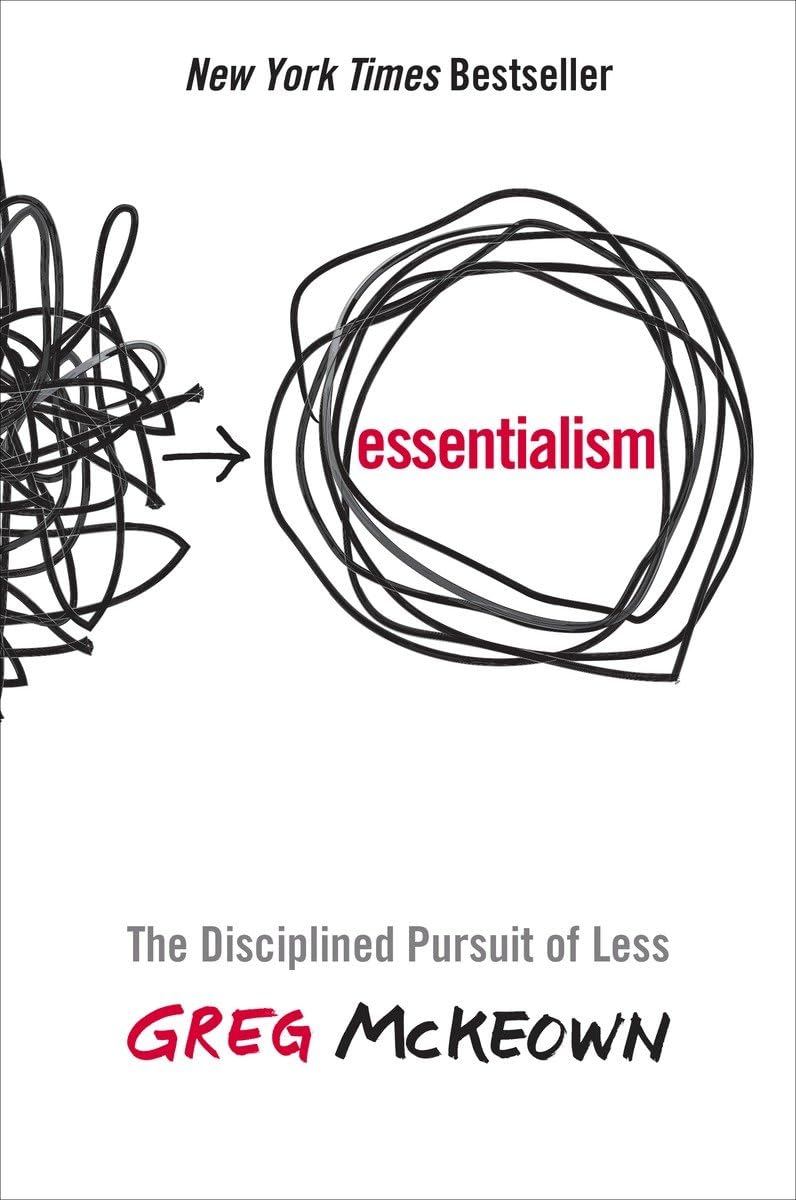
What if building a better life required doing fewer things, not more? In Essentialism, Greg McKeown argues that meaningful progress begins when we stop treating every request, opportunity, and obligation as equally important. The book is not a case for laziness. It is a practical approach to choosing the small number of activities that deserve our best time and energy.
This Essentialism summary explains seven useful lessons about focus, priorities, boundaries, and disciplined execution. These ideas apply to personal goals, careers, businesses, and the long-term work of building a life with more value and less noise.
“If you don’t prioritize your life, someone else will.”
— Greg McKeown, Essentialism
A Short Reflection: Less but Better in Practice
The strongest idea in Essentialism is not simply that people should have fewer tasks. It is that attention is a limited resource, and careless choices spend it before important work has a chance to begin. That makes the book especially useful for anyone trying to build a career, business, or financial life over a long period.
My rating: 4.5/5. The framework is clear, memorable, and practical. Its main challenge is also its main strength: the book asks readers to make real trade-offs. It is easy to admire the idea of focus; it is harder to disappoint an opportunity, decline a request, or remove a familiar commitment. The value appears when the principle is practiced in the calendar, not just highlighted on the page.
A good starting experiment is to protect one essential project for the next seven days and remove one recurring source of noise. The result may not feel dramatic immediately, but the recovered attention can become the beginning of better work.
What Is Essentialism About?
Essentialism is the disciplined pursuit of less. The essentialist asks a different question from the person who is simply trying to fit more into the day: What is truly important, and how can I give it my best contribution?
That shift matters because modern life rewards availability. Messages, meetings, notifications, and new opportunities can fill every open space. Without deliberate choices, other people’s priorities quietly become our schedule. Essentialism creates a filter so that time, attention, and money are directed toward the work that matters most.
7 Essentialism Lessons That Improve Focus and Results
1. Choose deliberately instead of drifting
You have more choice than a busy schedule may suggest. Every commitment has a cost: time that cannot be spent elsewhere, attention that cannot be recovered, or energy removed from an important relationship or project. The first lesson is to pause before automatically saying yes. A deliberate choice protects your ability to shape your own direction.
2. Discover what is genuinely important
Not every good opportunity is the right opportunity. Essentialism encourages a higher standard for deciding what deserves attention. Ask whether an activity strongly supports your most important goal, whether it uses your strengths, and whether the result is meaningful enough to justify the cost. Clarity makes trade-offs easier because you are comparing options against a real priority rather than against vague ambition.
3. Use selective criteria
When every option looks acceptable, the calendar becomes overcrowded. A more selective approach creates space for the exceptional opportunities. Instead of asking, “Can I do this?” ask, “Is this one of the few things I should do?” This does not require perfection. It requires a clear threshold that prevents small, low-value commitments from accumulating into a large burden.
4. Say no with respect
Saying no is difficult because it can feel personal. A respectful no is not a rejection of someone’s worth; it is a boundary around your responsibilities. Keep the explanation brief, thank the person for thinking of you, and avoid leaving a vague promise that creates future pressure. A clear answer today is often kinder than a reluctant yes followed by poor follow-through.
5. Remove what is no longer valuable
Priorities change, but old commitments often remain. Review recurring meetings, subscriptions, projects, and routines. If an activity no longer supports your direction, reduce it, delegate it, or stop it. Removing nonessential work is not wasted effort. It is an investment that returns time for better work and more thoughtful decisions.
6. Make important work easier to execute
Good intentions are not enough when the path is full of friction. Build buffers into your schedule, prepare the next action, simplify your tools, and create routines that reduce repeated decisions. The goal is not to force yourself to work harder every day. It is to design an environment in which the essential action is easier to begin and complete.
7. Protect space for what matters
Focus is not a one-time decision. It needs protection. Reserve uninterrupted time for important work, leave margin between commitments, and create regular moments to review your priorities. A life with no margin turns every small disruption into a crisis. Space gives you the ability to respond thoughtfully rather than react to whatever is loudest.
How to Apply Essentialism Step by Step
- Write down your current commitments. Include work, personal obligations, recurring meetings, subscriptions, and active projects.
- Identify your most important outcome. Choose one result that would make the biggest positive difference during the next 90 days.
- Set a decision filter. Define what an opportunity must offer before it receives your time.
- Remove one nonessential commitment. Start with something small but recurring, such as an unnecessary meeting or notification stream.
- Schedule protected focus time. Put the essential work on your calendar before less important requests fill the space.
- Create a weekly review. Ask what mattered, what created noise, and what should change next week.
Why Essentialism Matters for Wealth and Career Growth
Focus has financial consequences. People who spread their attention across too many projects may stay busy without building a valuable skill, dependable business system, or meaningful body of work. Concentration gives important efforts enough repetition to compound.
The same principle applies to money. A simple financial plan that is followed consistently can be more useful than a complicated plan that is constantly abandoned. Essentialism encourages fewer priorities, clearer decisions, and a longer time horizon. Those habits support better work, calmer spending, and more deliberate investing without promising instant results.
Final Takeaway
Essentialism is a reminder that progress is not created by collecting more obligations. It comes from identifying what matters, removing what does not, and giving the essential work enough time to produce results. You do not need to do everything to build a meaningful career, a healthier life, or long-term wealth. You need the courage to choose what deserves your best contribution.
Start with one decision today: What important activity would receive more of your attention if you removed one nonessential commitment?
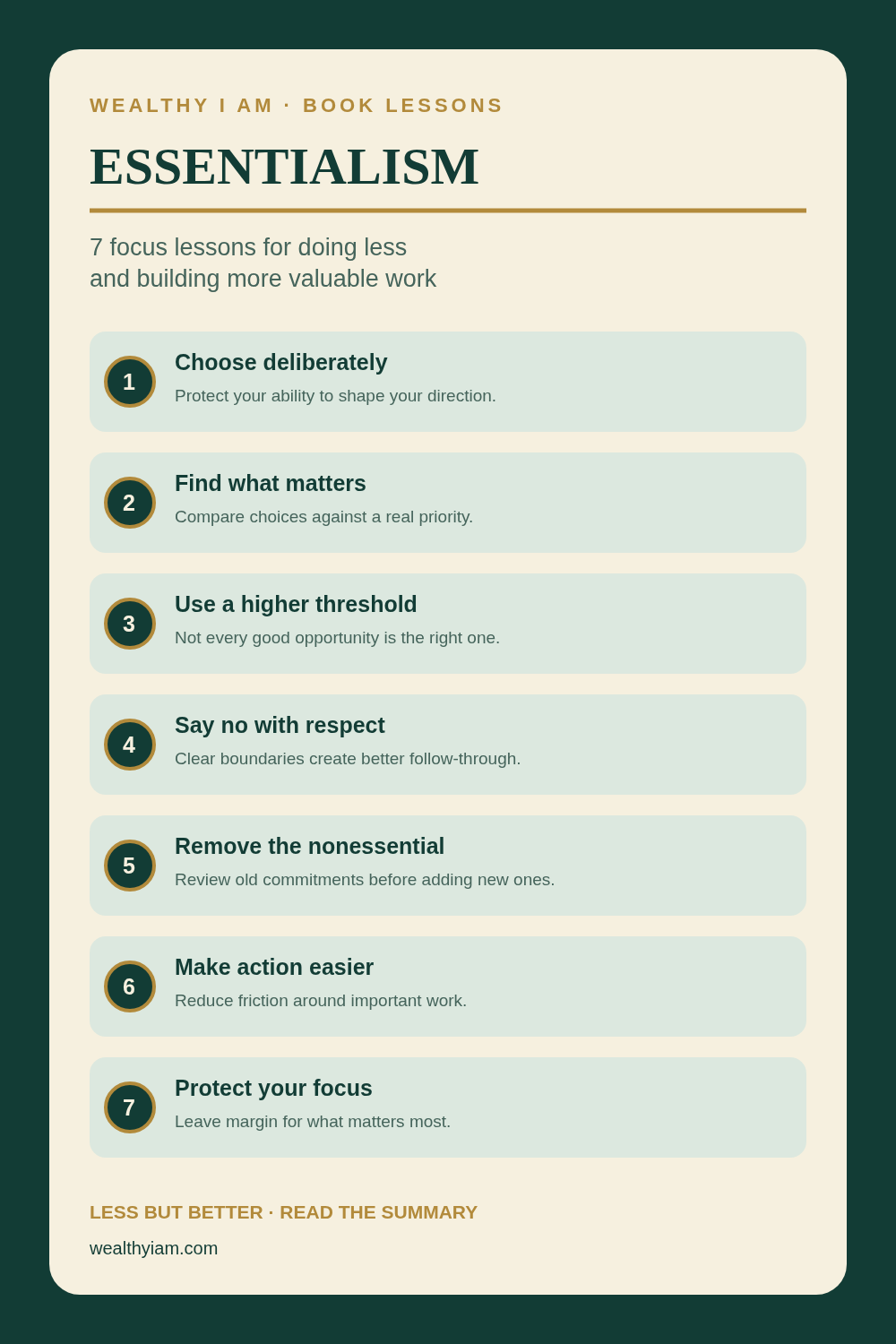
Wealthy I AM Action Card
Wealthy I AM Pinterest Copy
TITLE
Essentialism: 7 Focus Lessons for Doing Less and Building More Valuable Work
DESCRIPTION
Discover seven practical Essentialism lessons about focus, priorities, saying no, meaningful work, and building long-term value through the disciplined pursuit of less.
KEYWORDS
Essentialism book summary, productivity books, focus and priorities, personal development, meaningful work, time management, self-improvement, wealth building
ALT TEXT
Wealthy I AM Action Card summarizing Essentialism lessons about focus, priorities, saying no, and meaningful work.
ARTICLE URL
https://nappot.com/essentialism-book-summary-focus-priorities-meaningful-work/