The Four Pillars of Investing is a classic book for people who want to understand investing without getting lost in jargon. William J. Bernstein’s big idea is simple: if you want to grow money well, you need to understand the rules of the game, the mistakes people keep making, and the way the finance industry works. [1][2]
In plain words: good investing is not about excitement. It is about knowing what matters, staying calm, and not making dumb mistakes.
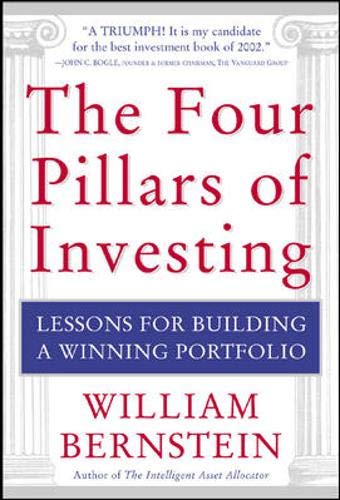
Book facts
| Author | William J. Bernstein |
|---|---|
| First published | 2002 |
| Publisher | McGraw-Hill |
| Main topics | Investing theory, market history, investor psychology, portfolio design, and the investment business. [1][2][3] |
| Why it stands out | It explains why a calm, diversified plan usually beats guesswork and hype. [2][4] |
What the book is about
Bernstein says most investors do not fail because they are lazy or stupid. They fail because they do not understand the basics of risk, they forget history, they let emotions steer the wheel, or they trust salespeople who benefit from bad choices. The book is built around four pillars:
- Theory — how risk and reward really work.
- History — why markets go through booms, crashes, and bubbles again and again.
- Psychology — how fear, greed, and overconfidence hurt investors.
- Business — how the finance industry often earns money from your mistakes.
The goal is not to make investing fancy. The goal is to make it safer, simpler, and more honest.
Main ideas explained simply
Risk and reward
Higher return usually comes with more risk. If something promises big gain with no risk, be careful. That promise is usually a trap.
Diversification
This means spreading money across many investments instead of betting on one horse. If one part falls, the whole bucket does not break as easily.
Market history
People keep repeating the same mistakes. They get excited, push prices too high, panic, and then act surprised when the cycle turns.
Behavioral finance
This is the study of how feelings affect money choices. It shows why smart people still buy high, sell low, and chase the crowd.
A practical plan for using the four pillars
The value of Bernstein’s framework is that it can become a repeatable process. You do not need to master every formula before you take a sensible next step. Work through the pillars in order and write down your decisions.
- Start with your purpose. Write down what the money is for, when you expect to need it, and how much loss you could tolerate without abandoning the plan. A retirement account with decades to grow should not be judged the same way as a house deposit needed next year.
- Learn the basic theory. Understand the relationship between risk, expected return, diversification, inflation, and fees. If you cannot explain an investment in everyday language, pause before buying it. Knowledge is not a guarantee, but ignorance is an avoidable risk.
- Use history as a stress test. Imagine your portfolio during a severe bear market, a period when prices fall broadly. Ask whether you would still be able to pay your bills and continue investing. Keep an emergency reserve separate from long-term investments so a temporary fall does not force a permanent sale.
- Design a simple allocation. Decide how much belongs in growth assets, defensive assets, and cash based on your time horizon and capacity for loss. Spread exposure across regions and asset types rather than concentrating everything in one company, sector, or story.
- Control the human factor. Make rules before emotions rise. Rebalance on a schedule, limit how often you check prices, and write down the reason for every change. A written plan creates a pause between a frightening headline and an expensive decision.
- Inspect the business model. Look at fees, commissions, conflicts of interest, tax consequences, and the service you are actually receiving. Ask whether a recommendation would still be attractive if the seller earned the same amount from every option.
Review the plan once or twice a year, not every time the market makes news. The goal is not to predict the next move. It is to build a portfolio you can understand, afford, and hold through uncomfortable periods.
Who will benefit most
This book is especially useful for a reader who has started investing but still feels pulled around by headlines, tips, and complicated products. It is also valuable for someone who wants to understand why low-cost diversification is more than a slogan. Bernstein gives enough history to make market crashes less mysterious and enough theory to explain why a portfolio needs both expected return and emotional durability.
If you are completely new to money, read slowly and focus on the vocabulary first. If you already invest, use the book as an audit: check your fees, concentration, assumptions, and reaction to losses. Either way, the lasting lesson is independence—not doing everything alone, but becoming informed enough to recognize a sound plan and question a costly one.
What the book gets right
- Investing is mostly a behavior problem. Many losses come from panic, greed, and chasing the latest hot thing.
- Costs matter. Fees, taxes, and trading churn can quietly eat a lot of returns over time.
- History is useful. If you know markets can get wild, you are less likely to be shocked when they do.
- Simple plans can work very well. You do not need a complicated setup to build real wealth.
- The industry has incentives. Some products are sold because they pay the seller, not because they help the buyer.
What to be careful about
The book is excellent, but it is not a magic rulebook. Markets change. Taxes change. Your income, age, debt, and family needs all matter. A portfolio that works for one person may be wrong for another.
Also, Bernstein’s opinions are strong. That is useful, but it means readers should treat the book as a smart guide, not as a law of nature. The safest takeaway is the simplest one: know what you own, keep costs low, spread risk, and stay patient.
Kid-simple version: do not build a money plan like a toy tower made of only one block.
Bottom line
The Four Pillars of Investing is one of the best books for learning the foundation of sensible investing. It does not chase hype. It teaches judgment. If you want to understand how to build a stronger portfolio and avoid the usual money traps, this book still belongs near the top of the list.
Sources
- [1] McGraw Hill publisher page
- [2] Google Books
- [3] Open Library
- [4] Efficient Frontier introduction
- [5] Goodreads
- [6] Amazon.com product page
Related reading: For a fuller beginner roadmap, see Investing Basics.
Wealthy I AM Action Card
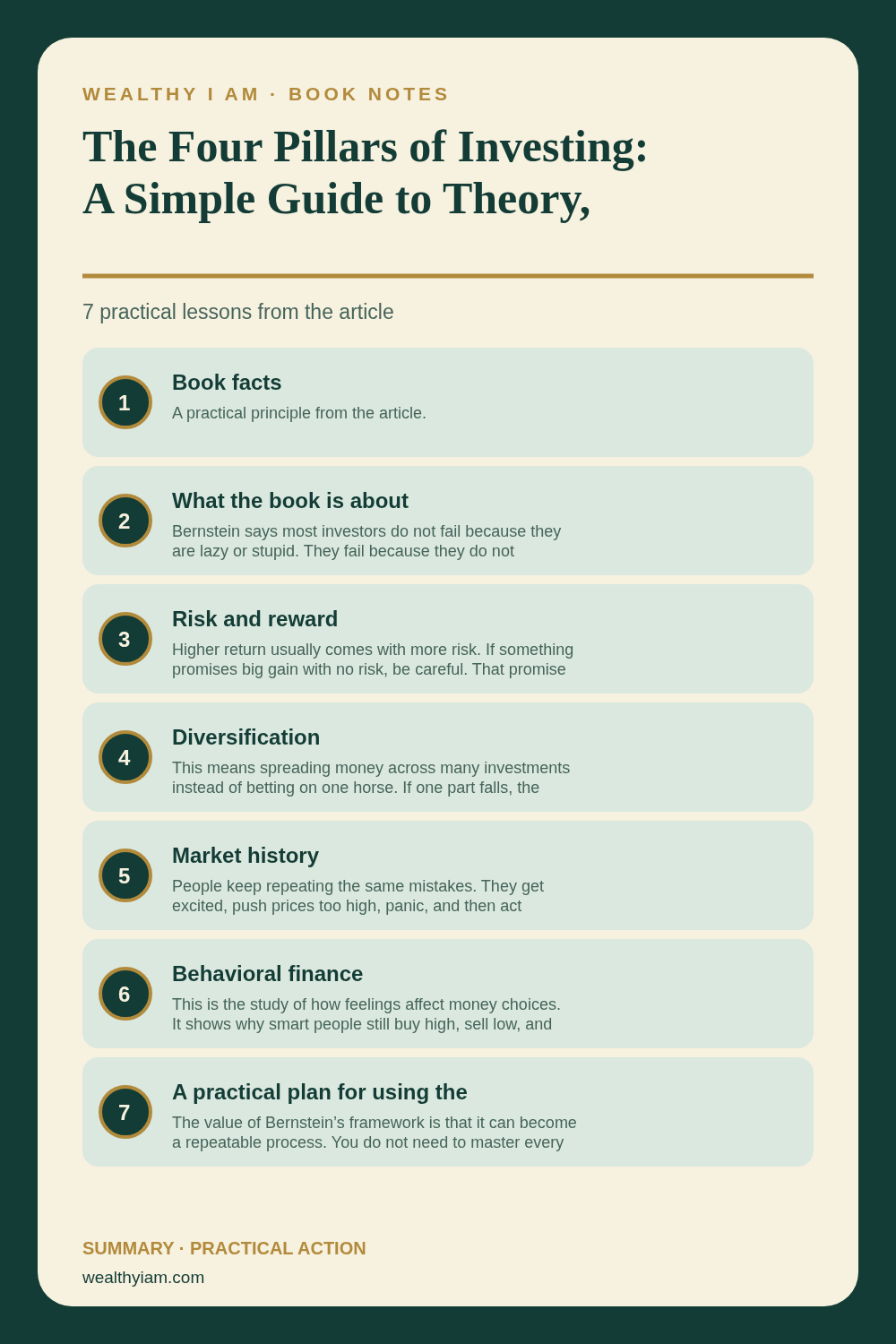
Wealthy I AM Pinterest Copy
TITLE
The Four Pillars of Investing: A Simple Guide to Theory, History, Psychology, and the Business of Money
DESCRIPTION
An original, easy-to-read guide to William J. Bernstein’s classic investing book and its core lesson: build a calm, diversified portfolio and avoid costly.
KEYWORDS
The Four Pillars of Investing book summary, Four Pillars Investing lessons, personal development, wealth building, productivity books
ALT TEXT
Wealthy I AM visual summary of The Four Pillars of Investing: A Simple Guide to Theory, History, Psychology, and the Business of Money