When a preschooler mixes up yesterday today tomorrow, it can sound as if the words have been shuffled in a drawer: “Tomorrow we went to Nana’s,” or “Yesterday we are going to the park.” This is usually a normal part of learning a difficult idea. Young children live very much in the present, while these words ask them to place an event on an invisible timeline. The most helpful response is to make time visible in ordinary routines—not to turn the conversation into a test.
This guide is general developmental information, not an assessment of any child. Preschoolers develop language at different rates and may use a correct time word one day and mix it up the next. If concerns extend beyond time words, or communication is hard across settings, bring specific observations to your child’s pediatrician or early-childhood educator.
Why time words take practice
“Yesterday,” “today,” and “tomorrow” are relational words. Their meaning changes every day, unlike a word such as “shoe” or “banana.” A preschooler also needs repeated experience linking a word to an event, remembering that event, and talking about it later. They may understand the routine perfectly while still choosing the wrong label. Rather than correcting every sentence, model the word naturally: “Yes, we went to Nana’s yesterday. Today we are home. Tomorrow we will go to the library.”
Look for understanding, not perfect wording
A child who says “tomorrow” but can show you the picture on the calendar, remember what happened after lunch, or anticipate the next step in a familiar routine is building useful foundations. Confusion alone does not diagnose a language or learning problem. Notice the broader picture: how your child understands everyday directions, shares experiences, hears and uses language, plays, and communicates with familiar adults and peers.
Start with a calm, concrete check
For a few days, listen without quizzing. Jot down one or two examples: what your child said, what was happening, and whether a photo, routine, gesture, or choice helped. This gives you better information than a memory of “they always get it wrong.” It also keeps the goal realistic: more meaningful exposure, not a performance.
- Does your child use words such as before, after, now, or later in familiar situations?
- Can they tell a simple event in order with help from pictures?
- Do they understand a predictable sequence, such as bath, pajamas, story, then bed?
- Are there broader concerns about hearing, speech, comprehension, loss of skills, or communication in more than one setting?
If the last question is yes, record examples and discuss them with the child’s health professional or school team. A prompt conversation can help identify whether observation, a hearing check, language support, or another next step makes sense.
A playful plan for building time words
Step 1: Name three anchors in the day
Choose a few events that happen reliably: breakfast, pickup, bath, bedtime, or a regular preschool day. Use the same short phrases often: “Today is preschool.” “After snack, we pick up your coat.” “Tomorrow is Saturday.” Keep the language connected to something your child can see or do. A tiny routine chart with two or three pictures is enough; it does not need to be decorative or perfect.
Step 2: Make yesterday visible
At breakfast or bedtime, look at one photo, drawing, or object from the previous day. Say one sentence first: “Yesterday we found a red leaf.” Then invite a low-pressure response: “What did you notice?” If your child says “Tomorrow we found it,” repeat the meaning rather than demanding a correction: “We found it yesterday. Today it is on the table.” Repeated, warm modeling teaches more than a rapid series of questions.
Step 3: Give today a job
Use a simple “today” marker: move a magnet, circle a day on a family calendar, or place one picture on a three-column board labeled Yesterday, Today, Tomorrow. Let your child add the day’s activity after it happens. The physical action makes the word easier to connect with the present moment.
Step 4: Preview tomorrow without overpromising
At the end of the day, name one likely event: “Tomorrow we will take your backpack to school.” Keep plans flexible and avoid using tomorrow as a reward you may not be able to keep. If plans change, model the update: “We thought we would go to the playground tomorrow. Rain changed our plan, so today we are choosing an indoor game.” This shows that time words organize plans, not guarantees.
Step 5: Turn the words into a game
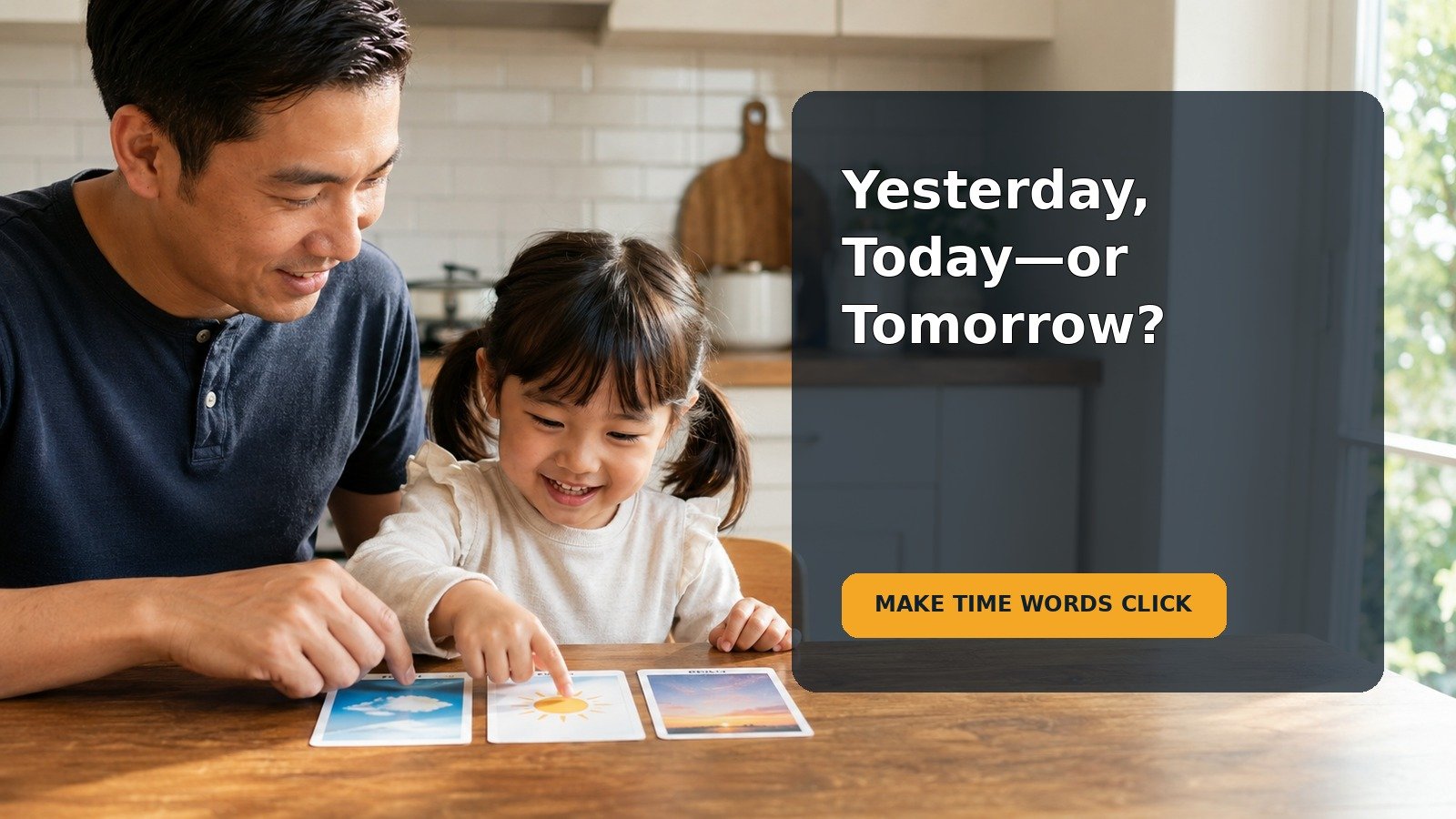
Try a three-card story. Draw a beginning, middle, and end of a familiar event—making toast, visiting a playground, or planting a seed. Mix the cards, then put them in order together. Use “first,” “then,” and “after” before expecting yesterday and tomorrow. Another option is a nightly “two things” ritual: one thing from yesterday and one thing hoped for tomorrow. Keep it brief; stop while it is still enjoyable.
Use language that protects confidence
Time concepts are learned through many small conversations. Phrases such as “No, that’s wrong” can make a child less willing to tell stories. Try: “I know what you mean—let’s put it on our time line,” or “That happened yesterday; today we are talking about it.” If your child loses interest, move on. Learning grows through responsive back-and-forth interaction, where an adult notices the child’s focus and adds a little language, rather than pushing a lesson past the child’s capacity.
Common traps—and kinder alternatives
- Drilling with flashcards: use real routines, photos, and stories instead.
- Correcting every slip: recast the sentence naturally and keep talking.
- Using a crowded calendar: begin with just three meaningful markers.
- Comparing siblings or classmates: focus on your child’s next small step.
- Assuming confusion means a diagnosis: look at communication as a whole and seek advice when concerns are broader or persistent.
When to ask for extra support
Bring the topic up at a routine visit or with an educator if time-word confusion comes with difficulty understanding everyday language, trouble being understood, regression or loss of previously used skills, concern about hearing, or frustration that limits participation. Share your short notes and ask what is typical for your child’s age and setting. An educator may suggest classroom language or a screening process; a pediatrician can help decide whether other evaluation is appropriate.
Seek prompt medical guidance for sudden loss of communication skills or other acute changes in your child’s health or behavior. For ongoing developmental questions, a calm, early conversation is more useful than waiting for a child to “grow out of it” without support.
A one-page routine to try this week
- Morning: say one “today” sentence tied to the schedule.
- After an activity: take or choose one photo/drawing that can become “yesterday.”
- Evening: tell one short yesterday story together.
- Before bed: name one realistic tomorrow event.
- Once or twice: sequence three picture cards using first, then, and after.
- At week’s end: notice what helped and share concerns with a trusted professional if needed.
Frequently asked questions
Is it normal for a 3- to 5-year-old to mix up these words?
It can be. Time language develops gradually, and the meaning of yesterday, today, and tomorrow changes daily. What matters is the broader pattern of communication and whether your child benefits from concrete, repeated experiences.
Should I use a calendar?
A simple visual can help when it connects to real events. Start small—a three-part board or a few pictures—rather than expecting a preschooler to understand an entire month grid.
How long should we practice?
Use brief moments already built into the day. A minute or two of warm conversation, repeated often, is more valuable than a long lesson that becomes frustrating.
The bottom line
When a preschooler mixes up yesterday today tomorrow, respond with concrete routines, photos, repeated language, and play. Model the words without shame, watch the wider communication picture, and ask for individualized advice if concerns are persistent, broad, or include regression. Time words become clearer through many connected moments with someone who is paying attention.