In business, expertise may earn attention, but trust earns the opportunity to act. A client can admire your knowledge and still hesitate to share sensitive information, accept difficult advice, or recommend you to someone else. The Trusted Advisor argues that durable professional success depends on becoming the person others feel safe relying on when the decision matters.
Written by David H. Maister, Charles H. Green, and Robert M. Galford, this practical classic examines the human side of consulting, sales, negotiation, leadership, and professional service. Its central lesson is highly relevant to wealth building: revenue becomes more durable when it is supported by credibility, dependable delivery, strong relationships, and a genuine focus on the other person’s interests. The authors’ trust equation and five-stage process turn that broad idea into behaviors a reader can practice.
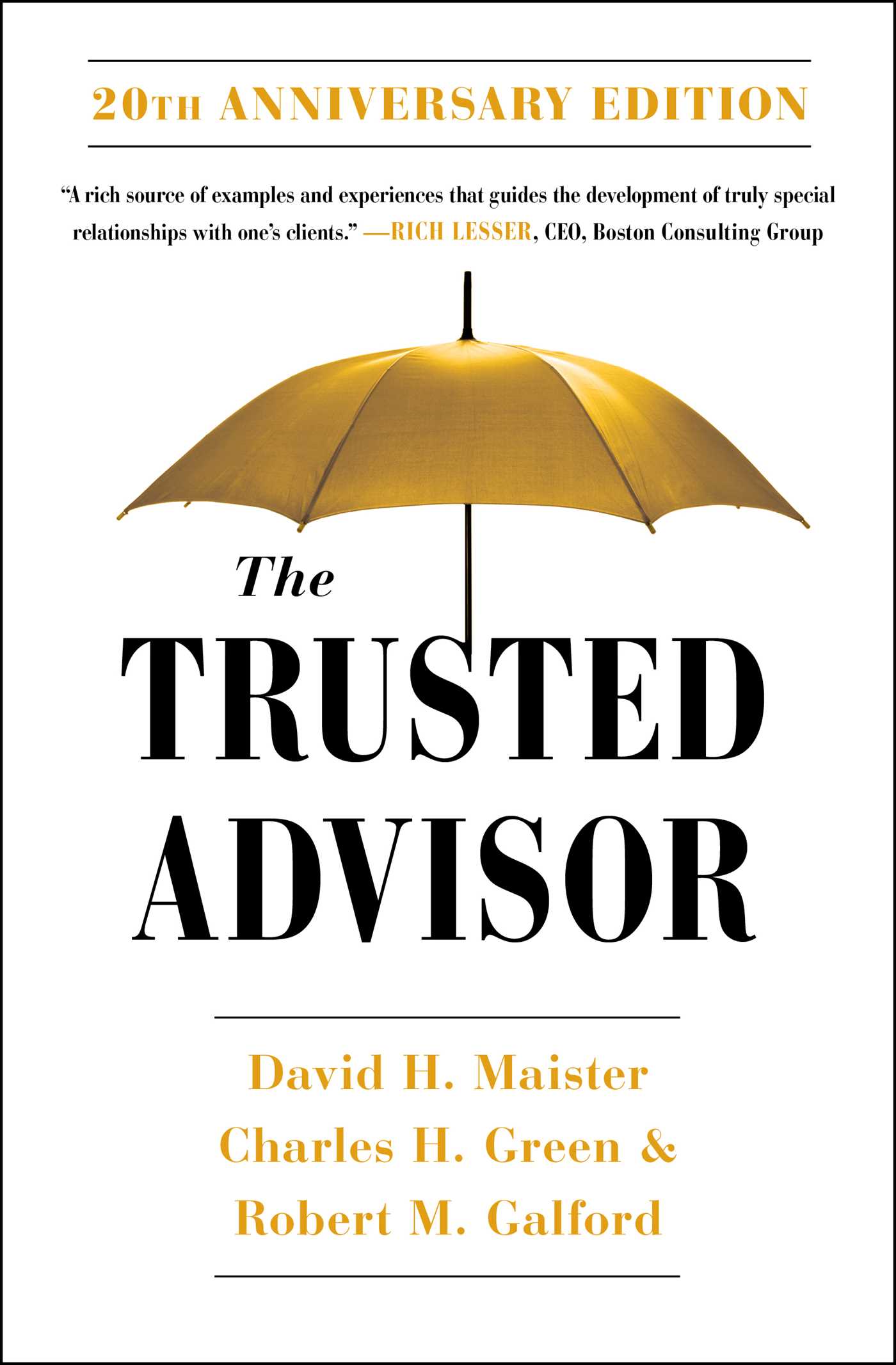
Book facts
| Title | The Trusted Advisor: 20th Anniversary Edition |
|---|---|
| Authors | David H. Maister, Charles H. Green, and Robert M. Galford |
| Original publication | 2000 |
| Edition shown | 20th Anniversary Edition, updated for the digital world |
| Core topics | Trust, client relationships, advising, listening, communication, negotiation, and professional value |
Why trust is a wealth skill
Trust is often treated as a soft quality, separate from financial performance. The book makes a stronger case: trust changes what people are willing to tell you, buy from you, delegate to you, and build with you. A trusted professional can spot the real problem sooner, recommend a better solution, retain clients longer, and generate referrals without relying on constant persuasion.
That does not mean trust is a shortcut or a sales trick. In the authors’ framework, it is the result of repeated evidence. You know what you are talking about, you do what you said you would do, you create safety around difficult conversations, and you keep your attention on the client rather than on your own status or commission. Those actions compound into reputation—the business asset that becomes more valuable with time.
The trust equation in plain English
The authors describe trustworthiness as a combination of credibility, reliability, and intimacy, divided by self-orientation. Credibility answers, “Do you know what you are doing?” Reliability asks, “Will you follow through?” Intimacy asks, “Can I speak honestly with you without being exposed or dismissed?” Self-orientation asks, “Are you mainly focused on me, or on yourself?”
The equation is useful because it shows why technical brilliance is not enough. A highly knowledgeable advisor who misses deadlines may feel unreliable. A dependable advisor who never creates psychological safety may not hear the whole story. And even a capable, warm professional loses trust when every recommendation appears designed to maximize personal gain.
Five practical lessons from the book
1. Engage before you advise
Do not rush into your solution. Give the other person your full attention and establish that you are present for the actual conversation, not merely waiting for a chance to present an offer. Before a sales call or client meeting, write down what you need to understand—not just what you want to sell.
2. Listen for the problem beneath the problem
People often describe symptoms first. A business owner may say that sales are weak when the deeper issue is poor positioning, fear of hiring, or uncertainty about the next stage. Ask open questions, reflect back what you heard, and notice what is avoided as well as what is said. Better listening improves advice and prevents expensive misunderstandings.
3. Frame the decision together
Framing means creating a shared view of what is really happening. Separate facts from assumptions, define the decision that must be made, and agree on what success would look like. When the client helps shape the frame, your recommendation feels less like pressure and more like a logical next step.
4. Envision a useful future
Before discussing tactics, help people picture the outcome they want. What would change in their numbers, workload, confidence, customer experience, or freedom? A clear future gives practical work a purpose. It also exposes unrealistic expectations early, when they are still easy to correct.
5. Commit to specific next actions
Trust grows when conversation becomes visible action. End every important interaction with owners, dates, deliverables, and a definition of done. Then follow up before the other person has to chase you. Small promises kept consistently are more persuasive than dramatic promises made once.
Step-by-step: apply the trust equation this week
- Choose one relationship that matters. It could be a client, manager, supplier, partner, or prospective customer.
- Score yourself honestly. From one to five, rate your credibility, reliability, intimacy, and self-orientation. Ask the other person for feedback if the relationship allows it.
- Pick one weak link. If reliability is low, improve updates and deadlines. If intimacy is low, create a safer space for questions. If credibility is low, study the problem and state what you do not yet know.
- Run an engage-listen-frame-envision-commit conversation. Do not force all five stages into a rushed call; let the other person’s needs set the pace.
- Document the promise. Send a short recap with decisions, responsibilities, and dates. This turns good intention into evidence.
- Review after delivery. Ask what worked, what surprised the client, and what should change next time. Post-project care is part of trust, not an optional extra.
How this helps entrepreneurs and professionals build value
Trust-based work improves more than closing rates. It can reduce wasted effort because clients share better information. It can increase pricing power because people pay for judgment and reduced risk, not only for hours. It can strengthen partnerships because disagreements are easier to resolve when motives are clear. It can also create a healthier form of growth: referrals and repeat business built on a history of useful outcomes.
There is an important boundary, however. Trust should never be confused with guaranteeing results. A trusted advisor is candid about uncertainty, conflicts of interest, costs, and limitations. Honest disagreement can be more valuable than agreeable advice. In financial or business decisions, protect the relationship by making assumptions visible and encouraging appropriate professional review.
Bottom line
The Trusted Advisor offers a durable business lesson: relationships become economically valuable when people experience you as capable, dependable, safe, and sincerely other-oriented. Build those qualities through small, observable actions. Listen longer, define the real problem, make realistic promises, keep them, and review the result. Over time, trust becomes a compounding asset—one that supports better work, stronger reputation, and more resilient wealth.
Sources and credits
- Amazon.com product page: The Trusted Advisor: 20th Anniversary Edition
- Trusted Advisor Associates: official book information and Trust Equation overview
- Open Library bibliographic record for the original work
- Cover image: Simon & Schuster high-resolution cover image for ISBN 9780743205443
Book credit: David H. Maister, Charles H. Green, and Robert M. Galford. This article is an original educational summary and is not affiliated with the authors or publisher.
Wealthy I AM Action Card
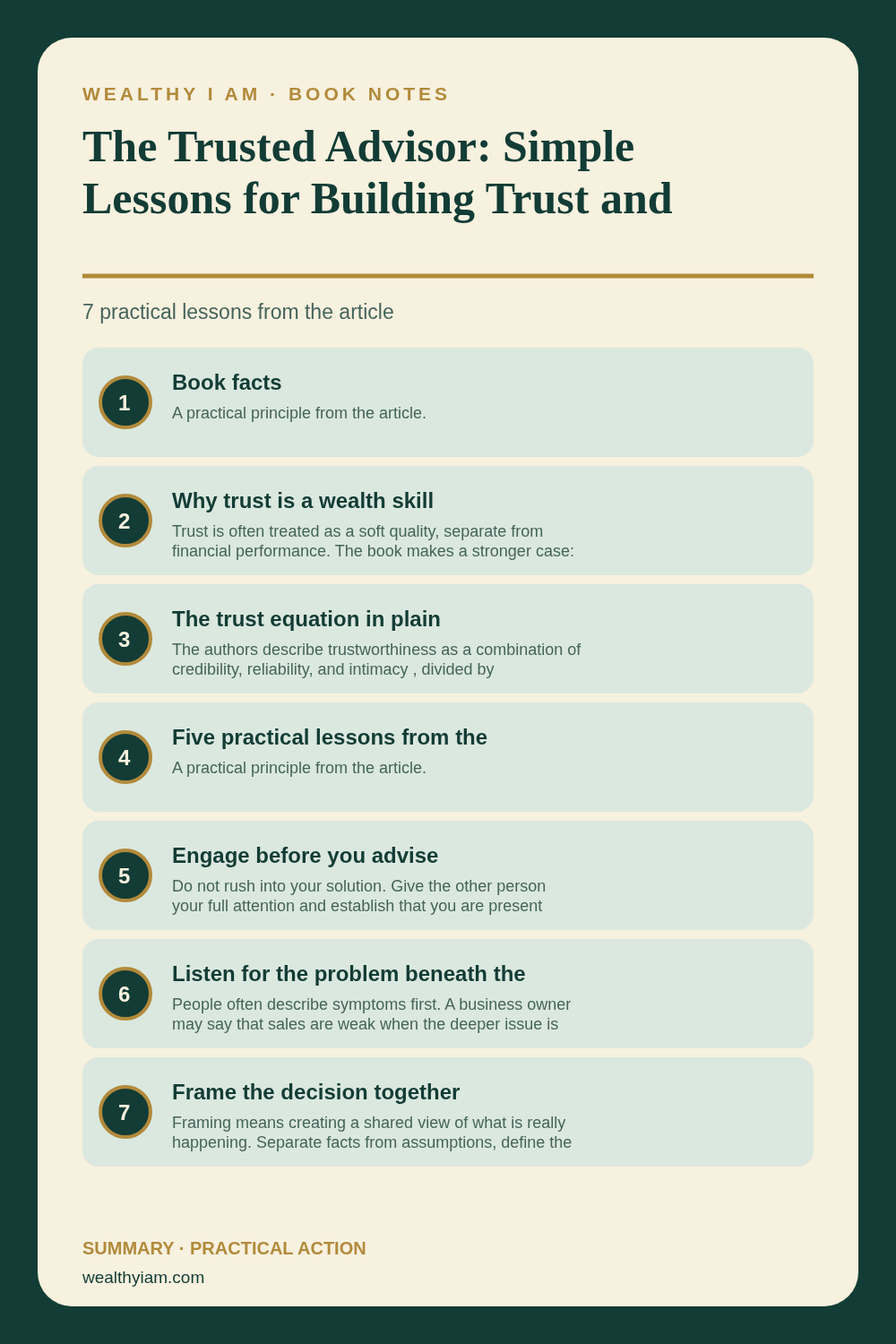
Wealthy I AM Pinterest Copy
TITLE
The Trusted Advisor: Simple Lessons for Building Trust and Business Value
DESCRIPTION
Practical lessons from The Trusted Advisor on credibility, reliability, listening, and building durable business.
KEYWORDS
The Trusted Advisor book summary, Trusted Advisor lessons, personal development, wealth building, productivity books
ALT TEXT
Wealthy I AM visual summary of The Trusted Advisor: Simple Lessons for Building Trust and Business Value
ARTICLE URL
https://nappot.com/the-trusted-advisor-simple-lessons-building-trust-business-value/