A toddler who collects pebbles, coins, beads or toy pieces is not being “sneaky” in an adult sense. At 12–36 months, pockets can feel like portable treasure boxes. The problem is that the same curiosity can bring a small object close to the mouth, nose or ear. If your toddler puts tiny objects in pockets, use a calm routine that removes the immediate hazard without turning every discovery into a confrontation.
The 60-second safety check: Keep your child beside you, ask them to empty both pockets into your open hand or a container, and check the mouth only if you have reason to think something is there. Do not sweep a finger blindly inside the mouth. If your child cannot breathe, cry or make sounds, turns blue, becomes limp or appears to be choking, call your local emergency number and use age-appropriate choking first aid if you are trained.
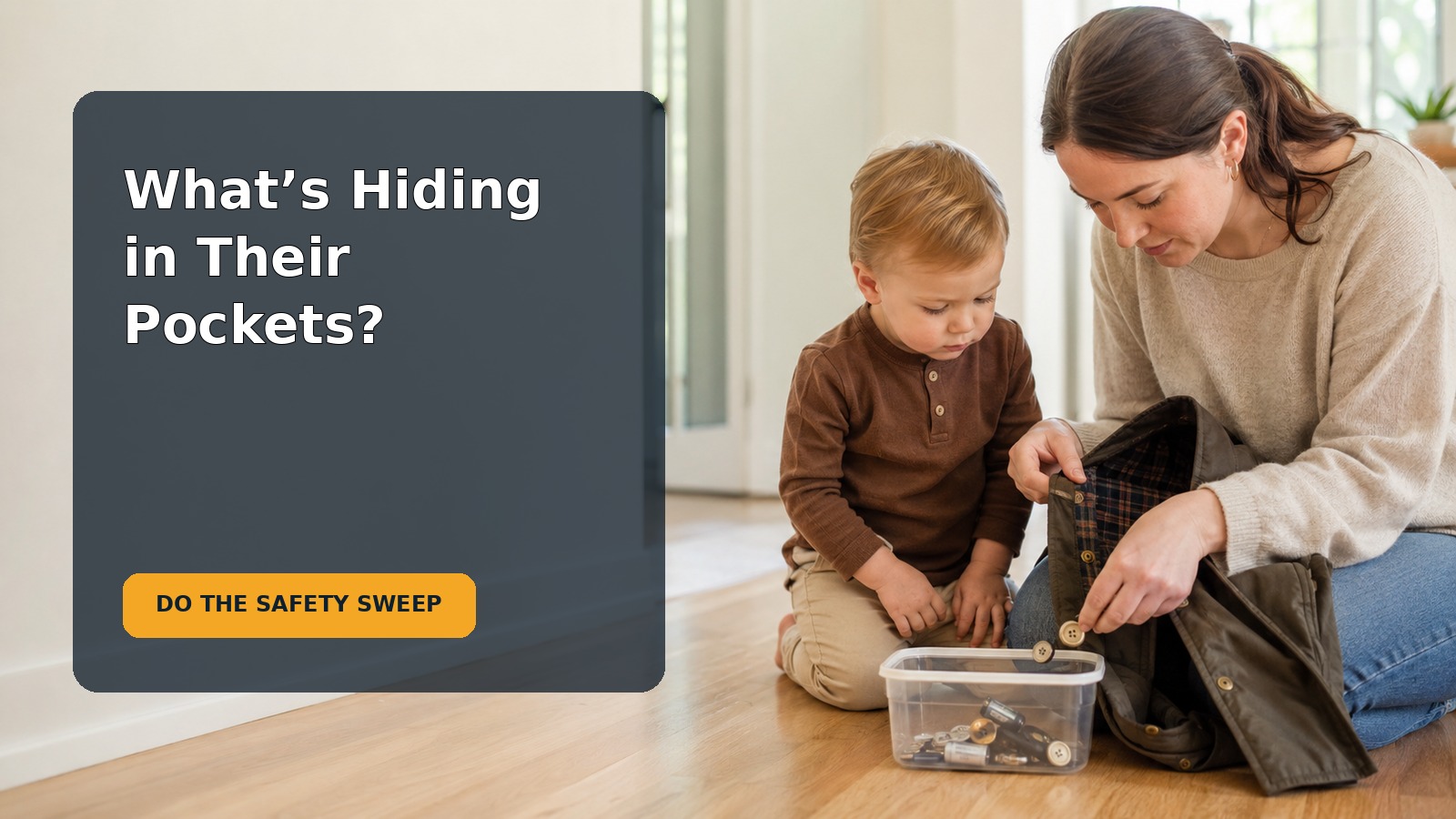
Why toddlers collect tiny objects
Toddlers learn by touching, carrying, filling and emptying. A shiny button, smooth stone or loose toy wheel may be interesting precisely because it is small. Their judgment about danger is still developing, and a verbal warning given yesterday may not guide an excited choice today. This is why prevention must rely more on the environment and adult routines than on a toddler remembering a rule.
Young children also explore with their mouths. The American Academy of Pediatrics notes that babies and toddlers are at especially high risk of choking because they can reach small objects and may put them in their mouths. A pocket creates an extra blind spot: an item found at daycare, a playground or an older sibling’s room can travel home unnoticed.
What changes the risk
Risk is higher when your child still mouths objects, moves quickly between rooms, plays near older children’s toys, or visits places where coins, hardware, beads or craft supplies are accessible. Developmental differences that affect chewing, swallowing, impulse control or understanding may call for a more individualized plan. Ask your child’s pediatrician or relevant therapist if ordinary household precautions do not match your child’s needs.
Know which finds are urgent
Any small object can obstruct an airway, but several items deserve immediate action even when a child looks well. Do not wait for symptoms if you suspect a button battery or more than one magnet was swallowed.
| Possible find | Main concern | What to do |
|---|---|---|
| Button or coin battery | Rapid internal burns if swallowed; injury if placed in the nose or ear | Seek immediate expert guidance. In the U.S., call the National Battery Ingestion Hotline at 1-800-498-8666 or Poison Control at 1-800-222-1222. Do not induce vomiting. Follow their instructions. |
| Two or more high-powered magnets, or an uncertain number | Magnets can attract across intestinal tissue and cause severe injury | Seek immediate medical attention, even without symptoms. |
| Medication, nicotine product, cannabis edible, cleaning pod or unknown substance | Poisoning | Call your local poison center immediately; in the U.S., call 1-800-222-1222. Call emergency services for breathing trouble, collapse or a seizure. |
| Sharp object, glass or pin | Cuts or internal injury | Keep the child still and seek urgent medical advice. Do not make the child vomit. |
| Coin, bead, toy piece, cap or pebble | Choking or lodging in the nose, ear or digestive tract | Remove it from reach. If ingestion or insertion may have occurred, call the child’s clinician for case-specific advice; use emergency care for breathing difficulty. |
For a suspected ingestion, do not rely on the object’s size, a homemade “choke tube,” or the fact that your child seems comfortable. A gauge may help identify some small toy parts, but it cannot make batteries, magnets, medications or sharp items safe. Keep packaging or a matching item available for professionals if doing so does not delay care.
Do a practical pocket-and-floor safety sweep
Step 1: secure the child and the object
Move away from traffic, stairs or water. Use a low, steady voice: “That is not safe for your body. Put it in my hand.” Offer a small bowl if handing an item directly to you causes a struggle. Check jacket, pants, overalls, backpack compartments and stroller pockets. Look for a bulge or a repeated reach toward one pocket rather than turning the check into a rough search.
If your child is actively choking, do not spend time looking for the item. Call emergency services and follow recognized first-aid guidance. If they can cough or make sounds, watch closely and be ready to act if breathing worsens; do not perform a blind finger sweep.
Step 2: sweep the places where finds begin
Get to toddler eye level. Scan under the sofa, between cushions, along baseboards, under tables, near entryways and around bags. Add these often-missed sources:
- loose batteries in remotes, key fobs, musical cards, scales and small electronics;
- magnetic desk toys, building pieces or jewelry belonging to older family members;
- coins, earrings, screws, pen caps, hair accessories and craft beads;
- broken toy parts, deflated balloons and pieces of pet toys;
- pills dropped near bags, nightstands or bathroom counters;
- pebbles, seeds, bottle caps or other finds brought in from outdoors.
Put dangerous items in locked storage or a place your child cannot access. “Up high” is not enough if furniture can be climbed or a bag can be pulled down. Check battery compartments and toys regularly for damage. Separate older children’s small-part play into a controlled area, then count pieces and sweep the floor before the toddler returns.
For a broader room-by-room reset, use Nappot’s childproofing safety sweep. The same floor-level view helps reveal hazards adults routinely step over.
Step 3: add pocket checks to transitions
Choose moments that already happen: leaving the playground, getting into the car, arriving home and putting clothes in the laundry. Say the same short phrase each time: “Pockets out, treasures in the tray.” Keep one lidded “found treasure” container for safe outdoor items and a separate adult-only disposal container for hazards.
At childcare, ask staff to use the same neutral routine rather than describing your toddler as stealing or hiding. A useful handoff is: “They are collecting small items in pockets right now. Could we do a quick pocket check before pickup and keep older children’s small pieces in a separate area?”
Teach the boundary without shame
A clear rule can be both firm and respectful:
“You found something tiny. Tiny things stay out of pockets and mouths because they can hurt your body. Give it to a grown-up. We can keep this safe leaf in the treasure cup instead.”
Do not demand a confession, label the child dishonest or repeatedly ask “Why did you do that?” A young toddler may not be able to explain the impulse. Notice the helpful action instead: “You gave me the bead. That kept you safe.” Then redirect to a legal collecting activity—large leaves, big blocks or chunky toys that are suitable for the child’s age.
If your child resists, keep the limit physical and brief. “I won’t let you keep that battery. I’m going to help your hand open.” Once the object is secure, reconnect and move on. For more support with firm, calm limits, see Nappot’s guide to toddler transitions without power struggles.
Common mistakes and better alternatives
- Mistake: relying on repeated warnings. Better: lock hazards away, supervise and use a predictable check.
- Mistake: chasing the child. Better: block access to unsafe areas, approach calmly and offer a hand or container.
- Mistake: asking a sibling to monitor. Better: keep adult responsibility for safety while teaching older children where small pieces belong.
- Mistake: assuming “not a choking hazard” means harmless. Better: treat batteries, magnets, medicines and sharp items according to their specific risks.
- Mistake: waiting for pain after a suspected battery or magnet ingestion. Better: seek immediate expert help because serious injury may begin before obvious symptoms.
When to call for help
Call emergency services now if your child cannot breathe, cry or make sounds; turns blue; becomes limp or unconscious; has severe breathing difficulty; or has a seizure. Use choking first aid appropriate to the child’s age if trained, and follow the dispatcher’s instructions.
Seek immediate medical or poison guidance for a suspected button-battery, magnet, medication, nicotine or chemical ingestion; a sharp object; or an item inserted in the nose or ear that you cannot easily remove without pushing it deeper. Poison and emergency numbers differ by country, so save the correct local numbers in your phone.
Schedule routine advice if pocket collecting continues despite a safer environment, if your child frequently mouths or eats non-food items, or if there are concerns about swallowing, development or impulse control. Keep a short record of where items were found, what they were, and whether they reached the mouth. That pattern is more useful than a label.
One-page parent checklist
- Scan floors, cushions, entryways, bags and older children’s play areas.
- Lock away batteries, magnets, medicines, nicotine products and sharp objects.
- Check that battery compartments and toys are intact.
- Use “Pockets out, treasures in the tray” at predictable transitions.
- Teach “Give tiny finds to a grown-up” without shame.
- Know the signs of choking and take a certified pediatric first-aid/CPR course.
- Save local emergency and poison-control numbers.
- Act immediately for suspected batteries, magnets or poisonous substances.
Frequently asked questions
Is pocket collecting common for toddlers?
Collecting and carrying objects can fit ordinary toddler exploration, but the behavior still needs active safety management. The goal is not to punish curiosity; it is to control access and teach a repeatable safe response.
How long should we use pocket checks?
Continue while your child regularly collects or mouths small objects and whenever the setting contains small parts. Reduce checks gradually only after the environment is safer and your child consistently hands tiny finds to an adult.
Should I use a small-parts tester?
A properly designed small-parts cylinder can help adults recognize some toy-related choking hazards, but it is not a complete safety test. Batteries, high-powered magnets, medicines and sharp objects remain dangerous regardless of whether they fit a gauge.
What if I am not sure whether something was swallowed?
Do not guess when the missing item could be a battery, magnet, medicine, poison or sharp object. Contact emergency, poison-control or medical professionals immediately and describe exactly what may be missing.
Sources
- U.S. Centers for Disease Control and Prevention: Choking Hazards
- American Academy of Pediatrics: Choking Prevention for Babies and Children
- U.S. Consumer Product Safety Commission: Magnets
- National Capital Poison Center: Button Battery Ingestion
This article provides general safety education and does not replace medical advice, poison-control guidance, emergency services or hands-on first-aid training. Recommendations and emergency numbers may differ by location.