# How to Evaluate an ETF Before You Invest: A Practical 10-Point Checklist
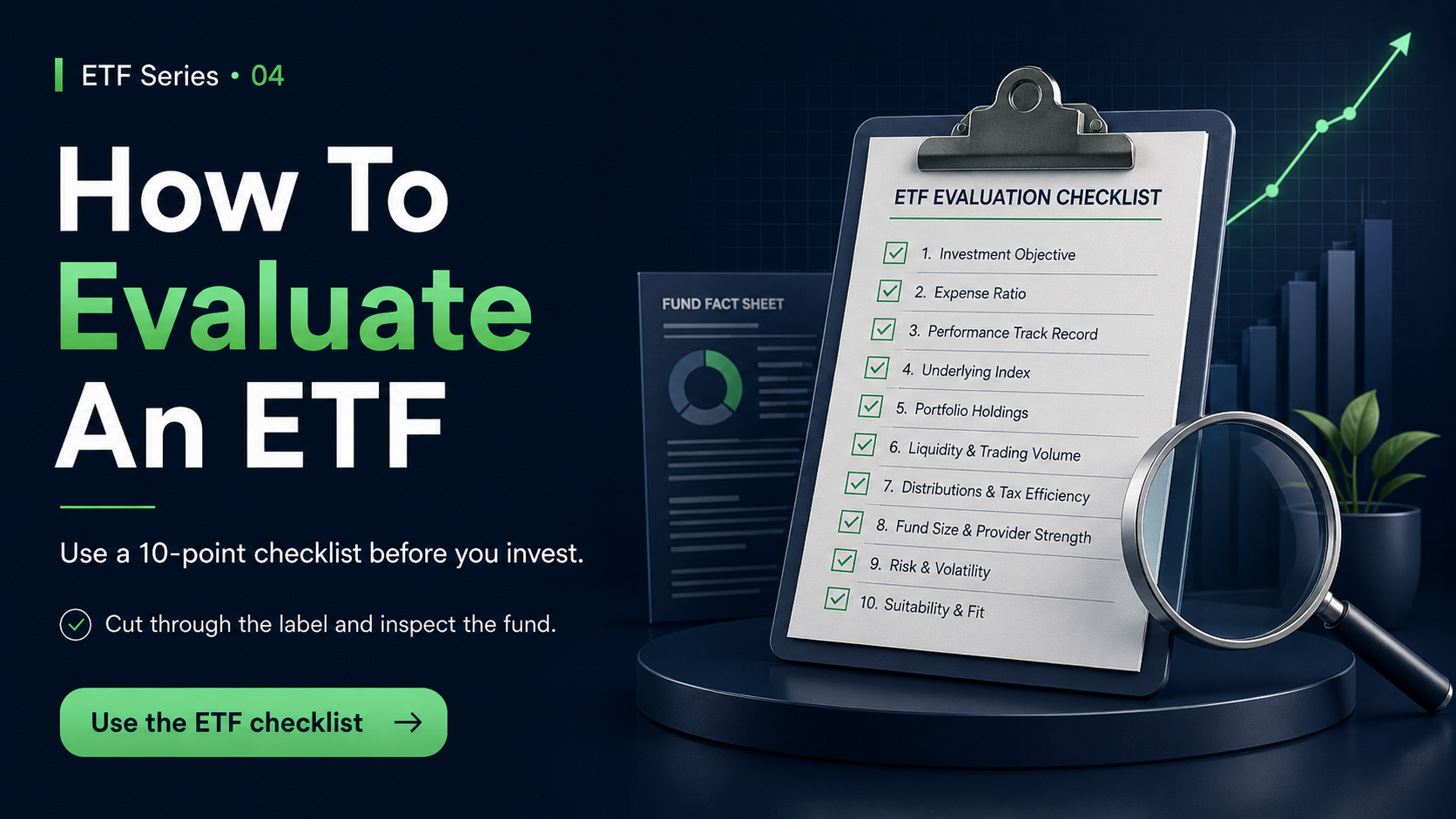
Hero image: https://nappot.com/wp-content/uploads/2026/07/04-how-to-evaluate-an-etf-10-point-checklist.png
ETFs can look simple from the outside. A ticker, a catchy name, a low fee, and you are done — right? Not quite. Before you buy any ETF, you want to know what it owns, how it is built, what it really costs, how it trades, and whether it fits your portfolio.
To make this practical, I’ll use one hypothetical example throughout the article:
Running example — hypothetical only:AtlasCore U.S. Equity ETF (ticker: ACORE)
Objective: broad U.S. equity exposure with a quality screen
Expense ratio: 0.14%
Holdings: 92 stocks
Turnover: 18% per year
Rebalance: quarterly
Method: full replication
We will use ACORE only as a teaching example, not as a recommendation.
What the ETF Name Does Not Tell You
An ETF name can be useful, but it is not enough for due diligence. A name may tell you the broad category, but it usually does not tell you the whole story.
It does not tell you the actual holdings. Two “S&P 500” or “income” ETFs can own very different securities.
It does not tell you the index rules. A “quality” or “value” ETF may define those terms in very different ways.
It does not tell you the true cost. Expense ratio is only one part of the picture; spreads, turnover, and taxes matter too.
It does not tell you how liquid it is. The ticker may trade actively, or it may be thinly traded.
It does not tell you the risk level. Sector concentration, leverage, covered calls, or bond duration can change the risk profile dramatically.
It does not tell you how the fund behaves in stress periods. Tracking error, discounts/premiums, and creation/redemption mechanics matter when markets move fast.
That is why the official fund documents matter more than the marketing label.
The 10-Point ETF Evaluation Checklist
1) What exactly is the ETF trying to do?
Start with the investment objective. Is the ETF trying to track a broad market index, a sector, a factor screen, a bond strategy, or an active manager’s view? A clear objective should be easy to state in one sentence. If you cannot explain it simply, that is a warning sign.
For ACORE, the objective is straightforward: broad U.S. equity exposure with a quality screen. That is easier to evaluate than a fund with multiple layers of options, leverage, or derivative overlays.
Red flag: If the ETF name sounds familiar but the objective feels vague, narrow, or overly clever, read the prospectus before you buy. “Income,” “growth,” and “opportunity” are marketing words, not full explanations.
2) What does it actually hold?
Do not stop at the name or sector label. Open the holdings list and look at the top positions, concentration, geography, market-cap mix, and whether the fund owns stocks, bonds, derivatives, or a mix of instruments. A fund can look diversified and still be heavily concentrated in a few names or one industry.
ACORE holds 92 U.S. stocks, which is broad enough for a single-fund core sleeve. If the top 10 holdings make up most of the fund, the “diversified” label deserves a second look.
Red flag: If holdings are hidden behind incomplete disclosure, frequent delays, or complicated derivatives, pause. You should know what you own before you buy it.
3) How is the ETF built?
Read the index methodology or active strategy description. Ask how the ETF selects securities, how often it rebalances, whether it uses full replication or sampling, and whether there are screens for sector, size, quality, volatility, or dividends. The methodology tells you whether the fund’s process is simple and rules-based or more opinion-driven.
ACORE uses quarterly rebalancing and full replication. That makes the process easier to understand and compare with similar funds.
Red flag: If the methodology is hard to find or full of vague language like “dynamic allocation” without clear rules, do more homework.
4) What is the real cost?
Expense ratio matters, but it is not the only cost. Also check bid-ask spread, average trading volume, portfolio turnover, possible trading commissions, and any tax drag from distributions. In some funds, the visible fee is low but the hidden costs are not.
ACORE’s 0.14% expense ratio looks reasonable, but you would still want to compare its spread and turnover with similar ETFs. A low fee is helpful only if the ETF is also efficient to trade and hold.
Red flag: A cheap-looking ETF with wide spreads, high turnover, or frequent taxable distributions can cost more than its headline fee suggests.
5) Can you buy and sell it easily?
Liquidity is about more than one day’s trading volume. Look at average spread, assets under management, trading history, and whether the fund has healthy market maker support. This matters because an ETF you can sell easily in calm markets may still be expensive to trade in a rush.
If ACORE has moderate assets and tight spreads, it may be fine for normal investing. If the spread jumps around or the fund is tiny, you need to be more careful with order size and timing.
Red flag: Thin trading, tiny assets, or erratic spreads can make a fund more expensive to enter and exit than it appears on paper.
6) How closely does it track what it says it tracks?
If the ETF is designed to track an index, compare its performance to the index over multiple periods. Look for tracking difference and tracking error. Small gaps are normal; persistent or large gaps deserve explanation. For active ETFs, look for consistency with the stated process and benchmark instead of index tracking.
ACORE should stay close to its benchmark if the fund is well-run and the replication process is efficient. If performance repeatedly lags the benchmark by more than the fee alone would explain, investigate why.
Red flag: Repeated underperformance versus the benchmark can mean a sloppy process, high turnover, cash drag, or poor tax handling.
7) How will it behave after taxes?
ETF tax behavior depends on the strategy, turnover, and whether the fund distributes dividends, capital gains, or other taxable income. Equity index ETFs are often more tax-efficient than high-turnover strategies, but that is not a guarantee. Bond ETFs, covered-call ETFs, and many active strategies can create more frequent taxable events.
ACORE may be more tax-efficient than a high-turnover thematic ETF, but you still need to read the tax sections of the official documents and check the distribution history.
Red flag: If the fund pays large or frequent distributions and you are investing in a taxable account, do not assume the ETF structure automatically protects you from taxes.
8) Is the fund big, stable, and likely to survive?
Size is not everything, but it matters. Look at assets under management, fund age, sponsor strength, and whether the strategy has a long enough record to judge. Very small or brand-new ETFs can close if they do not gather assets.
ACORE would be easier to trust if it had a meaningful asset base and a sponsor with a serious long-term ETF platform. A tiny fund with little volume deserves more skepticism.
Red flag: A low-asset ETF with little history may be fine, but it also may be more vulnerable to closure, wider spreads, or strategy changes.
9) Who runs it, and how disciplined is the process?
Read the issuer page and the prospectus to understand who manages the fund, whether there is an experienced team, and how the rules are enforced. For index ETFs, the quality of the index provider and the rebalancing rules matter. For active ETFs, manager skill, turnover discipline, and risk controls matter.
With ACORE, the process is rules-based, so the main question is whether the sponsor follows the methodology consistently and explains changes clearly.
Red flag: If you cannot tell who is responsible for the process — or the process changes without clear disclosure — treat that as a trust issue.
10) Does it fit your portfolio and risk tolerance?
The most important question is not whether an ETF is “good” in isolation. It is whether the ETF improves your portfolio. Ask what role it plays: core holding, bond sleeve, dividend tilt, sector bet, tactical trade, or hedge. Then check whether you already own something similar, whether it increases concentration, and whether it matches your time horizon.
If you already own a broad U.S. equity ETF, ACORE may be redundant unless its quality tilt adds something you specifically want. If it is a narrow thematic fund, you need to decide whether the extra risk is worth it.
Red flag: If the ETF sounds exciting but does not have a clear job in your portfolio, it may be speculation dressed up as diversification.
Final Scoring Worksheet
Use this simple scorecard to keep your decision disciplined. Score each line:
2 = strong / clear / acceptable
1 = mixed / needs more research
0 = weak / caution / likely avoid
Check
Score (0–2)
Notes
1. Clear objective
2. Holdings are transparent
3. Methodology is understandable
4. Real cost is acceptable
5. Liquidity and spreads are workable
6. Tracking is tight or strategy is consistent
7. Tax behavior fits your account
8. Fund size and stability are acceptable
9. Sponsor and process inspire confidence
10. It fits your portfolio
Total
/20
How to read the score:
16–20: Strong candidate. Still read the prospectus, but the ETF appears well-structured.
12–15: Mixed. Research the weak spots before buying.
Below 12: Be cautious. There may be a simpler or better option.
Example score for ACORE (illustrative only): If the fund scores well on objective, holdings, methodology, and fit, but only average on liquidity or taxes, it may still be a decent choice — just not an automatic buy.
One-Page Summary Checklist
Use this quick version before placing an order:
☐ I can explain the ETF objective in one sentence.
☐ I know the top holdings and concentration level.
☐ I understand the index or active strategy rules.
☐ I checked expense ratio, spread, and turnover.
☐ I checked liquidity, AUM, and trading history.
☐ I reviewed tracking difference or manager consistency.
☐ I understand the tax implications for my account type.
☐ I know the fund’s size, age, and sponsor reputation.
☐ I know who manages the fund and how decisions are made.
☐ I know exactly why this ETF belongs in my portfolio.
Official Information Sources
When you evaluate an ETF, the best information comes from the issuer and other official sources. Start here:
Issuer fund page — look for the fund summary, fact sheet, holdings, distribution history, and fees.
Prospectus / summary prospectus — the official disclosure that explains objective, strategy, risks, and costs.
Statement of Additional Information (SAI) — deeper details on methods, policies, and governance.
Annual and semiannual reports — useful for performance, holdings, and expenses over time.
SEC EDGAR — for official filings and fund documents.
Exchange page / fund facts page — for ticker, trading data, and basic market information.
Where to look inside the issuer site: use labels such as Documents, Fund facts, Prospectus, Library, Regulatory documents, or Holdings. If you cannot find those pages quickly, that itself is a reason to slow down and research more carefully.
FAQs
Is the lowest-fee ETF always the best ETF?
No. A low fee is good, but only if the ETF also has sensible holdings, tight spreads, a clear process, and a role in your portfolio. The cheapest fund can still be the wrong fund.
How much assets under management is “enough”?
There is no universal threshold, but very small funds deserve extra caution because they can have wider spreads or a higher chance of closure. Bigger is usually better for trading comfort, but it is not the only factor.
Should I only buy index ETFs?
Not necessarily. Index ETFs can be simple and efficient, but active ETFs, bond ETFs, sector ETFs, and income strategies can also be useful. The key is understanding the trade-offs and knowing why you own the fund.
What is the biggest beginner mistake when buying ETFs?
Buying based on the name alone. A fund can sound broad and safe while actually being concentrated, tax-inefficient, or built around a strategy you do not fully understand.
Disclaimer
This article is for educational purposes only and is not investment, tax, or legal advice. ETFs can lose value, and past performance does not guarantee future results. Before investing, read the official prospectus and other fund documents, and consider speaking with a qualified financial professional if you are unsure how a fund fits your situation.